Mary of Nazareth — The Mother Protestants Have Forgotten

Are you ready to fly so dangerously close to the sun that will make most Protestants reel from extreme discomfort?
In the aftermath of Protestants separating from Roman Catholicism, these Christians jettisoned a variety of practices, including the veneration (and borderline deification) of the Virgin Mary. However, I am beginning to wonder if the pendulum has swung too far in the opposite direction with Mary of Nazareth.
This is the case for the mother Protestants have forgotten.
The Grave of Mary Lies in Modern Bias
As a historical Christian theology enthusiast (yes, it is as obscure as you think), I ran into a bit of mystery. Here I am reading about Christians prior to 1000 AD actively fighting for a gospel of grace and denouncing the rising tide of relics, Medieval sacramentalism, and church corruption. We are talking about Christians who are so radically grace-first that it makes Calvinists today look mild. These early Medieval Christians write so incredibly concise and dense in their compact commentaries, yet they all pause to venerate the Virgin Mary. Why?
When studying these Latin texts, I would skim over these passages about Mary of Nazareth as some special vessel of grace. I just dismissed this notion of Mary as some sort of error of their time period that, for whatever reason, they could not shake. I made the mistake I have been denouncing all along — letting my modern bias and inherited religion cloud my mind.
Growing up Mormon, any type of veneration and exalting of Mary the mother of Jesus was vehemently denounced. As we mocked the headlines of the superstitious flocking to a statue of Mary appearing to be weeping, we donned on our robes and aprons to do rituals for the dead in the temple. Now in Protestant Christianity, I am experiencing a very similar rejection of Mary. She is just kind of there as another chosen woman of God in the Biblical narrative. Nothing more, nothing less. In fact, I learn more about the apologetics against Mary than an actual analysis of who she was.
Mary the mother of Jesus has been reduced to a dagger wielded in anger towards those who believe differently. Thus, she sits in a hidden place only to be brought out to ward off an attack. As she is a sharp blade, Mary is only observed from a distance with only a select few allowed to handle and understand her. Jesus Christ definitely did not treat His earthly mother as a dangerous weapon in a theological battleground, so what are we doing?
Mary the Recipient of Profound Grace
To the great horror of church leaders today, I decided to read historical sermons from the early Medieval era to understand why they interpret Mary in Scripture as some highly special figure (it can be hard to answer when people ask what I did over the weekend). I was shocked at what I found.
Protestants tend to default that all veneration of Mary is idolatry regardless of the time period and throw it all into the same bucket. Believe it or not, this is incorrect thinking. Like most side doctrines in Christian history, there are spectrums within beliefs that also evolve over time. This means it gets complicated. The side of the spectrum we are familiar with was developed in the 13th-15th centuries. Mary became exalted as the chief channel through which all grace flowed and was seen as the mediator between humanity and Christ. Prayers to Mary developed out of these beliefs asking for mercy or to prompt Christ on their behalf. However, there is another side of this spectrum.
And Simeon blessed them and said to Mary his mother, “Behold, this child is appointed for the fall and rising of many in Israel, and for a sign that is opposed (and a sword will pierce through your own soul also), so that thoughts from many hearts may be revealed.”
— (ESV) Luke 2:34–35
In the Carolingian/Pre-Scholastic era (8th-10th c.), there was a pocket of gospel-of-grace Christians, who venerated Mary but in a grounded way. They viewed Mary being a model recipient of grace that is deeply profound. These Christians did not see her as meriting anything, rather a chosen vessel to bring about the Christ. By observing passages like Luke 2:34–35, the phrase “and a sword will pierce through your own soul also” stood out to them that a special connection between Jesus Christ and Mary was established by God.
Get A Call For Reform’s stories in your inbox
Join Medium for free to get updates from this writer.
Passages on being conformed to the image of Christ (John 14:20, Romans 8:29) was not seen as just an invitation; it was seen as a divine command in regenerative grace. Our early Medieval Christians also interpreted that it was more than just behavior that would change. This transformation would be extremely intimate connection with Christ. Wherever He went, we would follow. When He was sorrowful, we would be sorrowful. When the Lord suffered, so would we.
Only one person truly matched this intense level of regenerative unity with Christ, and it was Mary of Nazareth. She sought Him when He was lost and physically went to Him where she did not expect (Luke 2:41–51). She was present at the beginning of His ministry with her faith preceding her understanding (John 2:1–5). She bore the quiet grief of watching her son be misunderstood, opposed, and drawn away when she did not know the divine plan (Mark 3:21, 31–35). She remains at His side at the foot of the cross when most decided to flee, but not just as a witness — a suffering participant (John 19:25–27). She is present with the other disciples awaiting the Spirit as part of the Church’s birth (Acts 1:14).
Mary followed Jesus before others even knew who He is. The sorrow came before it became visible. She suffered with Christ when others dare to draw near. Mary was His disciple in suffering, not just His mother. This is why these early-Medieval Christians revered her — she was the first and fullest image of what it means to be a true image bearer of Christ all the way to the cross and beyond. The spectrum of Marian veneration they were in was far from being idolatrous, which they denounced. This was an image of honor that she had a union with Christ that all of us had yet to partake in.
To these Christians’ eyes, Mary had received a glorified condition that anticipates what will happen to all believers later. She is in a state of reflecting the light of the Lord, just as the moon does with the sun (1 Corinthians 15:41). As she has been elevated in the image of Christ, so will we.
Mary is the first to partake in an offered grace of intimacy.
Christians in this honoring of Mary did not doctrinally separate her from the rest of the believers. To do so they recognized to be unbiblical. However, Mary of Nazareth was uniquely illuminated as the prototype of what the Church will one day become. They yearned for this like you would not believe. She was a fulfillment of promise that the Bible gave and a celebration that it can be done. Their pauses to honor Mary in their writings was an expression of inward hope, which I mistakenly read as idolatry.
Hmm…maybe these early Medieval Christians were onto something.
The Shedding of Reactionary Identity Politics
Mary is not venerated the same way in all times and places. In fact, veneration does not equal to worship. It is a great respect given to the one who gave birth to the Incarnation and the blessed among women (Luke 1:42). The avoidance of Marian dogma has led Protestants to empty her of all significance, which is a retreat from Scripture. With how much we permanently stay in Paul’s epistles for our sermons, one could almost make the accusation we venerate this apostle too much.
To take our trip even one step closer to the sun, early Church fathers saw Mary as the new Eve in a typological sense, or should I say…allegorically.
“For Eve, who was a virgin and undefiled, having conceived the word of the serpent, brought forth disobedience and death. But the Virgin Mary received faith and joy, when the angel Gabriel announced the good tidings to her that the Spirit of the Lord would come upon her, and the power of the Highest would overshadow her: wherefore also the Holy Thing begotten of her is the Son of God.”
— Justin Martyr, Dialogue with Trypho (link)“And thus also it was that the knot of Eve’s disobedience was loosed by the obedience of Mary. For what the virgin Eve had bound fast through unbelief, this did the virgin Mary set free through faith.”
— Irenaeus of Lyons, Against Heresies (Book III, Chapter 22, Section 4) (link)
This theological reflection is the origin of the veneration of Mary of Nazareth and why for centuries she shows up in an honorary title. All of our gospel-of-grace forefathers understood the Biblical significance of Mary, so why are we rejecting this?
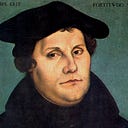
Martin Luther retained the Marian feast of days and praised her as the “highest woman and the noblest gem in Christianity after Christ” in his 1531 Christmas sermon. Luther recognized systematically burring Mary of Nazareth, like we have, would be rejecting all of the Christians before him starting at the early Church. Otherwise, it would be a novel way of interpreting the Bible just through silence.
Some may have felt like they have had their hair singed by this point in the article, but, truthfully, Scripture is not always supposed to make you feel comfortable. One of the greatest gifts of Christ is to be freed from the agendas of institutionalized religion that severely narrows our scope of understanding. In fact, Protestantism’s allergic reaction to Mary seems to be more to do with reactionary identity politics than careful theology. Has the veneration of Mary gotten significantly out of hand? Certainly. However, we do not need to fall into the political trap of taking the polar opposite side of a view just out of spite with the other side.
It is time to permanently retire the blade of Mary the mother of Jesus and return her as a sign of hope for the grace of transformation we all will receive — an intimate unity with Christ.