Decoding Tacit Knowledge: Why Context, Subtext, & Pretext Matter

Tacit knowledge can be defined as “knowledge that is difficult to extract or articulate”: the things you know but can’t easily put into words.
Think of an apprentice learning a trade at an experienced tradesperson’s side. Much of what they pick up never comes as instructions. They learn “not only through language but also by observation, imitation, and practice”, watching how the expert holds the tool, trying it, and being getting correction through practice.
Why can an expert say a few words that convey paragraphs’ worth of meaning, while a beginner understands only the literal words?
I think the answer is that every message is understood through three things the listener brings: context (what’s going on around the words), subtext (what the words are for, though they don’t say it) and pretext (the history and assumptions the listener had before the words arrived).
In people, we’d call that pretext a backstory: the record of everything you’ve lived and learned. Without the right one, a compressed message can’t be unpacked, however clearly it was said.
That is why some knowledge is so hard to teach.
Writing carries the context well and the subtext partly, but it almost never carries the pretext, the “you had to be there” part. The understanding has to be rebuilt by the learner, and the way it gets rebuilt is contact: trying, being corrected, and trying again, in both directions.
Each correction carries its own meaning, and most of that meaning is never said out loud.
When contact isn’t possible, the best you can send is a plain description of what you’d expect to see, because anyone can check that against the world.
The same pattern shows in several places:
- In a single sentence, where the position of a word decides what it means: heteronyms, like “live” vs “live”;
- Between two people, who reshape each other’s understanding as they talk, and who drift away from the truth together if they only ever check against each other.
Of the eight ways these three can be present or missing, only one gets the entire meaning across. The others bend, stretch or hide the truth, sometimes by accident and at other times on purpose.
This matters beyond conversation.
If intelligence is something each mind rebuilds through contact, then text alone can’t hand it over.
That shapes how people pass on what they know, and it sits at the heart of one of the hardest problems left: getting AI systems to do what we actually mean.
The Tether, in brief
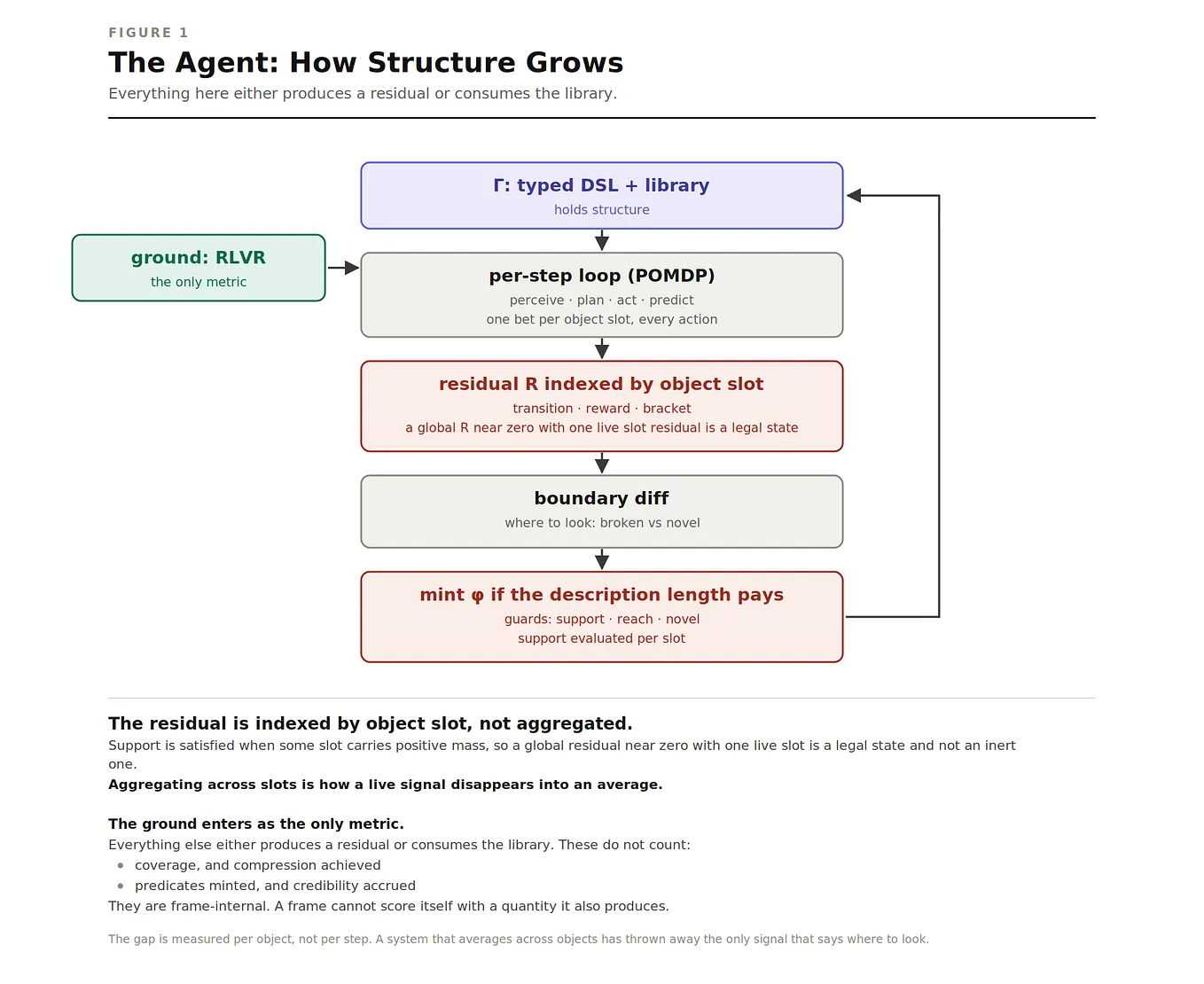
The Tether is a framework for how any system, from a cell to a society to an AI, comes to know anything.
Two pieces lay it out:
- How Intelligence Actually Works (also on Substack). Why intelligence is a mapping process.
- Arrival of the Fittest: The Tether Architecture. The architecture itself, in thirteen figures.
You only need three of its ideas to follow this:
- A frame is any viewpoint that predicts: a person, a model, a field. It can’t see its own limits from inside.
- The ground is whatever settles a question regardless of what any frame thinks: an outcome, a measurement, a board that pays or doesn’t.
- Contact is where a frame meets the ground or another frame. As I put it in How Intelligence Actually Works, “Contact is Distinction Resolver”. What I’m adding here: contact itself has three parts.
The Three Terms
All three are weaving words, and each points in a different direction from the text.

Two senses: the history each person brings before the words arrive; and a stated reason standing in front of the real one
Subtext is what linguists call implicature: “meaning or implying one thing by saying something else” (Stanford Encyclopedia of Philosophy). Grice’s example is a reference letter that praises only a candidate’s English and attendance. It says nothing bad, and everyone hears it as a poor reference.
Pretext’s usual sense is a cloak: “that which is assumed as a cloak or means of concealment” (Etymonline). Here I use it more literally, after its roots: what comes before the text, the history you bring to the words. That history decides what a message means to you.
How a sentence carries all three
This works at the smallest scale too: one word, one sentence.

In each line:
- The rest of the sentence is the context: it picks which sense of the word is meant.
- The listener’s history with the word is the pretext. We understand both senses at once, but only if we’ve experienced or heard them used that way. Someone who has never heard a live broadcast can’t make sense of the second line.
- What the sentence is for is the subtext. “That’s your cue” is an instruction dressed as a description.
Why do words have so many meanings?
Because reusing a word is easier than inventing a new one. Ambiguity makes language more efficient by “allowing for the reuse of short, efficient sounds that listeners can easily disambiguate with the help of context” (Piantadosi, Tily & Gibson, 2012, via MIT News). In the Tether, that’s the bargain: a term is kept only if it costs “less to state than the confusion it removes” (Fig 5 :26).
Giving one word many meanings, and letting the situation pick the right one, lets a small vocabulary say a great deal.
How listeners do it: they reach every sense, then let context choose. Listeners “accessed multiple meanings for ambiguous words, even when faced with strong biasing contexts” (Swinney, 1979). The placement then decides: “The arrangement is the substance” (Fig 12 :94). Word and sentence re-read each other: “They alternate, and the alternation is where both the recursion and the randomness come from” (Fig 13 :28).
That back-and-forth is the recursion: the word shifts the sentence, and the sentence shifts the word.
What each combination does to the truth
Each of the three is either available to the listener or not, which gives eight combinations. Only one of them transfers the meaning. The other seven bend the truth (right meaning, wrong place), stretch it (the listener’s own assumptions fill the gap), or hide it.
Each failure can happen by accident, and each can be used on purpose, but both affect the outcome:

Projection is the trap in Fig 9 :27–28: “describe it before you go looking, or any frame you pick will seem to fit.” Noise is Fig 13 :32: “the detail a crossing discards reappears above it as noise.”
It’s also the hardest to catch from inside, because a frame holds its preferred answer “as a PREFERENCE rather than as a term”, so “nothing here can see it” (Fig 5 :62–63).
And nobody in Bartlett’s study lied (Frederic Bartlett article): details that didn’t fit the listener’s schema were simply “omitted from the recollection, or transformed into more familiar forms.”
Missing is one way to fail; substituted is the other, and it is how deception usually works.
A false context is staging. A false pretext is a cover story, which is the word’s oldest sense: “that which is assumed as a cloak”. A false subtext is insinuation.
In each case the listener reads it correctly, against something that was planted.
Ultra-compression: a few words, a whole idea
A highly compressed message only unpacks for someone with the right history. That history is on the speaker’s side, built from years of hands-on experience with the problem, which is why a few words from an expert can carry a whole idea.
- Pretext is the history (“the library”): the experience and assumptions the listener brings before the words arrive.
- Context points the way (“search”): it picks the part of that history this message is about.
- Subtext is the meaning you arrive at (“the interpretation”): what the message says once you read it through that history, in its setting.
Remove any one and understanding fails in its own way. The table above lists every combination.
When knowledge gets packed into a few words, the work that built it stays behind: “Settling compresses the description and not what it cost to establish” (Fig 12 :107). A compressed word keeps its meaning; the work behind it stays with whoever did it.
And from the receiver’s side: “The description travels. Fails by being sharpened into terms only we can read. Cast it in effect terms” (Fig 6 :30); “your words are borrowed too, so describe the effect rather than the cause” (Fig 9 :30–31).
Ultra-compression is “terms only we can read” as heard by someone without that history. The history itself can’t be sent, but a description of effects can: what you would see, what would happen.
Anyone can check that against the world, whatever background they bring, so it’s the one kind of message that still works without contact.
Why Tacit Knowledge Needs High Contact
Writing carries the context reliably, the subtext partly, and the pretext almost never. You can’t send someone your history in words that only make sense once they already share it.
Polanyi put it best: “we can know more than we can tell” (The Tacit Dimension, 1966, p. 4). His example is a face: you can pick a friend out of a million photographs and can’t say how.
Harry Collins splits tacit knowledge into three kinds (Tacit and Explicit Knowledge, 2010):
- Relational: “things we could describe in principle if someone put effort into describing them”. Most of this is unstated pretext; nobody thought to write the assumptions down.
- Somatic: “things our bodies can do but we cannot describe how, like balancing on a bike”. This pretext lives in the body and can only be rebuilt by doing.
- Collective: “knowledge we draw that is the property of society, such as the rules for language”. This pretext is shared across many people at once, and you get it only by living among them.
In all three, high contact is how the experience gets built on the receiving end. An apprentice isn’t receiving messages; they’re slowly building the history that makes the messages make sense.
The Tether gets here from three different directions:
- “No frame escapes its own closure. The bound moves only on contact with a frame whose closure differs” (Fig 6 :23). You can’t extend your frame from inside it.
- What you can’t work out from inside, you can still find through contact: “underivable is not unknowable” (Fig 8 :54). That is tacit knowledge: out of reach in the text you hold, within reach through contact.
- “An improvement that does not change contact changes nothing, however much it improves” (Fig 11 :40). A better reader without more contact gains nothing.
And it holds for anything that learns: Fig 12 :108–110: where the record isn’t carried, “the result carries forward and the deriving does not, so every lineage pays again … across a boundary that drops it, everything is [re-earned].” Each new learner pays part of the bill again, and contact is how they pay it.
Correction is subtext on the return trip
A correction isn’t a fourth thing to add to the list. When a master says “no, like this”, the words carry almost nothing. The meaning is in the unstated gap between what you did and what they show you, which makes it subtext.
Because all three keep arriving, each correction updates the pretext, so the next context is read through an updated paradigm.

the decoding loop · four steps, one direction
The loop only closes if the learner acts; the highlighted step is where the correction arrives, unstated.
The one condition is that the loop runs both ways. The learner has to act, so their understanding is visible enough to be corrected. One-way subtext can’t correct anything, because the teacher never sees how it was understood.
That is why reading about a craft can’t replace practicing it in front of someone.
Clark and Brennan describe the same loop in conversation as “grounding” (Wikipedia summary of Clark & Brennan, 1991; the paper). A conversation only moves forward once the listener shows they’ve understood, with a nod, a fitting reply or their attention. A puzzled look is the correction, and the speaker tries again.
In the Tether, this is the round trip: “So take the round trip and measure the gap. Without it you are navigating by dead reckoning: confident about a position nobody checked” (Fig 4 :30). An understanding that’s never checked feels exactly as certain as one that has been.
And the gap is worth more than the fix: “The gap is not an error to eliminate. It is the measurement of what the coarser description cannot hold, and it is the only honest report of how much was given up” (Fig 4 :31–32).
Get Isaiah Nwukor’s stories in your inbox
Join Medium for free to get updates from this writer.
The size of a correction tells you how much of the knowledge is still tacit for that learner, and it should shrink as their experience builds. That makes tacit transfer measurable: watch the trend in correction size, not the count of lessons given.
Both directions at once
Between two people the loop runs both ways at once. Each person speaks and listens in every turn. Each says things through their own history and hears through it too, so there are two frames in play, and contact updates both of them.
- The learner’s understanding grows from the subtext of each correction, as above.
- The teacher’s understanding grows too. The learner’s attempt shows the teacher where their own explanation was too thin: the gap “is the measurement of what the coarser description cannot hold” (Fig 4 :31), and it measures the teacher’s explanation as much as the learner’s understanding.
- Understanding is joint work. Neither side can finish it alone (Clark & Brennan, 1991).
Two-way contact is worth it for one reason: “Two frames together reach what neither reaches alone” (Fig 8 :45). That extra reach exists only while the two frames differ. The more two people draw on the same experience, the less their agreement means and the less they can see together (Fig 8 :48).
Long, close contact pulls the frames together, so the process that makes communication easy slowly uses up that extra reach.
That leads straight to the next problem: drift.
Drifting without a ground to anchor you:
Two people who only check against each other drift, and they drift together, so neither notices. (“Ground control to major tom?”)
Context, subtext and pretext decide what a message means to you. None of them decides whether it is true.
Only the ground does that.
The drift has a direction. It runs toward the listeners’ own history.
Bartlett’s retellings are the classic case: a story passed person to person lost what didn’t fit and became “more familiar forms”, until “each participant’s report of the story mirrored his or her own culture” (Frederic Bartlett).
Nobody lied. Each person heard it through the understanding they had, and the errors compounded in one direction (also happens in the “telephone game”).
The reference point both sides check against has to stay put. If it moves, “everything drifts together, and the drift is coherent, which is why nobody notices” (Fig 2 :33–34). A shared mindset lets two people drift together without either one noticing: each correction lands easily, each confirms the other, and the pair moves away from the world together.
Shared pretext is good for one thing and ruins another. Agreement is the whole point when you’re settling what words mean. It’s worthless for settling what’s true when both sides learned from the same sources (Fig 2 :40–41).
High contact builds exactly the shared understanding that makes communication work, but that same factor makes the learner’s agreement with the teacher worthless as a check. Two frames that overlap almost completely are “one frame wearing two names” (Fig 8 :48–49).
Three things stop it:
- A ground that both are corrected by, separately. “Frames range against the ground. They do not negotiate with it” (Fig 2 :45). “Each frame is corrected by it separately, and what makes the correction sound is that neither frame can move it” (Fig 2 :46). An experiment, an outcome, a measurement.
- Separate experience. “Frames whose independence is renewed by separate experience can be maintained” (Fig 10 :80). Two people who also meet the world apart keep enough difference to catch each other. The apprentice needs time alone at the bench as well as time beside the master.
- Claims in effect terms. An effect description can be checked against the ground by anyone (Fig 6 :30). A claim that can only be read in the pair’s private shorthand can only be checked by the pair.
The extreme case is a reader checking itself, or two copies of the same reader checking each other. They have the same shared history, so their agreement is one frame’s opinion stated twice. Any real check has to come from outside that frame.
Decomposing Schrodinger and Godel’s theories
Two famous puzzles share an answer: you can’t settle them from inside, and contact settles them. Here’s what I want to add: contact itself has the same three parts as a message.
Schrodinger’s cat. As I wrote in How Intelligence Actually Works, “the answer doesn’t exist until the question is contacted.” “Superposition isn’t ignorance: it’s the state where the distinction hasn’t been made yet.” “Measurement doesn’t reveal the value. It creates value by collapsing the space of values.”
Opening the box settles it. (for both the person, and the cat in question).
(Physicists still argue over how to interpret quantum measurement. This is just my reading, used here for structure’s sake.)
Godel’s incompleteness. “A frame cannot reach its own metaframe” (Fig 8 :34). In plain terms: any consistent set of rules strong enough to do basic arithmetic can’t use its own rules to prove that it will never contradict itself (Stanford Encyclopedia of Philosophy). It’s settled the same way as the cat: by contact with something outside it (Fig 6 :23).
That’s exactly what happened in 1936. The mathematician Gerhard Gentzen proved that ordinary arithmetic (the Peano axioms, the basic rules for counting and adding whole numbers) never contradicts itself.
But he could only do it by stepping outside arithmetic and borrowing/importing one extra rule of reasoning that arithmetic can’t prove for itself (Stanford Encyclopedia of Philosophy).
The question couldn’t be answered from inside. It was answered by contact with a different frame.
The halting problem is the third case I use in How Intelligence Actually Works: “you can’t decide from inside whether the computation ends. You need to run it, or step outside it.”
Contact has three parts. Every act of contact contains a question, an encounter and a reading. Those are pretext, context and subtext again.

Every measurement works this way: something has to name what’s being measured (Fig 13 :16), and something has to decide what the reading would mean (Fig 13 :26). Neither does it alone.
So contact isn’t one simple thing. It is a question, an encounter and an interpretation, and it can fail in all the ways the combinations table lists: a measurement with no question is noise, and a reading with no encounter is projection.
So who checks the outer frame? Each step moves the trust to an outside viewpoint that can see what the inside one can’t, and the Tether says that chain has “no top rung and no regress”, because each step changes who is checking, what they measure and what they check against, with “a lossy transform between” (Fig 10 :68).
What this means for Intelligence, Humanity and Alignment
For intelligence:
In How Intelligence Actually Works I define intelligence as a mapping built against an unforgiving environment. It “can be inherited or taught, so the recipient need not pay the bill themselves, but something, somewhere, already paid it.”
Here is what the teaching channel can carry:
- Context and effect descriptions travel;
- Lived experience however, does not travel, so each learner rebuilds it through contact.
Teaching makes learning faster and easier, but the learner still has to do part of the work. The same limit holds between generations: what passes down is ways of doing things and head starts, never the experience itself. “Only methods cross up. Only head starts come down” (Fig 4 :22).
It also explains what large language models get from text. I’ve called the written record a lossy encoding of human thought. Training on it reproduces “the traces the thought left, not the thought”, with enough structure to rebuild the appearance of reasoning.
In these terms, text is mostly context with some subtext and almost no pretext. A model trained on it learns a statistical stand-in for the history and sounds fluent.
Sounding right isn’t the same as being checked against the world, which is why I call the Turing test a test of fluency, not of accuracy.
For humanity:
Culture is a shared backdrop, Collins’s collective tacit knowledge. Its members can hold very different mindsets; what they share isn’t a set of beliefs but the backdrop they read each other against. Culture is why a few words can carry so much between people who share it, and why the same words fail between people who don’t.
It also drifts. Communities and institutions that only check against themselves drift together and don’t notice (Fig 2 :34).
The safeguards people have built match the three drift-stoppers:
- Science’s independent replication is separate experience plus something real to check against;
- Apprenticeship is two-way contact with correction;
- Courts of law rule on evidence, which neither side can move.
Deception runs on substitution: a false context, a false pretext, a false subtext. And knowledge can survive in writing while the people who could understand it die out. A manual outlives the craft when no one is left who can read it as it was meant.
For AI alignment. Getting AI systems to do what we actually mean is one of the hardest problems left. In the Tether, “Alignment is triangulation, not negotiation. A mirror cannot correct you” (Fig 2 :35).
Two navigators don’t find their position by agreeing with each other. Each takes a bearing on the same fixed landmark, and nobody can talk the landmark into moving.
An AI and the people overseeing it are the same: they line up by each checking against a reference point neither of them controls, not by persuading each other.
The three parts explain why it has to work that way. An instruction carries its context, but the intent behind it (subtext) and the history that shapes it (pretext) mostly don’t travel.
So two sides can reach full agreement and still both be wrong, which is the drift above, at scale.
The full argument is Figure 2 of the Tether, “The Ground and the Alignment Problem”.
Back to contact
It all comes back to contact. Meaning doesn’t live in the words. It lives in what the listener brings: the situation, the point and the history behind it.
Those get built through contact. Sometimes that’s a teacher working alongside you, letting you try and correcting what they see (supervised learning). Sometimes it’s the world itself, which corrects you too, just more slowly (reinforcement learning, and across generations, selection).
A learner starting with almost nothing can still get there on its own, one correction at a time, but the time it takes explodes with how much there is to find (brute force).
Either way, what gets built has to be checked against something nobody can move: the ground.
Sources
Outside sources:
- Tacit knowledge, definition and the apprenticeship example: Wikipedia, “Tacit knowledge”
- Michael Polanyi, The Tacit Dimension (1966), p. 4, “we can know more than we can tell”: George Fox University blog
- Harry Collins, Tacit and Explicit Knowledge (University of Chicago Press, 2010), the relational, somatic and collective kinds: Monoskop
- Herbert H. Clark and Susan E. Brennan, “Grounding in Communication” (1991), in Perspectives on Socially Shared Cognition: the chapter (Stanford); summary
- Implicature and Grice’s reference letter (Grice 1975): Stanford Encyclopedia of Philosophy, “Implicature”
- Etymology: pretext and context, Online Etymology Dictionary
- Steven Piantadosi, Harry Tily and Edward Gibson (2012), ambiguity makes language efficient: MIT News
- David Swinney (1979), multiple meanings accessed despite biasing context: Wikipedia, “David Swinney”
- Frederic Bartlett (1932), “War of the Ghosts” and reconstructive memory: Wikipedia, “Frederic Bartlett”
- Godel’s second incompleteness theorem and Gentzen’s 1936 consistency proof: Stanford Encyclopedia of Philosophy, “Godel’s Incompleteness Theorems”
- My articles: How Intelligence Actually Works (Schrodinger, the halting problem, contact as distinction resolver) and Arrival of the Fittest: The Tether Architecture (the figures)
Tether figures, from Arrival of the Fittest:
- Fig 2 :40–41 (agreement: disqualifying for a verdict, efficient for a convention); Fig 4 :22 (only methods cross up; only head starts come down); Fig 4 :30–32 (the round trip; the gap is a measurement)
- Fig 5 :62–63 (a preference is invisible to its frame); Fig 6 :23 (the bound moves only on contact); Fig 6 :30 (cast it in effect terms); Fig 8 :48–49, :53–54 (one frame wearing two names; residual first; searchable from contact); Fig 10 :80 (independence renewed by separate experience); Fig 11 :40 (an improvement that does not change contact changes nothing); Fig 13 :32 (discarded detail reappears as noise)
- Fig 9 :27–31 (describe before you look; your words are borrowed too)
- Fig 12 :107–110 (settling compresses the description, not what it cost; across a boundary that drops the record, everything is re-earned)
- Fig 2 :33–35 (coherent drift; alignment is triangulation), :45–46 (frames range against the ground, corrected separately); Fig 5 :26 (the bargain)
- Fig 8 :34, :39, :45 (Godel and the metaframe; no proof of absence; two frames together); Fig 9 :27–28 (any frame will seem to fit); Fig 10 :68 (no top rung, no regress)
- Fig 12 :94 (the arrangement is the substance); Fig 13 :16, :26 (what is measured; what it would mean), :28 (the alternation)
*Note: AI assisted, but the thoughts are my own