Building a Readmission Prediction Engine: The Architecture, Data Inputs, and Accuracy Benchmarks That AI Predictive Analytics Healthcare Solutions Actually Require


Hospital readmissions cost the U.S. healthcare system between $17 billion and $26 billion annually in unplanned costs. A Minnesota health system was losing $4.2 million per year to prevent readmissions alone — until a predictive analytics implementation cut that figure in half within 18 months. Corewell Health used a readmission prediction model to prevent 200 readmissions in a single study period, generating $5 million in cost savings. These are not pilot project outcomes. They are production deployments operating at scale, built on architecture that most healthcare organizations have not yet defined clearly enough to replicate.
For product teams and clinical technology leaders evaluating predictive analytics in healthcare, the question is not whether readmission prediction works. The evidence is settled. The question is what it takes to build a model that performs reliably in a live clinical environment — one with messy EHR data, variable clinical workflows, and regulatory requirements that do not pause model tuning cycles. This article breaks down the architecture, the data inputs, and the accuracy of benchmarks that separate production-grade readmission prediction from expensive proof-of-concept deployments that never reach clinical utility.
Why Most Readmission Prediction Models Fail Before They Reach Clinical Utility
The gap between a readmission model that performs well in a research setting and one that performs well in a clinical workflow is not primarily a machine learning problem. It is an integration, data quality, and workflow problem. Research models train clean, labeled, retrospective datasets. Production models operate on incomplete records, late-arriving lab values, real-time EHR data with inconsistent field completion, and clinical staff who have neither the time nor the incentive to interact with a tool that requires any workflow change at all.
Three failure patterns account for the majority of readmission prediction deployments that do not reach sustained clinical adoption. First, models built on structured data alone — diagnosis codes, procedure codes, length of stay — miss the 30 to 40 percent of clinically relevant information that lives in unstructured clinical notes. Second, models surfaced through standalone dashboards or separate applications are ignored by clinical staff operating in time-constrained environments. Third, models that generate false positives at a rate above clinical tolerance — typically anything below 65 percent accuracy for readmission prediction — produce alert fatigue that trains staff to dismiss the output reflexively.
Understanding these failure modes is the prerequisite for specifying a system that avoids them.
The Data Architecture a Readmission Prediction Engine Actually Requires
Structured and Unstructured Data Integration
A readmission prediction model that draws only on structured EHR fields is operating with less than two-thirds of the available clinical signal. Medication adherence patterns, comorbidity documentation, social determinants of health, and the clinical narrative around a patient’s discharge status all live in free-text fields that structured data pipelines do not capture.
Production-grade predictive analytics in healthcare requires a data ingestion layer that handles both structured and unstructured inputs simultaneously. On the structured side, that means ICD-10 diagnosis codes, procedure codes, lab values, vital sign trends, medication lists, length of stay, prior admission history, and payer information. On the unstructured side, it means clinical note processing through a natural language processing layer that can extract risk-relevant information — medication non-adherence language, social isolation indicators, housing instability documentation — from free-text discharge summaries, nursing notes, and physician documentation.
Hospitals generate 50 petabytes of data annually according to the World Economic Forum. The readmission prediction models that perform at the top of the accuracy range are the ones that access a meaningful portion of that signal rather than the structured subset that is easiest to query.
Real-Time vs. Retrospective Data Pipelines
Readmission risk is not static. A patient’s risk profile at admission differs from their risk profile at hour 48 and differs again at discharge. A model that scores patients once at admission and does not update that score as clinical status evolves is producing predictions that may be accurate now they are generated and clinically irrelevant by the time a discharge decision is made.
Production readmission prediction architecture requires a real-time data pipeline that updates patient risk scores continuously as new clinical data arrives — new lab results, vital sign readings outside normal range, medication changes, or new physician documentation. The technical requirement is a streaming data layer, typically built on event-driven architecture, that pushes updated feature vectors to the model inference engine as source system data changes rather than on a batch processing schedule.
This distinction matters operationally. A patient whose sepsis risk is rising on day three of a hospitalization needs an updated readmission risk score that reflects that change before discharge planning begins, not a score calculated at admission that has not been refreshed.
FHIR-Native Data Exchange and EHR Integration Depth
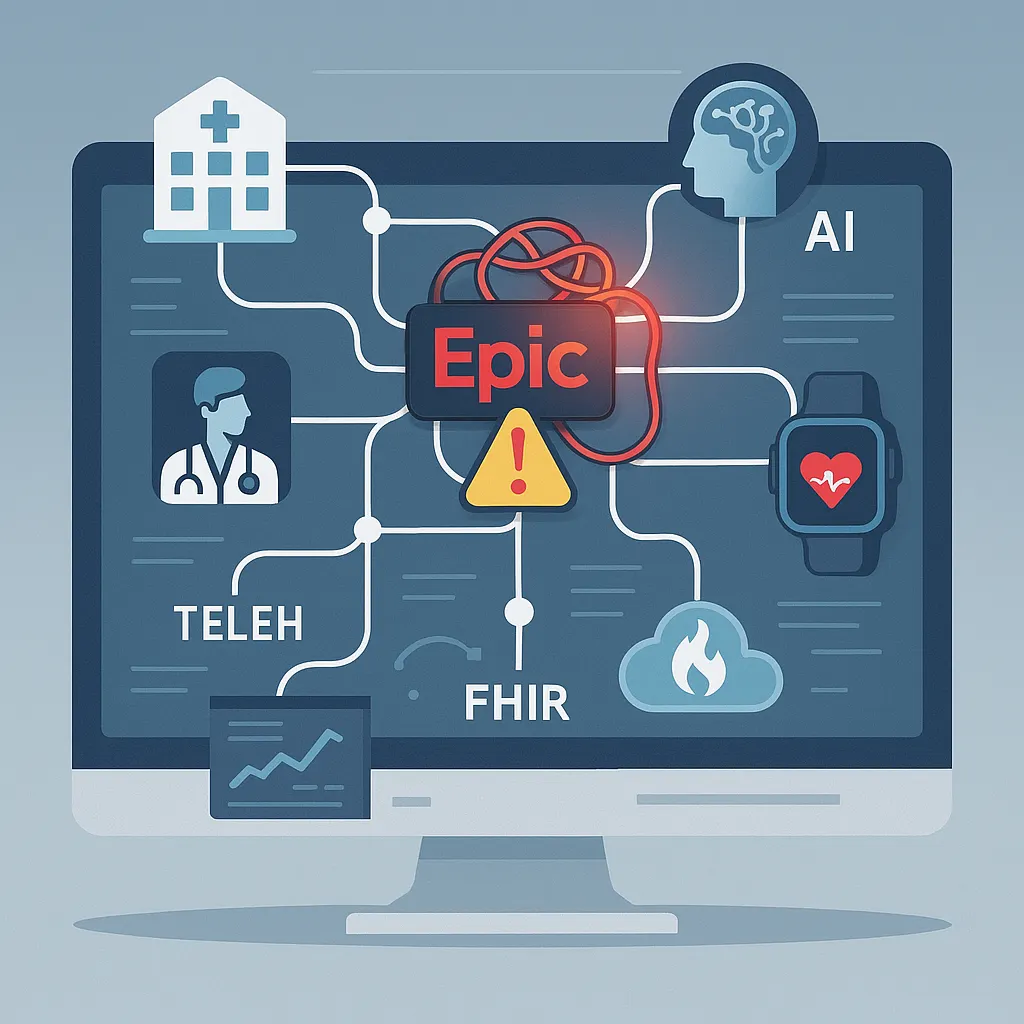
Predictive analytics in healthcare that cannot exchange data with the EHR systems clinical staff already use will not be adopted by clinical staff. The integration requirement for a production readmission prediction engine is not a surface-level API connection that pulls demographic data. It is a deep, bidirectional FHIR R4 integration that ingests clinical data from the EHR in real time and surfaces risk scores inside the EHR interface where clinical decisions are made.
Epic’s SMART on FHIR framework, Oracle Health’s integration APIs, and athenahealth’s platform all expose patient data through FHIR R4 endpoints. A readmission prediction engine built on FHIR-native architecture can ingest that data without custom middleware for each EHR deployment, present risk scores as embedded widgets inside the clinician’s existing EHR workflow and write risk stratification outputs back to the patient record as structured data that informs discharge planning documentation.
Get Larisa Albanians’s stories in your inbox
Join Medium for free to get updates from this writer.
The integration depth requirement is not a technical preference. It is the mechanism through which clinical adoption actually happens. A risk score that requires a separate login to view will not be viewed consistently enough to influence clinical decisions at scale.
The Model Architecture That Delivers Production-Grade Accuracy
Algorithm Selection by Clinical Use Case
Readmission prediction does not require a single model architecture. Different clinical use cases within the readmission risk domain perform better under different algorithmic approaches, and production systems typically use ensemble models that combine the outputs of multiple algorithms to outperform any single approach.
Gradient boosting models — particularly XGBoost and LightGBM implementations — consistently outperform logistic regression on readmission prediction tasks where the feature set includes both structured and unstructured inputs. For patient populations with significant temporal patterns in their clinical data, LSTM recurrent neural networks capture time-series dependencies in vital sign trends and lab value trajectories that gradient boosting models miss. For clinical settings where explainability is a regulatory or liability requirement, decision tree ensembles that produce feature importance rankings at the individual prediction level allow clinical staff to see which factors drove a specific patient’s risk score — a requirement that black-box deep learning models cannot satisfy without additional explainability tooling.
Production readmission prediction engines at health systems with sophisticated data science teams typically deploy a two-layer architecture: a primary prediction model that optimizes for accuracy, and an explainability layer that generates human-readable factor rankings for each prediction output to support clinical review workflows and documentation requirements.
Feature Engineering for Clinical Signal
The features that drive the strongest predictive signal in readmission models are not always the most obvious ones. Prior admission history within the preceding 90 days is consistently among the strongest predictors across populations. Polypharmacy — the number of concurrent medications at discharge — is a reliable readmission risk indicator that structured medication list data captures directly. Incomplete follow-up appointment scheduling at the time of discharge predicts readmission risk in populations managing chronic conditions.
Social determinants of health significantly improve model performance when they can be captured. Patients without reliable transportation to follow-up appointments, patients in unstable housing situations, and patients with documented social isolation are materially higher readmission risks than their clinical profiles alone would indicate. Models that incorporate social determinant data from community health records, case management notes, or structured social history fields in the EHR outperform models built on clinical data alone by measurable margins in published research.
Accuracy Benchmarks That Define Clinical Utility
What the Numbers Actually Mean in Practice
Readmission prediction models in production clinical environments achieve accuracy in a defined range and understanding that range is essential for setting realistic expectations before commissioning a development engagement.
Readmission models operating on structured EHR data typically achieve 65 to 80 percent accuracy. Sepsis prediction models achieve 70 to 85 percent. Fall risk models achieve 60 to 75 percent. Models below 70 percent accuracy in readmission prediction generate false positives at a rate that produces clinical alert fatigue — the condition under which staff learn to dismiss model outputs because the signal-to-noise ratio does not justify the attention cost.
AUROC — the area under the receiver operating characteristic curve — is the standard evaluation metric for readmission prediction models because it measures discriminative ability across all classification thresholds rather than at a single operating point. Production models targeting clinical utility should achieve AUROC scores above 0.75 for 30-day all-cause readmission prediction. Models achieving AUROC above 0.80 on held-out test sets drawn from the deployment population are considered high-performing by published clinical benchmarks.
The critical validation requirement is that model evaluation uses data from the specific population and clinical environment where the model will be deployed. A model trained and evaluated academic medical center data will not perform identically at a community hospital with a different patient population, different EHR configuration, and different clinical workflow patterns. Population-specific validation using retrospective data from the deployment organization is a non-negotiable requirement before any readmission prediction model is deployed in a live clinical environment.
Post-Deployment Monitoring as a Clinical Safety Requirement
Model accuracy at deployment is not model accuracy at month six. Clinical practice patterns shift, patient population characteristics change, and EHR configuration updates alter the data fields that the model’s feature engineering depends on. A readmission prediction model that achieved 78 percent accuracy at go-live and has not been monitored since may be performing at 61 percent six months later — below the clinical utility threshold — without anyone having detected the degradation.
Post-deployment monitoring architecture for predictive analytics in healthcare requires automated tracking of model performance metrics against clinical outcomes, drift detection that flags when the statistical distribution of incoming feature data deviates from the training distribution, and documented response protocols that specify what happens when a performance threshold is crossed. The regulatory direction is clear: updated HIPAA guidance and emerging CMS frameworks both point toward continuous monitoring standards for AI systems operating in clinical environments. Building monitoring into the deployment architecture before go-live is not optional for hardening — it is a clinical safety requirement.
What a Production Readmission Prediction Engine Requires in Summary
A readmission prediction engine that achieves and sustains clinical utility requires FHIR-native EHR integration that surfaces risk scores inside existing clinical workflows, a data pipeline that handles both structured and unstructured clinical data in real time, an ensemble model architecture that optimizes for both accuracy and explainability, population-specific validation achieving AUROC above 0.75 before deployment, and post-deployment monitoring that catches performance degradation before it affects clinical decisions.
Predictive analytics in healthcare that meets these requirements is not a vendor product you license and configure. It is a purpose-built clinical system that requires healthcare-specific engineering expertise at every layer of the architecture.