EgoSystems: The Culture Your Ego Builds


Every leader has an ego. The culture it builds depends on that moment when bad news arrives.
Every leader I have worked with or advised had an ego, we all have one. Me more so than most. I was once asked in an interview what my ‘weaknesses’ were. I didn’t hesitate. I openly admitted to having a fragile ego, prone to tears of anger and have had to learn to be respected before being liked. I am still surprised when I find that someone doesn’t like me. I know…it’s a journey and I am still working on it.
Ego is the part of us that holds our identity, and for founders and leaders, the business tends to move in and take up residence right in the middle of it. Once it does, we interpret criticism about the business as a direct criticism of ourselves.
Across my career I have watched how leaders evolve (or don’t) and how their ego-awareness shows up during moments of inflection. Five leaders taught me the range and archetypes that exist in the arena of leadership. (I have changed the details to protect everyone involved.)
The Filter. I once knew a Founder who built their identity on being the sharpest analytical mind in the room. Everything that needed to be explained or discussed was accompanied by a spreadsheet. People, places, text-based notes with no numeric content… it was all communicated on a spreadsheet. If there was ever confusion or push back against an idea, they built a bigger, more detailed spreadsheet which took time to communicate. When the business needed trust, vulnerability, honesty and a compelling story for investors, they instead went deeper into the data. They did not understand the power of words for a narrative, nor did they understand that emotions must be addressed humanistically, and sometimes numbers don’t tell a story. When growth milestones did not materialize and poor traction led to losses, they switched from one business trend or model to another hoping to ‘generate capital’ to supplement those losses. The signals that mattered most were completely missed or ignored, because they did not arrive in a ‘cell’. Absent a spreadsheet, reality was suspended and their world of numbers became a house of cards.
The signals that mattered most were completely missed or ignored, because they did not arrive in a ‘cell’
The Discounter. A leader I once knew could raise capital with extraordinary ease. There was a magnetic quality to their persona and people gravitated easily to them. What came across as being ‘driven’ actually masked an inner need to ‘belong’. Building the business became a crusade to prove worthiness to the exclusion of all else. This yearning for the trappings of wealth and acceptance came with a deaf ear to normal business cycles. They ignored and downplayed warnings about risk, expenses and industry shifts. Forever sure that their ‘membership card’ was only a few million dollars away and would absolve them as well as solve all issues. Partners who promised access and money but delivered neither were a distraction from self-awareness and glaring truths. Ignoring the red flags and downplaying business realities came with a high price. They embraced flattery from people as gospel truth. They chose to listen to their fawning audience, and when the market turned, there was nothing left to stand on and no one left to help, flatter or blame.
The Destroyer. I encountered and counselled a leader who was rarely present in the office but managed their organization from conferences and offsite meetings with fear and unveiled rage. It is rare to see outright intimidation in the workplace in today’s era of human-centric leadership. Short-term fixes to mistakes caused by the previous poorly strategized directives were delivered via Zoom. Most tasks came with micro-management, threats and no incentive. Board members were kept in the dark and often dismissed with little notice. Eventually the names of Board members were kept from most of the staff and other stakeholders. Funded projects were delivered way past deadlines.
Blame had no address, so it circulated and swelled the ecosystem with mistrust and hearsay. Good leadership left and new hires were selected based on ease of manipulation. When the element of destruction threatening you is The Leadership who has dispensed with reliable advisors and has no respect for others, confronting that Leader takes on a dangerous quality. You won’t just lose your job, your mental health will be impacted and you might take that lack of trust into your next role. Destructive egos are horrifically deleterious to business ecosystems.
Blame had no address, so it circulated and swelled the ecosystem with mistrust and hearsay
The Avoider. I know of a co-founder who brought fresh energy and commitment to every new venture, and people genuinely liked them. Their blind spot made it difficult to have hard conversations, and saying ‘NO’ was even harder. Their management style involved ‘swooping in and rescuing’. If the team appeared unable or unwilling to complete a task, the co-founder would do it for them. Taking on other people’s work was a form of ingratiation; they hoped that their example would ignite enterprise-wide commitment; or that they would be admired for their skill. The ultimate ego-stroke for This Avoider was any hint that a team member might emulate them. As the old adage goes, ‘imitation is the sincerest form of flattery that mediocrity can pay to greatness’ (strike greatness from this version, though).
Avoiding difficult conversations rarely works as a strategy. The team drifts into comfortable numbness, then loses respect for the leader. When The Avoider finally got serious or frustrated, they would explode and communicate their disappointment and distress with invective and volume. The emotional outburst would surprise everyone, but only for a moment, and then the moment would pass. The cycle of avoidance would play out: A season of resentment followed by a return to their warm friendly demeanor and the cycle would start all over again: Wash, rinse, repeat. Their crowning act of avoidance would involve switching priorities and tasks. Jumping to something new was the equivalent of ‘leaving on the next train that pulled into the station’.
The Metabolizer. I grew to admire and follow an Executive who was hired after a gruelling selection process, and they were treated as the underdog from day one. This Executive trained every team member individually, fought the board for team benefits, and gave people many chances to ‘get it right’. They understood each team member individually, knew their families, their motivations, their fears and their hopes. They could see where each person was coming from and respected them as individuals. They truly believed in second, third and even fourth chances. This Executive ensured that the assistant was trained and ready to ‘step up’ as part of ongoing succession planning. The Metabolizer did not fear becoming indispensable. Being absent from the office rarely had an impact on production.
Their skill lay in creating an empowered ecosystem and holding the team accountable with clear rules and support. The team turnover was low with the average tenure sitting at about eleven years. Glowing as all of this is, they had flaws and blind spots; they were certainly not perfect. I watched them struggle to find the balance between benefit of the doubt and acting decisively with speed. Sometimes, they paid the price for being slow to act on issues which would unsettle the team dynamic, threatening to erode all that had been built. However, when they made a decision, it was a masterclass in grace with no regrets.
A blind spot that I observed was their need to prove that they were good enough. They would worked hard, sometimes too hard to prove their value. They set the bar so high so early that stakeholder expectations became unrealistic. They allowed some stakeholders to push further than they should. Their best trait and their blind spot shared a root: self-esteem tied to investment in people. Sometimes it worked out, sometimes it didn’t.

What the five have in common
The Filter, the Discounter, the Destroyer, the Avoider, the Metabolizer. In each case, something threatened the leader’s identity, and this shaped the culture for everyone else and the organization at large. The ecosystem is the accumulated record of those responses.
When I reflect on these and other leaders I have known, I see two other patterns emerge. The first relates to Timing. Even the best Leader delays in taking action; the lag may have a cost. The distance between the signal and the action is related to the leader’s ‘Ego Stance’ and confidence. I have observed leaders pause, reposition and consider their vulnerabilities, often sub-consciously. The time lag is the tax the ego extracts for being front and center.
Get Viola A. Llewellyn’s stories in your inbox
Join Medium for free to get updates from this writer.
The second is The Loop. Ecosystems feed an ‘Ego Ping’ back to the leader. Successful funding rounds, winning business, applause and a deferential team can inflate this. It brings on the ‘Cape & Hero Syndrome’. Invulnerability sets in and the inner ear goes deaf. Fear and distance can harden the Ego and the Leader runs the risk of becoming intractable. They dig in when the red flags burn crimson. Ego builds the culture, and the culture raises or lowers the ego.
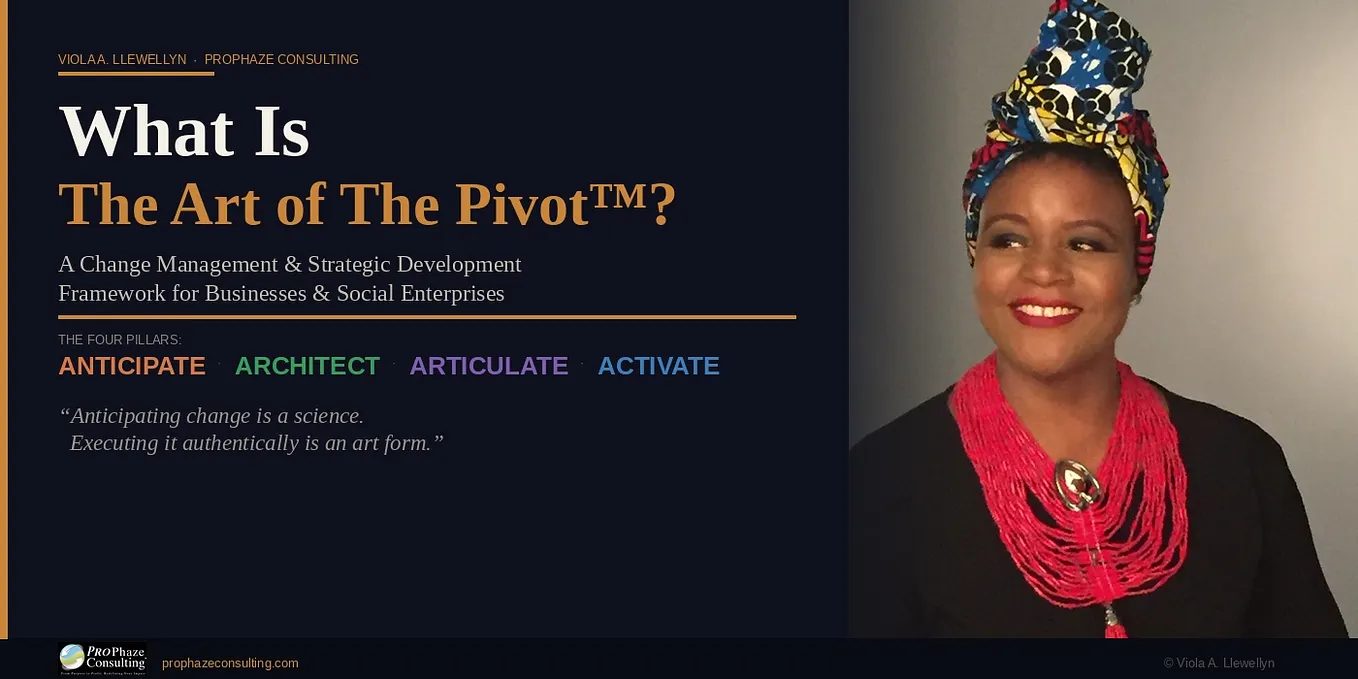
The Art of The Pivot & EgoSystems — What Can You Do?
- Anticipate. Learn your tell. What do you do when the news about your business feels like news about you? How do you handle that emotion and how do you plan your response?
- Architect. Build channels that treat news or information as data, nothing more, nothing less. Create channels for this data to travel with transparency to eliminate the impact of rumors and uncertainty. Negative news is as important as positive news. Leaders are celebrated for how they use data as a narrative tool to gain team commitment & stakeholder buy-in. It is important to protect the people who use these channels and understand that the team models its responses on you, the Leader.
- Articulate. Say the hard thing early and say it plainly. Emotions fill the void that credible information and leadership silence creates. Protecting your ego can be interpreted as a lack of concern for others.
- Activate. Close the gap between signal and action and let go of what no longer serves the mission, including your own centrality. Fragile egos don’t grow through challenges, they contract. An ecosystem built on inspiring leadership in others will build legacy.
Two questions to ask yourself
What happens to your organization when you are gone? The leader who micromanaged from afar and the manager who never checked in on vacation were both absent. Only one had built something that could stand without them.
Do you leave things, or do things leave you? Some of these leaders never decided to end anything. Their ventures imploded, or they were asked to leave, or they just boarded the next train. The strategic leader chooses the ending while there is still value to protect. This is where legacies are born — outside of the ego.
If you guessed that I was the Avoider in this story you guessed right; not in entirety, but enough that once upon a time I had to course correct. I opened with my own ego because it is the only one I can audit from the inside. The answer I gave in that interview has not expired. I still bruise and I am a known crier. ‘Getting over myself’ was a pricey and lengthy journey. My pivot came from learning to listen without reacting emotionally and take action with conviction and sincerity. It was my responsibility to deliver and handle ‘bad news’ and set backs, just as much as it was my responsibility to take immediate action to address my leadership performance.
I look back and see that it was a gift to be given honest feedback. Somewhere along the way I had engendered enough trust for stakeholders and the team to tell me when I was not at my best and how my fragile ego was affecting them. I got to understand the impact it had on all concerned. That was the echo/ego chamber pinging back at me. I was able to avoid looking ONLY for the bright positive highlights and respect how crucially important non-positive data can be. How you handle and interpret data and use information is what Leadership is about.
Every leader in this piece experienced the sting of criticism. What set them apart was how their introspection evolved (or didn’t) and the long term impact of their choices on the business ecosystem.
So here is my invitation. Think about the last piece of news about your business or department that landed like a verdict on you. Who delivered it? What happened to that person afterward? Whatever you did next is already written into your culture, and your team has read it more closely than you think.
A well-examined ego is one of the best assets an ecosystem can have. The leaders worth following feel the sting, name it, and still hold the door open for the truth. Legacy begins with the next hard thing you choose to hear and how your ego influences your response.

Don’t Forget to ‘Clap’ Respond & Share. I work with businesses and leaders to help them to plan & execute winning strategies using this 4 Pillar methodology. Connect with me to #Anticipate your next #Pivot at vllewellyn@ProphazeConsulting.com.
About the Author
Viola A. Llewellyn is the Founder and CEO of PROPhaze Consulting, a change management & strategic development consultancy serving businesses, social enterprises, organizations, and executive leaders navigating transformation in global and emerging markets. She is the creator of The Art of The Pivot™ framework.
Learn more: prophazeconsulting.com
Newsletter: The Art of The Pivot — available at PROPhaze Consulting
YouTube: @PROPhazeConsulting
© Viola A. Llewellyn / PROPhaze Consulting. The Art of The Pivot™ framework and methodology are the intellectual property of Viola A. Llewellyn and PROPhaze Consulting.