I Set 47 Goals Last Year. Here’s How Goal Management Software Saved Me From Myself

Spoiler: I actually achieved 34 of them. And no, one of them was NOT “drink more water.”
Let me paint you a picture.

It’s January 2nd. You’ve got a brand-new notebook (the fancy Moleskine one, not the ₹20 one from the corner store). You’re fired up. You write down goals like you’re writing a manifesto. “Double my revenue.” “Launch the product.” “Get fit.” “Be more present.” “Learn Spanish.”
By February 14th? You can’t find the notebook.
Sound familiar? Yeah. I’ve been there — multiple times. And I’m not alone. According to research from the University of Scranton, only 8% of people actually achieve their New Year’s resolutions. Eight. Percent. That means 92% of us are basically writing beautiful fiction every January.
But here’s what changed everything for me: I stopped trusting my memory, my motivation, and my Moleskine — and started using goal management software.
Let me walk you through what happened, what I learned, and why this is the single biggest productivity shift I’ve made in years.
Wait, Is “Goal Management Software” Just a Fancy To-Do List?
Absolutely not — and this is where most people get it wrong.
A to-do list is reactive. It’s “do this thing today.” Goal management software is proactive. It’s “here’s where you’re going, here’s how today connects to that, and here’s how far you’ve come.”
Think of it this way: a to-do list is your grocery list. Goal management software is your entire financial plan, meal plan, and health strategy — with weekly check-ins and a dashboard that tells you if you’re on track.
The best tools in this space — especially ones built around OKRs (Objectives and Key Results) — help you do three things that humans are genuinely terrible at doing alone:
- Setting goals that are actually measurable
- Tracking progress consistently (not just when you feel motivated)
- Aligning your daily work with your big-picture vision
That last one is killer. Most of us are busy. Very, very busy. But busy doing what? Goal management software forces you to answer that question.
The OKR Framework: Not Just for Google Anymore
Here’s a quick real-talk on OKRs, because you’re going to hear this term a lot.
OKRs — Objectives and Key Results — were popularized by Intel in the 1970s and famously adopted by Google when it was just a scrappy little startup with 40 employees. John Doerr (the guy who introduced OKRs to Google) wrote in his book Measure What Matters that OKRs were the “superpower” behind Google’s meteoric rise.
Cool story, right? But here’s the thing — OKRs aren’t just for billion-dollar companies. They work for solopreneurs, small teams, and individuals who want to stop drifting and start steering.
An OKR looks like this:
Objective: Launch a profitable online course by Q3
Key Result 1: Complete 12 video modules by June 30
Key Result 2: Collect 50 beta tester sign-ups by May 15
Key Result 3: Achieve ₹2,00,000 in revenue within 30 days of launch
See how that works? The Objective is your “what” — the direction. The Key Results are your “how do I know I got there” — the measurable proof. No fluff. No vague aspirations. Just clarity.
The best OKR software and OKR product management tools take this framework and build systems around it — reminders, progress sliders, team alignment views, weekly check-ins, and more.
Real Story: How a 7-Person Startup Used This to 3X Their Revenue
I want to share a story from a friend of mine — let’s call her Priya — who runs a SaaS startup in Bangalore with a team of seven people.
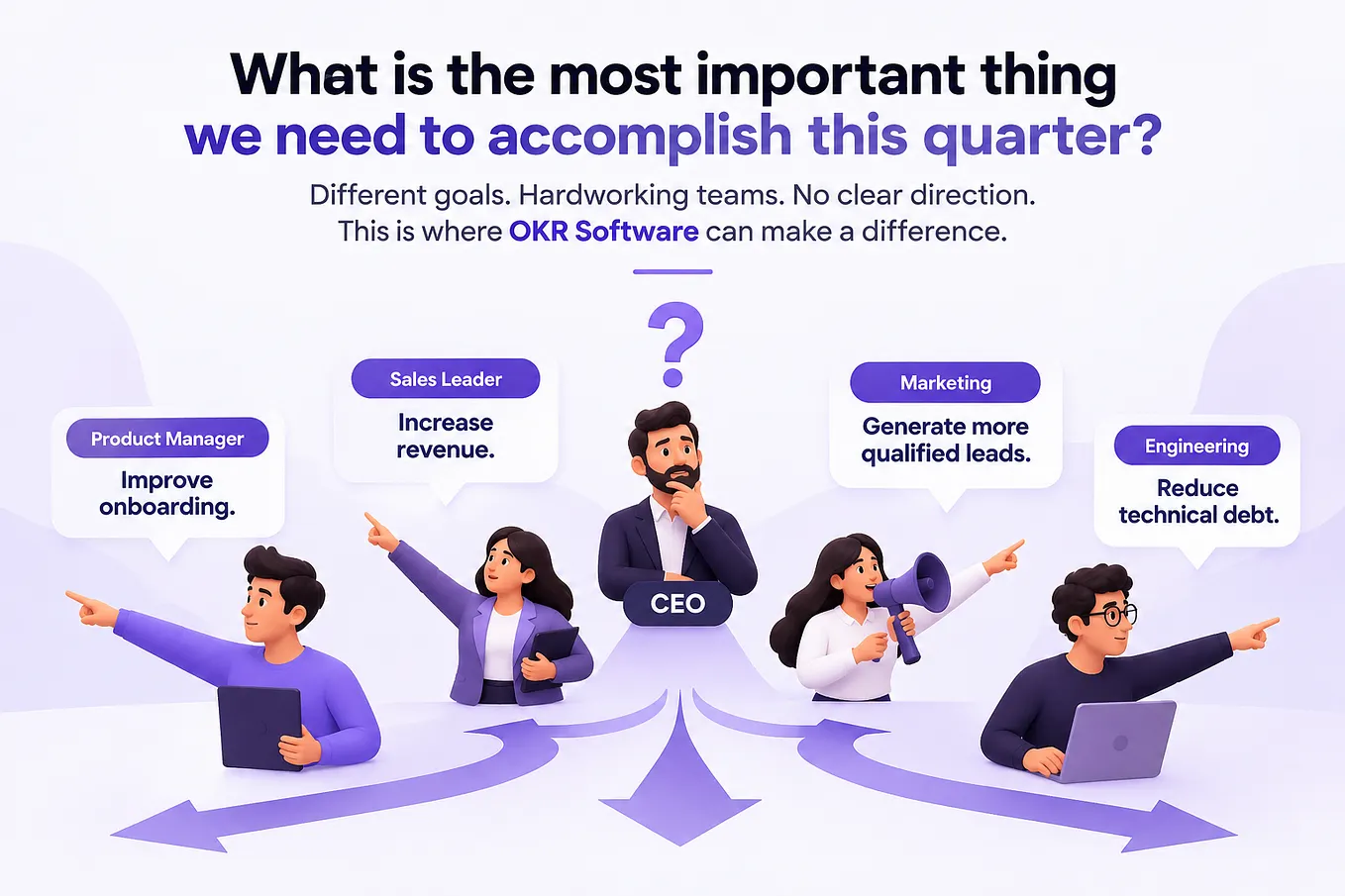
In 2022, Priya’s team was working hard but felt completely scattered. Everyone had different ideas about what “success” looked like that quarter. The developers were building features the sales team didn’t even know about. The marketing team was running campaigns targeting the wrong customer persona. Sound chaotic? It was.

Then Priya implemented an OKR-based goal management system. Within the first 30 days:
- Every team member knew the company’s top 3 quarterly objectives
- Each department had 2–3 key results tied to those objectives
- Weekly 15-minute check-ins replaced their scattered Slack updates
- Tracking progress became visual — not a chore, but a motivator
By end of that year? Revenue had grown 3X. Not because they hired more people. Not because they worked more hours. But because everyone was pulling in the same direction.
That’s what goal management software does. It creates alignment where there was previously just ambition.
The Psychology Behind Why We Need These Tools
Here’s where it gets interesting — and a little uncomfortable.
Get Pandiyan’s stories in your inbox
Join Medium for free to get updates from this writer.
Humans are notoriously bad at long-term thinking. We’re wired for immediate rewards. Our brains release dopamine when we check off a task, scroll Instagram, or eat a samosa — not when we spend 90 minutes on deep work that moves a 6-month goal forward.
This is called present bias, and it’s basically the villain in your productivity story.
A 2015 study published in Psychological Science found that people are significantly more likely to follow through on goals when they have implementation intentions — specific plans that connect “when X happens, I will do Y.” Goal management software does exactly this by:
- Breaking annual goals into quarterly objectives
- Breaking quarterly objectives into monthly milestones
- Breaking monthly milestones into weekly actions
- Sending you reminders so you don’t “forget” your dream (yes, we forget our dreams — it’s embarrassing but true)
The act of tracking progress also triggers something powerful: the progress principle, first described by Harvard Business School professor Teresa Amabile. Her research showed that the single biggest motivator at work — bigger than salary, bigger than recognition — is the feeling of making progress on meaningful work.
Goal management software makes that progress visible. And visible progress is addictive in the best possible way.
What Makes the Best OKR Software Actually Good?
Not all goal management tools are created equal. Here’s what separates genuinely useful platforms from glorified spreadsheets:
Intuitive goal hierarchy
You should be able to see how your daily tasks connect to your quarterly OKRs connect to your annual vision — in one view, without a PhD in project management.
Progress tracking that doesn’t feel like homework
Weekly check-ins should take 5 minutes, not 45. The best tools make updating progress as easy as moving a slider.
Team alignment features
For product managers and team leads especially, OKR product management tools should show how individual OKRs nest inside team OKRs, which nest inside company OKRs. Misalignment is expensive — McKinsey estimates that misaligned teams waste up to 20% of their productive capacity.
Integrations
Your goal management software should talk to your project management tools, your calendar, your CRM. Goals that live in isolation die in isolation.
Analytics and retrospectives
At the end of a quarter, you should be able to see why you hit or missed goals — not just that you did. This is where learning lives.
The Honest Part: Software Won’t Save You From Yourself
Okay, I have to say this because I’d feel bad if I didn’t.
Goal management software is a tool. A powerful one. But it’s not magic.
If you set goals that are completely misaligned with your actual values, software will just help you sprint in the wrong direction faster. If you refuse to do weekly check-ins, no amount of reminders will help. If you set 47 goals (like I once did — yes, forty-seven), you’ll spread yourself so thin the software will just witness your chaos more clearly.
The best approach? Start with 3 objectives. Maximum.
Seriously. Three. Pick the three things that, if you achieved them this quarter, would make you feel genuinely proud. Then build your key results around those. Let the software do the heavy lifting of reminding, tracking, and visualizing — but you have to do the thinking first.
A Quick Note on the Data (Because Numbers Matter)
Let’s ground this in some stats that might surprise you:
- Only 16% of organizations have a formal system for tracking goals, according to a Gallup survey. No wonder most teams feel lost.
- Companies that use OKR frameworks report 10–25% improvement in goal achievement rates, based on research from the OKR Institute.
- A study by Dominican University found that people who wrote down their goals and sent weekly updates to a friend achieved 76% of their goals — compared to just 35% for those who only thought about their goals.
That last stat is wild, right? Simply making your goals visible and accountable nearly doubles your success rate. Goal management software is essentially that “friend with weekly updates” — just more patient and available at 11pm when you finally remember to check in.
So, Should You Invest in Goal Management Software?
If you’re a solopreneur who wants to stop spinning your wheels — yes.
If you’re a product manager trying to align your team around outcomes instead of outputs — absolutely yes.
If you’re a startup founder who’s tired of quarters passing by without knowing what you actually achieved — yesterday would have been a good time to start.
The investment pays off not just in goals achieved, but in clarity gained. There’s something genuinely peaceful about knowing exactly what you’re working toward and being able to see your progress over time.
It’s the difference between wandering through a forest and hiking a marked trail. Both involve walking. But only one gets you to the summit.
The Bottom Line
Goal management software — especially tools built around the OKR framework — is no longer just for Silicon Valley giants. It’s for anyone who’s serious about turning ambition into achievement.
Tracking progress stops being a chore when it’s built into your workflow. OKR product management stops being a buzzword when you watch your team align around shared outcomes. And the best goal management software stops being “just an app” when it becomes the scaffolding your best work is built on.
So yeah — I set 47 goals last year. That was dumb. But I used goal management software to whittle those down, prioritize ruthlessly, track honestly, and cross the finish line on 34 of them.
The other 13? I’m coming for them this quarter.
And the water thing — I’m still working on it.
Have you tried goal management software or OKRs in your work? Drop your experience in the comments — I read every single one.