MONETISING THE MUSE: THE ART OF STEAL
CHAPTER ONE
Previous: Prologue (Monetising the Muse: The Art of Steal)

Six Months Earlier
The first thing Kathak taught Amaira Rai was how to listen.
Not to music. Music came later, along with the ghungroos, the mirrors, the impatient corrections of her guru, and the thousand other things people mistook for the beginning of dance.
Listening came first.
She was six when her guru, Pandit Shankar Vyas, placed her in the middle of his practice room and clapped a short sequence of beats.
“Listen carefully,” he instructed. “Now reproduce the rhythm with your feet. Exactly as you heard it.”
Amaira watched his hands, trying to memorise the pattern before striking the wooden floor with her right foot, then her left.
She got it wrong.
“Again,” he said.
She tried once more.
“Again.”
By the fourth attempt, she had begun to feel the rhythm somewhere beneath her ribs, a small, insistent pulse that seemed to arrive a fraction of a second before his hands met.
She had watched his hands carefully. She knew when the next clap should come. Or thought she did.
She stamped her foot.
“Too early.”
She stamped again.
“Too late.”
By the seventh attempt, she was angry enough to cry.
Her guru crouched in front of her. His white kurta smelled faintly of sandalwood and the dust that settled over the room each summer. He took her small hand between his palms and held it there until she stopped trying to pull away.
“You are waiting for me to tell you when the rhythm begins,” he said. “But the rhythm has already begun. You simply haven’t learned to hear it.”
Amaira had understood none of this.
She had nodded anyway.
Years later, she would stand beneath the lights of concert halls in London, New York, Singapore, and Mumbai, performing for audiences who rose to their feet before she had even finished her final pranam. Critics would describe her command over rhythm as extraordinary. Interviewers would ask how she made such complicated footwork appear effortless. Young dancers would approach her after performances and confess that they had watched her chakkars with their mouths open, unable to understand how a human body could spin so many times without surrendering to gravity.
She had learned to answer these questions with a smile.
Practice, she would say.
Discipline.
Years of training.
All true, and none of it quite the answer.
The answer was that, somewhere along the way, she had stopped trying to anticipate the rhythm. She had learned to enter it.
At thirty-one, she still listened before she danced.
Even when she was alone.
Especially then.
On the morning Kinesis Dynamics entered her life, Amaira was setting up her practice space. Outside, Mumbai was already awake. Traffic pressed against the road below her apartment. A vegetable vendor called out to someone in the neighbouring building, and the smell of brewing chai drifted in from the kitchen, where her mother had left a saucepan on the stove before going out.
Amaira looked at the clock.
Seven twelve.
Her rehearsal was supposed to begin at seven.
She had been in the room since six.
This, she often told people, was the difference between being a dancer and being someone who danced. The first required you to show up before the world had finished waking. The second could be done whenever you found the time.
She lowered her foot and reached for the ghungroos resting beside the mirror.
They were old enough that the metal had darkened and the bells had lost their original lustre. She had bought her first proper pair at fourteen, saving money from performances and refusing to let her parents contribute. These were a replacement pair, gifted by her guru after her debut solo performance. He had insisted that she break them in herself.
“Your feet will tell you when they’re ready,” he had said.
She had thought it was another one of his strange sayings.
Now she knew better.
Amaira sat on the floor and began fastening the bells around her ankles, tightening the strings one at a time. She checked each knot with her thumb. Too loose, and the bells shifted. Too tight, and the strings dug into her skin, blocking blood flow and making her feet lose sensation.
She had learned to recognise the difference without looking.
When she stood, the ghungroos settled against her ankles with a familiar weight.
For a moment, she did nothing.
Then she began.
The first strike was quiet, almost tentative.
She increased the pressure, allowing the sound to gather beneath her feet. Her right heel met the floor, then her left, the syllables forming themselves in the space between movement and intention.
She ignored it.
The sequence lengthened. Her feet moved faster, testing the floor, finding the places where the wood returned the sound cleanly and where it swallowed it. Her body settled into the mathematics of the taal, every strike deliberate, every pause carrying as much weight as the movement before it.
There were things about Kathak she had never been able to explain to people who had not trained in it.
The bells were not decoration. The spins were not tricks. The footwork was not simply a way of keeping time.
Every movement belonged to a conversation: between the dancer and the tabla, the body and the floor, the rhythm and the silence that gave it shape. Even the most intricate sequence had a grammar. Even improvisation required knowledge of the rules.
And yet, within that discipline, there was room for something no rule could fully contain.
A dancer could perform the same tihai (dance piece) a hundred times and arrive at a different feeling on the hundred-and-first.
The body remembered what the mind forgot.
The body also remembered what the mind had never known how to name.
Amaira finished the sequence with three precise strikes and a stillness that seemed to suspend the room around her.
For a few seconds, the only sound was her breathing.
She laughed.
Her phone vibrated on the windowsill.
She almost ignored it. Her manager, Naina, had a talent for calling at precisely the moment Amaira reached a state of concentration that took half an hour to achieve. There would be a sponsor asking for photographs, a journalist requesting an interview, or another organiser wanting to know whether a forty-minute performance could be compressed into twenty-five.
Amaira wiped her forehead with the edge of her dupatta and checked the screen.
Three missed calls.
One message.
Please tell me you’re awake. Actually, don’t. I know you’re awake. Call me when you finish.
Amaira called.
Get Aadita bansal’s stories in your inbox
Join Medium for free to get updates from this writer.
“You’re late,” Naina answered.
“Good morning to you too.”
“It’s almost eight.”
“I have a clock.”
“And yet you continue to treat it as a decorative object.”
Amaira smiled and crossed to the window. From there, she could see a narrow strip of the sea between two apartment buildings. The water was grey beneath the morning haze.
“What happened?”
“Nothing happened. Something might happen. I’ve sent you an email.”
“That sounds suspiciously like something happened.”
“An invitation.”
“To what?”
“A meeting.”
Amaira closed her eyes.
“Naina.”
“Listen to me before you reject it. This one is interesting.”
“They’re all interesting until somebody asks me to dance beside a luxury car.”
“This is not a car company.”
“Worse, then. A jewellery company.”
“Technology.”
Amaira opened her eyes.
There was a brief silence.
Then she said, “No.”
“You haven’t even heard the pitch.”
“I heard the word technology. I am exercising my right to refuse on instinct.”
“It’s a preservation project.”
That made her pause.
Naina knew it, too. She had learned long ago that the quickest way to get Amaira’s attention was not to mention money, publicity, or international exposure. It was to mention the possibility of making something last.
“What kind of preservation project?”
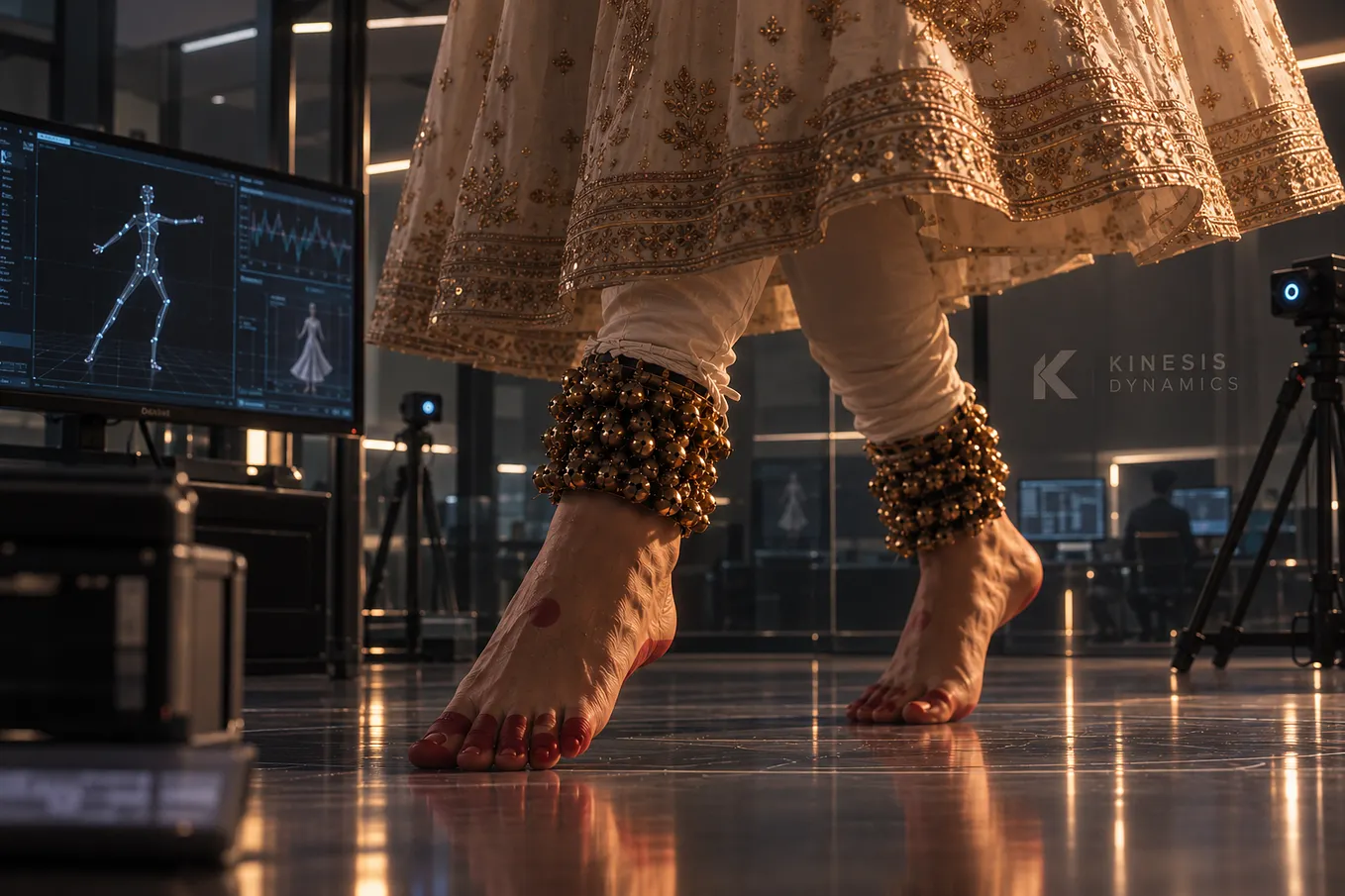
“Motion capture. Digital archiving. They want to record classical dance performances using advanced sensors, create a detailed digital archive, and develop tools that could help future generations study the form.”
Amaira turned towards the mirror.
Her reflection looked back at her: hair escaping its knot, a faint line of sweat along her temple, the bells still fastened around her ankles.
“Why me?”
“Because you’re you.”
“That is not an answer.”
“Because you’re internationally recognised, because your footwork is precise, because your performances are documented, because they want to work with an artist who can explain what they’re recording instead of just giving them something pretty to film.”
Amaira looked down at her feet.
Something pretty to film.
She had spent half her life trying to explain that Kathak was not something to be looked at from a safe distance. It was a language. A history. A way of carrying stories through a body that would eventually become too old, too tired, or too injured to carry them any further.
“How much are they paying?”
“Reasonably well.”
“Naina.”
“Very well.”
Amaira groaned.
“Don’t do that.”
“Do what?”
“Make the money sound like an unfortunate side effect of doing something meaningful.”
Naina laughed. “I know you better than that. Read the email. Their director wants to meet you personally. They’ve asked for an initial consultation, no commitment.”
“And the archive?”
“That’s what you’ll discuss.”
“Who owns it?”
“I knew you’d ask that.”
“Then you should have an answer.”
“I don’t. That’s why you need to meet them.”
Amaira watched a crow land on the neighbouring balcony, its claws scraping against the railing.
“What are they called?”
“Kinesis Dynamics.”
She repeated the name silently.
Kinesis.
Movement.
It sounded like the sort of word someone would choose when they wanted an ordinary thing to seem extraordinary.
“Send me the email,” she said.
“I already have.”
“Then I’ll read it.”
“And?”
“And nothing. I said I’d read it.”
“Progress,” Naina said, with the exhausted satisfaction of a woman who had negotiated far more difficult contracts.
After the call ended, Amaira remained by the window for another minute.
Then she went back to the centre of the room.
She untied the ghungroos, placed them carefully beside the mirror, and looked at the empty space where she had been dancing.
A digital archive.
For future generations.
She wondered what it would mean to leave something behind that could be studied by people she would never meet.
She wondered, too, whether it was possible to preserve a dance without preserving the person who understood why it had to be danced.