From Noise to Clarity | Track 6
COMPLEXITY AND STRATEGY: Why Strategy Fails Without Clarity #4
Complexity and Strategy | Post 4 of 15


Before you read: Think of a strategy conversation you have been part of where everyone in the room seemed aligned. Now ask yourself honestly: did you actually share the same picture of what success looked like, or did you share the same words without ever testing whether those words meant the same thing to everyone who heard them?
Why strategy fails without clarity
Most organisations do not fail because they lack strategy.
They fail because different people are executing different strategies simultaneously, each one convinced they are executing the right one, each one working hard, and each one pulling in a direction that made complete sense from where they were standing.
This is one of the more difficult problems to diagnose because it does not look like a problem from the inside. It looks like effort. It looks like commitment. The meetings are happening. The plans are being followed. The people are trying. And yet the results keep disappointing in ways that are difficult to explain, because nobody can point to the moment when things went wrong. Things went wrong before execution began. They went wrong in the room where the strategy was agreed.
I have worked with enough organisations across the region to recognise this pattern with a degree of confidence. The strategic plan is often not the problem. The strategic plan is frequently well-constructed, thoughtfully developed, and clearly written. The problem is what happens between the moment the plan is presented and the moment people walk out of the room and begin acting on their own interpretation of it.
Strategy does not fail at execution. It fails at understanding. And understanding, in my experience, requires something that most strategic conversations never produce.
A shared picture.
Visual Prompt 1 Title: Same word. Ten different pictures. Hand-drawn sketchnote, black ink throughout, blue accents on key elements only, white background, rough sketch aesthetic. A single word in large letters at the top: “growth.” Below it, six rough sketches from six different figures, each sketch showing a different interpretation: revenue chart, new markets map, headcount increase, product development, customer numbers, capability building. Blue note at the bottom: “everyone heard the same word. nobody drew the same picture.” Rough sketch aesthetic.

Strategy lives in interpretation, not in documents
There is a widespread assumption in organisations that strategy lives in documents.
In the strategic plan. In the vision statement. In the slide deck from the leadership offsite. In the carefully worded priorities document that was reviewed, revised, and eventually approved by the senior team before being distributed across the organisation.
That assumption is incorrect, and the cost of holding it is significant.
Strategy does not live in documents. Strategy lives in people’s heads. The document is an attempt to communicate it. The real strategy, the one that actually drives decisions and shapes behaviour, is the version that each person carries into their work every day. And that version is formed not by what the document says but by how each person interprets what the document says, filtered through their own role, their own priorities, their own understanding of what the organisation actually values versus what it says it values.
This is why a beautifully written strategy can still fail. The document may be clear. The interpretation may not be. And interpretation is where strategy either becomes shared or begins to fragment.
Consider what happens in the room after a strategy is presented.
The CEO explains the direction. The leadership team listens. The presentation is clear, the logic is sound, and when it ends, the people in the room nod. They ask reasonable questions. They express support. And then they leave.
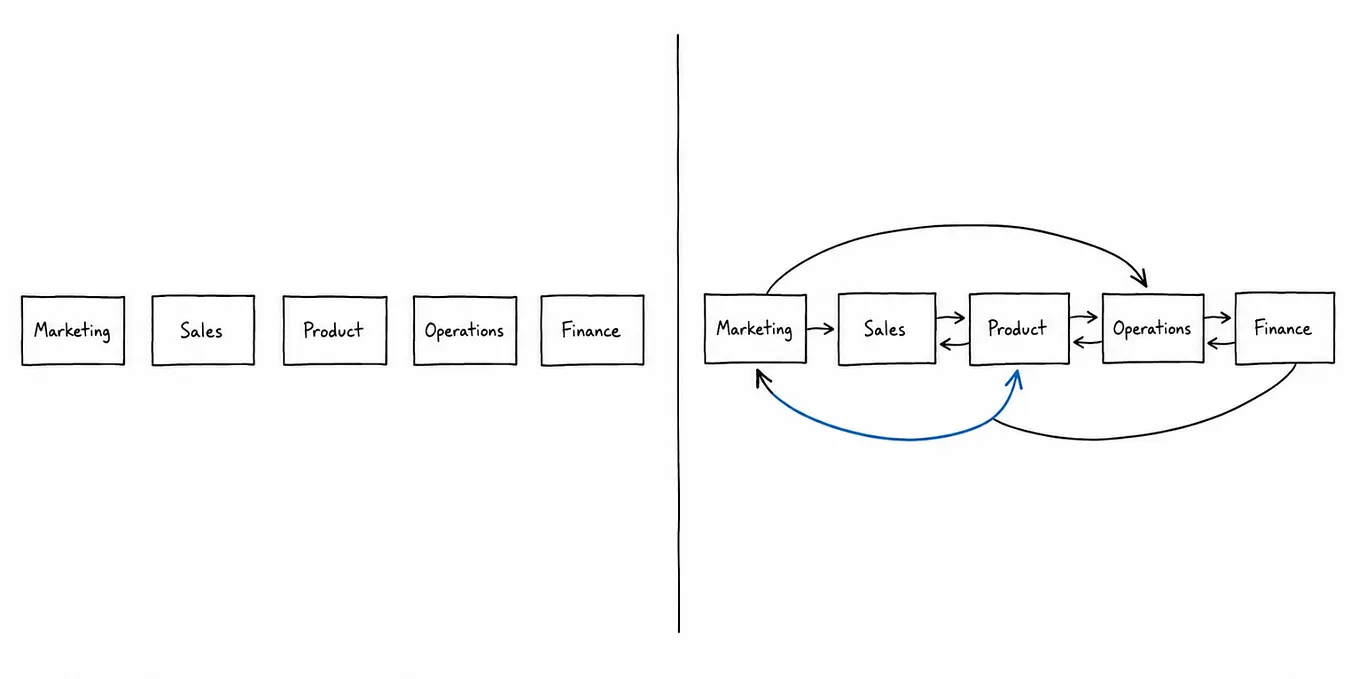
Ask those same people a week later, individually and without preparation, to describe the strategy in their own words. In my experience, you rarely receive the same answer twice. The head of sales hears growth. The head of finance hears efficiency. The head of operations hears process improvement. The head of people hears capability development. The head of marketing hears customer acquisition. Each interpretation is internally coherent. Each is grounded in something real. And each is pulling the organisation in a slightly different direction from every other one.
Nobody was being deliberately difficult. Nobody was failing to pay attention. People interpret. That is what people do. The question is whether the strategy was made visible enough that interpretation had something concrete to work from.
Why language creates the illusion of alignment
The specific words that organisations use to describe strategy are part of the problem.
Innovation. Transformation. Customer centricity. Growth. Excellence. These words carry genuine meaning. They also carry enormous ambiguity. Ask ten people in an organisation to define what innovation means in the context of their specific work, and you will receive ten different answers, all of them defensible, none of them identical.
Language is powerful precisely because it is flexible. The same word can hold different meanings for different people, which makes communication feel more aligned than it actually is. When everyone agrees that the strategy involves growth, they are agreeing on the word. They are not necessarily agreeing on what growth means, where it should come from, how it should be pursued, what trade offs it requires, or what it should take priority over when resources are limited and choices have to be made.
This is the mechanism behind the alignment gap that most strategy conversations fail to close.
Alignment looks like agreement because people are using the same language. But language, in complex organisations with diverse functions and competing priorities, creates the appearance of shared understanding rather than the reality of it. The test of genuine alignment is not whether people can repeat the strategy. The test is whether they would make the same decisions at the boundary cases, the moments when priorities conflict, when resources run short, when the plan meets a reality it did not anticipate.
At those moments, the version of the strategy that lives in each person’s head determines what happens. And if those versions are different, the organisation fragments, quietly, without anyone quite noticing, until the results make it impossible to ignore.
The strategy drawing test
There is a simple exercise I have used repeatedly in leadership and facilitation work that reveals the state of strategic alignment faster than any survey or diagnostic tool.
Ask the people in the room to draw the strategy.
Not a polished diagram. Not a slide. A rough sketch on a piece of paper, done in two or three minutes, showing what they understand the strategy to be. What the organisation is trying to achieve. What drives success. What matters most. What supports what. Where the focus sits and what sits outside it.
Then place the sketches side by side and look at them together.
Get Ai Yat Goh’s stories in your inbox
Join Medium for free to get updates from this writer.
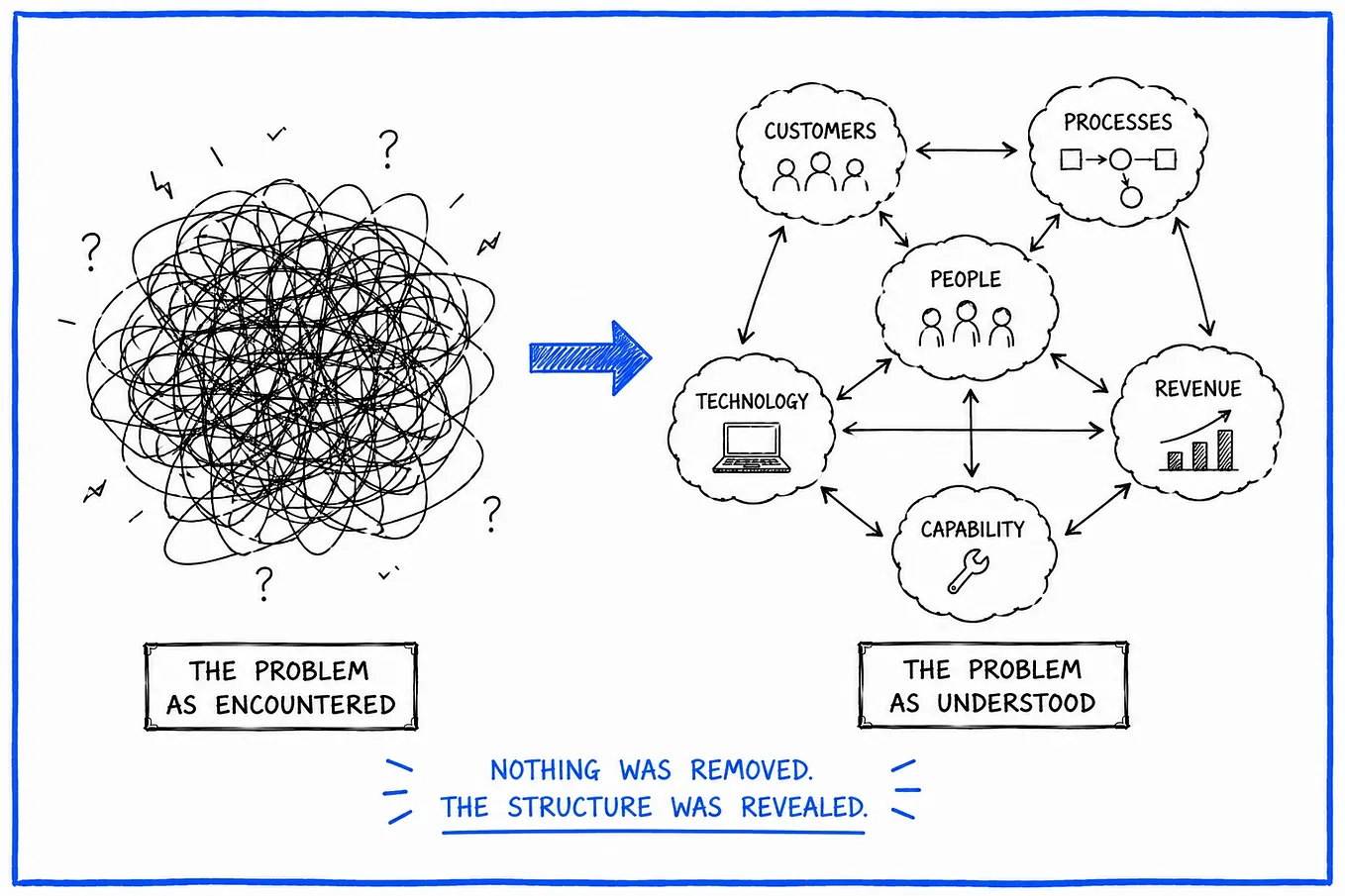
What the exercise consistently reveals is not that people have misunderstood the strategy in dramatic ways. It is that the mental models people are working from are meaningfully different in the specific places that matter most for execution. One sketch shows the customer at the centre with everything else in service of the customer relationship. Another shows the product at the centre with the customer as the destination. Another shows the financial outcome at the centre with the product and customer as the means. These are not the same strategy. They will not produce the same decisions. They will not create the same culture, the same resource allocation, or the same behaviour at the moments when choices have to be made.
The power of the exercise is not in the drawing itself. It is in what the drawing forces.
When you draw a strategy, you have to make decisions that language allows you to avoid. You have to decide what goes at the centre and what sits at the edge. You have to decide what connects to what and in which direction the arrows flow. You have to decide what is inside the picture and what is outside it. Every one of those decisions is a strategic choice, and the fact that different people make different choices reveals the assumptions that the verbal conversation never surfaced.
This is one reason visual thinking is not merely a communication tool in strategic contexts. It is a diagnostic tool. It makes the invisible visible. And what becomes visible, when a leadership team draws its strategy together for the first time, is often the conversation that should have happened before any of the execution planning began.
Visual Prompt 2 Title: The drawing test Hand-drawn sketchnote, black ink throughout, blue accents on key elements only, white background, rough sketch aesthetic. Six rough sketches pinned to a wall, each showing the same organisation’s strategy but with a different element at the centre: customer, product, revenue, capability, market, technology. Figures standing in front of the wall, looking at the sketches. Blue caption: “same strategy. drawn six different ways. this is where alignment work begins.” Rough sketch aesthetic.

Good strategy is choice, not addition
There is a related problem that compounds the alignment gap.
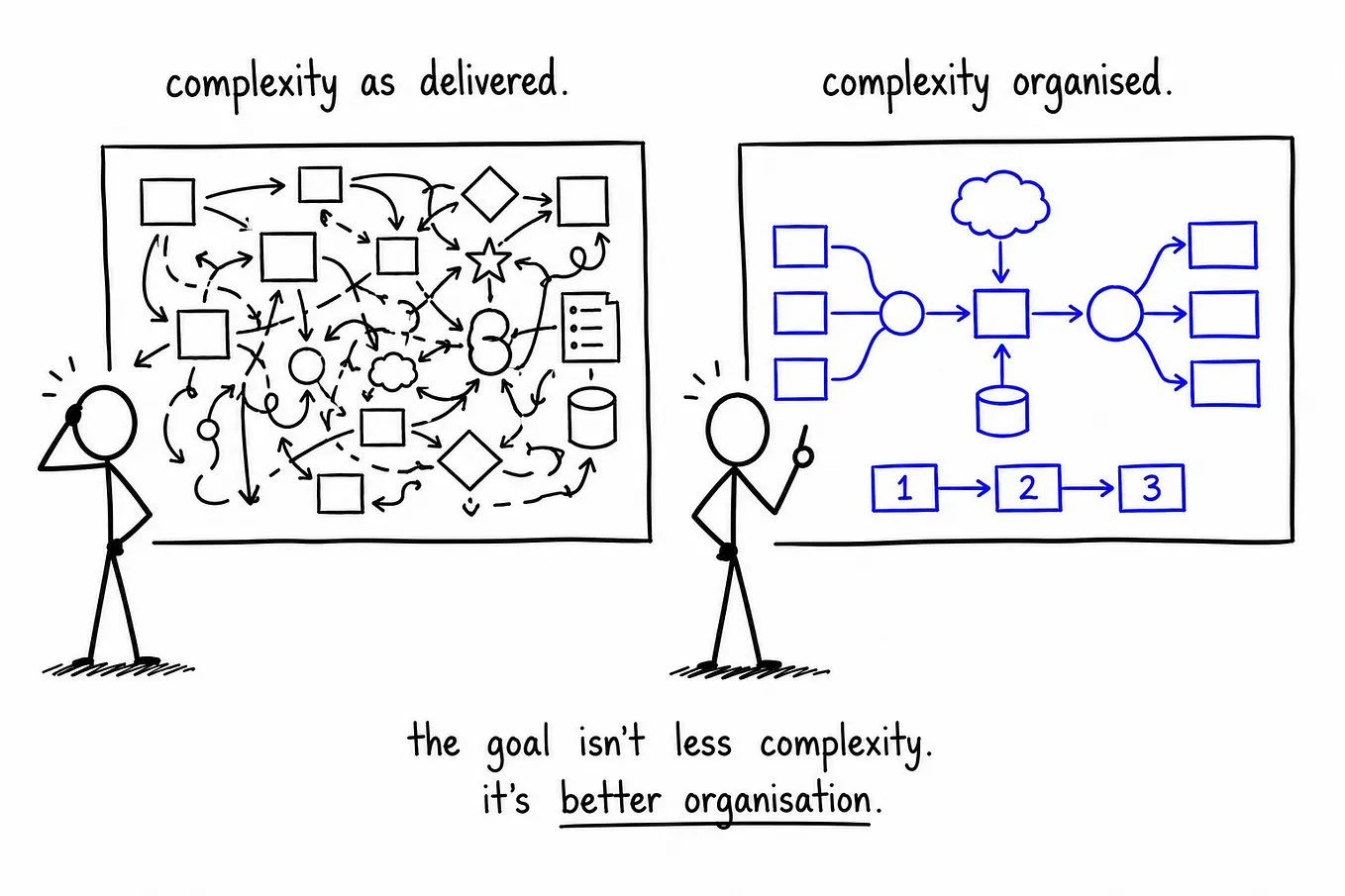
Many strategic plans attempt to include everything. Growth and innovation and transformation and customer experience and digitalisation and talent development and operational excellence and sustainability and culture. Each item appears because it is genuinely important. Each item has a legitimate case to be made for its inclusion. And the cumulative effect is a strategy that is attempting to move in every direction simultaneously.
When everything is important, nothing is strategic.
Strategy is not addition. Strategy is choice. It is the deliberate decision to pursue some things rather than others, to allocate resources in ways that reflect genuine priorities rather than apparent ones, to accept that focusing on what matters most necessarily means doing less of what matters less. That is not a comfortable decision to make, particularly in organisations where different functions have legitimate and competing claims on resources and attention.
But without choice, the strategic plan becomes a list of aspirations rather than a guide to decisions. And a list of aspirations does not resolve the alignment problem. It deepens it, because now there are more things for people to interpret differently.
The organisations where execution works well are rarely the ones with the most comprehensive strategies. They are the ones where the choices embedded in the strategy are clear enough that people at every level can make consistent decisions without needing to escalate every trade off to the top. That clarity does not come from more thorough planning. It comes from the willingness to choose, and from making those choices visible in a form that people can actually work from.
Clarity is a collective achievement, not a personal one
Many leaders believe clarity is something they personally possess.
I know what I mean. I know where we are going. I know what matters and why. I have thought this through carefully and the direction is clear to me.
That is a necessary starting point. It is not sufficient.
Strategic clarity is not a personal achievement. It is a collective one. The clarity that matters is not the clarity in the leader’s head. It is the clarity that exists in the shared space between every person who has to make decisions in service of the strategy. That clarity has to be built, deliberately and explicitly, through the kind of conversation that most strategic processes do not make time for.
The conversation that asks not just whether people heard the strategy but whether they can see it. Whether the picture in one person’s head bears sufficient resemblance to the picture in another person’s head that their decisions will be consistent rather than contradictory. Whether the choices embedded in the strategy are visible enough that they can guide behaviour in the specific moments when competing priorities create pressure and the plan meets a reality it did not anticipate.
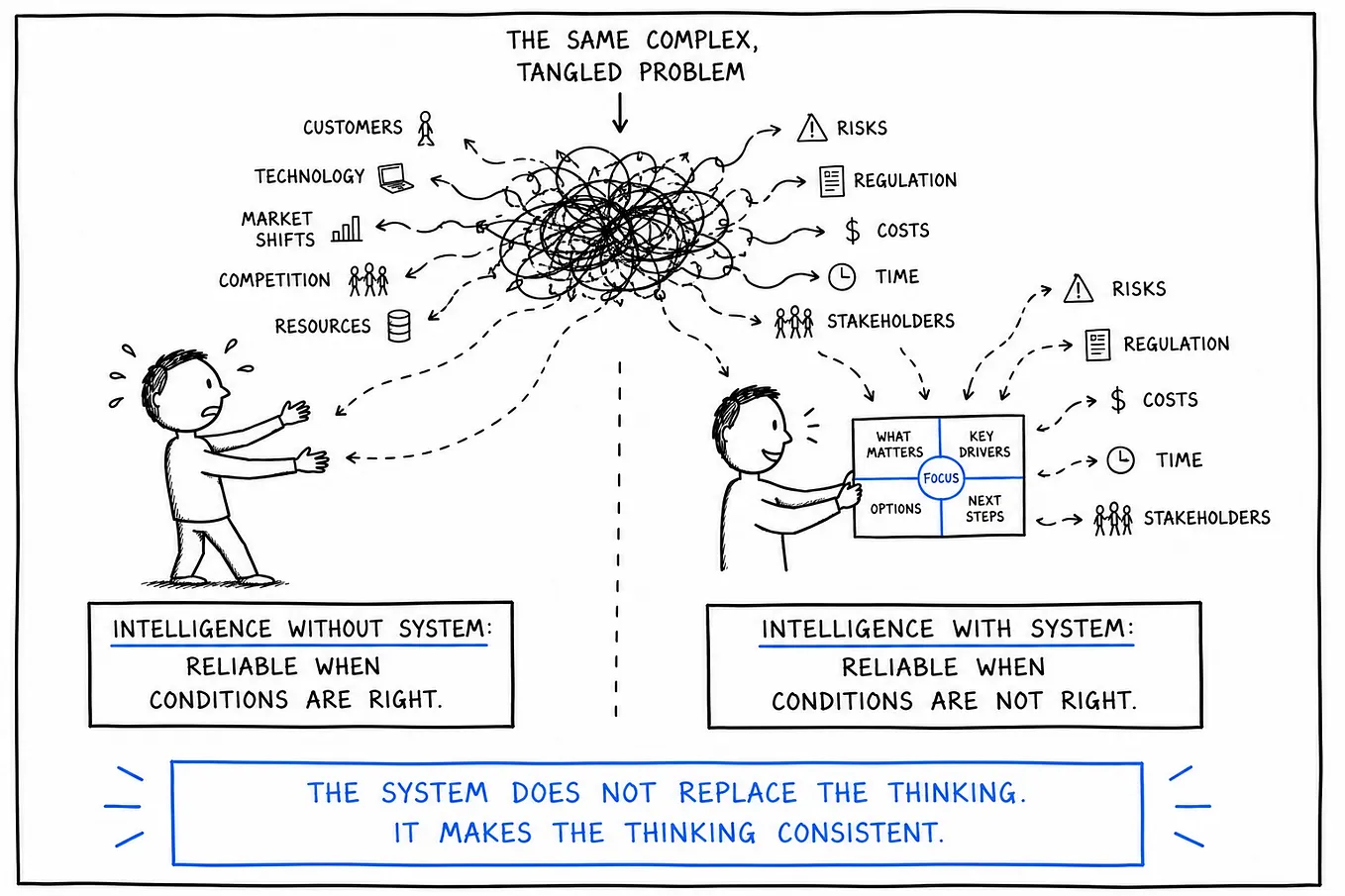
Building that kind of shared visibility is not a communication exercise. It does not happen by presenting the strategy more clearly or more frequently. It happens by creating the conditions under which people can make their mental models visible, compare them, examine the differences, and work toward a shared picture that is robust enough to guide execution without constant supervision.
That is a different kind of strategic work. It is slower at the front end and considerably faster at the back end, because execution that begins from genuine shared understanding does not produce the endless cycle of misalignment, correction, relaunch, and frustration that consumes so much organisational energy.
Visual Prompt 3 Title: Clarity before execution Hand-drawn sketchnote, black ink throughout, blue accents on key elements only, white background, rough sketch aesthetic. A horizontal timeline with three stages. Stage one: a group of figures each holding a different rough sketch above their heads, labelled “misaligned mental models.” Stage two: the same figures gathered around a single whiteboard sketch, labelled “shared picture built.” Stage three: the same figures walking in the same direction, labelled “execution from shared understanding.” Blue arrow connecting the three stages. Note beneath: “the front end investment that saves the back end.” Rough sketch aesthetic.

If this resonates with you
The ideas in this series sit at the heart of the work Sherrie Low and I explore in The S.T.A.R. System: Applying Visual Thinking for Career and Business Success, published by Marshall Cavendish Business. The book is a practical guide to using visual thinking as a structured discipline for clearer communication, stronger decisions, and more confident professional navigation. If you want to go deeper than a series of posts allows, you can find it on Amazon.
Closing reflection
When strategy fails, the instinct is to blame execution.
Sometimes that instinct is correct. But more often, in my observation, the people responsible for execution were working genuinely hard in the direction they understood the strategy to point. The problem was not their effort or their commitment. The problem was that the direction they understood was not the same direction others understood. And nobody noticed until the gap between intention and result became too wide to explain away.
Strategy succeeds when people stop carrying different pictures in their heads and begin working from the same picture together.
That is not a communication challenge. It is a visibility challenge. And it begins not at the point of execution but at the point where a leadership team is willing to make its thinking visible, compare the pictures honestly, and do the work of building genuine shared understanding before asking anyone to act on it.
When did you last test whether the people around you were working from the same strategic picture, not the same words, but the same picture?
The next post examines what it actually means to simplify without losing the substance of what matters. Coming up: “How to simplify without losing meaning.”

I am Ai Yat Goh, a visual thinking strategist and co-author of The S.T.A.R. System. I write about thinking clearly in a world full of noise. Follow me here on Medium for the rest of this series, or connect with me on LinkedIn www.linkedin.com/in/aiyatgoh
#FromNoiseToClarity #VisualThinking #Leadership #Strategy #Clarity