From Noise to Clarity | Track 14
Why Brainstorms Fail Without a Shared Picture #17
Building a Visual Thinking Organisation | Post 17 of 30. (The team)


Before you read: think of the last brainstorm you joined. How many of the ideas on the wall actually turned into something?
By four in the afternoon, the wall of the hotel conference room is covered. A team of twelve has spent the day at an off site brainstorm, and well over a hundred sticky notes are arranged in loose clusters, colourful and full of energy. Then the facilitator asks the obvious question. Which of these should we actually do? The room goes quiet. People scan the wall, unsure where to start. Eventually, a quick vote produces three favourites, someone photographs the wall, and the team heads to dinner. Within a month, none of the three has moved. A room full of good ideas still produced nothing usable, and the real reason is surprisingly simple. The ideas had nothing to attach to, because nobody had drawn the problem first.
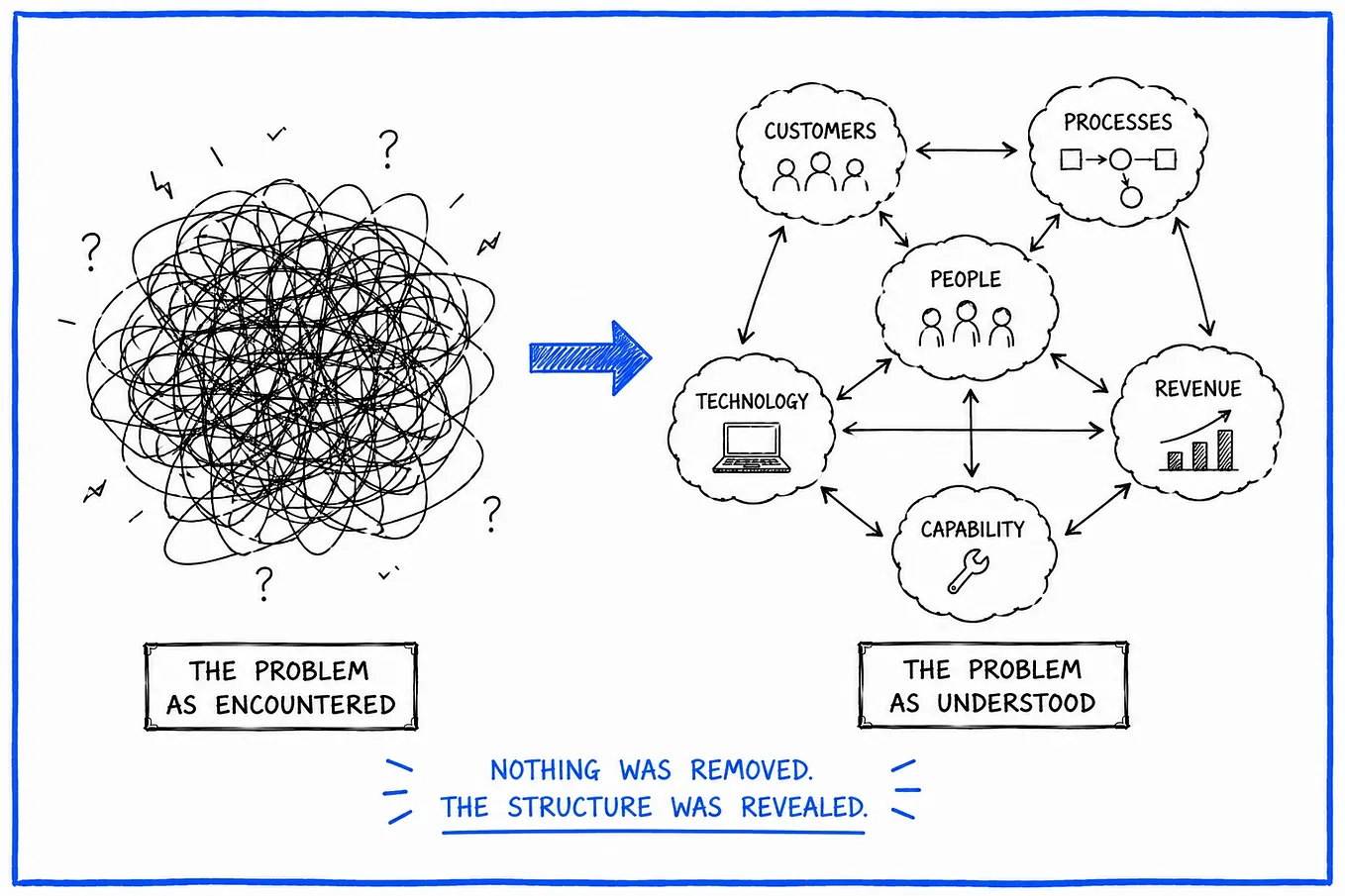
This isn’t a story about a bad facilitator or an uncreative team. The day felt productive, and in one sense it was. People contributed freely, built on each other’s suggestions and generated a genuinely interesting range of possibilities. What the day lacked wasn’t ideas. It lacked a shared picture of the situation the ideas were meant to change.
This post continues the second circle’s shift from talking together to thinking together on a shared surface. Brainstorms are a useful place to look, because they’re often a very visual part of a team’s working life, full of sticky notes and whiteboards, and they still so often fail for lack of the right picture.
Why do brainstorms produce so much and deliver so little?
A typical brainstorm begins with a question, how might we improve retention, how might we reduce costs, how might we delight customers, and then invites ideas. The question is usually a sentence on a slide or a heading on a flipchart. It points in a direction, but it doesn’t show the terrain. Everyone fills in the terrain from their own experience, so the ideas that come back are aimed at many different parts of the problem, often without anyone realising it.
That makes the ideas very hard to compare. One sticky note addresses the first week of a customer’s experience. Another addresses the moment they renew. A third addresses something internal that customers never see. All three sit side by side on the wall as if they were alternatives, when really they’re answers to different questions. When the room is finally asked to choose, it has no basis for choosing except instinct and popularity.
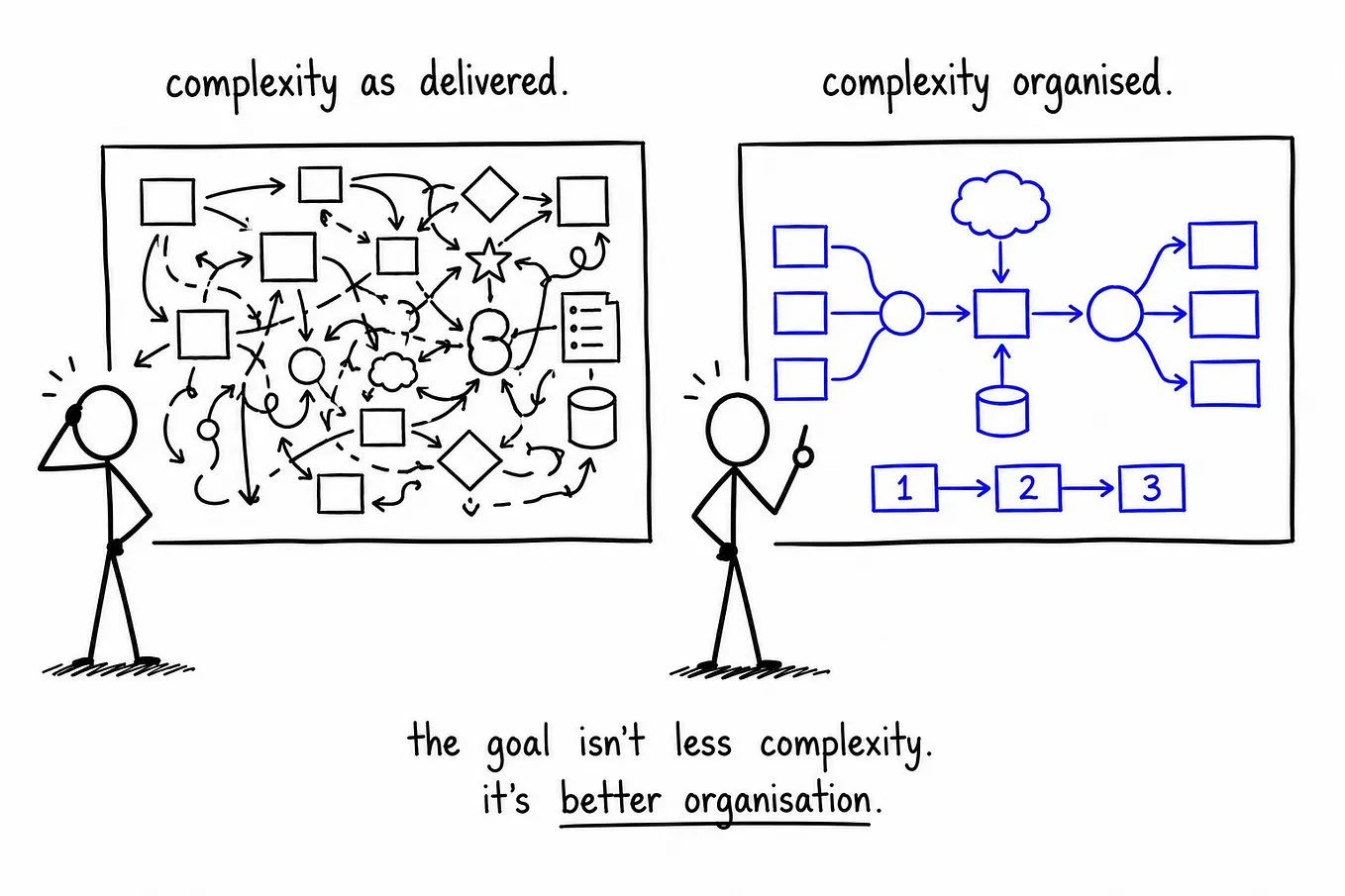
As a visual strategist, I’ve seen this pattern often enough to recognise it straight away. A wall of sticky notes looks visual, but it isn’t really a picture. It’s a list that happens to be stuck to a wall. Without a drawn problem underneath it, there’s nothing to show where each idea belongs, which ideas overlap, or where nobody has thought to look at all.
Voting makes this worse rather than better. When people are asked to choose without a picture, they tend to pick ideas that are easy to understand, pleasant to imagine or proposed by someone respected. None of those qualities says anything about whether the idea will change the problem. The vote feels fair, and it often selects the comfortable ideas rather than the useful ones.
“A wall of sticky notes looks visual, but it isn’t really a picture. It’s a list stuck to a wall.”
A client of mine runs a group of fitness studios, and she had already held one brainstorm on member retention, which produced around eighty ideas and very little change. When she planned a second session, we changed one thing. Before anyone wrote a single idea, the team drew a member’s first three months as a long line across the wall, and marked the key moments along it, joining, the first class, the first missed week, the first renewal reminder.
Then she shared a fact from her own records. Most members who left did so somewhere around the sixth week. A small circle went on the line at that point. Only then did the team start generating ideas, and each sticky note had to be placed on the line at the moment it was meant to help.
Within half an hour, the wall told a story nobody had seen in the first session. Dozens of ideas were crowded around the joining moment, welcome packs, introductory offers, a friendly first call. Almost nothing sat near the sixth week circle. The team’s creativity had been pouring into the part of the journey that wasn’t the problem. They spent the rest of the session generating ideas specifically for week six, chose three to trial, and within a couple of months the drop off at that point had eased noticeably.
What struck her was that the first brainstorm had included many of the same people, with the same knowledge, in a similar room. Nothing about their creativity had changed between sessions. The only difference was the line on the wall, and that line was what let them see where their effort had been going.

What does a shared picture give a brainstorm?
Try this: Before your next brainstorm, spend two minutes drawing the problem as a single line with four or five key moments marked on it, so every idea has a place to land.
It gives every idea an address. When the problem is drawn first, as a journey, a map, a set of bars showing how much, or a loop showing how something repeats, each idea can be placed where it acts. That single habit changes everything that follows.
Clusters become visible. When several ideas land in the same spot, you can see they’re variations on one theme, and the team can combine them rather than vote between them. Gaps become visible too. A part of the picture with no ideas near it is a part of the problem nobody has thought about yet, and that’s often exactly where valuable work lies. And comparison becomes possible, because ideas sitting at the same place on the picture really are alternatives, while ideas at different places are answers to different questions.
Get Ai Yat Goh’s stories in your inbox
Join Medium for free to get updates from this writer.
The drawing doesn’t need to be elaborate. A single line with five moments marked on it is enough. So is a rough sketch of a process, or a few bars of different heights. What matters is that the whole team agrees the picture represents the problem before anyone starts suggesting how to solve it.
“A part of the picture with no ideas near it is a part of the problem nobody has thought about yet.”
I once anonymously observed a case at an organisation where a manufacturing business held a brainstorm on reducing costs. The ideas came quickly and covered a wide range, from cutting printing and travel to renegotiating stationery contracts and switching office suppliers. The wall filled up, and the mood was positive.
Before the session ended, a finance manager in the room drew a few bars on a spare flipchart, one for each major category of spending, with the height of each bar roughly showing how much the business spent there. One bar, for energy used on the factory floor, towered over everything else. Several others, including travel and office supplies, were barely visible. Then she began moving the sticky notes onto the bars they related to.
Nearly all of them ended up crowded onto the short bars. The tall energy bar had a single note beside it. The room had spent most of the day being creative about the parts of the business that cost very little. The next session focused entirely on energy, and the savings it eventually produced were far larger than everything on the original wall combined.
The finance manager hadn’t needed new data to make that picture. Everyone in the room knew roughly where the money went. It had simply never been drawn, so the brainstorm had drifted towards the costs people saw every day at their desks, rather than the one that dwarfed them on the factory floor.

How should a team run a brainstorm differently?
Spend the first part of the session on the picture, not the ideas. Ten or fifteen minutes is usually enough to draw the problem roughly and agree that it’s a fair representation. This can feel slow to people eager to start contributing, but it’s the part that makes everything afterwards usable.
Then generate ideas as normal, with one rule. Every idea goes on the picture, at the place it’s meant to help. If someone can’t say where their idea belongs, that’s worth a short conversation. Sometimes the picture is missing something. Sometimes the idea is aimed at a different problem altogether.
It also helps to keep the picture visible for the whole session, not just at the start. People naturally drift back towards their favourite parts of the problem, and a picture on the wall gently pulls the room back to the whole of it.
“The room had spent the day being creative about the parts of the business that cost very little.”
Next, step back and look at the picture as a whole. Where are the clusters? Where are the gaps? If an important part of the problem has few or no ideas near it, run a second, shorter round aimed specifically at that spot. Finally, choose by position as well as by preference. An idea that addresses the part of the picture that really drives the outcome is usually a better bet than a popular idea aimed somewhere less important.

A note on the book that shapes this series
Turning a group’s creativity into something it can actually act on is where the Takeaway stage begins to give way to Application in The S.T.A.R. System: Applying Visual Thinking for Career & Business Success, which I co authored with Sherrie Low. Ideas only become actions once a team can see where they fit. Sherrie and I wrote the book for professionals who enjoy generating ideas and want more of those ideas to survive the walk from the workshop to the working week.
The next time your team gathers to brainstorm, resist the urge to start with the sticky notes. Draw the problem first, as a line, a map or a few bars, and agree on it together. Then let the ideas come, and give each one an address. You may well generate fewer ideas than usual. You’ll almost certainly be able to use more of them.
For the next brainstorm your team runs, what single line, map or set of bars would you draw first so every idea has an address?
Next in this series, we look at the one ritual that keeps a team thinking together, a small, repeatable habit that does more for alignment than another all hands meeting.
This idea comes from The S.T.A.R. System: Applying Visual Thinking for Career & Business Success, co authored by Ai Yat Goh and Sherrie Low, published by Marshall Cavendish Business. If helping your team turn ideas into action is useful to you, the book goes further into applying visual thinking across career and business decisions. Get it on Amazon.
Ai Yat Goh is a Visual Thinking Strategist, educator and entrepreneur based in Singapore, and Asia’s first Master Trainer for Dan Roam’s Power of Visual Series. She works with professionals, teams and organisations navigating a pivot, helping people see clearly before they act. Connect on LinkedIn or read more on Medium.
#FromNoiseToClarity #VisualThinking #Brainstorming #Innovation #Teamwork
BK HAN Candy Chan RH Malini Lawrence Lee Jessica Leong PUN Kai Loon Bernard Koh Joelynn Koh