Why Web Scrapers Fail: The Complete Debugging and Error Handling Guide


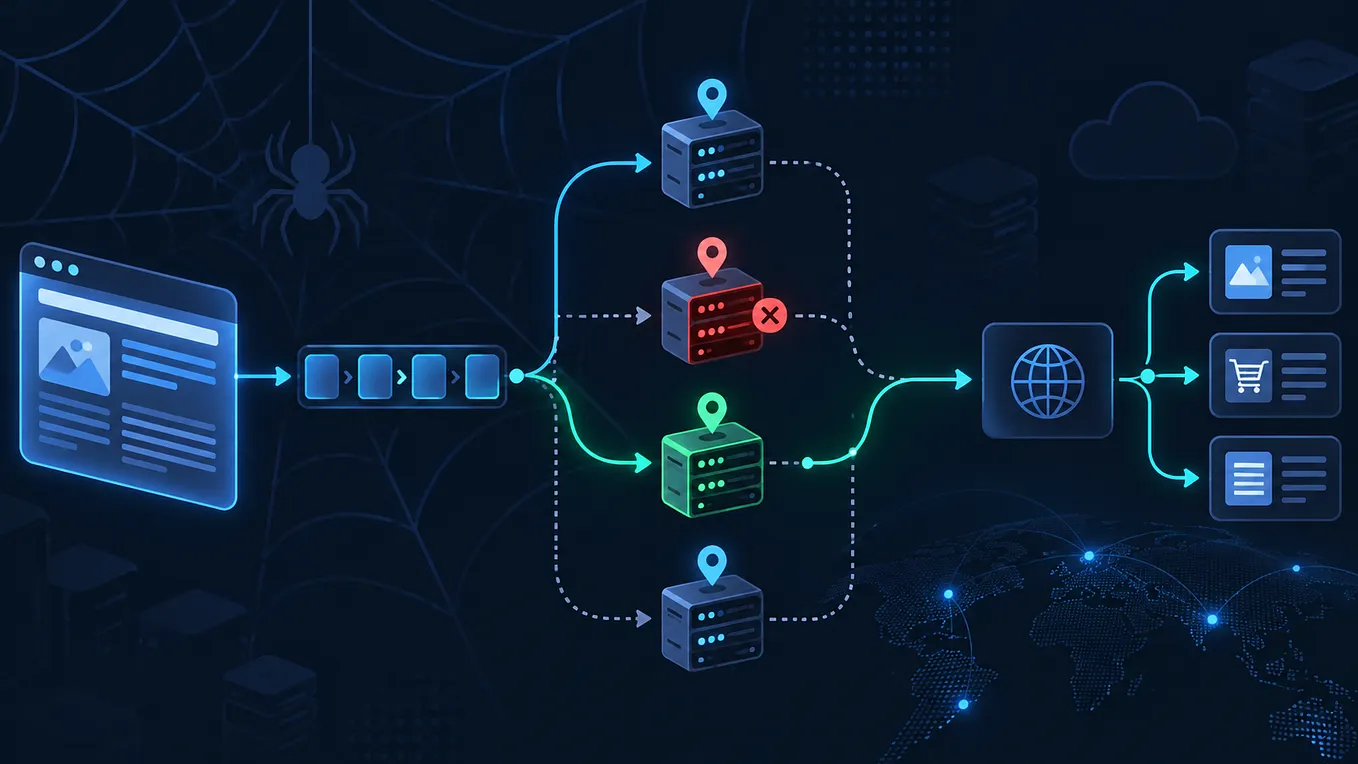
Automated bot traffic crossed 57.5% of all open web requests by mid-2026, prompting edge security vendors to aggressively deploy upstream detection algorithms. As targets deploy layered Web Application Firewalls (WAFs) and sophisticated bot management systems, traditional workarounds like swapping user agents or relying on a basic web scraping proxy consistently fail. Custom scraping infrastructure now costs engineering teams 15 to 25 hours per week in maintenance, absorbing up to 40% of available data engineering bandwidth, according to PromptCloud’s 2026 TCO Analysis. This guide provides a comprehensive technical framework for diagnosing why production scrapers break and how to implement resilient, self-healing pipelines.
What is the “Silent Empty” Threat in Web Scraping?
The “silent empty” threat refers to scraper failures where the target server returns a successful HTTP 200 OK status, but the payload contains no usable data. This is the most dangerous failure mode in production web scraping because it entirely bypasses traditional error logging and HTTP status monitoring.
According to an analysis of over 15,000 browser automation runs by DEV Community Research, implicit structural drift (such as Cannot read properties of undefined) outnumbers explicit selector failures by a ratio of 35 to 1. On platforms heavily protected by anti-bot measures, up to 50% of scraping runs can return HTTP 200 OK with zero extracted rows. This happens when an anti-bot system serves a challenge page, a dummy HTML layout, or when the underlying DOM structure subtly shifts, poisoning downstream databases with null values without ever triggering an alert.
Why Do Production Scrapers Break?
Modern web scrapers fail due to a variety of vectors that span the OSI model, ranging from low-level transport handshakes to high-level semantic DOM rendering.
How Does TLS and JA4 Fingerprinting Block Scrapers?
When an HTTP client establishes an HTTPS connection, it broadcasts a ClientHello packet that lists supported TLS versions, cipher suites, extensions, and signature algorithms. The modern standard for hashing these sequences is JA4, which normalizes and sorts values before hashing to counteract browser extension shuffling.
Standard Python libraries like requests and urllib3, or Node.js libraries like axios, use system-level OpenSSL bindings. These bindings emit TLS signatures that are fundamentally distinct from those of a modern Chrome or Firefox browser. As a result, scrapers using clean residential IPs and correct user agents still fail with an instant 403 Forbidden because their JA4 fingerprint advertises an unmasked scripting library to the WAF, as detailed by Datacelix.
Why Do Protocol and HTTP/2 Frames Trigger Anomalies?
CDNs such as Akamai and Cloudflare deeply inspect HTTP/2 connection parameters. They validate the order of SETTINGS frames, window update sizes, and the casing of header pseudo-elements (:method, :authority, :scheme, :path). Faking a Chrome User-Agent while sending headers in an alphabetical or Python-default order immediately triggers an anomaly veto at the CDN edge, blocking the scraper before the application layer even receives the request.
What Are Soft Blocks and Silent IP Bans?
Sophisticated anti-bot engines frequently avoid issuing hard 403 Forbidden or 429 Too Many Requests status codes. Instead, they return an HTTP 200 OK containing a challenge payload or dummy data. Key detection signatures include:
- Cloudflare: Headers like
cf-ray,cf-mitigated, and cookies such ascf_clearanceorchallenge.js. - Akamai: The
_abckcookie andakamai-grnheaders, which silently categorize visitors before blocking them (ScrapeBadger). - DataDome & Kasada: Injected script tags (
tags.js) or specific SDK tracking headers (x-kpsdk-ct).
How Do AI Labyrinths and Honeypots Trap Scrapers?
Honeypots use CSS rules (like display: none; or position: absolute; left: -9999px;) to hide links from human visitors while remaining visible to bot crawlers. When scrapers traverse these hidden URLs, they trigger instant subnet-wide IP bans.
Taking this a step further in 2026, Cloudflare introduced AI Labyrinth, an active defense system that serves dynamic, LLM-generated HTML pages populated with infinite synthetic sub-links. Scrapers that lack behavioral validation get trapped in these recursive crawls, draining proxy security bandwidth and CPU cycles without extracting any valid production records.
Why Do DOM Mutations Cause Data Loss?
Modern frontend frameworks like React, Next.js, and Vue compile class names into dynamic hashes (e.g., .css-1r8k2xa-productTitle) that shift with every single build deployment. Scrapers that rely on brittle, hard-coded CSS selectors fail silently during these deployments, leading to schema drift where the scraper runs successfully but fails to capture the target fields.
How to Diagnose Web Scraping Errors
Before rewriting extraction rules or swapping proxies, engineers must execute a systematic diagnostic triage to isolate the exact layer of failure.
Get Amit kumar’s stories in your inbox
Join Medium for free to get updates from this writer.
Symptom Error Layer Root Cause Immediate Diagnostic Action Instant 403 Forbidden (<200ms) TLS / Protocol JA4, Cipher, or HTTP/2 frame mismatch Test the request using curl_cffi or inspect the ClientHello via packet capture to verify proxy security parameters. 403 after HTML loads JavaScript / Client navigator.webdriver = true or WebGL challenge failure Inspect the headless browser fingerprint and ensure automation flags are stripped. 429 Too Many Requests Network / Rate IP rate limit or request concurrency exceeded Implement exponential backoff and rotate traffic through an intelligent scraper proxy. 200 OK with empty body Soft Ban / Anti-Bot Challenge served as 200, or dynamic layout shift Inspect response.text for signature cookies (e.g., _abck, cf_clearance). Infinite redirect loop Content Layer Honeypot or AI Labyrinth trap Inspect links for hidden CSS selectors and filter out non-canonical URL structures. Cannot read property... Semantic DOM Layer Selector rot or schema drift Implement schema validation contracts (e.g., Pydantic) and fallback selectors.
How to Implement Resilient Scraping Workflows
To combat modern anti-bot systems, data pipelines must integrate transport-layer impersonation, intelligent retry logic, and strict schema validation.
Python Pipeline: JA4 Impersonation and Schema Validation
In modern web scraping, an HTTP 403 Forbidden is rarely an IP block; it is almost always a fingerprint mismatch. Using curl_cffi allows you to spoof modern browser TLS signatures, while Pydantic ensures your data structure hasn't silently mutated.
import time
import random
import logging
from curl_cffi import requests
from pydantic import BaseModel, Field, ValidationError
logging.basicConfig(level=logging.INFO, format="%(asctime)s [%(levelname)s] %(message)s")
logger = logging.getLogger("ProductionScraper")class ProductItem(BaseModel):
title: str = Field(min_length=1)
price: float = Field(gt=0.0)
sku: str = Field(min_length=1)class ScrapingEngine:
ANTI_BOT_SIGNATURES = [
"cf-browser-verification",
"challenge-platform",
"_abck",
"datadome",
"Just a moment...",
] def __init__(self, max_retries: int = 5, base_delay: float = 1.0):
self.max_retries = max_retries
self.base_delay = base_delay def _is_soft_ban(self, html_content: str) -> bool:
for signature in self.ANTI_BOT_SIGNATURES:
if signature in html_content:
return True
return False def fetch_with_resilience(self, url: str, proxy: str = None) -> str:
attempt = 0
while attempt < self.max_retries:
attempt += 1
try:
# Impersonate modern Chrome JA4 and HTTP/2 behavior
response = requests.get(
url,
impersonate="chrome124",
proxies={"http": proxy, "https": proxy} if proxy else None,
timeout=15,
headers={
"Accept-Language": "en-US,en;q=0.9",
"Sec-Fetch-Dest": "document",
}
) if response.status_code in [403, 429, 500, 502, 503]:
logger.warning(f"HTTP {response.status_code} on attempt {attempt}.")
elif response.status_code == 200:
if self._is_soft_ban(response.text):
logger.warning(f"Soft ban challenge detected on attempt {attempt}.")
else:
return response.text
else:
logger.error(f"Unrecoverable HTTP {response.status_code} on {url}.")
break except Exception as exc:
logger.warning(f"Network exception on attempt {attempt}: {str(exc)}") sleep_duration = self.base_delay * (2 ** (attempt - 1)) + random.uniform(0.1, 1.0)
time.sleep(sleep_duration) raise RuntimeError(f"Failed to fetch {url} after {self.max_retries} attempts.") def parse_and_validate(self, raw_data: dict) -> ProductItem:
try:
return ProductItem(**raw_data)
except ValidationError as err:
logger.error(f"Schema Drift Alert: Extraction structure altered! {err}")
raise
Node.js Pipeline: Playwright Circuit Breakers and Fallbacks
When running headless browsers, you must actively override automation signals like navigator.webdriver and gracefully handle DOM drift through multi-selector fallback chains.
const { chromium } = require('playwright');async function scrapeWithResilience(url, proxyServer) {
const browser = await chromium.launch({
headless: true,
proxy: proxyServer ? { server: proxyServer } : undefined,
args: ['--no-sandbox', '--disable-blink-features=AutomationControlled'],
}); const context = await browser.newContext({
userAgent: 'Mozilla/5.0 (Windows NT 10.0; Win64; x64) AppleWebKit/537.36 (KHTML, like Gecko) Chrome/126.0.0.0 Safari/537.36',
}); // Strip automation signals
await context.addInitScript(() => {
Object.defineProperty(navigator, 'webdriver', { get: () => undefined });
}); const page = await context.newPage(); try {
await page.goto(url, { waitUntil: 'domcontentloaded', timeout: 30000 }); // Honeypot Filter: Ignore links hidden via CSS
const safeLinks = await page.$$eval('a', anchors =>
anchors.filter(a => {
const style = window.getComputedStyle(a);
return style.display !== 'none' && style.visibility !== 'hidden' && a.offsetHeight > 0;
}).map(a => a.href)
); // Multi-Selector Fallback Strategy for DOM Drift Resilience
const title = await page.evaluate(() => {
const selectors = ['h1.product-title', 'h1[data-testid="product-name"]', 'meta[property="og:title"]'];
for (const selector of selectors) {
const el = document.querySelector(selector);
if (el) return el.tagName === 'META' ? el.getAttribute('content') : el.innerText.trim();
}
return null;
}); if (!title) throw new Error('Structural Drift: Title selector returned null.');
return { title, safeLinksCount: safeLinks.length };
} finally {
await browser.close();
}
}
How ScrapeOps Eliminates the DIY Failure Cycle
Building custom retry loops, balancing proxy health, engineering JA4 spoofers, and maintaining DOM validation scripts traps data teams in an expensive maintenance loop. According to FourA’s benchmark research, engineering teams operating DIY scrapers spend up to 40% of their bandwidth reacting to blockades and selector rot.
ScrapeOps shifts this operational burden to a dedicated web data infrastructure layer. Instead of struggling with complex proxy software integration, teams can rely on the ScrapeOps Proxy API Aggregator, which actively handles the heavy lifting:
- Intelligent Proxy Routing: The platform automatically balances requests across datacenter, residential, and mobile networks. It defaults to lower-cost datacenter IPs and automatically escalates to premium residential routing only when WAF hurdles demand it.
- Automated Response Validation: Rather than paying for failed runs or empty data blocks, the built-in validation engine pre-screens HTTP responses for CAPTCHAs, bot challenges, and soft bans. Users are only billed for validated, successful responses (valid
200and404status codes). - Turnkey Telemetry: The ScrapeOps Scrapy SDK and Python Requests middleware provide zero-config observability. By tracking request volume, extraction drops, and structural drift in real-time, engineering teams can detect and fix “silent empty” runs before they poison upstream data models.
Conclusion
Diagnosing web scraper failures requires a shift in perspective. Moving away from assuming all 403 errors are simple IP bans and recognizing the impact of TLS fingerprinting, protocol-layer scrutiny, and semantic DOM mutations is the only way to build reliable pipelines in 2026.
While a free proxy scraper might suffice for hobbyists testing local scripts, scaling production operations demands professional infrastructure. By combining robust transport-layer evasion, defensive schema validation, and specialized infrastructure like ScrapeOps, organizations can drastically reduce their weekly maintenance churn and guarantee the integrity of their data extraction efforts.