You Cannot Truly Know Someone Whose Name You Do Not Know — Including Allah

Why the 99 Names of Allah are not a list to memorize but a relationship to enter — and the complete resource that makes that possible
There is a difference between knowing about someone and knowing them.
You can know about a great leader — their decisions, their history, their impact on the world — without ever knowing them personally. You can know their policies without knowing their character. Their public acts without their private nature. The shape of their influence without the texture of who they actually are.
Knowing someone is different. It requires time, presence, attention — and crucially, it requires knowing their name. Not just the name the world calls them by, but the names that reveal who they are: what they care about, how they respond, what they offer, what they withhold, what they value, what they are like when no one is watching.
This distinction — knowing about versus truly knowing — is the most important frame for understanding what the 99 Names of Allah actually are, and why they are not a list to check off but a journey to enter.
“To Allah Belong the Most Beautiful Names — So Call Upon Him By Them”
Allah says in the Quran (7:180):
“And to Allah belong the Most Beautiful Names, so call upon Him by them, and leave alone those who deviate concerning His Names.”
The command is not: “know about the Names.” It is: “call upon Him by them.”
This is an instruction for relationship, not scholarship. Allah is telling the believer: use these Names when you address Me. When you come to Me with fear, come to Me as Al-Rahim — the Especially Merciful. When you come to Me broken, come to Me as Al-Jabbar — the Restorer, the One who sets broken things right. When you come to Me not knowing what to do, come to Me as Al-Hakim — the Perfectly Wise. When you come to Me at the end of your resources, come to Me as Al-Ghani — the Self-Sufficient, the One who has never run out of anything.
The Names are not descriptions of a distant deity. They are the access points of a relationship — the specific names by which you find the specific aspect of Allah you most need in any specific moment.
And the Prophet ﷺ gave this an extraordinary weight. In the hadith narrated by Abu Hurairah:
“Allah has ninety-nine Names — one hundred minus one — and whoever ahsaha will enter Paradise.” (Bukhari, 2736; Muslim, 2677)
The word the Prophet ﷺ used — ahsaha (أَحْصَاهَا) — is from the root ihsa’, which means to count, to comprehend, to enumerate with full understanding. The scholars of hadith have explained that this is not mere memorization of a list. It is to know the Names, understand their meanings, reflect on their implications, and live in relationship with what each Name reveals.
Whoever does this will enter Paradise.
Not whoever prays the most. Not whoever fasts the most. Whoever truly comprehends the Names of Allah.
The Names Are Not Synonyms — Each One Opens a Different Door
The first mistake most Muslims make when encountering the 99 Names is treating them as interchangeable — as if they are 99 ways of saying “Allah is good.” They are not. Each Name reveals a distinct attribute, a specific facet of the divine reality, a different dimension of Who Allah is. And the differences between apparently similar Names carry profound theological weight.
Ar-Rahman (الرَّحْمَن) and Ar-Rahim (الرَّحِيم) — both derived from the root rahma (mercy), both often translated “the Merciful.” But they are not the same.
Ar-Rahman is Allah’s vast, all-encompassing mercy — the mercy that extends to all of creation in this world, Muslim and non-Muslim, believer and disbeliever, human and animal. It is the mercy of rain falling on the righteous and the wicked alike. The mercy of the sun rising on everyone without distinction. The scholars say Ar-Rahman is more intensive in its grammar — a superlative of mercy that is almost incomprehensible in its scope.
Ar-Rahim is Allah’s specific, sustained, intimate mercy — the mercy directed especially toward the believers, reserved for them in the hereafter. It is relational and particular in a way that Ar-Rahman is not. The mercy of a Parent to a child — not the mercy of rain to the earth, but the mercy of sustained, intentional, personal care.
Both Names are recited in Al-Fatihah — which opens every prayer: “Bismillahi Ar-Rahmani Ar-Rahim.” The Surah begins with the universal (Ar-Rahman) and narrows to the particular (Ar-Rahim) — encompassing all of creation before drawing the believer into the specific, sustained mercy that is theirs.
This is theology at the density of two words.
Al-Awwal (الأَوَّل) and Al-Akhir (الآخِر), Al-Zahir (الظَّاهِر) and Al-Batin (البَاطِن) — four Names often listed together, and for good reason. They appear together in the Quran (57:3):
“He is the First and the Last, the Apparent and the Hidden, and He is of all things Knowing.”
These four Names describe the totality of existence from four perspectives:
Al-Awwal — The First. Before everything that exists, there was Allah. Before time, before space, before the universe, before angels, before the very concept of “before” — Allah existed. There is nothing that preceded Him.
Al-Akhir — The Last. After everything ends — after this universe, after time itself dissolves, after the Day of Judgment, after Paradise and Hell are established — Allah remains. He is the only constant across the entire arc of existence.
Get Aryanarya’s stories in your inbox
Join Medium for free to get updates from this writer.
Al-Zahir — The Manifest. Allah is evident in His creation — in the complexity of a cell, in the precision of an orbit, in the beauty of a face, in the miracle of consciousness. His signs (ayat) are everywhere. He is not hidden from those who look.
Al-Batin — The Hidden. And yet Allah Himself is beyond the created things that manifest Him. He is not any of His creation. He is not visible to human eyes in this world. He is the Hidden reality behind the manifest world — present everywhere but not identical to anything.
Together these four Names say: Allah encompasses every dimension of reality. There is no “before” without Him, no “after” without Him, no “apparent” world without Him, no hidden depth beyond Him. He is the totality within which all of existence occurs.
Ten Names That Change How You See Everything
Among the 99 Beautiful Names — each deserving its own chapter — here are ten that carry particular transformative weight when understood rather than merely recited:
Al-Ghaffar (الغَفَّار) — The Repeatedly Forgiving. The grammatical form ghaffar (not simply ghafir — one who forgives) indicates repetition and intensity. Not “He forgave once.” He forgives again and again and again. Every time you return. Every time. The Prophet ﷺ said that if believers did not sin, Allah would create a people who would sin so that He could forgive them — so beloved to Him is the attribute of forgiveness. (Muslim, 2748) Al-Ghaffar is the Name for the Muslim who feels they have asked too many times already.
Al-Fattah (الفَتَّاح) — The Opener. The One who opens what is closed — closed doors, closed hearts, closed situations, closed futures. Al-Fattah is the Name for the moment when you have exhausted every option, tried every approach, and the way forward is still sealed. You are not addressing a deity who is watching from a distance. You are calling on the One whose attribute is specifically: opening what is closed.
Al-Razzaq (الرَّزَّاق) — The Provider, the Continual Sustainer. Every breath of air, every heartbeat, every piece of food, every moment of health, every resource that has ever reached you — all of it is from Al-Razzaq. The grammatical intensity (razzaq, not simply raziq) indicates continuous, abundant, ongoing provision. Not “He provided once.” He provides without interruption, without exhaustion, without limit. This is the Name for financial anxiety. For the fear that there is not enough. For the moment when provision feels uncertain.
Al-Mujeeb (المُجِيب) — The Responsive, the One Who Answers. This Name is specifically about Dua. Al-Mujeeb is the One who responds — not “might respond,” not “responds to worthy requests,” but the One whose very attribute is response. The Quran uses this Name in the context of Dua explicitly: “Indeed, my Lord is Near and Responsive.” (11:61). When you make Dua and the answer does not come in the form or timing you expected, the Name to hold is Al-Mujeeb — not a Name that promises the specific outcome, but a Name that promises you were heard.
As-Sabur (الصَّبُور) — The Patient, the Endlessly Forbearing. This is among the last of the 99 Names in traditional lists, and among the least commonly discussed — but perhaps the most profound. Allah is Himself Patient. He watches every sin, every ingratitude, every moment of forgetfulness — and He waits. He does not punish immediately. He does not respond to every transgression in real time. His forbearance is infinite. The implication for the believer: the One you have wronged by your sins is As-Sabur — and His patience with you is not exhaustion but mercy.
Al-Wadud (الوَدُود) — The Loving, the Affectionate. This Name does not appear as often in popular discussions as Ar-Rahman — but it is theologically extraordinary. Wudd in Arabic is not the generic word for love. It is warm, intimate, tender affection — the love that finds joy in the beloved. Allah loves His believing servants with wudd. Not merely the love of a Creator for creation. The affectionate, personal, particular love of Al-Wadud — the One who loves.
Al-Qareeb (القَرِيب) — The Near. The Quran says: “And when My servants ask you about Me — indeed I am Near.” (2:186). Not “tell them I hear them.” Not “tell them I exist.” I am Near. The Name Al-Qareeb is among the most personally comforting in the entire 99 — the antidote to the spiritual experience of distance, of prayer feeling like it is going nowhere, of worship feeling hollow. You are not addressing a far-off deity. You are speaking to Al-Qareeb.
Al-Muhyi (المُحْيِي) — The Giver of Life, the Reviver. This Name extends beyond biological life. The scholars note that Al-Muhyi revives hearts — turning a dead, hardened heart back to feeling, to faith, to connection with Allah. For the Muslim who feels spiritually dead — who prays without feeling, fasts without presence, goes through the motions of Islamic practice without inner life — the Name to call upon is Al-Muhyi. The One whose attribute is specifically to revive.
Al-Latif (اللَّطِيف) — The Subtle, the Gentle, the Knower of Subtleties. Latif carries a double meaning in Arabic: subtle (imperceptible in His workings) and gentle (in the way He works). Al-Latif is the Name for the blessings you did not notice until later — the door that closed that protected you from something worse, the delay that placed you exactly where you needed to be, the gift that came disguised as loss. His gentleness works beneath the surface of events.
Al-Malik (المَلِك) — The King, the Sovereign. The absolute, ultimate, unchallengeable sovereignty of Allah over all of existence. In the Quran, the Day of Judgment is described as “the Day when they will [all] come forth and nothing concerning them will be concealed from Allah. Whose is the kingdom this Day? It is Allah’s, the One, the Prevailing.” (40:16). Whatever power any king, government, corporation, or institution holds in this world is borrowed, contingent, and temporary. Al-Malik’s sovereignty is absolute and eternal.
What Quranbookk’s 99 Names of Allah Provides
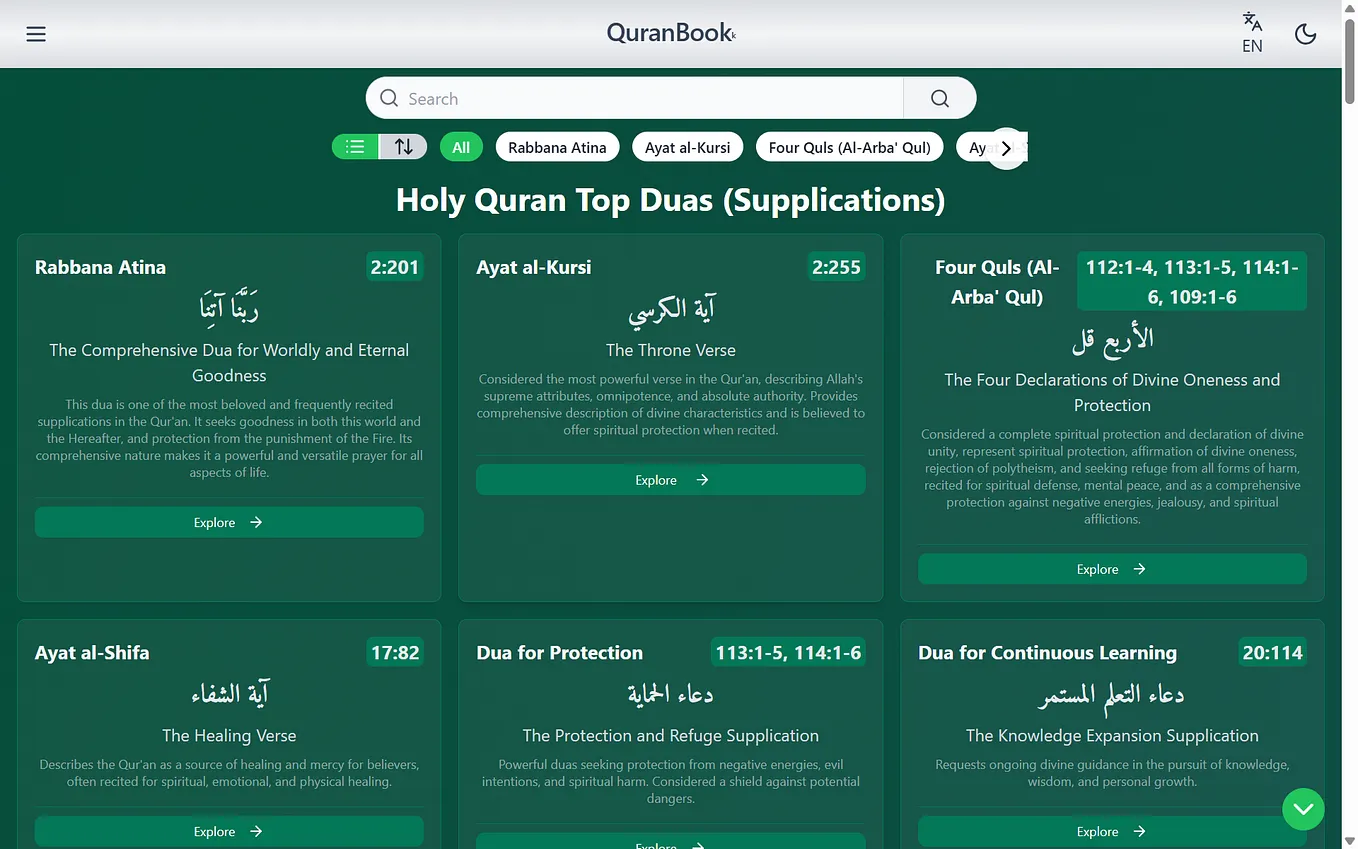
quranbookk.com/99-names-of-allah was built to serve the journey of knowing these Names — not just listing them:
All 99 Names with authentic Arabic text. Every Name precisely as it appears in the Quran and Hadith, with full diacritical marks for correct reading and recitation.
Audio pronunciation for every Name. Because the Arabic of the Asma ul Husna carries its own spiritual dimension — hearing Al-Latif or Al-Wadud spoken correctly is different from reading its transliteration. The audio removes the barrier of Arabic pronunciation for non-Arabic speakers, making each Name fully accessible.
Meanings, transliterations, and explanations. Not a bare translation — the kind of shallow rendering that turns Al-Fattah into “The Opener” without conveying what “opening” means in the divine context. The meanings and explanations at Quranbookk go deeper — giving the Name its proper weight.
Part of the complete Islamic platform. The 99 Names exist alongside the full Quran, Quranic Duas, Digital Tasbih, prayer times, Qibla direction, Hijri calendar, and Islamic AI — so that your engagement with the Names exists within a complete Islamic context, not as an isolated list.
No account. No download. Any browser.
Ramadan — The Month to Begin Knowing Allah
The Prophet ﷺ said: “Whoever knows themselves knows their Lord.” The inverse is also true: whoever truly knows their Lord knows who they are and why they are here.
The 99 Names of Allah are 99 doors into that knowing. Each one reveals something about the Creator that the previous did not. Each one repositions the believer in their relationship with Allah — giving them not just information about the divine, but a language with which to address Him, call upon Him, and understand why they can trust Him completely.
Ramadan is the month in which Allah’s Name Ar-Rahman fills every Iftar table, every Tarawih row, every moment of Suhoor in the dark. It is the month when Al-Ghaffar is most actively sought. When Al-Mujeeb is most called upon. When Al-Qareeb is most felt.
Start with one Name. Really start — not read the translation and move on, but sit with it. Say it. Learn to pronounce it correctly with the audio. Understand what it means for your specific life right now. Ask yourself: when do I need Al-Fattah? When do I need As-Sabur? When do I need Al-Latif most — and can I recognize His subtle working when it comes?
Ninety-nine doors. One relationship. A lifetime to enter it.
Quranbookk.com is a free, comprehensive Islamic platform offering the 99 Names of Allah with Arabic text, audio, meanings, and transliteration — alongside Quran audio and video, digital Mushaf, Islamic AI, prayer times, Qibla direction, Hijri calendar, and more. No download or account required.
Tags: Islam · 99 Names of Allah · Asmaul Husna · Ramadan 2026 · Muslim · Allah · Islamic Theology · Divine Names · Islamic Spirituality · Asma ul Husna · Know Allah · Islamic Tools