The Role of Blockchain in Modern Secure Mobile App Development


Why Blockchain Is Showing Up in Mobile App Security Conversations
Back in 2023, a fintech client of an agency I worked with lost a chunk of user trust. Not from a hack. From a data mismatch between their backend and a third-party KYC vendor. No breach happened, but it showed everyone how fragile centralized data trails really are. That single incident is a good example of why teams keep bringing blockchain into security conversations for identity, transactions, and audit logs.
Here’s the thing, though. Almost nobody is building these systems natively for each platform anymore. Budgets just don’t stretch that far. Most teams are working with cross platform mobile application development services so they can ship one blockchain-integrated codebase for iOS and Android instead of writing the cryptographic logic twice.
Get Edward Marshall’s stories in your inbox
Join Medium for free to get updates from this writer.
Key takeaways before you keep reading:
- Blockchain adds a tamper-evident trail. It doesn’t make your app “unhackable.”
- Wallet key management is the actual hard problem. The ledger is the easy part.
- Cross platform frameworks now support Web3 libraries well enough to build on.
- Gas costs and latency still rule out on chain calls for a lot of everyday features.
Decentralized Identity as the Entry Point
Most teams don’t start with payments. They start with identity. Decentralized identity, or DID, lets an app check a user’s credentials against a blockchain record instead of trusting one company’s database. That matters a lot for healthcare or financial apps, where one breach used to mean everyone’s data got exposed at once. Standards like W3C’s decentralized identifier spec let users hold verifiable credentials in a wallet and show proof of something without handing over the raw document. That’s a real shift in how trust works, not just OAuth with a new coat of paint.
Smart Contracts as Business Logic, Not Just Payments
People hear “smart contract” and think crypto trading. In practice, teams use them as rules that can’t be quietly overridden by an admin. Think of a loyalty program nobody can manually tamper with, or an escrow flow inside a marketplace app. The logic sits outside your own server, so the “someone on the inside changed the database” risk mostly disappears. But there’s a cost. Once a contract goes live, bugs are expensive and slow to fix. Audit cycles before launch take longer than a normal sprint, and there’s no shortcut around that.
On Chain vs Off Chain Data Splitting
Almost no app puts everything on chain. Storage costs too much and transactions move too slowly for that to make sense. What actually works is keeping hashes or proofs on chain while the real payloads, things like images, documents, or personal data, sit off chain in encrypted storage, whether that’s IPFS or a regular cloud bucket. This is where I see the most architecture mistakes. Teams either decentralize things that don’t need it, or they assume the blockchain layer protects the off-chain half too, when it doesn’t touch it at all.
Wallet and Key Management in Practice
This part separates products that actually work from ones sitting at two stars in the app store six months after launch. Lose your private key, and there’s no recovery flow waiting for you. No “forgot password” link. That’s the design, not a bug. Most production apps now build in social recovery or MPC wallets to soften that risk. The Ethereum Foundation’s documentation on account abstraction explains how newer wallet standards let you build programmable recovery without handing custody back to one central party. On our own projects, adding MPC wallet SDKs added around three to four weeks to the timeline, mostly spent testing recovery edge cases nobody wants to think about until it’s too late.
Latency, Gas Fees, and UX Tradeoffs
Blockchain calls are slow compared to a normal API. A confirmed transaction on Ethereum mainnet can take anywhere from 15 seconds to several minutes depending on network congestion, and gas fees swing around unpredictably. Teams work around this by using layer 2 networks like Polygon or Arbitrum, or by batching writes that don’t need to happen instantly. Here’s the mistake I keep seeing, though. Someone designs the UI as confirmation happens right away, then scrambles to add loading states late in the build once QA flags the gap between what the screen shows and what’s actually happening on chain.
Choosing an Architecture: Public, Permissioned, or Hybrid Ledger

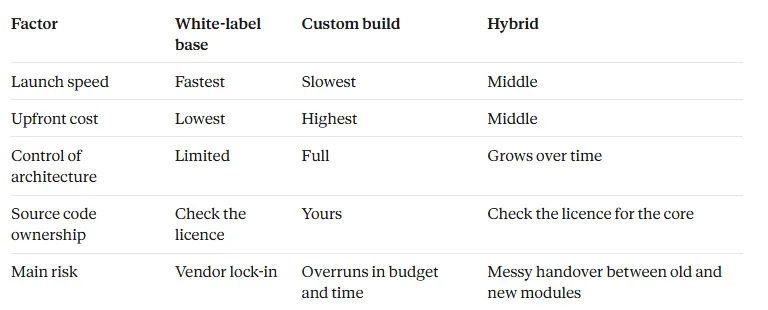
Most consumer-facing apps end up in that hybrid row. Public verifiability where it actually matters, permissioned speed for everything else. Nobody serious picks a pure public chain unless the product is crypto native from day one.
Common Pitfalls and Quick Answers
Treating blockchain like a security fix-all. It protects data integrity, not your API endpoints or your app’s actual code.
Skipping the smart contract audit to hit a launch date. This is where most exploited apps get burned.
Underestimating how much friction wallets add for users who’ve never touched crypto before. Retention drops fast.
Does blockchain slow the whole app down? No. Only the specific on-chain actions, and only if you didn’t isolate them properly in the architecture.
Final Thoughts on Picking the Right Partner for Hybrid, Blockchain Ready Apps
Adding blockchain doesn’t change what good mobile engineering looks like. It just adds a layer that needs real thought instead of getting bolted on at the end. That’s why teams comparing vendors for this kind of build usually start by looking at established Hybrid mobile app development companies, checking who actually has production experience with wallet SDKs and layer 2 integrations rather than just claiming it on a landing page. The real question isn’t which chain a team picks. It’s whether they’ve shipped a key recovery flow that survives what real users actually do with it.