I Awoke to a Nightmare, and Radioactive Decay Was My Lifeline

On free will, the authenticity of contemplation, and freedom at the foundations of reality
1. The Nightmare
This morning, I awoke to a nightmare.
Not the kind that ends when one opens one’s eyes, but one that begins when the implications of an idea become impossible to ignore.
What if there is no free will?
Not merely no freedom to choose between one action and another, but no genuine freedom to think, question, criticise, discover or contemplate anything at all?
What if contemplative reality itself is a charade?
I had considered the problem of free will before, as most people interested in philosophy eventually do. But something about the question appeared different this morning.
I was no longer contemplating whether my decisions were influenced by preceding events, biological mechanisms, inherited dispositions or environmental circumstances. None of those possibilities particularly disturbed me. We are plainly conditioned by the world in which we exist.
The more troubling possibility was that every thought I had ever entertained, every argument I had ever criticised, every discovery I had ever celebrated and every conviction I had ever reconsidered might have been the inevitable outcome of a sequence that could never have unfolded otherwise.
Even my recognition of this predicament would have been predetermined.
And so would my resistance to it.
I found myself confronting a peculiar paradox:
I am compelled to believe that I have free will, whether I possess it or not.
But the paradox concealed something more disturbing.
If my belief in free will were itself predetermined, then my attempts to establish whether I possessed free will would also be predetermined. I would be compelled to ask the question, compelled to follow whichever arguments I happened to find persuasive, and compelled to arrive at whichever conclusion the preceding history of the universe necessitated.
The appearance of intellectual exploration would remain.
But what of its ontological genuineness?
That was the nightmare.
2. The Charade of Contemplative Reality
The usual discussion of free will concerns human behaviour.
Could I have chosen differently? Was my decision genuinely mine? Am I responsible for my actions if my character, desires and circumstances were determined before I acted?
These are important questions, but they did not reach the centre of what troubled me.
My concern was with contemplation itself.
What does it mean to reason?
When we reason, we experience ourselves as examining possibilities. We encounter competing explanations, identify contradictions, question assumptions and sometimes abandon convictions that previously seemed secure.
Critical thinking is not merely the accumulation of information. It is an encounter between what we believe and what we might come to believe.
We experience ourselves as active participants in that encounter.
But suppose every intellectual event were fixed from the beginning.
The moment of doubt would be predetermined.
The criticism would be predetermined.
The discovery of an error would be predetermined.
The apparent revision of a belief would be predetermined.
Even the exhilarating moment when a new insight suddenly becomes apparent would be an event that could never have failed to occur under precisely those circumstances.
There would be no genuine openness in the unfolding of contemplation.
The philosopher might experience intellectual freedom while possessing none. The scientist might experience discovery while participating in an entirely predetermined sequence. The theologian might experience a search for God while being unable to do anything other than follow the path already fixed.
Even the atheist’s rejection of God would belong to the same sequence.
In such a reality, the distinction between seeking and merely arriving becomes profoundly troubling.
This does not necessarily mean that the conclusions reached would be false.
A deterministic calculation can produce a mathematically correct result. A deterministic process might identify a contradiction or generate a valid proof. Causal necessity does not, by itself, invalidate logic.
The problem is more fundamental.
Can there be genuine intellectual authorship when the entire act of contemplation is ontologically closed?
A determinist may answer yes. The capacity to respond to evidence and revise beliefs might be sufficient for rational agency, even if those responses are themselves determined.
But I find this answer incomplete.
It explains how reasoning might function. It does not fully address what it means for a contemplative being to participate in determining its own intellectual future.
The issue is not whether thought can occur.
It is whether the thinker possesses any genuine freedom within thought.
If not, what we experience as the open landscape of contemplation might be no more than the internal appearance of a process whose outcome was never genuinely open.
And that possibility struck me as an ontological nightmare.
3. The Imaginary Observer Outside the Universe
Much of the philosophical attraction of determinism comes from an image of the universe viewed from outside.
Imagine an intelligence possessing complete knowledge of every particle, every force, every initial condition and every governing law.
If the universe were perfectly deterministic, such an intelligence could, in principle, calculate every subsequent event.
This is the famous thought experiment associated with Pierre-Simon Laplace.
The future would be contained within the present, just as the present would be the inevitable consequence of the past.
But there is something extraordinary about the position we have granted this imaginary intelligence.
We have placed it outside the universe.
We have given it access to the entirety of physical reality, including information unavailable to any actual observer.
We have permitted it to survey the complete history of existence from a vantage point that no participant in existence can occupy.
In effect, we have constructed a God-like frame of reference.
Yet what justifies such a perspective?
Every actual observer is situated within reality. Every observation involves physical interactions. Every description is formulated through conceptual and mathematical structures developed by beings who are themselves participants in the universe they seek to understand.
There is no demonstrated external observatory from which the totality of existence can be inspected.
This does not mean that objective knowledge is impossible.
Nor does it mean that deterministic laws cannot describe particular systems with extraordinary accuracy.
But it does mean that we should distinguish between a mathematical description of a system and a claim about the ultimate ontological character of everything that exists.
A deterministic model may provide a complete account of a specified domain under specified assumptions.
It does not automatically follow that existence itself is an already completed sequence.
There is a temptation to imagine reality as a finished mathematical object whose entire history exists in some ultimate description.
But that image is itself a metaphysical proposition.
It is not simply a fact delivered by physics.
Nor is the absence of an external observer sufficient to prove that determinism is false. An entirely deterministic universe could exist without anyone being able to survey it completely.
The point is more modest, but philosophically important.
We should not mistake the imagined perspective of an omniscient observer for the perspective of reality itself.
Once that distinction is recognised, a different ontological orientation becomes possible.
Perhaps reality is not best understood as a completed history awaiting description.
Perhaps it is an unfolding process in which possibilities, constraints and boundaries are genuinely involved in the production of what becomes actual.
And perhaps freedom belongs to that unfolding before it ever becomes a property of human consciousness.
4. Radioactive Decay: An Unexpected Lifeline
It was at this point that radioactive decay entered my thoughts.
An unstable atomic nucleus may persist for an unpredictable interval before undergoing radioactive decay.
Physics can describe the probability that a nucleus will decay within a particular period. For a large population of identical unstable nuclei, the resulting statistical behaviour can be predicted with remarkable accuracy.
But the exact moment at which an individual nucleus decays is not specified by the ordinary quantum-mechanical account.
The distinction is important.
The statistical regularity of radioactive decay does not imply that every individual event has a predetermined time of occurrence.
Nor does the unpredictability of an event automatically establish that it is fundamentally indeterministic. Hidden-variable approaches, including deterministic interpretations of quantum mechanics, remind us that predictability and ontology are not the same question.
Nevertheless, quantum theory provides a serious physical framework in which individual events can be understood as genuinely indeterministic.
And here I found my philosophical lifeline.
In a reality without a God-like frame of reference, radioactive decay is an expression of ontological free will in its most primal form.
I do not offer this as an experimentally established interpretation of radioactive decay.
It is an orientating philosophical assertion.
I am not suggesting that an atomic nucleus possesses consciousness, deliberates over alternatives, or consciously decides when to decay.
Rather, I am questioning the assumption that freedom must first appear with consciousness.
Why should freedom be something that emerges only after matter has developed sufficient complexity to become aware of itself?
Why should we imagine an ontologically unfree universe somehow producing beings who experience genuine freedom?
Perhaps the order of explanation should be reversed.
Perhaps what we recognise as free will in conscious beings is a developed manifestation of something already present within reality.
Under this interpretation, radioactive decay is not a primitive version of human decision-making.
It is an elementary expression of a more fundamental principle: the actualisation of reality need not be exhaustively fixed by what preceded it.
Freedom, in this primal sense, would not require intention.
Intention would be one of the sophisticated structures through which fundamental freedom eventually expresses itself.
That is the philosophical reversal I wish to propose.
Not that radioactive nuclei are miniature conscious agents.
But that the distinction between a free agent and an indeterministic physical event may concern levels of organisation rather than an absolute division between two entirely unrelated kinds of existence.
5. Is Indeterminism Merely Randomness?
The obvious objection is that indeterminism is not free will.
A random event is not necessarily a free act.
If a radioactive nucleus decays at one moment rather than another, we do not ordinarily say that it exercised a choice.
And if a human decision depended merely upon a random fluctuation, why would that make the decision genuinely free?
This objection has considerable force.
It exposes a difficulty in many attempts to derive free will directly from quantum indeterminacy.
Replacing a predetermined outcome with a random outcome does not automatically produce agency.
But I want to challenge a deeper assumption embedded within the objection.
Why must freedom, at its most fundamental level, already possess the defining characteristics of human agency?
We do not require an elementary physical process to possess every property of the complex structures that eventually emerge from it.
A single molecule does not possess the organised properties of a living organism.
An isolated neuron does not possess the reflective capacities of a conscious mind.
Get Bill Giannakopoulos’s stories in your inbox
Join Medium for free to get updates from this writer.
Yet biological life and conscious thought arise through the organisation of physical systems.
Might something similar be true of freedom?
The conventional distinction between randomness and agency often assumes that agency must involve an identifiable subject exercising control over an outcome.
That may be appropriate when discussing human responsibility.
But it need not determine what we mean by freedom at the foundations of reality.
I propose distinguishing between primal ontological freedom and organised agency.
Primal ontological freedom would mean that reality possesses genuine openness in its actualisation.
Organised agency would arise when that openness becomes incorporated into systems capable of maintaining boundaries, responding to their environments, preserving internal organisation and eventually representing possibilities to themselves.
In this account, randomness and agency are not simply identical.
Nor must they be mutually exclusive.
What appears as randomness at one level may be interpreted philosophically as an elementary expression of ontological openness, while agency represents that openness organised into increasingly elaborate forms.
A radioactive nucleus does not contemplate its decay.
A human being can contemplate the nature of radioactive decay.
The difference is enormous.
But it does not necessarily follow that the underlying ontology of freedom must be entirely different.
There remains a substantial challenge: how does fundamental openness become the freedom of an agent, rather than merely an event that happens within an agent?
That question cannot be answered simply by invoking quantum mechanics.
It requires an account of organisation, boundaries, persistence and the emergence of self-directed activity.
6. Boundaries, Conflicting Degrees of Freedom and the Emergence of Agency
Reality does not consist of isolated events occurring independently of one another.
Physical systems interact.
Their possible behaviours are shaped by their internal structures, their environments and the constraints imposed by their interactions.
A degree of freedom, in physics, describes an independent variable or mode through which a system can be specified or evolve.
When systems interact, their degrees of freedom may become coupled. Constraints may restrict their behaviour. New collective patterns may appear that cannot be understood simply by considering each component in isolation.
It is within this landscape of interaction that I locate the emergence of boundaries.
A boundary need not be understood exclusively as a physical wall separating one object from another.
It may also represent a dynamically maintained distinction between a system and its surroundings.
Consider a living cell.
Its membrane establishes a physical boundary, but the existence of the cell depends upon much more than the membrane itself.
The cell maintains gradients, regulates exchanges, processes information, repairs damage and sustains an organised distinction between its internal processes and the external environment.
The boundary is not merely something the cell possesses.
Its continuing maintenance is integral to what makes the cell a living system.
In a more general philosophical sense, boundaries make identifiable forms of organised existence possible.
Without distinctions, there could be no identifiable systems.
Without systems, there could be no interactions between systems.
Without organised interactions, there could be no progressively complex forms of agency.
This suggests a possible developmental sequence:
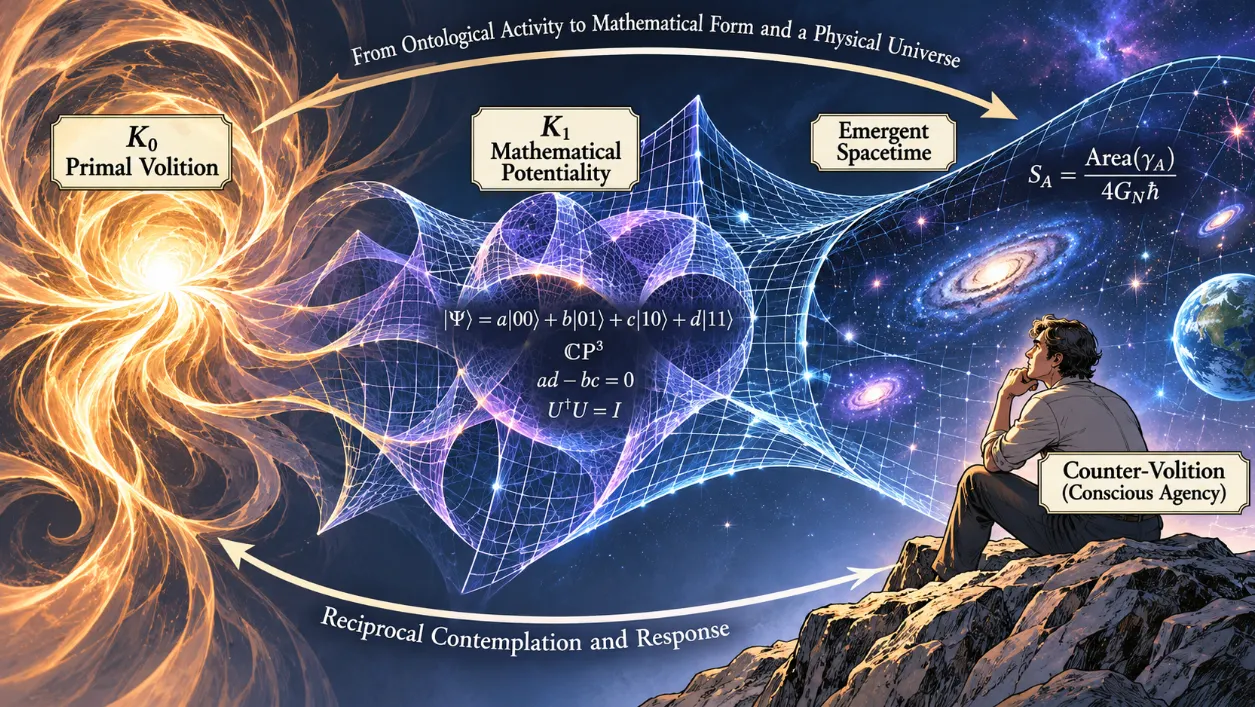
Ontological openness → interacting possibilities and constraints → emergent boundaries → persistent organisation → agency → reflective consciousness.
This is not a proposed equation of physics.
It is an ontological orientation.
The essential idea is that freedom need not appear fully formed as the capacity for deliberate human choice.
Instead, fundamental openness may become increasingly structured through the interactions of systems possessing different degrees of freedom.
Constraints do not necessarily abolish freedom.
They may provide the conditions through which freedom acquires organised expression.
A system possessing no organisation cannot maintain an identity through which its activity can be attributed to it.
A system possessing no constraints cannot sustain the stable relationships needed for coherent activity.
Freedom without organisation may remain indistinguishable from randomness.
Organisation without freedom may produce complex but entirely predetermined dynamics.
Agency, under the account I am proposing, involves organised systems participating in the actualisation of possibilities that are not already completely settled.
This remains a philosophical hypothesis. The existence of boundaries and complex organisation does not, by itself, demonstrate the emergence of ontological freedom.
But it provides a way of understanding how primal openness might acquire the characteristics we associate with agency.
And it removes the need to imagine free will as a miraculous exception suddenly appearing within an otherwise unfree universe.
7. From Agency to Contemplation
Human consciousness introduces another extraordinary development.
We do not merely act within reality.
We contemplate it.
We construct representations of possible circumstances. We revisit past decisions, anticipate future consequences, question our assumptions and formulate explanations of the world in which we exist.
Most importantly, we can turn our critical attention upon our own thoughts.
A belief can become the object of another belief.
An argument can be examined by the same mind that produced it.
An assumption can be identified, challenged and rejected.
Through reflection, a system that participates in reality begins to contemplate the conditions of its own participation.
Under my proposed ontology, this is not the sudden appearance of freedom from nothing.
It is the development of a new relationship between freedom, organisation and self-representation.
Primal ontological freedom concerns the openness of actualisation.
Biological agency concerns organised activity within that openness.
Reflective free will concerns an agent’s capacity to represent possibilities, evaluate them and participate in determining its own intellectual and practical direction.
This is where the original nightmare returns.
If every act of contemplation were predetermined, then reflection might still occur, but the alternatives contemplated would never represent genuinely open alternatives in the relevant ontological sense.
One might deliberate between competing explanations while being unable, under exactly the same preceding conditions, to reach any conclusion other than the one eventually reached.
A compatibilist philosopher might insist that this does not undermine the authenticity of deliberation.
If a person changes their mind because of evidence, then the reasoning is genuinely theirs, regardless of whether the process was determined.
That response deserves serious consideration.
But the conception of intellectual freedom I am exploring demands something further.
I am not satisfied merely by the capacity of a system to respond causally to information.
I am asking whether the contemplative act participates in an ontologically open process.
Does criticism merely register the inevitable conclusion of preceding causes?
Or can critical reflection participate in what reality becomes?
If the latter possibility is genuine, then contemplation is more than an internal representation of predetermined events.
It is one of the ways in which the universe participates in its own unfolding.
And human reason becomes an especially remarkable expression of ontological freedom.
8. Reason, Truth and the Freedom to Criticise
This brings us to the most difficult philosophical question.
Does reason require free will?
There is an established argument that it does not.
Logical relationships are independent of our freedom to recognise them.
The conclusion of a valid deductive argument follows from its premises whether or not a thinker could have reasoned otherwise.
A person can possess knowledge even if the processes through which that knowledge was acquired were causally determined.
These observations prevent us from simply declaring that determinism abolishes reason.
But they do not exhaust the philosophical problem.
Reason has at least two dimensions.
One concerns the logical relationships between propositions.
The other concerns the activity of a reasoning subject who encounters, evaluates and responds to those relationships.
Logical validity does not depend upon an individual’s freedom.
But what about the ontological character of the subject’s participation in reasoning?
When we criticise an argument, we do more than produce another sequence of propositions.
We experience ourselves as exercising judgement.
We suspend acceptance, interrogate premises and entertain alternatives.
We distinguish what we currently believe from what we might have reason to believe.
For me, this openness is central to the meaning of contemplative reality.
If there is no ontological openness whatsoever, then every act of criticism belongs to a fixed sequence.
Criticism can still be logically effective. It can still correct errors, produce knowledge and transform behaviour.
But it cannot change the fact that, in the strict deterministic picture, the entire process could not have unfolded otherwise.
That is precisely what I find philosophically troubling.
It leaves reason operationally intact while threatening the ontological openness of the reasoning subject.
Perhaps that threat is acceptable to a compatibilist.
It is not acceptable to the conception of contemplative freedom I am attempting to articulate.
My claim is therefore not that determinism has been logically refuted by the existence of reason.
Rather, it is that a genuinely open contemplative reality requires an ontology in which intellectual activity participates in the determination of what becomes actual.
Reason is then neither unconstrained choice nor mere randomness.
It is organised intellectual agency operating within a reality that has not already settled every outcome.
This also explains why freedom cannot mean the arbitrary ability to believe anything.
To reason is to encounter constraints.
Evidence matters.
Logical consistency matters.
The relationships between propositions matter.
Freedom does not abolish those relationships.
Instead, it permits the reasoning subject to participate in an open encounter with them.
Under this conception, the authority of reason and the freedom of contemplation are not enemies.
They are complementary aspects of intellectual agency.