“Alexa, Teach My Kid English” — What Actually Works (And What Doesn’t)


Last Tuesday, eight-year-old Mia walked into my online lesson, proudly announced that she had “studied English for one hour,” and then couldn’t tell me what the word apple meant. Turns out she’d spent that hour making Duolingo’s owl cry.
Sounds familiar?
AI language tools are everywhere now, and parents are understandably excited. If an app can teach your child Spanish while you make dinner, surely it can handle English too, right? Well — sort of. As someone who has spent years watching kids interact with screens, flashcards, and increasingly confused chatbots, I want to give you an honest, slightly caffeinated breakdown of what’s actually worth your time.
First, the good news: AI is genuinely helpful
Let’s not be luddites. AI tools have come a long way, and for young English learners, several categories are genuinely brilliant.
- Vocabulary builders like Quizlet, Memrise, and Anki use smart repetition to make new words stick. Instead of drilling the same 20 words in the same order forever (boring for kids, soul-crushing for everyone), they adapt to what your child is struggling with. I once had a student who could recite 200 animal names but blanked on “table.” Anki would have caught that. His mother’s flashcard system, bless her heart, did not.
- Writing helpers like Grammarly and ChatGPT are wonderful for older kids in the 9–12 range who are starting to write sentences and short paragraphs. They catch errors, suggest better phrasing, and — crucially — explain why something is wrong. This is miles better than a red pen and a sad face.
- Speaking tools like ELSA Speak and Rosetta Stone listen to your child’s pronunciation and give real feedback. This is huge. I can tell a six-year-old that their “th” sounds like a “d” seventeen times in one lesson. ELSA will tell them the same thing, more patiently, at 9pm when I am not available.
- Listening apps like FluentU and LingQ expose kids to real English — cartoons, short videos, conversations — with subtitles and interactive vocabulary built in. For kids aged 8 and up, this is gold. Hearing English in real contexts, with real accents, is something no textbook can replicate.
Now, the honest part
Here’s what I’ve noticed after years in the classroom: kids aged 5–7 mostly need humans. A chatbot can say “great job!” but it cannot notice that your five-year-old’s eyes glazed over three minutes ago, or that she laughs every time someone says the word “duck.” (They all do. It’s universal.)
Get Catherine Green’s stories in your inbox
Join Medium for free to get updates from this writer.
AI tutors and chatbots like Duolingo or Replika are genuinely fun for kids who are already comfortable with basic English — around ages 9–12 — and want extra conversation practice. But for the little ones, they work better as a warm-up or wind-down activity than as a main event.
I’d also gently flag something I call the “owl problem.” Duolingo’s streak system is extremely effective at motivating children to open the app every day. It is slightly less effective at teaching them English if they discover they can maintain their streak by clicking through lessons at warp speed without reading anything. Parents: check in occasionally. Ask your child to show you what they learned. If they can demonstrate it, great. If they stare at you blankly, it might be time to slow down.
A sensible way to use all of this
There’s a rough guideline in education that AI should make up no more than about 30% of study time. That sounds about right to me. Think of AI tools as practice, not instruction. They’re the piano scales, not the piano teacher.
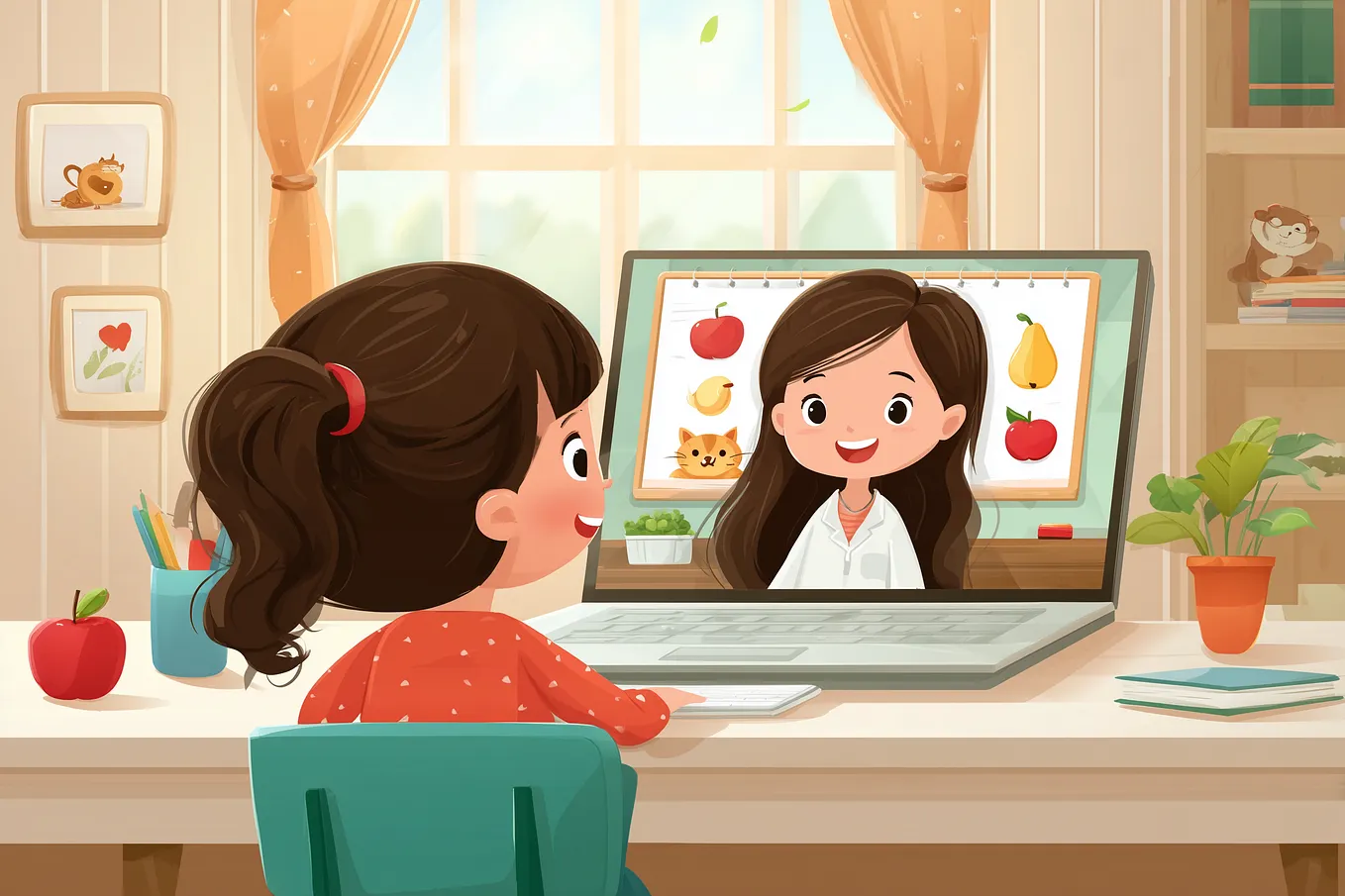
A week that works might look like this: two or three live English lessons (with a real teacher who can laugh at their jokes and catch the moments when something isn’t clicking), plus a few short sessions with a vocabulary app, a pronunciation tool, or a listening activity. That’s it. Twenty minutes of Duolingo does not need to become a two-hour odyssey.
The bottom line for parents
AI tools are wonderful helpers, and some of them are genuinely impressive. But the kids who make the fastest progress in my classes are the ones who have a mix: real lessons with a real teacher, regular app practice at home, and — this is the secret ingredient — someone asking them “so what did you learn today?” at the dinner table.
Mia, by the way, now knows what apple means. We spent five minutes drawing one and talking about it. The owl had nothing to do with it.