🧭 The Dual-Lens Framework: Why Strategy Fails Without Empathy


Your most brilliant 2025 strategy may fail, not because the data is wrong, but because you’re only seeing half the picture. In an era of AI disruption and unprecedented employee activism, relying solely on spreadsheets is a form of professional malpractice.
We’ve all seen it. A meticulously planned project, backed by data and approved by every stakeholder, shatters the moment it comes into contact with reality. A top-down policy that looks perfect on a spreadsheet but results in mass resignations and a collapse in morale.
The failure isn’t in the data. It’s in our vision. This limited perspective is particularly perilous in today’s rapidly evolving landscape, prompting the crucial question: Why is this framework more critical now than ever?
💬 We’re often using only one eye to see a three-dimensional world. We analyze the “what” but ignore the “why.”
Why Now?
As the ground is shifting beneath our feet faster than ever before, daily headlines of layoffs and market uncertainty have replaced professional stability with widespread anxiety.
Simultaneously, disruptive AI is no longer confined to rote automation; it is now tackling **cognitive tasks** once thought safe, including the rational analysis that powers the *Strategy Lens* of this framework. Research shows it could automate **up to 65 % of current work activities [2] by 2030.**
The leadership models that brought us success even a year ago are officially obsolete; our only defensible human advantage as leaders is mastering the ‘Empathy Lens.’ Understanding the gut-level human reaction to change is no longer a soft skill; it is the core competency for navigating the future of work.
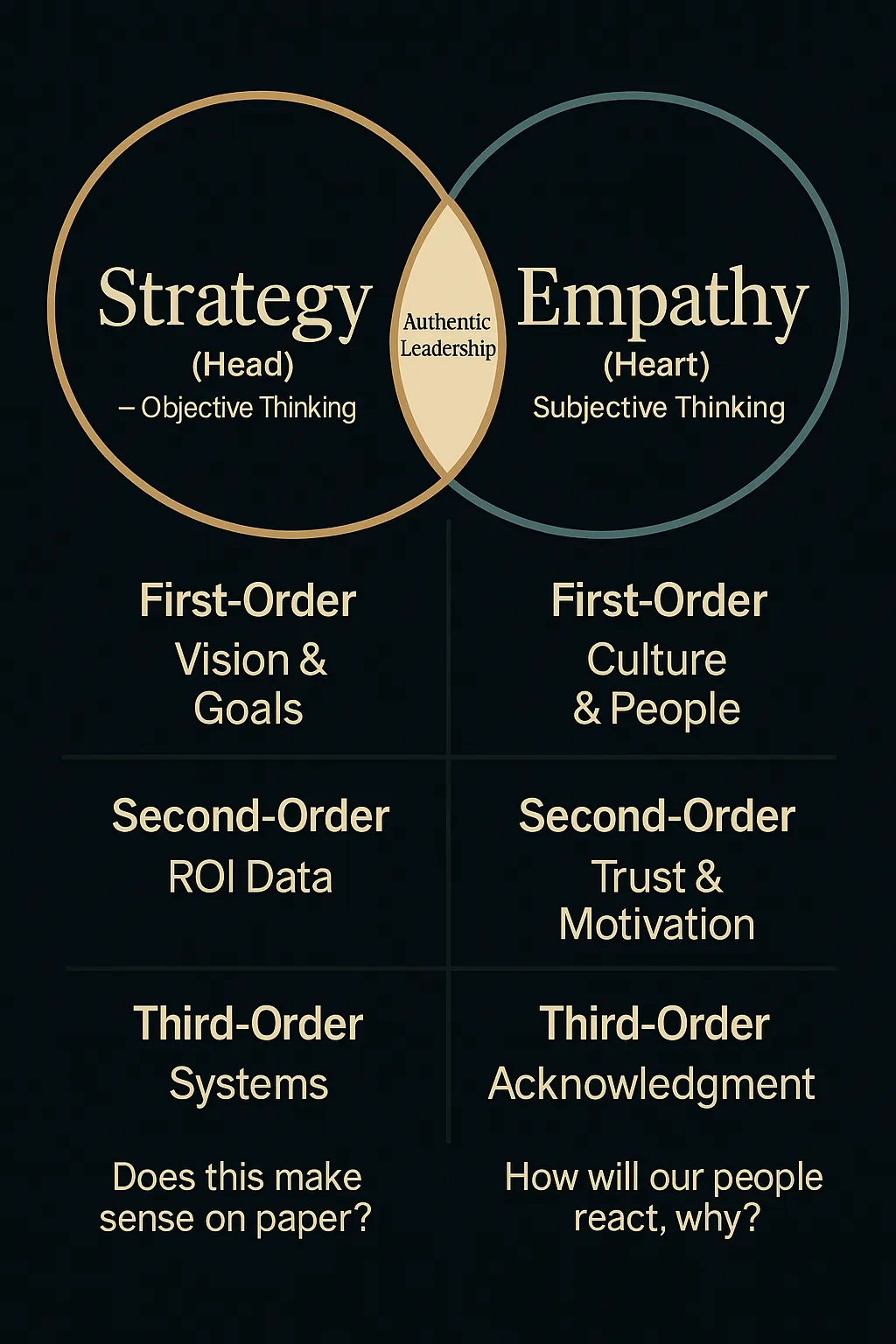
To lead in today’s complex environment, we need to upgrade our operating system. The Dual-Lens Framework is a simple but powerful model for doing just that, ensuring that every critical decision is viewed through two complementary perspectives.
Drawing on the work of Peter Senge, Howard Marks, and Daniel Goleman, I integrate systems thinking, second-order effects, and emotional intelligence into a unified perspective.
Lens 1: 📊 The Strategy Lens (The ‘Head’)
This is the lens of rational analysis, logic, and quantification. It’s the “spreadsheet view” of the world, focused on the mechanics of a decision. It asks the essential question: Does this make sense on paper?
Key components include:
🎯 Vision & Goals: The concrete outcome (e.g., “cut churn 15 %”)
What is the specific, stated objective we are trying to achieve?
📊 ROI & Data: Costs, benefits, KPIs. **In-person brainstorming teams generate ~17 % more ideas than video teams**.
What are the measurable costs, benefits, and key performance indicators?
⚙️ Systems Thinking: Upstream/downstream interactions
How does this decision interact with other parts of our organization, our clients, and the market?
Lens 2: The Empathy Lens (The ‘Gut’)
This is the lens through which we examine human dynamics, culture, and motivation. It highlights the importance of considering the people who will be impacted and the underlying, often unspoken, factors that play a crucial role in the success of a strategy. It encourages us to ask the meaningful question:
Key components include:
🧑🤝🧑 Culture & People: Real-world fit with existing values
How does this decision align with or oppose our current culture and values?
🤝 Motivation & Trust: What lifts or erodes it
What are the true motivations of the people involved? Will this build or erode trust?
🔍 Transparency & Acknowledgment: Fears, hopes, clarity of process
Are we acknowledging people’s fears and hopes, creating a transparent process?
💬 “A strategy that ignores empathy is merely a calculation. A leader who masters it creates a movement.”

Thinking in 3D: Mastering Orders of Effect
The power of the Dual-Lens Framework is unlocked when you use it to look forward in time. This foresight is achieved by applying both the ‘Head’ and ‘Gut’ lenses to anticipate the ripple effects of your decisions.
Thinking in “orders of effect” is how you stress-test your decision.
💥 First-Order Effect: The immediate, obvious, and intended consequence.
🔁 Second-order effect: The reaction to that immediate result, the “and then what happens?”
🧠 Third-order Effect: The new, long-term reality that emerges from that reaction.
“Linear ripple diagram showing first-, second and third-order effects as progressively lighter circles with arrows.”

As Howard Marks explains, “First-level thinking is simplistic and superficial… Second-level thinking is deep, complex, and convoluted.”
💬 Every decision creates ripples. The Dual-Lens Framework helps us see beyond the splash to the lasting shift.

Do we always stop at the third order?
No, it’s not a hard rule. The goal isn’t to perfectly predict the 10th-order effect. The purpose of the exercise is to train your mind to look beyond the immediate and anticipate the chain reaction. Pushing to the third order is typically sufficient to uncover the most critical unforeseen risks and opportunities.
For example, consider the decision to assign a software development team a new generative AI code assistant that is already being used in many large organizations.
💥 First Order: Developers write code faster and more efficiently, resulting in increased immediate output.
🔁 Second Order: Senior developers now spend most of their days reviewing and debugging subtly flawed AI-generated code from juniors, causing mentorship to plummet.
🧠 Third Order: A year later, the junior developers’ core skills have stagnated, and the team’s overall innovation capability has declined.
➡️ **Worth noting:** teams that pair AI coding tools with rigorous code reviews, continuous up-skilling, and clear ownership often avoid these downstream pitfalls, and I’ll cover those safeguards in Part II.
This illustrates a deployment focused solely on first-order effects. Conversely, a leader using the same framework might identify that having senior developers use the same tool to automate a tedious task, such as generating test cases, would free them up for higher-value, strategic work. The difference isn’t the tool; it’s the vision.
💬 “You can’t spreadsheet your way to trust.”
🏢 The Framework in Action: A “Return to Office” Case Study
Let’s apply the framework to a common business challenge: A mandated full Return to Office (RTO).
🔁 First-Order Effect:
📊 Strategy Lens (The ‘Head’): The stated goal is reached as office attendance grows. The strategic effects include more spontaneous collaboration (“water cooler moments”), stronger team cohesion, and a projected increase in innovation and productivity, which justify the company’s real estate investment.
👥 Empathy Lens (The ‘Gut’): Perceived as a profound lack of trust, the mandate disregards that for many, remote work was a critical solution for managing complex caregiving responsibilities. This disproportionate impact on women and disabled colleagues creates not just immense resentment, but a direct blow to the company’s talent pool and stated inclusion goals.
🌱 **DEI impact note** — Five-day RTO hits caregivers, women, disabled & neuro-divergent staff hardest, shrinking your talent pool.
🔁 Second-Order Effect:
💡 Strategy Lens: Top performers with the most career leverage quietly update their resumes and resign for flexible roles at competitor companies. Recruitment costs increase.
👥 Empathy Lens: The Psychological Contract Is Broken. Trust erodes. The remaining employees may engage in “quiet quitting,” doing the bare minimum required.
🔁 Third-Order Effect:
💡 Strategy Lens: The company successfully fills its buildings but becomes a “B-player” in its industry, staffed by a less skilled, less motivated workforce and unable to attract top talent.
👥 Empathy Lens: A vibrant, trust-based culture is replaced by a transactional, low-trust environment that prioritizes presence over performance.
The first-order result appeared to be a success, but the second- and third-order consequences, visible only through the dual lenses, reveal a long-term strategic failure.
🚪➡️ Companies enforcing 5-day RTO saw a 13 % attrition spike
🔁 Actionable First Step
🎯 Making It Real: Your First Step. This framework can feel overwhelming, so break it down into smaller components. Take one decision you have to make this week, even a minor one, like changing a team meeting’s format.
- ✅ Draw two columns on a piece of paper: ‘Strategy (Head)’ and ‘Empathy (Gut).’
- ✅ Under ‘Strategy,’ write down the logical goal and intended outcome.
- ✅ Under ‘Empathy,’ write down how each person on your team will likely feel about the change.
This simple, five-minute exercise is your first rep in building a true strategic vision.
📊 Quick self-score (1 = weak · 5 = world-class)
Below is a quick-reference table. For each row, rate your team or decision on a scale of 1 (weak) to 5 (world-class). Circle your 1s and 2s; these are immediate priorities for improvement.

🎯 Mark the box that best reflects your current state. Circle your 1–2s; those become tomorrow’s priorities.
Get Narasimha B Sarma (B.N.Sarma)’s stories in your inbox
Join Medium for free to get updates from this writer.
Below is a quick-reference guide to help you understand what each row measures, why it matters, and how to interpret the score.
🎯 Vision & Goals
- Measures: How clear and specific the outcome is.
- Why it matters: A crisp north star removes churn and rallies teams.
- 1 vs 5 quick check:
- 1 = “Improve value.”
- 5 = “Cut churn 15 % in two quarters.”
- If you’re at 1–2, rewrite one SMART target and publish it where everyone can see it.
📈 ROI & Data
- Measures: Rigor of cost/benefit math and KPI tracking.
- Why it matters: Hard numbers justify resources and flag pivots early.
- 1 vs 5 quick check:
- 1 = gut feels, no baseline.
- 5 = vetted model + real-time dashboard.
- If you’re at 1–2: Build a one-page ROI sheet; stand up a simple metric board.
⚙️ Systems Thinking
- Measures: Awareness of upstream/downstream ripple effects.
- Why it matters: Prevents local wins that wreck the wider system.
- 1 vs 5 quick check:
- 1 = silo fix, ignores dependencies.
- 5 = maps inputs/outputs; stress-tests 2nd/3rd-order impacts.
- If you’re at 1–2: Run a 30-min ripple workshop: “Who else does this touch?”
🌱 Culture Fit
- Measures: Alignment with existing norms and values.
- Why it matters: Culture clashes stall or get quietly sabotaged.
- 1 vs 5 quick check:
- 1 = violates cherished norms.
- 5 = extends or gently evolves them.
- If you’re at 1–2: Ask, “Which unwritten rule does this break?” Adapt language or pacing.
🤝 Trust Level
- Measures: Stakeholder confidence in people and leadership.
- Why it matters: Trust is a lubricant — low trust multiplies cycle time.
- 1 vs 5 quick check:
- 1 = blame, info hoarding.
- 5 = psychological safety, open feedback loops.
- If you’re at 1–2: Start a weekly “Wins & Worries” stand-up; act on the top concern/worry.
🔍 Transparency
- Measures: Openness of data, decisions, and rationales.
- Why it matters: Sunlight kills rumors and surfaces edge-case risks early.
- 1 vs 5 quick check:
- 1 = closed-door decisions, opaque metrics.
- 5 = shared docs and narrated thinking.
- If you’re at 1–2: Publish a short “Why we decided X” memo; link all data sources.
📊 How to use:
- Read each block and assign yourself a score of 1–5.
- Any 1–2 becomes tomorrow’s priority.
- Re-score monthly to track improvement.
Rule of thumb: You don’t need all 5s. A balanced 3–4 across the board outperforms a lopsided mix of 5s and 1s.
🌅 From Analysis to Vision
This framework isn’t new; it synthesizes the insights of thinkers like Peter Senge, whose systems thinking, **The Fifth Discipline**, reshaped organizational learning; Howard Marks, **Second-level thinking** in his investment memos and book The Most Important Thing; and Daniel Goleman, whose Emotional Intelligence highlighted the power of self-awareness in leadership.
The power lies in its synthesis, making it a practical tool for any leader.

The difference isn’t the tool. It’s the vision.
Authentic leadership resides at the center, where logic and empathy converge.
Authentic leadership isn’t just about making the correct strategic calculation. It’s about understanding that the ‘Head’ and the ‘Gut’ are not opposing forces; they are two essential lenses for seeing the whole picture. Ultimately, that requires having the humility to challenge our own biases and listen to the unspoken truths the Empathy Lens reveals.
👏 If this resonated, please clap, follow, or share your thoughts below.
💬 What’s your most costly empathy oversight as a leader?
📌 P.S. In my next post, I’ll flip the coin and red-team the Return-to-Office strategy, not from critique, but to uncover the ‘innovation citadel’ vision that many leaders are betting their future on. When seen through the Dual-Lens Framework, even conviction has consequences.
🔖 **Bookmark this story** & **follow me** to catch Part II: the ‘Red Team’ analysis.
📚 Sources That Inspired the Dual-Lens Framework
Peter Senge (1990) — *The Fifth Discipline*
Howard Marks (2011) — *The Most Important Thing*
Daniel Goleman (1995) — *Emotional Intelligence*
Gartner (2025) — Return-to-Office Talent Risks
Nature (2022) — Virtual vs In-Person Brainstorming
McKinsey — Generative AI & Cognitive Work (2025)
#Leadership #Strategy #EmotionalIntelligence #HybridWork #DecisionMaking #FutureOfWork #RTO #Framework