I Survived HTB CAPE as an Incident Responder — Here’s My Honest Review (2026)


My Background
I’m an Incident Responder. My day job is investigating what attackers did reading logs, chasing IOCs, Forensic Evidence, writing timelines and also work with CSOC team to handle the incident cases.
I had some experience with pentest and red teaming from create Infrastructure Labs and from CSOC Incident Cases — when you investigate a breach, you eventually learn what a Kerberoast looks like, what BloodHound graphs mean, what CrackMapExec output says. But “recognizing it in logs” is very different from “actually doing it in a lab.”
All my certifications up to this point were firmly on the blue side of the fence: BTL1, BTL2, eCTHP, and eCIR.
I don’t know exactly how threat actor attack the Active Directory. When Red team pentest the Active Directory, I have no idea how can they Attack,Lateral Movement, Bypass EDR to gain acces DC. So I decided to close that gap. Enter: HTB CAPE — the Certified Active Directory Penetration Tester Expert certification from Hack The Box.
When the Blue Team gets attacked, it’s like…

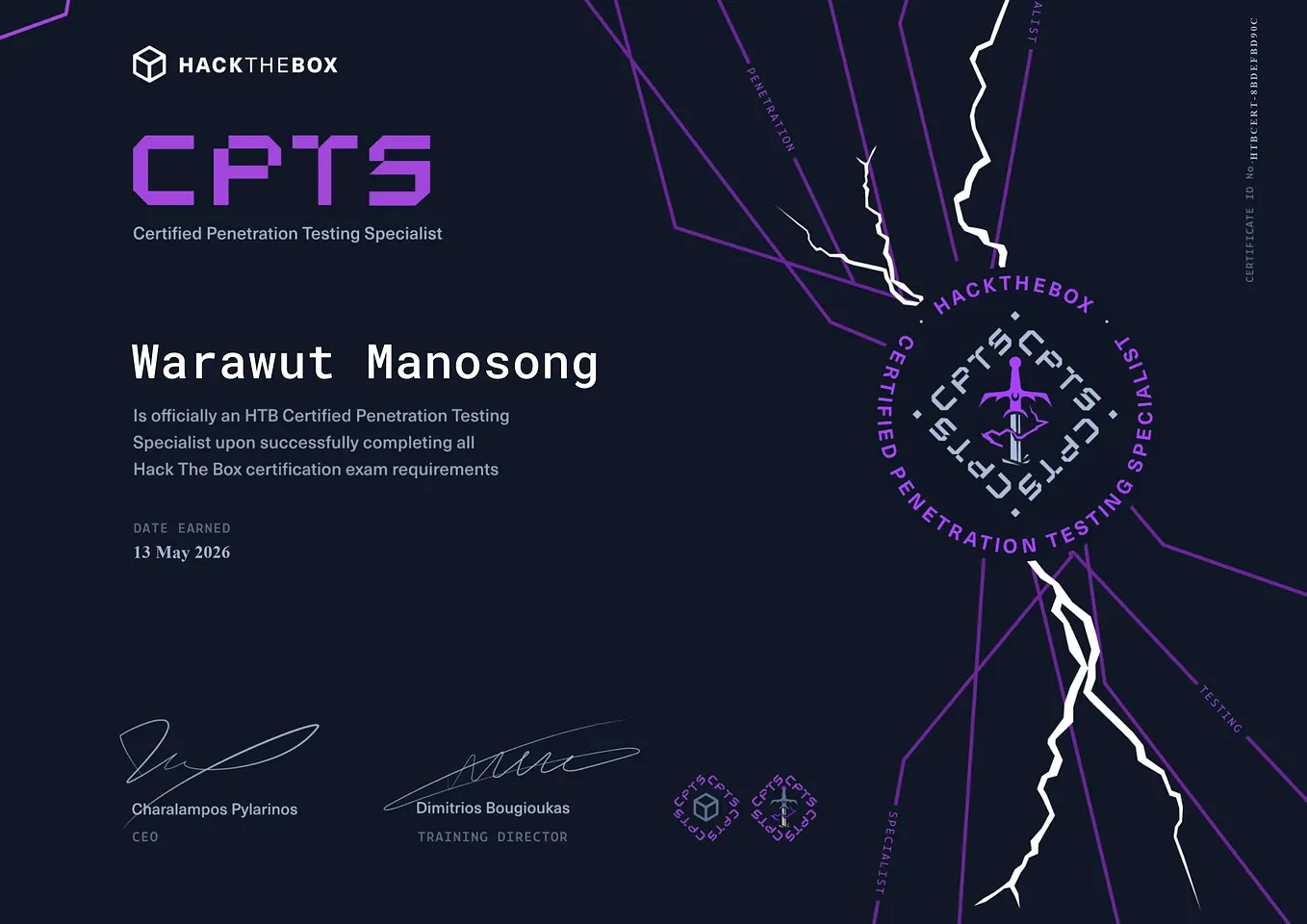
My strongest recommendation: Take HTB CPTS before CAPE.
CAPE assumes you already have a solid foundation in general penetration testing — network enumeration, Linux and Windows privilege escalation, and general offensive tooling. None of that is taught inside the CAPE modules (Some Module such as Windows Priviledge Escalation is not enough for Exam) . The CAPE path dives straight into Active Directory-specific attacks and expects you to keep up.
When I hit certain sections, I found myself Googling concepts that felt like they should have been introduced somewhere earlier — but weren’t. That’s not a flaw in CAPE’s design, it’s a prerequisite gap. CPTS exists to fill it.
Think of it this way: CPTS teaches you the fundamentals of pentesting and gives you your first taste of Active Directory attacks. CAPE builds on that foundation and pushes you deep into advanced, real-world Active Directory compromise scenarios.
If you skip CPTS and come in with only blue team or IR experience like I did, you will spend extra time fighting foundational confusion on top of already difficult material. You’ll get through it — but you’ll work much harder than you need to.

The Journey: 3 Months Through 15 Modules of Pain
The path starts with Introduction to Active Directory — which sounds innocent. Then you hit the Active Directory Penetration Tester learning path: 15 modules, fully covering the modern AD attack surface. Here’s what’s waiting for you:
AD Trusts Attacks, ADCS, DACLs, Kerberos Attacks, MSSQL, Exchange, SCCM, NTLM Relay, Sliver C2 and Windows Defender Bypass
Each module is dense, technical, and completely merciless about assuming you’ll figure out the gaps. I wanted to give up many times. But the content is genuinely excellent — well structured, covering everything.

The Exam: 10 Days of Living in a Domain
The exam combines everything from all modules into one connected environment. I used 9 days for the labs and 1 day for the report. The report was written with the help of Claude AI and Sysraptor — which produced an enterprise-grade, 240-page document covering the full attack path, remediation recommendations, and even a clean-up phase.
I took the exam on workdays. That means every morning I had to switch my brain into “incident responder at work” mode, then come home and switch back into “I am the threat actor” mode. Every night was the same loop — 5 hours of sleep, wake up, open the Lab, continue where I left off.

The First Flag: A Journey Through Hell
Let me be honest about the first flag. Getting it required approximately 6 to 8 chained exploit steps. I am not exaggerating. Each step depends on the previous one. If you miss anything, you go back to the beginning.
Get Chayanin Khawsanit’s stories in your inbox
Join Medium for free to get updates from this writer.
Every module matters — and enumeration is king.

Exam Tips
Test your tools before you need them.
The CAPE lab environment has Windows Defender active. Before you start chaining attacks, make sure your tools and C2 framework can actually bypass the latest version of Windows Defender. Don’t assume that a technique that worked in your local VM will work in the lab — Defender signatures update frequently and what bypasses it today may get caught tomorrow.
Spend time upfront testing your tooling against a current Windows Defender build. This will save you hours of frustration mid-exam when something gets flagged and you don’t know if the problem is your technique or your tools.
Suggested tools for obfuscate executable:
Practice pivoting across multiple domains and interfaces. The exam environment is not a single flat network. You will need to pivot through multiple domains and multiple network interfaces. If you are not comfortable with pivoting and tunneling, practice it before exam day. Getting stuck on movement between domains when you are already exhausted is not a fun experience.
Exam Report
The report is a real deliverable, like a professional penetration test report for an enterprise client.
One important tip for the report: capture every single step as you go. Don’t rely on memory at the end of 9 days. I documented each step during the exam and wrote everything down into a .md file — every command, every output, every finding. Then I used Claude Code and Sysraptor API to structure and polish it into the final report.
The final output covered all 10 flags discovered, full attack paths, business impact, remediation steps, and clean-up guidance. All 230 pages of it.

I submitted my report on March 25, 2026. Thirteen days later, on April 7, 2026 — I got my result.

Final Thoughts
My company purchased an HTB Enterprise license that was expiring the following month. Originally I planned to take the CDSA certificate, but my senior suggested I go for CAPE instead. So after finishing BTL2, I made the decision — no gaming for 3 months, just study (and work).
During the exam, things got harder than just the technical challenges. In the middle of it all, I was dealing with family issues, problems at work, and still stuck on flags. My emotions hit rock bottom more than once. Everything was happening at the same time.
But I pushed through. After I submitted the report on March 25, 2026 and received my result on April 7, 2026 — I finally felt free.
Honestly, this is my first offensive certificate and the hardest thing I have ever studied for.
If you are planning to take CAPE, my advice is simple: prepare your free time in advance, eat well, sleep well, and go in ready. The exam will test not just your technical skills but your mental endurance.
Good luck — Keep on dreaming!.