Why It’s So Hard to Know What to Do When You’re Overwhelmed
It’s not a lack of support. It’s a lack of clarity when you need it most.

There’s a strange moment that happens when stress builds.
You know you need help. You just don’t know where to start.
You open your phone. You search for answers. You see a hundred options.
Therapy. Self-help articles. Apps. Advice from people who mean well. Workplace resources you vaguely remember exist.
And instead of feeling better, you feel worse. More stuck. More overwhelmed.
More unsure.
If you’ve felt this, there’s nothing wrong with you.
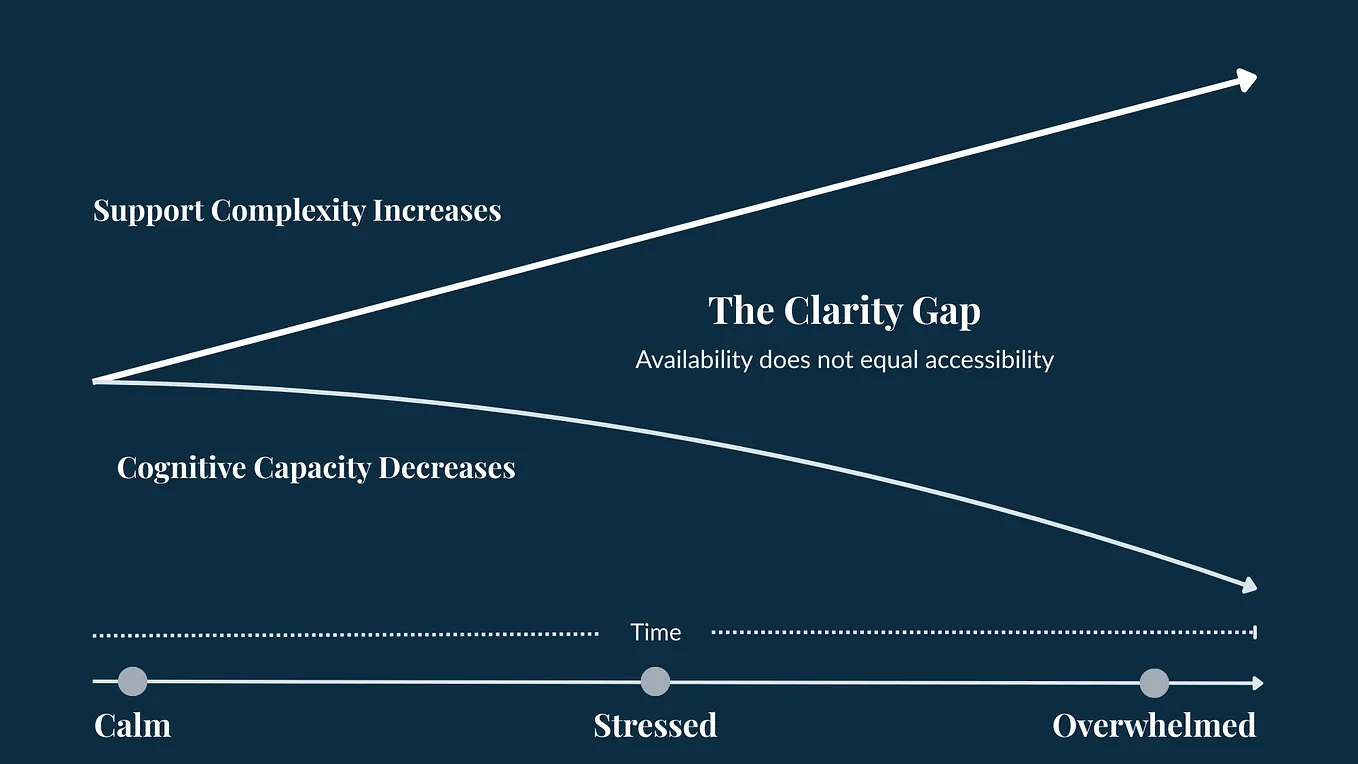
You’re experiencing something very common. I call it the Clarity Gap.

The Real Problem Isn’t Lack of Support
Most people today have access to some form of support.
Employee assistance programs. Insurance-covered therapy. Mental health apps. Friends. Family. Online resources.
On paper, support exists.
But in reality, when stress is high, your ability to process information drops. At the exact same time, the number of choices increases.
So you end up here: You have options. But no clear starting point.
That gap between available help and usable help is what makes everything feel harder than it should.
What the Clarity Gap Feels Like
It doesn’t always look dramatic.
Sometimes it looks like:
- Staring at your phone and doing nothing
- Opening multiple tabs in your browser and closing all of them
- Thinking “I should probably talk to someone” but not knowing who
- Feeling like every option is either too much or not enough
- Putting it off because choosing feels exhausting
This is not indecision. It’s cognitive overload.
The Mistake Most People Make
When we feel overwhelmed, we try to find the best solution.
The right therapist. The perfect app. The most helpful article.
But when your mind is already overloaded, searching for the best option makes things worse.
You don’t need the best solution.
You need the next step.
A Simpler Way to Start
Instead of asking “What’s the best thing I can do?”
Ask: “What kind of support do I need right now?”
Get Chris Cage’s stories in your inbox
Join Medium for free to get updates from this writer.
You can break it down into four simple directions:
- In immediate distress → reach out to urgent or crisis support
- Emotionally overwhelmed → talk to a person
- Mentally stuck → use a structured tool like journaling or prompts
- Physically exhausted → rest and reduce input
This removes the pressure to figure everything out.
It gives you a direction.
Why Preparation Matters More Than You Think
Here’s the part most people miss.
When you’re already overwhelmed, it’s the worst time to figure out your options.
That’s why clarity has to come before the moment you need it.
Think about it like this:
You don’t build a plan during the emergency.
You build it before.
Simple things help:
- Knowing who you would reach out to
- Understanding what support is available to you
- Having one or two tools you already trust
- Identifying what helps you reset quickly
When those decisions are already made, you don’t have to think as hard when things get difficult.
If You’re Struggling Right Now
If you’re reading this and feel overwhelmed, start small.
Pause the search. Name what you’re feeling. Choose one direction.
That’s it.
You don’t need to solve everything today.
You just need to take one step.
And if what you’re feeling is intense or urgent, please don’t try to handle it alone. Reach out to a trusted person or a professional support line right away. Immediate support exists for a reason, and using it is a sign of strength, not failure.
A Tool to Help You Prepare
I created a simple tool called the Clarity Gap Starter Kit to help with this.
It’s designed to take about 10 minutes and helps you:
- Map out your support system
- Identify what works for you
- Clarify your next steps before you feel overwhelmed
It’s not therapy and it’s not diagnosis.
It’s a way to make sure that when things feel heavy, you don’t have to start from zero.
We often assume that having support is enough. But support only works if you can actually access it when you need it.
Clarity is what makes that possible.
Chris Cage is the founder of The Mental Lens, where he writes about mental health, work, and the impact of modern technology. He developed the Clarity Gap framework to help individuals and organizations better navigate support when it’s needed most.
- Get the Clarity Gap Starter Kit
- Subscribe for practical tools and insights