Render unto God
Twenty-First Sunday after Pentecost

1 Thessalonians 1:1-5; Matthew 22:15-21
Let the words of my mouth, and the meditation of my heart, be acceptable in your sight, O Lord, my strength, and my redeemer.
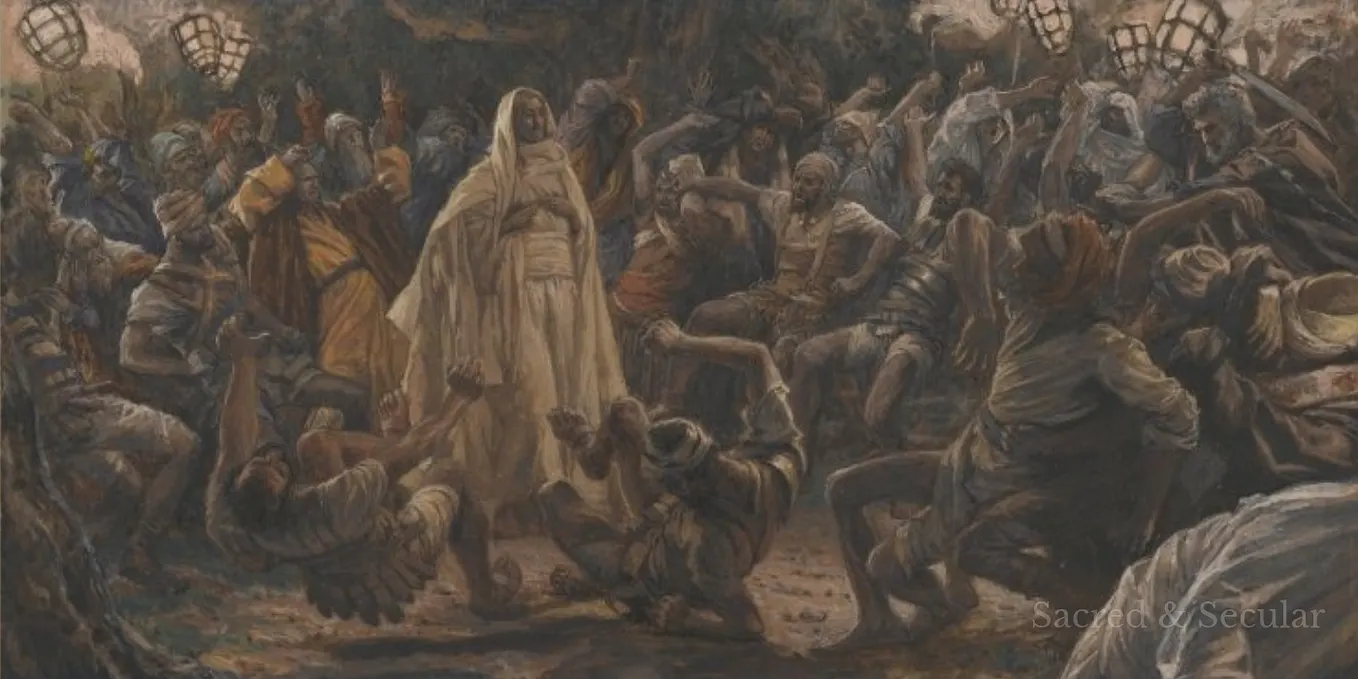
Today’s Gospel reading comes from Mathhew and is set after his triumphal entry into Jerusalem and before the passover meal with his disciples. Mathew places many of Jesus’ parables and altercations with the religious leaders here in this section, which eventually culminate in the plot to have Jesus killed since they believe him to be a threat to his power.
This specific and well known interaction can hide some very interesting details that we often overlook. Jesus is approached by a few pupils of the Pharisees and the Herodians in order that they might trap Jesus in his own words. That is they wanted to get Jesus to say something controversial enough that it would get him to be imprisoned or perhaps even killed. The Herodians are those religious leaders under the king of judea allied to the governmental power of Rome. They begin their interaction with some false flattery praising Jesus for exactly what they hope to prove that he is not, that is, an impartial and competent teacher of the law. The question that they ask is a significant challenge although at its face value is seemingly simple: Ought we pay taxes to Caesar or not? But this passage is not primarily intended to be a simple statement about Christians being upstanding citizens and paying their taxes, although of course this is our civic duty. Nor is this passage simply an argument in favour of the important democratic principle of separation of church and state, a point which I do believe this text can be used for, however once we dive a little deeper into this passage’s historical context we will be able to better understand what really was at stake here.
The real issue raised in this instance is that the question (Is it lawful to pay taxes to Caesar or not?) challenges Jesus to take a side. If he says no he condemns and denies the authority of the Empire and risks the ire of Roman law declaring him a seditious revolutionary. If he acquiesces and says yes he comes across as a sellout who legitimises oppressive Roman rule over himself and his people. Jesus understands that this is a trick question and his solution is quite genius. He first unmasks his interlocutors by identifying them as hypocrites they are, since they are not actually interested in his answer. But he then goes on to reply in a very creative way.
Jesus asks them to bring a coin and they hand him a denarius coin, and as Prof. Dana Schuler points out, this is probably what it looked like:
Get Christopher Govier’s stories in your inbox
Join Medium for free to get updates from this writer.
Tribute penny: Ti[berivs] Caesar Divi Avg[vsti] F[ilivs] Avgvstvs, Pontif Maxim
Jesus asks “Whose head is this and whose title?”
They probably would have looked to a coin similar to this one seen the Emperor Tiberuius’ face and read "Caesar Augustus Tiberius, son of the Divine Augustus" and on the flip side an image of the emperor’s mother Livia styled as the goddess roma titled “High Priest”
Naturally after seeing this, they answered, “Caesar’s.”
Jesus’ question and their subsequent answer already carries a hefty implication. First when we speak of taxes in the ancient world, we are speaking of an imperial extortion of money from the people to fund the imperial war machine. What could be more representative of the power and glory of Rome than the personified pagan deity Roma. The now late Augustus had also been deified and the current emperor Tiberius named the son of god. Jesus has somehow reformulated the issue at stake. Jesus shows that they now must choose between the god of Rome and its high priest or the God creator of the universe and the son of man. The battle lines have been redrawn and Jesus’ conclusion is, “Give therefore to Caesar the things that are Caesar’s and to God the things that are God’s.” In other words, Jesus is saying to the Pharisees and Herodians, you can give back the pagan king his pagan money, after all it is no more than minted metal and rather put yourself under the true God who rules over all including Caesar himself. Jesus with this short question is able simultaneously to get himself out of the tricky situation and still give a veiled criticism to his questioners, especially to the Herodians and their alliance with Rome.
Beyond this initial theological or political challenge that was resolved by Jesus we still have two other questions that arise: what does this passage teach us about to whom do things ultimately belong? If taxes belong to Caesar, what is it that belongs to God? Pope Benedict XVI in his homily on the subject reminds us of what the church fathers noticed about this passage. Jesus is affirming something deeper and inherent about human nature. The coin belongs to Caesar because it bears the image of Caesar. And humans, according to the biblical tradition, bear the image of God and so must consequently belong to God. The systems and institutions that create oppression do not belong to God, it is people who do. We as God’s creation belong to him and what can we render unto him if not our very selves. Just as the Apostle Paul says in his letter to the Romans “in view of God’s mercy … offer yourselves up as living sacrifices to God for it is your rational act of worship,” in effect that we might be embodiments of the description found in the reading from 1 Thessalonians we just read this morning: constant in prayer, full of works of faith, laboring in love and steadfastness in hope. Put simply we ought render everything we are to God. So there remains this practical principle at work, while we may be ruled by many worldly systems of government, whether oppressive or not, we ultimately do not belong to any of them but to a greater human family that is adopted into the God’s family through Jesus the Son who becomes our brother and whose mystical body we become a part of.
We may be tempted to think we can section off parts of our lives that don’t belong to God, and think we can limit what place God has in our lives like a few hours on a Sunday, but I believe we’ll find true fulfilment in following what Jesus outlines in this same Gospel as the greatest commandment of all “Love the Lord your God with all your heart and with all your soul and with all your mind.’ This is the first and greatest commandment. And the second is like it: ‘Love your neighbor as yourself.” When we follow this commandment our love, our very being is reoriented to the Good that is God, and together with all creation we will have found our true end and thus rendered unto God what is truly God’s. Amen.