A STORY OF EVERYTHING

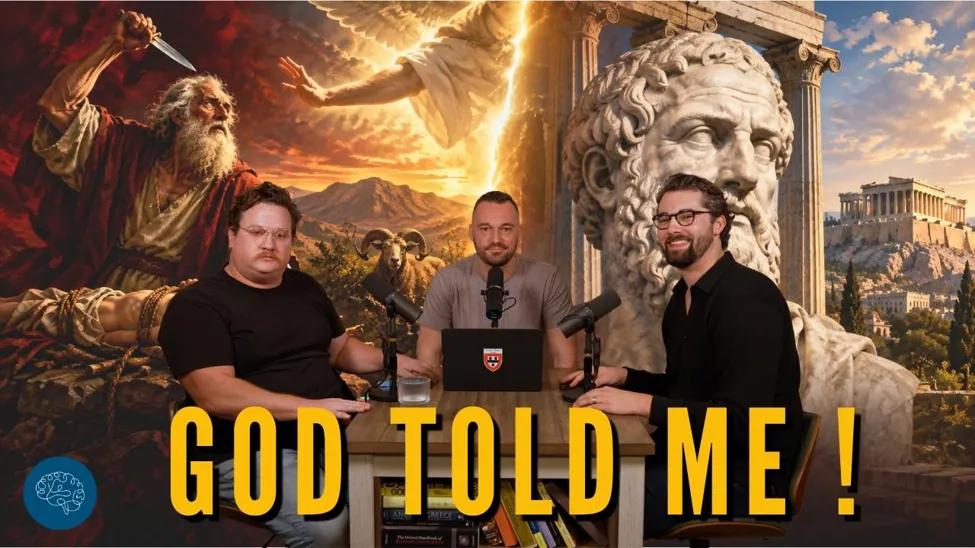
Around 57:20 minutes into the special review of the movie The Story of Everything presented by the evangelistic trio of the “No Brain Left Behind” podcast[1], something is said in the context of the strong anthropic principle that struck me almost as an epiphany.
“The probability of us being right where we’re at is incredibly so low that it puts in contrast how important what we do and who we are is. We’re the only thinking minds that are in the universe right now. We’re on this minuscule tiny little spot of a planet, and we’re alive. This adds credibility to the importance that we think God puts on us as individuals and as people. We’re not lost amongst eight billion people alive right now: we are here, [grounded, rooted, alive, thriving] amongst eight billion other souls, amongst trillions of stars and hundreds of millions of galaxies. One in eight billion humans alive right now is incredibly fortunate, special.”
In the same way the strongest argument for the global flood — and hence the whole Genesis scenario, the Torah and the entire Hebrew Bible — is Jesus’ witness, i.e., His referring to the law of Moses and the prophets, as contended by Major Coleman[2], in the same way, the strongest argument for God is, His Messiah, Jesus Christ. This is not religious rhetoric based on one verse: “I am the way, the truth, and the life. No one comes to the Father except through Me” (John 14:6). It is more based on the parable of the wicked vinedressers (Matthew 21:33–46; Mark 12:1–12; Luke 20:9–19): in the Old Testament God spoke to His people through His prophets; then, in the New Testament or Covenant, He manifested Himself through His own Son. Jesus said:
“If I do not do the works of My Father, do not believe Me; but if I do, though you do not believe Me, believe the works, that you may know and understand that the Father is in Me, and I in Him.” John 10:37–38
This is why Apostle Paul says “if Christ has not been raised, our preaching is useless and so is [our] faith” (1 Corinthians 15:14). The resurrection proves that life is eternal and, as such, goes on continuously from man to man, back to God, and comes from God. Hence the commandment:
“Thou shalt love thy neighbor as thyself.” Mark 12:31; Leviticus 19:18
But this is possible only if one obeys the first commandment:
“And thou shalt love the Lord thy God with all thy heart, and with all thy soul, and with all thy mind, and with all thy strength;’ this is the first commandment.” Deuteronomy 6:5; Mark 12:30
This is also why Jesus had to die the way He did, at the exact historical time He did (Daniel 9:24). Any human resurrection should suffice to make the point, but that of Lazarus did not, nor did that of the widow’s son of Nain (Luke 7:11–17) or that of Jairus’ daughter (Luke 8:40–56), any more than that of Dorcas by Peter did (Acts 9:36–42). Medical science will always find an explanation for a reanimated body and call it resuscitation, or NDE at best, which is normal: that’s what science is for, to establish standards, and medicine, to restore homeostasis. Religious people call resurrection a miracle, when in fact it should be considered “normal” too, from the perspective of what life is, i.e., how much greater and more complex it is than man can fathom.
In the podcast of interest, Joe Penrod says that “as Christians, we make almost no distinction between the spiritual truth and the actual truth.” I take “actual truth” to mean reality; however to us, Christians, the spiritual is more real than the natural proceeding from the former, which is why we see nature around us as a miracle and a “miraculous” healing as natural, according to divine order.
Jesus’ public calvary however, under orders for which there is written archeological documentation, including a death certificate by Roman witnesses, seals the fact that the person who reappeared to over five hundred witnesses after His return from the underworld (1 Corinthians 15:6) had indeed been diagnosed as “passed” and that He indeed must have had the keys of Death and Hades in His possession (Revelation 1:18) when He gave His life willingly (John 10:18) to show us the way back into eternal life — where there is God: where God is.
Therefore, God must be seen foremost as our Creator: the life-giving source and life-changing truth, i.e., the indelible, irrefutable information concerning the origin of life — the Word “without whom was not anything made that was made” (John 1:3).
“In the beginning was the Word, and the Word was with God, and the Word was God” (John 1:1). In the beginning God created the heavens and the earth” (Genesis 1:1) “By the word of the Lord the heavens were made, and by the breath of his mouth all their hosts” (Psalm 33:6)
The fact that this information is eternal makes it infinite as well and explaining why people, human beings with their limited intelligence, still debate as to whether or not man’s destiny is preordained, or whether he has free say in his fate, and also why the new doctrine of Open Theism is false and quite beside the point, i.e., erroneous, i.e., “sinful” according to the Hebraic denotation of the word, חָטָא (chata), “to miss the mark”.
And since this information is encoded within us biologically, once we acknowledge the Creator, we confess that we answer to the same extreme fine-tuning as the rest of the universe of which we are part, i.e., made from the same stuff, whereby the mystery of natural, physiological healing is solved. Moreover, the person may now understand forgiveness and repentance as the restored values of universal, spiritual constants, just as healing is the restoration of biological data in tune with the cosmic parameters of existence.
As long as Man can think as an individual being among the masses of eight billion other individuals, this proves his particular, “singular” origin, i.e., as a unique living entity, “body”. And thinking along those lines allows for answering many unsolved questions:
1) There is a Creator who is not separate from His creature: the Maker never stops finishing, perfecting His handiwork:
“So, because Jesus was doing these things on the Sabbath, the Jewish leaders began to persecute him. In his defense Jesus said to them, ‘My Father is always at his work to this very day, and I too am working.’” John 5:16–17
The importance of the notion of Sabbath is not religious, at least it was not to Jesus but only to extremists like the Pharisees: it refers back to the six days of Creation. Religious people think that God rests on the seventh day (maybe this is where the deists took their philosophy of a far-niente God) whereas, when you think of it, that’s when everything begins in life, the life of Man, that is, God’s very purpose. Adam was created eternal, his creation has never been put to an end. Life is a moving thing:
“For in Him we live, and move, and have our being;” Acts 17:28
And it is God who upholds the universe in place.
Get Chantal’s stories in your inbox
Join Medium for free to get updates from this writer.
“He is before all things, and in him all things hold together.” Colossians 1:17:
The fact that the Bible mentions the beginning of the creation, the universe, implies that what is being spoken of is considered existing in the actual timeframe of our hearing or reading about it: the heaven and the earth concern us because we were made so that we could read, think, and speak of them, examine and scrutinize them scientifically.
“In the beginning God created the heaven and the earth.” Genesis 1:1
“Then the Lord God took the man and put him in the garden of Eden to cultivate and keep it.” Genesis 2:15
2) We all come from Adam and Noah[3], a single man as opposed to a single cell[4], as Evolutionists would have it.
3) Regarding predestination, God knows the outcome and follows the process, but we have our freedom of choice within the limits of His Being: this means that as Creator of the Universe He is the one who sets the “rules”, who regulates the physical, chemical, environmental sensors; we, in turn, are in charge of our psychological, humoral and moral ones. Jesus “is the way” means there is a right way to live by and to regain access to the Tree of Life, and if there is a right way behind Jesus, with Jesus, in Jesus, this means there is a wrong way, too: without Jesus, outside of God’s universal boundaries. Wherever this latter path leads it will never end, and existence under unregulated, discordant constants will be horrific. The difference between godliness and godlessness is of the same order as between order and chaos.
4) Therefore, we can explain the presence of evil on earth as a whiff of this hellish afterlife, a surfeit that gets in to us through the gaps of our wrong tunings — acts of disobedience. It is not punishment: it is math, a regulatory mechanism like a pressure valve by which our bodies, our lives, our circumstances are automatically adjusted to the disturbances we cause or have caused in the universe, personally and collectively, including nature, including our fellow human beings’ lives, through our own untuning.
a) If we can explain evil using the strong anthropic principle, we can better understand what “sin” is. By opting for a scientific proof of the intelligent design, we no longer need to rely on religion — at least Christians don’t — which is a system instituted by men that substitutes for God on earth, that is Jesus, to help show “the way” to stranded humans and accompany them on their temporal “pilgrimage”.
b) The main point in practice is that, if evil and sin both fit in the anthropic universe model, little remains to be said about repentance and forgiveness. Those are the God-given tools we have available to us to do any fine-tuning that needs be done in our personality, in our life, our character, our relationships, in order to not affect our family, our neighborhood, our workplace, our nation, our planet disruptively. Think of breaking the law as breaking God’s Law, and of breaking God’s Law as upsetting some universal constant. Ecologists have the right reflex, unfortunately it is still an egocentric one, localized and materialistic. Likewise, the goal is not to work at improving, self-developing ourselves. This is still a misdirected, egotistic effort. We have to forget about ourselves altogether: by putting down the ego our mentality, our way of thinking, our intelligence can be renewed and bent on God’s global, universal purpose, and on having our thoughts of it, of everything about it, our entire worldview tuned in to God’s voice.
Love is what results from the perfect tuning of mankind to the will, i.e., project of God. Our behavior affects the natural elements. New Agers are fond of wavelength training exercises and heart-brain coherence discourses, the laws of attraction, and so on. Where did they take those from?
I like what Major Coleman says about the Bible. If regular school books, history books, psychology and philosophy books can be studied and learned from, why shouldn’t the Bible be used as a regular book, too, to get education from it, the least of which would not be the art of thinking beyond selfhood. The more we operate on the survival mode, the more we disturb the human fine-tuning factor brought to the environment.
Actually, what history shows in our age and time is that the Bible is a living book that grows not only on men but with them. It is the Creator’s handbook that contains, encrypted, the blueprint for our destiny which can only be read with the matching keyed-in mindset, or rather heart. Everything under the sun is mentioned, revealed, explained in it. There is no religion, no philosophy, no science that has not been and is not still inspired by it, because science is not what man makes and invents statically: it is what he discovers about himself and his universe that he can further apply to who he is becoming — the Christlike second Adam. And if it is the same intelligent mind that learns about itself, probes its own consciousness, this is a real wonder to dig into.
The question is not whether God exists or not, or who or what He is: the question is where is God in my life, because if He is not busy in me creating me, when I leave this earth I will remain eternally untuned, lost in translation, like in those Star Treck-type movies where the teletransportation aborts, part of the body is missing and the person disappears in oblivion between two points of entry, like a disentangled particle that never makes it to reunite with its double.
A good picture to keep in mind could be something like the photograph the bewildered Marty holds up in the movie Back to the Future (1985), on which faces, and then whole characters progressively vanish in the space-time matrix while he is desperately trying to make the coordinates agree so he can get back home on time.
If our life is a problem to be solved, let’s open the textbook that gives us all the values of all the constants we are to use to “pass” with honors; let’s open the book that gives us The Story of Everything.
“Remember the former things of old; for I am God, and there is none other; I am God, and there is none like Me, declaring the end from the beginning, and from ancient times the things that are not yet done, saying, ‘My counsel shall stand, and I will do all My pleasure,’” Isaiah 46:9–10
28 April 2026 13:05PM
[1] The Story of Everything | Movie Review | Taylor Lankford, Joe Penrod, and Igor Sobkowicz discuss Stephen Meyer’s upcoming movie “The Story of Everything” from scientific, philosophical, and faith-based perspectives. https://youtube.com/watch?v=1Xze0SGRGUM&is=pduqEIDAHEWhhBNM
[2] Meet Major Coleman: The guy who destroyed the evolutionary theory https://youtube.com/watch?v=sLsi25ArpU4&is=1pq5fsVIk0jM6EiF
[3] Modern Genetics Just Confirmed We All Came from Noah https://youtube.com/watch?v=BQ0ocwMbluU&is=3fUwtNYFOiAHvHpW
[4] Meet Major Coleman: The guy who destroyed the evolutionary theory https://youtube.com/watch?v=sLsi25ArpU4&is=1pq5fsVIk0jM6EiF