The Religions and Mythologies of the Abzuverse


The Religions and Mythologies of the Abzuverse
A Comprehensive Guide to the Pagan, Polytheistic, Indigenous, Dharmic, Abrahamic, Esoteric, and Original Religious Worlds of Abzu & Anki
Canon reference date: 18 October 2026
From the Mesopotamian Anunnaki to the Egyptian Netjeru, from the Greek Theoi to the Norse Æsir, from Indigenous cosmologies to the Abrahamic traditions, and from ancient reconstructed religions to original fictional theologies, the Abzuverse is an expanding creative universe devoted to the exploration of humanity’s many religious and mythological worlds.
Introduction: A Universe of Many Religions, Many Gods, and Many Cosmologies
The Abzuverse is an expanding mythological and cosmological universe originating from Abzu & Anki and developed through projects such as Abzu & Anki Expanded, Project Abzu & Anki, the Great Syncretism, the Maximum Mythological Proximity Project, and numerous religiously inspired alternate universes.
Its foundational mythology draws inspiration from ancient Mesopotamian religion and cosmology. From this foundation, the setting expands into the divine worlds of ancient Egypt, Greece, Rome, Scandinavia, Celtic societies, Slavic and Baltic cultures, South Asia, East Asia, the Americas, Africa, Oceania, the ancient Near East, and the Abrahamic religious traditions. It also incorporates philosophical and esoteric systems, Indigenous religious cosmologies, contemporary religious communities, and original fictional theological developments.
The result is a fictional multicosm in which different religious traditions can possess their own divine beings, sacred realms, cosmological structures, histories, civilizations, and understandings of existence while participating in a larger interconnected reality.
The project’s ambition is not merely to assemble a collection of gods from different cultures. It is to explore how entire religious worlds might exist, develop, and encounter one another within an expansive fictional setting.
The Mesopotamian Anunnaki can maintain their own divine civilization. The Egyptian Netjeru can inhabit a cosmological world shaped by Nun, divine order, the Duat, and the cycle of renewal. The Greek Theoi can maintain their relationships, institutions, primordial beings, and Olympian traditions. The Norse Æsir and Vanir can inhabit a universe structured around their distinctive cosmological traditions. Hindu, Buddhist, Jain, Sikh, Chinese, Japanese, Korean, African, Indigenous American, Abrahamic, and other religious worlds can also maintain their distinct identities.
Alongside these historical and contemporary traditions, the Abzuverse develops original cosmological projects that reinterpret primordial existence, creation, the universe, and the relationship between divine reality and the natural world.
An important distinction is that not every religion or mythology in the Abzuverse possesses the same degree of narrative development. Some traditions form the foundation of the original continuity or have dedicated lorebooks and detailed alternate universes. Others belong to the project’s wider integrated mythological landscape, have specific cosmological counterparts, or remain open to further development.
Accordingly, this article distinguishes between the project’s foundational mythology, its major integrated divine civilizations, its developed cosmological alternate universes, and its wider field of featured, planned, and expandable religious traditions.
The cutoff date for this overview is 18 October 2026.
Part I: The Foundations of the Abzuverse
1. Abzu & Anki: The Primordial Deep and the Manifest Universe
The names Abzu and Anki establish the foundational cosmological language of the original project.
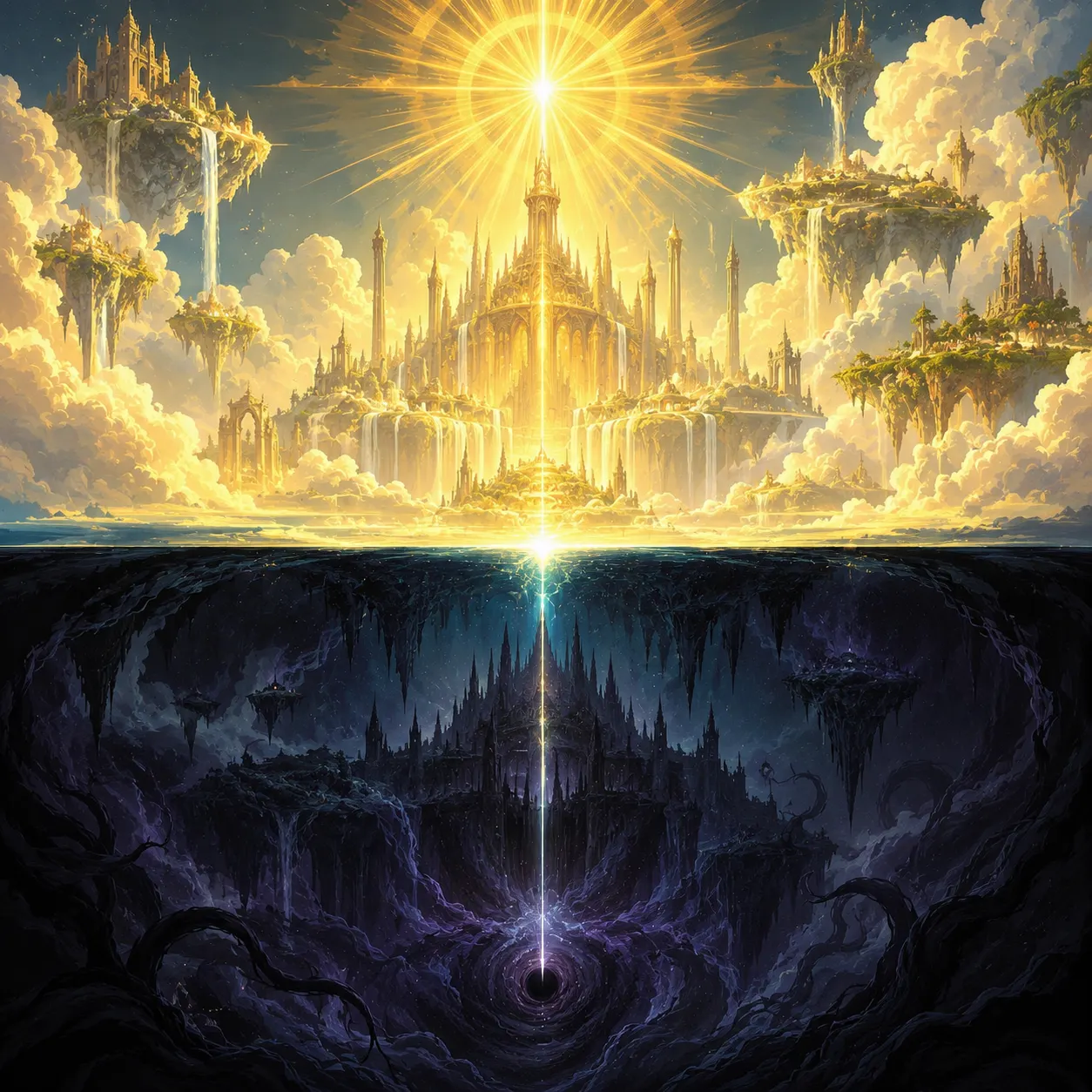
Within the Abzuverse’s fictional metaphysics, Abzu represents primordial depth, potential, mystery, and the underlying reality from which existence may emerge. Anki represents the manifest universe: the ordered and observable totality in which matter, energy, life, civilizations, and divine societies exist.
The relationship between these principles is not simply a conflict between good and evil.
Abzu is not automatically an embodiment of wickedness because it represents darkness or primordial depth. Likewise, Anki is not automatically morally perfect because it represents light, manifestation, and the ordered universe.
Primordial darkness can represent possibility, the unknown, generative power, and the foundations of existence. Manifestation can provide the conditions for life and civilization while also making destruction, suffering, and conflict possible.
The relationship between Abzu and Anki consequently raises several questions:
- What existed before the manifest universe?
- How does an ordered cosmos emerge from primordial reality?
- Can the foundations of existence possess consciousness or agency?
- What is the relationship between divine beings and the natural universe?
- Can different religions describe different aspects of a larger reality?
- What exists beyond the boundaries of the observable cosmos?
These questions provide the basis for the Abzuverse’s later explorations of divine civilization, extradimensional existence, cosmological plurality, and original fictional theology.
Zero Point and the Ultimate Principle
Later developments introduce Zero Point as a fictional ultimate principle that transcends the ordinary opposition between primordial depth and the manifest universe.
This concept extends the cosmology beyond a simple dual structure. It provides a framework for exploring whether the categories used to describe existence — darkness and light, potential and manifestation, origin and creation — are themselves limited descriptions of something more fundamental.
Zero Point belongs to the Abzuverse’s own speculative metaphysics. It should be understood as an original worldbuilding concept rather than an established scientific description of the universe.
2. The Great Syncretism
The Great Syncretism is one of the central concepts connecting the Abzuverse’s many religious and mythological worlds.
In historical comparative mythology, scholars investigate relationships between religious traditions, including similarities in creation narratives, divine genealogies, sacred geography, cosmological structures, and representations of the natural world.
The Abzuverse takes this comparative approach and turns it into a fictional principle governing the relationship between different cosmologies.
Within the Great Syncretism, Mesopotamian, Egyptian, Greek, Norse, Celtic, Hindu, Chinese, African, Indigenous American, Abrahamic, and other religious worlds can exist within one larger fictional reality.
The Anunnaki can encounter the Netjeru. The Greek Theoi can interact with Roman divine institutions. Norse gods can maintain relationships with other divine civilizations. Japanese kami can inhabit a sacred world with its own history and institutions. Yoruba orisha can retain their own religious identities while participating in a wider mythological setting.
The central proposition is that one religious or mythological world does not have to erase another in order to coexist with it.
Unity without homogenization
The Great Syncretism does not require every god to possess an identical personality, every religion to share one theology, or every cosmology to become a renamed version of Abzu and Anki.
Two deities may have related domains while remaining different individuals. Two creation narratives may exhibit similarities while expressing different cultural understandings of reality. Two religious traditions may interact while retaining incompatible theological claims.
The same distinction applies to monotheistic traditions. The inclusion of Judaism, Christianity, or Islam does not automatically turn the God of Abraham into a member of a polytheistic divine family.
The Great Syncretism therefore accommodates both connection and difference.
A multicosm rather than a single pantheon
The Abzuverse can be understood as a multicosm: a fictional framework containing multiple religious worlds and cosmological systems.
Some of these worlds may be connected through shared primordial structures. Others may interact through resonance, dimensional relationships, divine diplomacy, or encounters between their inhabitants.
Still others may belong to alternate universes with different historical developments or theological premises.
This flexibility allows the setting to contain more than one model of how mythologies relate to each other.
3. Divine Frequencies and Extradimensional Existence
The Abzuverse also explores the fictional concept of divine frequencies.
Within this framework, divine beings may be understood as intelligences, manifestations, or entities connected to dimensions of reality that ordinary human perception cannot fully access.
A deity associated with a natural process may embody aspects of that process without being reduced to a simple elemental power. A god associated with the sea can possess a distinct personality, history, family, civilization, and religious identity while also participating in the deeper structure of the fictional cosmos.
Divine frequencies therefore provide a possible explanation for how different divine civilizations can interact across otherwise distinct cosmological worlds.
However, frequency is a speculative metaphysical concept here. It does not mean that science has established the existence of gods as measurable frequencies, nor does it imply that an electromagnetic frequency can be identified with a particular religious being.
The value of the concept lies in its narrative possibilities: it allows the Abzuverse to investigate the relationships between matter, perception, consciousness, divinity, and extradimensional reality.
4. Different Continuities, Different Cosmological Models
Not every Abzuverse project adopts the same explanation for the relationship between pantheons.
Some continuities emphasize independent divine civilizations connected through cosmological resonance. Others propose more direct relationships among different pantheons.
For example, Abyss & Heaven 2: The Shadow Pantheon explores a more specific model in which the world’s pantheons are shadows or fragments of the original Anunnaki divine family.
That premise should not automatically be imposed upon every other Abzuverse story.
Different projects can explore different interpretations of the multicosm, just as the broader universe contains different cosmological models and alternate histories.
This is important because an expanding fictional setting does not have to resolve every creative variation into one rigid doctrine. Its alternate universes can explore competing explanations while sharing a common mythological heritage.
Part II: The Foundational Mesopotamian World
5. Mesopotamian Religion: The Anunnaki and the Origins of the Abzuverse
Mesopotamian religious traditions form the foundation of Abzu & Anki.
The historical religious world of ancient Mesopotamia included Sumerian, Akkadian, Babylonian, Assyrian, and other regional and historical traditions. These cultures shared religious relationships while also developing distinct cities, political institutions, theological interpretations, and divine cults.
The Abzuverse builds its original mythology around Mesopotamian-inspired cosmology while allowing the wider universe to develop beyond this starting point.
The Anunnaki Divine Civilization
The Anunnaki are central to the original continuity.
Important figures in the fictional divine world include:
- Anu: a major figure associated with heavenly authority.
- Enki: associated in the user’s Abzu & Anki lore with wisdom, hidden knowledge, and the Abyss.
- Enlil: associated with divine authority and the ordering of the cosmos.
- Nammu: associated with primordial creation and the foundations of existence.
- Ninhursag: an important maternal and creation-related deity in Mesopotamian traditions.
- Inanna: associated with love, sexuality, warfare, and royal power.
- Marduk: associated with Babylonian kingship and cosmic order.
- Isimud: a figure associated with Enki in Mesopotamian tradition.
- Aya: associated with light and connected to solar traditions in relevant Mesopotamian contexts.
The wider divine world also includes the Igigi, Udug, and numerous additional deities and spiritual beings.
The Abzuverse’s fictional reinterpretations of these figures may develop their personalities, relationships, political roles, and cosmological significance beyond what survives in ancient sources. Those inventions belong to the setting and should remain distinguishable from historically attested Mesopotamian religion.
Divine Civilization beyond the Pantheon
The Anunnaki are not merely isolated characters with supernatural powers.
Their fictional civilization can possess cities, divine courts, sacred institutions, political relationships, rivalries, alliances, specialized knowledge, histories, and responsibilities toward the manifest universe.
Such a world supports stories about divine society itself rather than limiting every narrative to a mortal protagonist encountering one god at a time.
Abzu & Anki as the Original Cosmological Architecture
The original cosmology provides a foundation for later alternate universes.
Instead of forcing every future religious world to use the names Abzu and Anki directly, the project can reinterpret the relationship between primordial potential and manifestation through different cultural vocabularies.
This leads to a growing collection of cosmological counterparts developed throughout the Abzuverse.
6. The Wider Mesopotamian and Ancient Near Eastern World
The Abzuverse’s Mesopotamian foundation extends into a wider ancient Near Eastern field.
It draws upon Sumerian, Akkadian, Babylonian, Assyrian, Canaanite, Phoenician, Aramaean, Palmyrene, Arabian, Anatolian, Iranian, and related religious worlds.
Relevant divine figures include Ea, Shamash, Sin, Ereshkigal, Nergal, Tiamat, Ashur, Anat, Baal, Mot, and Melqart, among many others.
These traditions are historically interconnected but should not be treated as one uniform religion. Their divine figures, sacred institutions, historical contexts, and theological ideas developed through different cultural environments.
The Abzuverse can consequently develop several distinct ancient Near Eastern divine civilizations, allowing their interactions to become part of the larger story without making every deity a renamed member of the Anunnaki family.
Part III: African and Mediterranean Divine Civilizations
7. Ancient Egyptian Religion: The Netjeru, Nun, and the Duat
Ancient Egyptian religion is one of the Abzuverse’s principal integrated religious worlds.
Its deities are commonly referred to through the Egyptian term netjeru, and its mythology offers an extensive field for exploring divine authority, creation, sacred kingship, death, renewal, ritual, and cosmic order.
The Netjeru
Important Egyptian divine figures include Ra, Atum, Osiris, Isis, Horus, Anubis, Set, Ma’at, Thoth, Sekhmet, Hathor, Ptah, Nut, Geb, and many others.
Their roles should not be reduced to a simplistic division between good and evil.
Ra’s solar associations, Osiris’s relationship with death and renewal, Isis’s protective and magical associations, Thoth’s relationship with knowledge and writing, and Set’s complicated associations with disorder, violence, wilderness, and protection offer different narrative possibilities.
The Egyptian divine world can contain relationships, conflicts, political institutions, sacred duties, and philosophical disagreements that reflect the complexity of its source traditions.
Nun & Nutgeb
Nun & Nutgeb is the Abzuverse’s principal Egyptian-inspired cosmological branch.
Nun is historically associated with the primordial waters that precede the ordered world. Nutgeb, as used in the project’s fictional framework, belongs to its original cosmological terminology and should not automatically be treated as a standard ancient Egyptian religious term.
The branch develops a relationship between primordial reality and the manifest world through an Egyptian-inspired conceptual structure.
Associated projects include Nun, Ma’at & Duat and other Egyptian cosmological developments.
The project also introduces fictional or cross-cultural manifestations such as Nun-Atum, Naunet-Iusaaset, and Nun-Ra. These are Abzuverse interpretations, not claims that historical Egyptians regarded their deities as manifestations of Abzu or Enki.
The Duat and the Renewal of Existence
The Duat, funerary traditions, sacred order, and the regeneration of life provide particularly important themes for the Egyptian branch.
An expanded narrative can explore the divine responsibilities associated with the solar cycle, the journey of the dead, the continuity of life, and the preservation of cosmic order.
The Egyptian world therefore becomes more than a collection of recognizable divine characters. It becomes a functioning religious civilization with its own internal cosmology and historical identity.
8. Kushite, Nubian, and North African Religions
The Abzuverse’s African and Mediterranean expansion recognizes several religious worlds beyond Egypt.
Kush and Nubia
Kushite and Nubian religious traditions, including the sacred worlds associated with Napata and Meroë, provide distinct areas of development.
These traditions interacted with Egyptian religious culture but possessed their own political histories and religious developments. Their divine civilizations should not be reduced to Egyptian copies.
Ancient Libyan and Amazigh traditions
The wider setting also includes ancient Libyan and Amazigh religious traditions, alongside Numidian, Mauretanian, and Garamantian religious worlds.
These branches can explore sacred landscapes, local divine identities, historical trade, regional political institutions, and cultural relationships across North Africa.
Punic and Carthaginian religion
The Punic or Carthaginian religious world includes figures such as Tanit and Baal Hammon.
Its maritime cities, religious institutions, political relationships, and Mediterranean connections give it a distinctive identity within the wider setting.
The significance of these branches is that Africa cannot be represented through ancient Egypt alone. The Abzuverse can accommodate multiple African and North African divine civilizations, each shaped by its own cultural history.
9. Greek Religion: The Theoi, Olympus, and Khaos & Uranogaia
Greek religion contributes another major divine civilization to the Abzuverse.
Its scope includes the Olympian gods, primordial deities, Titans, underworld figures, fate deities, heroic traditions, sacred institutions, and other figures from Greek religious and mythological sources.
The Greek Theoi
Important figures include Zeus, Hera, Athena, Apollo, Artemis, Aphrodite, Ares, Hermes, Demeter, Poseidon, Hades, Persephone, Dionysus, and numerous other divine beings.
The setting can develop their relationships, political structures, disputes, alliances, and responsibilities toward gods and mortals.
The Erinyes, associated with vengeance and retribution, and the Moirai, associated with the determination of fate, also provide a way to explore divine law, obligation, destiny, and the limits of power.
Khaos & Uranogaia
Khaos & Uranogaia is the Greek-inspired cosmological counterpart within the Abzuverse framework.
It adapts the relationship between primordial reality and the ordered cosmos through a Hellenic conceptual vocabulary.
It is not simply a renaming of Abzu and Anki, nor is it intended to establish that historical Greek religion contained an identical dual cosmological structure.
Instead, it offers a fictional framework in which Greek primordial beings, divine institutions, and cosmological traditions remain culturally recognizable while connecting to the broader multicosm.
Nyx & Phanes: The Orphic Alternate Universe
The Abzuverse also contains an Orphic-inspired alternate universe associated with Nyx & Phanes.
Its emphasis on primordial and cosmogonic figures offers another way to explore the emergence of an ordered cosmos.
Orphic traditions are not interchangeable with every form of Greek religion. This alternate universe therefore provides an opportunity to represent a particular strand of Greek religious and philosophical thought rather than making it a generic extension of the Olympian world.
10. Roman Religion: Nox & Mundus
Roman religion is a distinct branch of the Abzuverse, despite its historical connections with Greek religion.
The Roman religious world includes Jupiter, Juno, Neptune, Pluto, Venus, Mars, Minerva, Apollo, Diana, Mercury, Vulcan, Ceres, Vesta, Janus, and many other divine figures.
Roman religious life historically encompassed household practices, ancestral traditions, civic rituals, state institutions, and relationships between religion and political authority.
Nox & Mundus
Nox & Mundus is the Roman-inspired cosmological counterpart of Abzu & Anki.
Nox represents primordial night and depth within this fictional framework. Mundus represents the manifest and ordered totality of the universe.
The Roman branch can explore how divine existence relates to civic order, sacred obligations, sovereignty, law, ancestral traditions, and the institutions of civilization.
It is not merely a Greek universe with Latin names. Its distinctive emphasis on the Roman religious and civic world provides the foundation for its own history and cosmological interpretation.
11. Norse-Germanic Religion: The Æsir, Vanir, and Ginnungagap
Norse-Germanic religion provides one of the Abzuverse’s principal European mythological worlds.
Its divine and mythological figures include Odin, Thor, Freyja, Freyr, Frigg, Tyr, Heimdall, Baldr, Loki, Hel, and many others, alongside the Æsir, Vanir, jötnar, and additional beings.
The setting can explore their distinct roles, relationships, obligations, and cosmology without reducing the Norse world to a collection of warrior stereotypes.
Ginnungagap & Yggdrasil
One Norse-inspired cosmological project is Ginnungagap & Yggdrasil.
Ginnungagap, associated with the primordial gap in Norse cosmogony, provides a starting point for examining the emergence of the cosmos. Yggdrasil offers a central image for the relationships among worlds.
The related Ginnungagap & Himingjörð framework is also identified as a Norse-Germanic counterpart to the broader primordial-depth and manifest-universe model.
These projects should be understood as related but potentially distinct fictional interpretations rather than collapsed into one universally fixed cosmology.
Fate and Ragnarok
Norse mythology offers opportunities to explore the relationship between knowledge, fate, divine responsibility, and the limits of power.
Ragnarok provides a framework for narratives about catastrophe and transformation. Within the Abzuverse, these themes can interact with the larger multicosm without forcing every other religion to interpret cosmic destruction in the same way.
The Norse world remains a distinct civilization whose history, values, sacred landscapes, and relationships shape its place in the setting.
12. Celtic Religions: Annwn & Bith
The Abzuverse’s Celtic world includes several related but distinct religious and cultural traditions, including Gaulish, Irish, and Welsh mythological material.
Important figures include the Tuatha Dé Danann, Lugh, Brigid, the Dagda, the Morrígan, Danu, Manannán mac Lir, and others.
The wider setting can explore sacred groves, druids, heroic narratives, ancestral relationships, seasonal traditions, and the connection between divine beings and human communities.
Annwn & Bith
Annwn & Bith is the Celtic-inspired cosmological counterpart within the Abzuverse.
Annwn is associated with the Otherworld in Welsh tradition. Bith belongs to the project’s original cosmological terminology, used to represent the manifest world within this pairing.
The fictional framework explores the relationship between mortal existence and hidden or transmundane reality.
Annwn should not automatically be treated as a generic Hell, and the Celtic cosmology should not be understood as one uniform historical religion. Irish, Welsh, Gaulish, and other traditions can interact while preserving their distinctive sources and cultural identities.
13. Slavic Religion: Nav & Yav
The Slavic religious world forms another major component of the Abzuverse’s European mythology.
Its divine and spiritual figures include Perun, Veles, Mokosh, Svarog, Svarozhich, Rod, Rozhanitsy, Zorya, Belobog, Chernobog, and other beings associated with historical sources, folklore, and modern reconstruction.
The setting also includes Slavic household spirits, ancestral traditions, sacred groves, and modern religious revival movements such as Rodnovery.
Nav & Yav
Nav & Yav is the Slavic-inspired cosmological counterpart.
The pairing evokes relationships between the manifest world and hidden or otherworldly dimensions. Its particular interpretation belongs to the Abzuverse’s fictional development and should not be mistaken for a universal account of all historical Slavic cosmologies.
Veles’ Depth & Perun’s Sky
A related Slavic-Balkan syncretic branch, Veles’ Depth & Perun’s Sky, explores correspondences among Slavic, Thracian, Baltic, Balkan, and neighboring Indo-European motifs.
This is a fictional syncretic project rather than a claim that the historical traditions involved were identical.
14. Baltic, Finnic, Sámi, and Other European Traditions
The Abzuverse’s European world extends beyond the best-known Greek, Roman, Norse, Celtic, and Slavic traditions.
Baltic religions
The Baltic branch includes Dievas, Perkūnas, Laima, Saulė, Mēness, Gabija, and other divine or sacred figures.
Its cosmological projects include Dievas & Visata and Dievas & Pasaulis, which develop Baltic-inspired relationships between primordial reality, divine existence, and the manifest world.
Sacred fire, traditional song, local landscapes, and contemporary Baltic pagan traditions such as Romuva can contribute to this world.
Finnic traditions
The Finnic world includes Väinämöinen, Ilmarinen, Louhi, Ukko, Ilmatar, Ahti, and mythological locations such as Pohjola, drawing in part upon material associated with the Kalevala.
Its cosmological counterpart is Tuoni & Ilmanen.
The Finnic branch remains distinct from Norse-Germanic and Sámi religious traditions.
Sámi religions
Sámi traditions provide another distinct religious world, with references to Sápmi, noaidi practitioners, sacred drums, sieidi sites, Horagalles, and Beaivi.
Their inclusion provides opportunities to explore relationships among sacred landscapes, community traditions, ritual practices, and particular cultural histories.
Dacian, Thracian, Illyrian, and other European religious worlds
The wider European field includes several additional branches:
- Dacian religion, including traditions associated with Zalmoxis.
- Thracian traditions, including Sabazios and the Thracian Horseman.
- Illyrian and other Paleo-Balkan religious traditions.
- Lusitanian religion, including Endovelicus.
- Celtiberian and wider Indigenous Iberian religious worlds.
- Basque religious traditions, including Mari.
- Albanian pre-Christian traditions, including Zojz.
- Etruscan religion, including Tinia, Uni, and Menrva.
The project also includes a Proto-Indo-European-inspired branch, Dyḗus & Dʰéǵʰōm.
These traditions vary in how much dedicated lore they possess. Their inclusion expands the mythological field without claiming that all European pre-Christian religions formed one universal pantheon.
Part IV: The Wider Near East and Iranian Religious Worlds
15. Canaanite, Phoenician, and Aramaean Traditions
The Abzuverse’s ancient Near Eastern world includes several religious traditions beyond Mesopotamia.
The Canaanite and Ugaritic branches include El, Athirat, Baal, Anat, Astarte, Yam, Mot, Resheph, and other figures.
The Phoenician world includes Melqart, Eshmun, Tanit, and Baal Hammon.
The broader field also recognizes Aramaean and Palmyrene traditions.
Yam & Shamem
Yam & Shamem is the Canaanite-inspired cosmological counterpart.
It offers a fictional framework for exploring primordial and manifest reality through a Canaanite-oriented vocabulary and mythological structure.
The setting can develop the Ugaritic divine council, relationships between gods, sacred cities, maritime civilizations, divine authority, and the mythological significance of the sea and other natural forces.
These traditions remain distinct from Mesopotamian religion even when historical and cultural connections exist among them.
16. Ancient Arabian, Nabataean, and South Arabian Religions
Ancient Arabian religions are represented as a collection of regional traditions rather than one standardized pantheon.
The Abzuverse’s references include Allāt, al-ʿUzzā, Manāt, Hubal, Dushara, Almaqah, and ʿAthtar, alongside Nabataean and South Arabian religious worlds.
Baḥr & Falak
Baḥr & Falak is the project’s Arabian-inspired cosmological counterpart.
It develops a fictional relationship between primordial depth and the manifest cosmos using Arabian terminology.
This branch expands the setting’s religious geography while recognizing that pre-Islamic Arabian traditions were diverse and historically distinct from Islam, which emerged in a later religious context.
17. Hittite and Anatolian Religion
The Hittite and Anatolian world adds another ancient Near Eastern divine civilization.
Its figures include Teshub, Hebat, Arinna, Kumarbi, Shaushka, and other deities associated with historical Anatolian religious traditions.
The wider branch can explore divine kingship, sacred mountains, regional religious institutions, mythology, and relationships between neighboring civilizations.
Its significance lies in demonstrating that the religious world of the ancient Near East extended beyond the Mesopotamian heartland.
18. Iranian Religion and Zoroastrianism
The Iranian world includes ancient Iranian religious traditions and Zoroastrianism.
Relevant figures and concepts include Ahura Mazda, Angra Mainyu or Ahriman, Spənta Mainyu, Asha, Vohu Manah, Ārmaiti, Mithra, Anāhitā, and Frashokereti.
Zoroastrianism has a distinctive religious and theological history. It should not simply be classified as another generic polytheistic pantheon.
Its concerns with truth, ethical responsibility, the ordering of existence, destructive forces, and the final renewal of the world offer different narrative possibilities from those of divine societies centered primarily on divine genealogy or royal authority.
Vourukaša & Airyanem Vaejah
Vourukaša & Airyanem Vaejah is the Zoroastrian- and Iranian-inspired cosmological counterpart.
It provides a framework for developing an Iranian-oriented cosmological world without treating its theological concepts as identical to those of the Mesopotamian, Egyptian, or Greek branches.
The Abzuverse can explore the significance of sacred fire, ethical choice, divine order, and cosmic renewal while preserving the distinctive character of Iranian religious traditions.
19. Yazidi and Mandaean Traditions
The wider Near Eastern field also includes Yazidi and Mandaean religious worlds.
The Yazidi branch references Melek Tāʾūs and Lalish, while the Mandaean branch includes the Mandi and the community’s distinctive religious world.
These are not simply reconstructed ancient pantheons. They are historically continuous religious traditions with their own identities, practices, and sacred understandings.
Their inclusion broadens the Abzuverse beyond ancient mythology and reinforces the importance of treating different religious communities as distinct rather than combining them into one generic Middle Eastern supernatural system.
Part V: Dharmic Religions and Asian Religious Worlds
20. Hinduism: The Devas, Dharma, and Avyakta & Brahmāṇḍa
Hindu traditions constitute one of the Abzuverse’s major religious branches.
Their inclusion extends beyond divine characters into philosophical concepts, religious practices, sacred texts, theories of the self, and cosmologies of creation, destruction, and renewal.
The Dharmic worldbuilding encompasses ideas such as Brahman, Atman, Maya, Prakriti, Purusha, Dharma, Samsara, Karma, and Moksha, with inspiration drawn from traditions associated with the Vedas, Upanishads, Bhagavad Gītā, and Purāṇas.
These concepts have different meanings across Hindu philosophical schools and should not be treated as one universal doctrine.
Hindu deities and religious traditions
The setting includes Shiva, Vishnu, Brahmā, Pārvatī, Devī, Kāli, Durgā, Ganesha, Krishna, Rāma, Lakṣmī, Sarasvatī, Hanumān, and other divine figures.
The Trimūrti and the many relationships among Hindu deities provide opportunities to explore creation, preservation, transformation, devotion, divine manifestations, sacred geography, and the relationships between divine and mortal existence.
Hindu traditions do not all interpret these figures or the nature of ultimate reality in the same way. The setting should preserve this diversity rather than treating Hinduism as a single uniform pantheon.
Avyakta & Brahmāṇḍa
Avyakta & Brahmāṇḍa is the Abzuverse’s Hindu-inspired cosmological counterpart.
It explores unmanifest reality and the universe through terminology drawn from Hindu philosophical and cosmological traditions.
A related project, Karanodaka & Brahmāṇḍa, further develops a Hindu-inspired cosmic framework.
These fictional systems allow the Abzuverse to examine primordial reality and manifestation without forcing Hindu cosmology into a simple opposition between good light and evil darkness.
21. Buddhism: Śūnyatā & Dharmadhātu
Buddhism is included in the Abzuverse’s broader Dharmic world, but it requires a different approach from a conventional pantheon-centered religion.
Buddhist traditions encompass teachings and practices concerning suffering, impermanence, dependent origination, the nature of the self, ethical conduct, meditation, liberation, and awakening.
The setting’s Buddhist material includes the Four Noble Truths, the Noble Eightfold Path, dukkha, nirvāṇa, anātman, emptiness, the Sangha, and Buddhist cosmology.
It also recognizes Theravāda, Mahāyāna, and Vajrayāna traditions, alongside figures and concepts associated with the Buddha, bodhisattvas, Avalokiteśvara, Mañjuśrī, and Tārā.
Śūnyatā & Dharmadhātu
Śūnyatā & Dharmadhātu is the Buddhist-inspired cosmological counterpart.
Its concerns cannot be reduced to a hierarchy of gods or a struggle between good and evil. Instead, the fictional framework creates room to explore impermanence, interdependence, emptiness, conditioned existence, and liberation.
Buddhist emptiness should not be treated simply as an evil void or equated automatically with the Abzu’s primordial depth.
The purpose of this branch is to preserve the distinctive philosophical and religious dimensions of Buddhist traditions within the larger multicosm.
22. Jainism: Alokākāśa & Lokākāśa
Jainism is another distinct Dharmic tradition represented in the Abzuverse.
The Jain branch includes Mahāvīra and the principle of ahimsa, or nonviolence, alongside a distinctive cosmological and ethical framework.
Alokākāśa & Lokākāśa
Alokākāśa & Lokākāśa is the Jain-inspired cosmological counterpart.
It provides a fictional way to explore the distinction between the inhabited cosmos and the domain beyond it through Jain cosmological terminology.
This branch creates space for Jain teachings about living beings, karma, liberation, nonviolence, and the nature of existence.
Jainism is not simply another form of Hinduism or a pantheon religion, and the Abzuverse can represent its distinctive worldview without forcing it into either category.
23. Sikhism: Ik Onkar, the Gurus, and Sacred Community
Sikhism is also included in the Abzuverse’s wider Dharmic framework.
Its religious worldbuilding references Ik Onkar, Guru Nanak, the Ten Gurus, the Guru Granth Sahib, the Khalsa, the Five Ks, Langar, and Seva.
These concepts emphasize a religious tradition with its own history, scripture, communal practices, teachings, and understanding of the divine.
Sikhism should not be presented merely as another branch of Hinduism or Buddhism. Its inclusion as a separate religious world allows the Abzuverse to explore the diversity of Dharmic traditions without erasing their differences.
Part VI: East Asian and Southeast Asian Religious Worlds
24. Chinese Religion: Hundun & Qiankun
The Abzuverse’s Chinese religious world includes a broad range of traditions: Chinese popular religion, Daoism, Confucian traditions, Chinese Buddhism, ancestral veneration, local deities, and sacred geography.
Its mythological figures include the Jade Emperor, Xiwangmu, Pangu, Nüwa, Fuxi, Huangdi, the Dragon Kings, Mazu, Guan Yu, Tudi Gong, and many local divine beings.
Its conceptual landscape also includes Tian, Shangdi, Dao, De, Yin and Yang, the Five Phases, and Feng Shui.
These ideas and traditions should not be treated as interchangeable. Chinese religious life developed through multiple historical streams that interacted without becoming one uniform theological system.
Hundun & Qiankun
Hundun & Qiankun is the Chinese-inspired cosmological counterpart.
It provides a framework for exploring primordial undifferentiated reality and the ordered cosmos through Chinese terminology and concepts.
The branch can accommodate celestial bureaucracy, ancestral relationships, local gods, sacred landscapes, temples, divine institutions, and different understandings of the relationship between Heaven and Earth.
Chinese Buddhist traditions, including Chán, and figures such as Guanyin can also participate in the wider setting while retaining their Buddhist identities.
25. Korean Religion: Cheonji & Jeonse-gye
The Korean religious world is treated separately from the Chinese and Japanese branches.
Its scope includes Korean Muism, mudang ritual specialists, gut rituals, village gods, Sansin, Seonang, Jangseung, Jeju shamanic traditions, Korean Buddhism, Korean Seon, Confucianism, Jesa, Donghak, and Cheondoism.
Its mythological materials include figures and traditions associated with Dangun, Hwanung, Hwanin, and sacred landscapes.
Cheonji & Jeonse-gye
Cheonji & Jeonse-gye is the Korean-inspired cosmological counterpart.
It creates a fictional framework for exploring the relationships between the sky, earth, the divine world, and lived existence through Korean terminology.
The setting can develop relationships involving ancestral practices, local spirits, sacred geography, ritual performance, and the evolution of Korean religious traditions across different historical periods.
A separate comparative alternate universe, Tian–Cheon–Ten, explores correspondences among Chinese Tian, Korean Cheon, Japanese Ten, and related concepts.
This comparative project is intended to explore points of contact rather than claim that Chinese, Korean, and Japanese religious traditions are identical.
26. Japanese Religion: Shinto, Buddhism, and Yomi & Takama-ga-Hara
The Japanese religious world includes Shinto, Japanese Buddhist traditions, regional religions, sacred figures, and a variety of mythological and folkloric beings.
Shinto and the kami
Shinto encompasses kami, shrines, torii, purification practices, festivals, and sacred relationships among communities, natural places, and divine beings.
Get Cool Panda’s stories in your inbox
Join Medium for free to get updates from this writer.
Its important mythological figures include Amaterasu Ōmikami, Susanoo-no-Mikoto, Izanagi, Izanami, Inari Ōkami, Hachiman, and Tenjin.
The concept of kami covers a broad range of sacred beings and presences rather than serving as an exact equivalent of a single English religious category.
Yomi & Takama-ga-Hara
Yomi & Takama-ga-Hara is the Japanese-inspired cosmological counterpart.
It develops a fictional relationship between the world associated with the dead and the heavenly realm, drawing upon Japanese religious and mythological vocabulary.
Yomi should not automatically be treated as a Japanese equivalent of Christian Hell, and the kami should not all be reduced to one uniform class of gods.
Japanese Buddhism and other regional traditions
The wider East Asian lorebook includes Shingon, Tendai, Zen, Pure Land Buddhism, Nichiren Buddhism, and Shugendō.
It also recognizes Ryukyuan religious traditions and Ainu traditions, including the concept of kamuy.
These religious worlds can interact while retaining their distinct identities. The presence of Buddhism in Japan does not erase the significance of Shinto or regional Indigenous traditions.
27. Vietnamese and Other Southeast Asian Traditions
The Abzuverse’s regional expansion also includes Vietnamese and Southeast Asian religious worlds.
Its cosmological counterpart is Hỗn Độn & Vũ Trụ, a Vietnamese- and Southeast Asian-inspired framework for exploring primordial reality and the ordered universe.
This branch can incorporate local religious traditions, ancestor veneration, celestial figures, local spirits, and the historical influence of Buddhism and Daoism.
Southeast Asia should not be treated as one uniform religion. Its many cultures developed different religious institutions and cosmologies, even as they influenced one another through trade, migration, political exchange, and shared religious traditions.
The Abzuverse’s framework allows these regional differences to be developed without requiring every Southeast Asian tradition to conform to a single pantheon or cosmology.
Part VII: Indigenous American Religious Worlds
28. Mexica and Aztec Religion: Omeyocan & Cemanáhuac
The Abzuverse’s Mesoamerican framework includes Mexica or Aztec traditions alongside other Indigenous religious worlds of Central America.
Important Mexica divine figures include Tezcatlipoca, Quetzalcoatl, and Huitzilopochtli, among many others.
Their religious world offers opportunities to explore creation narratives, sacred time, divine obligation, agriculture, warfare, social institutions, and political authority.
Omeyocan & Cemanáhuac
Omeyocan & Cemanáhuac is the Mexica- or Aztec-inspired cosmological counterpart.
The branch develops a fictional relationship between primordial existence and the manifest world through Mexica-inspired concepts.
Its divine civilization can possess its own institutions, cosmological relationships, cultural history, and political identity rather than becoming another version of the Greek or Mesopotamian pantheon.
The setting should avoid reducing Mexica religious history to sensationalized portrayals of ritual violence. Its traditions deserve examination through their religious, agricultural, calendrical, political, and historical contexts.
29. Maya Religious Traditions: Primordial Sea & Heart of Sky
The Maya branch is organized around the fictional cosmological pairing Primordial Sea & Heart of Sky.
It provides a framework for exploring Maya-inspired creation traditions, the relationships between heaven and earth, sacred time, agriculture, solar phenomena, and the structure of the universe.
The broader Maya religious world includes diverse peoples, languages, periods, and regional traditions. A general Maya-inspired alternate universe should not be taken as evidence that every Maya community throughout history shared one completely uniform religion.
The Abzuverse can use this branch to explore how distinct Maya-inspired divine civilizations develop their own cosmological understandings and participate in the larger fictional multicosm.
30. Other Central American Traditions
The wider Indigenous Peoples World includes Nahua and Mexica worlds, Zapotec, Mixtec, Purépecha, Guna, Lenca, Miskito, Bribri, Cabécar, and other regional traditions.
Their sacred figures, creation narratives, cultural identities, and religious histories provide a broad field for development.
They should not be merged into one pan-Mesoamerican pantheon simply because some of their traditions share geographical or historical relationships.
The Abzuverse’s goal is to permit their coexistence within a larger setting while keeping their distinct identities recognizable.
31. Andean and South American Indigenous Religions
The Andean or Inca world is another important component of the Abzuverse’s Indigenous American framework.
Its traditions include Viracocha, Inti, Pachamama, Quechua religious worlds, Aymara traditions, and sacred geography associated with the Andes.
Ukhu Pacha & Hanan Pacha
Ukhu Pacha & Hanan Pacha is the project’s Andean-inspired cosmological counterpart.
It uses Andean cosmological vocabulary to establish a fictional relationship among different dimensions of existence.
The branch can develop its own divine civilizations, relationships with ancestors, sacred geography, and ecological responsibilities.
Other South American traditions
The wider Indigenous Peoples World also includes Mapuche, Guarani, Yanomami, Tukano, Tikuna, Shipibo-Konibo, Asháninka, Warao, Wayuu, and other Indigenous traditions.
These are distinct cultural and religious worlds, not components of one universal South American pantheon.
Their inclusion creates opportunities to explore different relationships between land, community, sacred beings, ancestors, and the natural environment.
32. Indigenous North American Religions and Cosmologies
The Abzuverse’s Indigenous Peoples World is explicit about the need to avoid presenting Indigenous North America as one universal religious tradition.
Its scope includes Inuit, Yup’ik, Haida, Tlingit, Coast Salish, Diné, Pueblo peoples, Hopi, Zuni, Lakota, Anishinaabe, Haudenosaunee, Wampanoag, Mi’kmaq, Cherokee, Muscogee, and other Indigenous nations and communities.
Their traditions possess distinctive languages, creation narratives, sacred geographies, animal relationships, community institutions, and systems of knowledge.
Multiple cosmological projects
The Abzuverse includes several Indigenous North American-inspired cosmological frameworks:
- Sky World & Turtle Island
- Emergence & Sacred World
- Above & Below
- Raven & World
These projects provide separate frameworks for different cultural and narrative settings rather than one invented mythology intended to represent every Indigenous nation.
Their use must remain attentive to source traditions, community identities, and the fact that many Indigenous religions are living traditions rather than relics of the past.
The setting can also explore Indigenous cultural revitalization, contemporary lives, political sovereignty, and relationships with land and sacred places.
33. Māori and Polynesian Traditions: Te Kore & Te Ao Mārama
The Abzuverse’s wider mythological field includes Polynesian and Māori traditions.
Māori religious and cosmological concepts include Rangi, associated with the sky father, alongside other divine or ancestral figures and relationships.
Te Kore & Te Ao Mārama
Te Kore & Te Ao Mārama is the Māori-inspired cosmological counterpart.
It adapts the broader project interest in primordial reality and the manifest world to Māori-oriented concepts.
The branch can explore the relationships among ancestors, sacred landscapes, creation, community, and spiritual existence.
Māori religion should not automatically be treated as interchangeable with Hawaiian, Samoan, Tongan, or other Polynesian traditions. Each possesses its own history, cultural identity, and religious developments.
34. Aboriginal Australian Religious Traditions: Dreaming & Country
The Abzuverse’s Australian Indigenous expansion uses Dreaming & Country as its cosmological pairing.
This branch draws upon broad concepts associated with ancestral relationships, creation, land, spiritual existence, community, and sacred places.
However, Aboriginal Australian religious traditions are extraordinarily diverse. Their concepts and practices are connected to specific peoples, languages, places, and inherited bodies of knowledge.
Dreaming and Country should therefore not be treated as one universal formula that fully represents every Aboriginal Australian religious tradition.
The fictional cosmological pairing is a framework for developing culturally attentive stories, not a substitute for the beliefs and knowledge of actual Indigenous communities.
Part VIII: African Religious Worlds Beyond Ancient Egypt
35. The African World: Many Religions and Many Divine Civilizations
The Abzuverse’s African World is a broad regional expansion that rejects the idea that Africa possesses one mythology or one universal religion.
Its scope includes North Africa, northeastern Africa, West Africa, Central Africa, East Africa, southern Africa, Madagascar, and the wider Indian Ocean region.
Each cultural world can possess its own religious traditions, languages, histories, sacred practices, divine figures, and relationships with the natural environment.
Yoruba Religion: Òkè Ọ̀run & Ayé
The Yoruba branch includes Olódùmarè, the orisha, Ọ̀rúnmìlà, Ọ̀ṣun, Ṣàngó, Èṣù, Ògún, Yemọja, Ọ̀bàtálá, Ọ̀ya, and other figures.
Its cosmological counterpart is Òkè Ọ̀run & Ayé.
The branch allows the Abzuverse to explore Yoruba religious concepts and divine relationships through their own cultural framework, including sacred places, religious communities, ritual practices, and different understandings of the divine world.
Yoruba religious traditions and the religions of the African diaspora have complex histories and should not be treated as interchangeable in every respect.
Akan and Asante Traditions: Sáman & Asasé
The Akan branch includes Nyame, Asase Yaa, the Abosom, and the Asante sacred world.
Sáman & Asasé is its cosmological counterpart.
The fictional branch can explore divine authority, sacred geography, ancestral relationships, and the connections between the spiritual world and human society.
Fon-Ewe Traditions and Vodun: Mawu-Lisa & Axié
The Fon-Ewe branch includes Mawu-Lisa, Dan, and other figures associated with regional religious traditions and Vodun.
Mawu-Lisa & Axié is the corresponding cosmological framework.
Vodun should be treated as a distinct religious tradition with its own history, divine relationships, ritual institutions, and communities, not as a generic name for African magic.
Other West and Central African Traditions
The African World also includes Serer, Mande, Bamana, Dogon, Senufo, Bobo, Mossi, Songhai, Hausa, Wolof, Mende, Temne, Baule, Dan, Kongo, Luba, Lunda, Kuba, Chokwe, Fang, Beti, Bamileke, Mbuti, and other regional traditions.
The lorebook includes materials associated with Amma, Nommo, Lebe, Ci Wara, Woot, and other regionally specific figures or sacred practices.
These religious worlds must not be compressed into a single African pantheon. Their inclusion creates a broad field for culturally distinct divine civilizations and narratives.
East African Traditions
The East African branch includes Oromo religion and Waaqeffannaa alongside Somali, Afar, Sidama, Maasai, Kikuyu, Kamba, Luo, Baganda, Dinka, Nuer, Shilluk, Acholi, and other traditions.
References include Waaqa, Ayaana, Enkai or Engai, Ngai, Kintu, and other figures and concepts.
Their religious worlds can explore creator figures, ancestors, sacred environments, community structures, and different forms of divine authority.
These traditions are not interchangeable, and their relationships with divine beings and the natural world vary across their respective cultural contexts.
Southern African Traditions
The Abzuverse includes Zulu, Xhosa, Swazi or Swati, Sotho, Tswana, Venda, Shona, Kalanga, Lozi, Tonga, Tsonga, Ndebele, San, Khoekhoe, Nama, Himba, Herero, Ovambo, and other religious worlds.
Its references include Unkulunkulu, Mvelingqangi, Dzivhani, Mwari, Mhondoro, and related sacred traditions.
San and Khoekhoe religious worlds are recognized separately rather than being collapsed into a universal southern African mythology.
Madagascar and the Wider African World
The African expansion includes Malagasy traditions such as Merina, Sakalava, and Betsimisaraka religious and cultural worlds, alongside Comorian Indigenous layers and sacred worlds of the Swahili coast.
Together, these traditions make the African World one of the project’s broadest regional expansions.
Their inclusion supports an Abzuverse in which African religious civilizations can maintain their own histories and sacred identities while also participating in the wider Great Syncretism.
Part IX: The Abrahamic Religious Worlds
36. Judaism and Hebrew-Biblical Cosmology: Tehom & Shamayim va-Aretz
The Abzuverse includes Jewish and Hebrew-Biblical cosmological material through Tehom & Shamayim va-Aretz.
This branch draws upon Hebrew-Biblical vocabulary and creation imagery to develop a distinct fictional cosmological world.
Tehom refers to the Deep in the Hebrew biblical creation account, while Shamayim va-Aretz means “heavens and earth.”
Within the Abzuverse, the title provides a conceptual framework for exploring the relationship between primordial depth, creation, the heavens, the earth, divine authority, and the wider multicosm.
Jewish religious diversity
Jewish traditions include diverse interpretations of creation, covenant, law, prophecy, divine unity, ritual, ethics, and communal history.
The Tanakh, rabbinic traditions, philosophical writings, mystical literature, and the experiences of Jewish communities across different historical periods all contribute to this complexity.
A Jewish-inspired Abzuverse narrative should not reduce Judaism to a pagan pantheon with one deity substituted for many, nor assume that a fictional cosmological construction describes all Jewish theological positions.
Tehom & Shamayim va-Aretz as a fictional framework
The project describes Tehom & Shamayim va-Aretz through a broader Jewish-Christian-inspired cosmological synthesis, while also recognizing distinct Christian and Islamic branches.
These distinctions matter.
The framework is an Abzuverse creative development rather than an authoritative statement of Jewish theology or a definitive reconstruction of historical Israelite religion.
Its significance lies in the setting’s willingness to develop a Hebrew-Biblical-inspired cosmological world with the same seriousness of worldbuilding given to other religious branches.
37. Christianity: Abyss & Creation and the Christian World
Christianity occupies a distinct position in the Abzuverse’s Abrahamic expansion.
Its cosmological projects include Abyss & Creation and the related alternate framing Abyss & Ouranos.
These fictional worlds develop a Christian-inspired cosmology without simply converting Christian figures into members of a conventional polytheistic pantheon.
God, Christ, and the created cosmos
The Christian branch includes God, the Trinity in Trinitarian traditions, God the Father, the Logos or Son, the Holy Spirit, Jesus Christ, Mary, angels, prophets, saints, the Church, sacred scripture, and the afterlife.
Its worldbuilding can explore creation, divine providence, Heaven, Earth, angelic hierarchies, human history, the existence of evil, moral freedom, suffering, and the relationship between the Creator and the created universe.
The distinction between God and created beings remains central to the framework’s intended theological interpretation.
Christian traditions and institutions
The wider Christian worldbuilding recognizes Catholic Christianity, Eastern and Oriental Orthodox traditions, Syriac and Church of the East traditions, Pentecostal and charismatic Christianity, and the global diversity of Christian communities.
Different traditions possess distinct liturgical histories, theological emphases, institutions, and relationships with society.
The Abzuverse can explore these differences through characters, institutions, and sacred histories rather than making every Christian community conform to one fictional church.
Its Christian-inspired worlds can also investigate prayer, liturgy, sacraments, saints, icons, Christian mysticism, and the relationship between faith, nature, science, and human life.
These remain fictional developments and should not be mistaken for universal descriptions of Christian belief.
38. Islam: Al-Lujj wa-as-Samāwāt wa-al-Arḍ
Islam receives its own cosmological branch, Al-Lujj wa-as-Samāwāt wa-al-Arḍ.
The title draws on the language of the deep, the heavens, and the earth. Within the Abzuverse’s fictional framework, Al-Lujj represents primordial depth while the heavens and earth represent the created cosmos.
Allah and divine transcendence
A central distinction is that Allah is not identified with Al-Lujj and is not treated as a conventional fictional character equivalent to one deity among many.
Allah remains the transcendent Creator in the branch’s intended interpretation.
This is essential to its worldbuilding. An Islamic-inspired fictional cosmology can contain elaborate structures, unseen beings, and multiple realms without turning Islam into a polytheistic pantheon.
The heavens and the unseen
The Islamic World lorebook includes the seven heavens, Sidrat al-Muntahā, angels or malāʾika, jinn, Barzakh, the Qur’an, Sunnah, Hadith, Muhammad, other prophets, the Ahl al-Bayt, ʿAlī, Fāṭimah, Sufism or Taṣawwuf, and numerous other figures and concepts.
The branch can explore how the heavens, the unseen, the world of human beings, and the afterlife relate to one another within the fictional multicosm.
Islamic diversity
The setting recognizes Sunni, Shia, and Ibadi traditions, alongside Sufi traditions and theological schools such as the Hanafi, Māturīdī, and Ashʿari traditions.
These are not interchangeable identities. They possess different histories, institutions, practices, and theological emphases.
The Islamic branch can explore this diversity while maintaining the distinction between Allah and created beings.
39. The Abrahamic Family and the Question of the Abrahamic Exception
The Abrahamic religious family is important to the Abzuverse because it challenges a common convention in mythological fantasy.
Many fictional works freely reinterpret Greek, Egyptian, Norse, or Mesopotamian deities while treating figures from living religions as categorically unavailable for similar literary exploration.
The Abzuverse’s interest in the Abrahamic Exception asks whether religious traditions should be treated according to consistent standards of creative consideration rather than divided into ancient mythologies that can be reinvented and living religions that can never be explored.
However, consistency does not mean pretending that all religious traditions have identical beliefs.
Jewish, Christian, and Islamic traditions possess distinct understandings of God, creation, prophecy, revelation, scripture, and religious practice. Their histories and internal differences must remain part of the worldbuilding.
The objective is not to erase theological distinctions. It is to allow the Abrahamic traditions to become substantial subjects of fictional cosmology and narrative, rather than restricting them to the margins of a universe dominated by polytheistic gods.
Part X: Esoteric and Philosophical Religious Worlds
40. Gnostic Cosmology: Bythos & Pleroma
The Abzuverse’s Gnostic-inspired branch is Bythos & Pleroma.
The terminology provides a distinct cosmological framework for exploring primordial depth and divine fullness.
Gnostic movements and texts were diverse, so this branch should not be treated as a complete representation of every historical movement grouped under the label Gnosticism.
Within the Abzuverse, the framework creates opportunities to explore relationships among the material world, divine reality, hidden knowledge, transcendence, and the limits of ordinary perception.
Its cosmological similarities to other branches do not require it to become identical to Abzu & Anki.
41. Manichaeism: Darkness & Light
The Manichaean branch is Darkness & Light.
It draws inspiration from the distinctive light-and-darkness dualism of Manichaean cosmology and provides a framework for exploring the relationship between different principles of existence.
This branch is not simply a generic form of Christianity, nor should its metaphysical concepts automatically be equated with the Mesopotamian-inspired Abzu and Anki.
The project can examine cosmic conflict, salvation, the relationship between the material and spiritual, and the consequences of a universe structured around opposing principles.
42. Hermetic Traditions: Chaos & Nous
The Hermetic-inspired branch is Chaos & Nous.
It explores the relationship between primordial reality, divine intellect, and ordered understanding through a fictional cosmological framework.
Hermetic traditions developed through distinct historical and philosophical contexts. The Abzuverse’s interpretation should therefore be understood as a creative adaptation rather than a claim that all Hermetic traditions share one standardized cosmology.
Its inclusion broadens the universe’s exploration of knowledge, mind, divine reality, and the emergence of cosmic order.
43. Orphic and Etruscan Alternate Universes
Two additional cosmological projects are:
- Nyx & Phanes, an Orphic-inspired alternate universe.
- Cilens & Tinia’s Cosmos, an Etruscan-inspired alternate universe.
They demonstrate the setting’s willingness to develop smaller or more specialized religious traditions through their own divine and cosmological frameworks.
These projects can complement the wider Greek and Mediterranean religious worlds without becoming interchangeable with them.
Part XI: Turkic-Mongolic Traditions
44. Hèng-Tenger & Ötüken
The Abzuverse includes a Turkic-Mongolic or Tengri-related expansion associated with Hèng-Tenger & Ötüken.
This branch explores relationships among the sacred sky, the manifest world, divine authority, and the sacred geography of the steppe.
Tengri is a central figure in several historical Turkic and Mongolic religious contexts. The setting can develop an associated divine civilization while recognizing that Turkic and Mongolic religious histories include many peoples, periods, and cultural transformations.
Ötüken provides an important historical and sacred geographical point of departure for the fictional world.
A distinct cosmological identity
The Hèng-Tenger & Ötüken framework extends the Abzuverse beyond divine societies associated primarily with large cities, temples, and centralized empires.
It can explore nomadic and mobile societies, ancestral authority, the open sky, animals, sacred territory, and the relationship between human communities and vast natural landscapes.
The branch is not intended to make Turkic-Mongolic traditions a variant of Norse religion. It provides its own cultural vocabulary and cosmological identity within the wider multicosm.
Part XII: Abzuism and Original Fictional Religion
45. Abzuism: A Religion Inspired by the Abzuverse
Unlike the historical religious traditions described in this article, Abzuism is an original fictional religious system developed around the cosmology of Abzu & Anki.
The project’s lore describes Abzuism as a naturalistic, monistic-polytheistic religion in which the divine is not separated from nature by an entirely independent supernatural realm.
Within this fictional theology, gods, spiritual phenomena, consciousness, and physical reality may be understood as different aspects or manifestations of a greater natural reality.
Abzuism is therefore a religious interpretation of the fictional universe rather than a claim that every version of Abzu & Anki constitutes a religion.
The central place of Abzu
Abzu stands at the center of Abzuist cosmology.
It represents primordial reality, depth, potential, mystery, and the foundations of existence.
Other figures, including Nammu, Enki, Aya, Anu, and the Anunnaki, belong to the wider theological framework.
The resulting religious world can explore the relationship between primordial reality, nature, divine existence, and the manifest universe.
Knowledge, science, and creation
Abzuism places emphasis on knowledge, investigation, wisdom, creation, and the responsible use of power.
Scientific inquiry can be approached as a meaningful pursuit, while the natural universe can also serve as an object of religious contemplation.
The framework emphasizes environmental stewardship, personal responsibility, pluralism, and openness to questioning established assumptions.
Technology and knowledge need not be viewed as enemies of spiritual life. They can become part of the relationship between human beings and the world they inhabit.
These principles remain elements of an original fictional theology, not an empirical demonstration that scientific investigation proves the religion’s metaphysical claims.
46. Abyssal Astralism
A related current, Abyssal Astralism, emphasizes contemplation of celestial objects and the deep cosmos as expressions of the Abyssal depth associated with Abzu.
Stars, planets, galaxies, nebulae, and black holes can acquire religious or symbolic significance within this fictional framework.
They do not necessarily have to be interpreted as separate conscious deities. Instead, they can represent the immensity, mystery, and underlying depth of existence.
Abyssal Astralism combines astronomical contemplation with a fictional spiritual approach to the unknown.
Its purpose is to explore how the cosmos can inspire both scientific investigation and reflection on the limits of human understanding.
Part XIII: The Cosmological Alternate Universes
47. A Multicosm of Culture-Specific Cosmologies
One of the most distinctive features of the Abzuverse is its use of cosmological alternate universes.
Instead of introducing more gods into one fixed mythology, the project also creates alternate cosmological frameworks through which different religious traditions can explore primordial reality, the manifest universe, divine civilization, mortal existence, and the afterlife.
These pairs use culturally recognizable vocabulary to establish fictional correspondences with the broader Abzu & Anki structure.
The following table summarizes the principal cosmological pairs documented in the supplied Abzuverse material.
Religious or cultural traditionAbzuverse cosmological projectMesopotamianAbzu & AnkiEgyptianNun & NutgebGreekKhaos & UranogaiaRomanNox & MundusNorse-GermanicGinnungagap & HimingjörðAdditional Norse-inspired frameworkGinnungagap & YggdrasilCelticAnnwn & BithSlavicNav & YavSlavic-Balkan syncreticVeles’ Depth & Perun’s SkyBalticDievas & Visata; Dievas & PasaulisFinnicTuoni & IlmanenProto-Indo-European-inspiredDyḗus & DʰéǵʰōmCanaaniteYam & ShamemPre-Islamic ArabianBaḥr & FalakHinduAvyakta & BrahmāṇḍaAdditional Hindu-inspired frameworkKaranodaka & BrahmāṇḍaBuddhistŚūnyatā & DharmadhātuJainAlokākāśa & LokākāśaChineseHundun & QiankunKoreanCheonji & Jeonse-gyeJapanese/ShintoYomi & Takama-ga-HaraVietnamese/Southeast AsianHỗn Độn & Vũ TrụMexica/AztecOmeyocan & CemanáhuacMayaPrimordial Sea & Heart of SkyAndean/IncaUkhu Pacha & Hanan PachaZoroastrian/IranianVourukaša & Airyanem VaejahYorubaÒkè Ọ̀run & AyéAkanSáman & AsaséFon-Ewe/VodunMawu-Lisa & AxiéPolynesian/MāoriTe Kore & Te Ao MāramaAboriginal AustralianDreaming & CountryHebrew-BiblicalTehom & Shamayim va-AretzIslamicAl-Lujj & as-Samāwāt wa-al-ArḍChristianAbyss & CreationAdditional Christian-inspired frameworkAbyss & OuranosGnosticBythos & PleromaManichaeanDarkness & LightHermeticChaos & NousOrphicNyx & PhanesEtruscanCilens & Tinia’s CosmosAbzuismAbzu-centered original religious cosmology
The table demonstrates the breadth of the project while maintaining an important distinction: these cosmological correspondences are fictional worldbuilding constructs.
They do not establish that the historical religions involved understood their own concepts as exact equivalents of Abzu and Anki.
Nor does their inclusion mean that every pair represents a fully developed alternate universe with the same volume of lore. Some branches have extensive dedicated material; others provide a framework for future expansion.
48. Cosmological Correspondence Does Not Mean Historical Identity
The project’s use of related cosmological structures is intended to support comparison, storytelling, and the integration of different worlds.
It does not mean that primordial waters in one tradition are historically identical to the Deep in another. It does not mean that a Buddhist philosophical concept is automatically interchangeable with the Abzu. It does not mean that a Hindu cosmological principle is simply another name for Anki.
The Great Syncretism allows the Abzuverse to explore correspondences while acknowledging that individual traditions possess distinct historical and theological meanings.
This is particularly important when dealing with living religions and Indigenous traditions, where creative adaptations should not be presented as authoritative replacements for the beliefs of actual communities.
Part XIV: Religion as a Foundation for Worldbuilding
49. Beyond a Collection of Divine Characters
The religious diversity of the Abzuverse creates opportunities for worldbuilding at many different levels.
A religion can inspire a divine civilization, a sacred geography, a creation narrative, an ethical system, political institutions, a theory of knowledge, an understanding of death, and a relationship between a community and the natural world.
These dimensions can become central to stories rather than serving only as background information.
Cosmology
Different religions can provide different ways of exploring the origin, organization, and possible transformation of the universe.
The Mesopotamian branch can emphasize Abzu and Anki. The Egyptian branch can explore Nun, the manifest world, and the Duat. The Hindu branch can investigate its own cosmological and philosophical traditions. Buddhist cosmology can explore conditioned existence and liberation. Abrahamic branches can maintain the distinction between the Creator and creation.
Divine civilization
The gods can possess families, institutions, cities, governments, sacred sites, and histories.
A divine civilization can change across time. It can have internal conflicts, intellectual traditions, diplomatic relationships, and different understandings of its responsibilities.
The setting therefore allows the divine world to become a subject of narrative in its own right.
Sacred geography
Mountains, rivers, forests, deserts, temples, islands, cities, celestial palaces, and other locations can serve as important parts of religious worlds.
These places can shape the relationships between gods, mortals, ancestors, and the natural environment.
Ritual and community
Religious life includes more than supernatural encounters.
Rituals, festivals, prayers, offerings, pilgrimage, ancestor traditions, religious institutions, moral obligations, and communal practices can all influence the setting’s human societies.
The importance and form of these practices should reflect the particular religious traditions being represented.
Death and the afterlife
The Abzuverse can explore different interpretations of death, the realm of the dead, resurrection, rebirth, liberation, judgment, ancestral existence, and other forms of post-mortem reality.
These concepts should not automatically be combined into one universal afterlife simply because the fictional universe contains them all.
Their differences can become a source of philosophical and narrative depth.
Knowledge and ethics
Religious traditions can also provide different perspectives on truth, suffering, responsibility, duty, freedom, the self, and the relationship between individuals and communities.
A fictional scholar from one divine civilization can approach a problem differently from a priest, philosopher, or religious practitioner from another.
The result is a setting in which theology and philosophy can matter as much as supernatural power.
50. Divine Empathy, Divine Dignity, and Divine Ecology
The Abzuverse’s creative philosophy can be expressed through three related principles.
Divine Empathy
Divine Empathy involves taking divine characters seriously as beings with their own perspectives, histories, responsibilities, and relationships.
A god may understand time, nature, or existence differently from a human character. Understanding that perspective does not require the narrative to justify every divine decision.
Instead, Divine Empathy allows a god to become a complex character rather than a convenient antagonist.
Divine Dignity
Divine Dignity concerns how divine beings are represented.
A deity should not automatically be humiliated, destroyed, enslaved, or treated as a trophy simply because the narrative wants to demonstrate a mortal protagonist’s strength.
At the same time, divine power does not automatically justify tyranny.
Divine Dignity makes room for powerful beings to possess moral complexity, dignity, limitations, responsibilities, and relationships that matter beyond their power level.
Divine Ecology
Divine Ecology explores the relationships between gods and the living world.
A deity associated with forests, rivers, agriculture, animals, the sea, or the atmosphere can be understood in relation to the communities and natural processes connected to those domains.
This principle can inspire stories about environmental responsibility, sacred landscapes, ecological crises, and the interdependence of divine and mortal existence.
51. Maximum Mythological Proximity
The Maximum Mythological Proximity Project emphasizes keeping fictional reinterpretations meaningfully connected to the traditions that inspire them.
The purpose is not to prevent creative invention. Rather, it is to preserve recognizable relationships, concepts, cultural identities, and cosmological themes while allowing them to develop in a fictional universe.
This approach requires distinguishing between historical source material and original additions.
A new divine character, cosmological pairing, or theological concept can be a valuable addition to the Abzuverse without needing to be presented as an actual belief held by an ancient or contemporary religious community.
The resulting balance allows the setting to remain imaginative while treating its diverse inspirations with care.
Part XV: Canon Status and the Expanding Scope of the Abzuverse
52. Foundational, Integrated, Developing, and Expandable Traditions
The Abzuverse’s scope is broad, but its religious worlds do not all occupy the same position within the setting.
The original Mesopotamian-inspired mythology is foundational to Abzu & Anki.
The Egyptian Netjeru, Greek Theoi, and Norse-Germanic traditions are among the major integrated divine civilizations.
Other traditions have dedicated cosmological alternate universes, developed lorebooks, broader regional frameworks, or established places within the Great Syncretism.
Still others remain open to further worldbuilding.
This distinction matters because being part of the Abzuverse’s intended scope is not the same as having a complete, fixed, and fully documented canon.
A tradition may already have a named cosmological counterpart while its characters, history, and divine civilization continue to develop. An Indigenous religious world may be included within the broader vision while requiring further culturally specific work before it can be treated as a mature fictional setting.
Likewise, an original theological concept may belong to one alternate universe without becoming a universal doctrine shared by all Abzuverse continuities.
53. Why the Universe Must Remain Expandable
A permanently closed catalogue of gods would limit the possibilities of the Abzuverse.
Its expansive approach allows additional religious traditions, divine characters, cultural worlds, and original cosmologies to be introduced over time.
This flexibility does not mean that every tradition should be treated as interchangeable or that every new addition must follow the same narrative structure.
Instead, each new branch can contribute its own perspective on existence while interacting with the established multicosm.
The universe becomes richer as it develops more distinct religious worlds rather than reducing every new tradition to a copy of the original Mesopotamian mythology.
Conclusion: One Fictional Multicosm, Many Religious Worlds
As of 18 October 2026, the Abzuverse encompasses a broad and continually developing range of religions, mythologies, cosmological systems, divine civilizations, and original theological concepts.
Its foundation is Mesopotamian, centered on Abzu, Anki, Nammu, the Anunnaki, and the relationship between primordial depth and the manifest universe.
From there, the setting extends into the Egyptian Netjeru, Greek Theoi, Roman gods, Norse-Germanic traditions, Celtic mythology, Slavic and Baltic religions, Finnic and Sámi traditions, and other European religious worlds.
It incorporates Hinduism, Buddhism, Jainism, Sikhism, Chinese religious traditions, Daoism, Confucianism, Shinto, Korean religious traditions, Vietnamese and Southeast Asian worldbuilding, and a broad range of African, Mesoamerican, Andean, North American Indigenous, Polynesian, Māori, and Aboriginal Australian traditions.
Its ancient Near Eastern expansion includes Canaanite, Phoenician, Arabian, Anatolian, and Iranian religions, alongside Zoroastrianism and distinct religious worlds such as Yazidism and Mandaeism.
Its Abrahamic branches include Hebrew-Biblical cosmology, Christianity, and Islam, with Gnostic, Manichaean, Hermetic, Orphic, and Etruscan-inspired projects adding further philosophical and cosmological dimensions.
Finally, Abzuism and Abyssal Astralism introduce original fictional religious approaches centered on the Abyss, nature, knowledge, scientific inquiry, and contemplation of the cosmos.
What connects these worlds is not the claim that all religions are identical. It is the creative premise that different religious and mythological systems can coexist, interact, and develop within one expanding fictional multicosm.
The Anunnaki can retain their foundational Mesopotamian identity. The Netjeru can possess their own Egyptian cosmology. The Greek Theoi and Norse gods can maintain distinct histories. Dharmic religions can explore their own philosophical and spiritual questions. Indigenous traditions can remain connected to their specific peoples, sacred landscapes, and cultural histories. Jewish, Christian, and Islamic worlds can retain the theological distinctions that make them different from conventional polytheistic pantheons.
Some Abzuverse continuities may interpret the world’s pantheons as shadows or fragments of an original divine family. Others may emphasize independent civilizations connected through resonance, cosmological correspondence, or extradimensional interaction.
These different models can coexist within an expanding body of creative work without needing to become one rigid and universally binding explanation.
Ultimately, the Abzuverse is not best understood as one universal religion or one universal pantheon. It is an expanding fictional multicosm in which mythology can become civilization, cosmology can become worldbuilding, religion can inspire philosophical inquiry, and different understandings of existence can become sources of narrative depth.
Its central creative possibility is simple but far-reaching:
A shared universe does not require a single mythology, a single pantheon, or a single understanding of the sacred. It can contain many religious worlds while allowing each one to retain its own identity.
That is the defining ambition of the Abzuverse: to build a fictional cosmos in which the world’s religions, mythologies, divine civilizations, Indigenous cosmologies, philosophical traditions, and original theologies can be explored together — not because they are all the same, but because their differences make the larger universe richer.
Scope note: This article follows the Abzuverse lore and cosmological projects described in the supplied material, using 18 October 2026 as the reference date. The setting is expandable, and its projects differ in their development. Historical and living religious traditions serve as inspirations for fictional worldbuilding; Abzuverse cosmological correspondences are not claims that those traditions historically shared one theology.