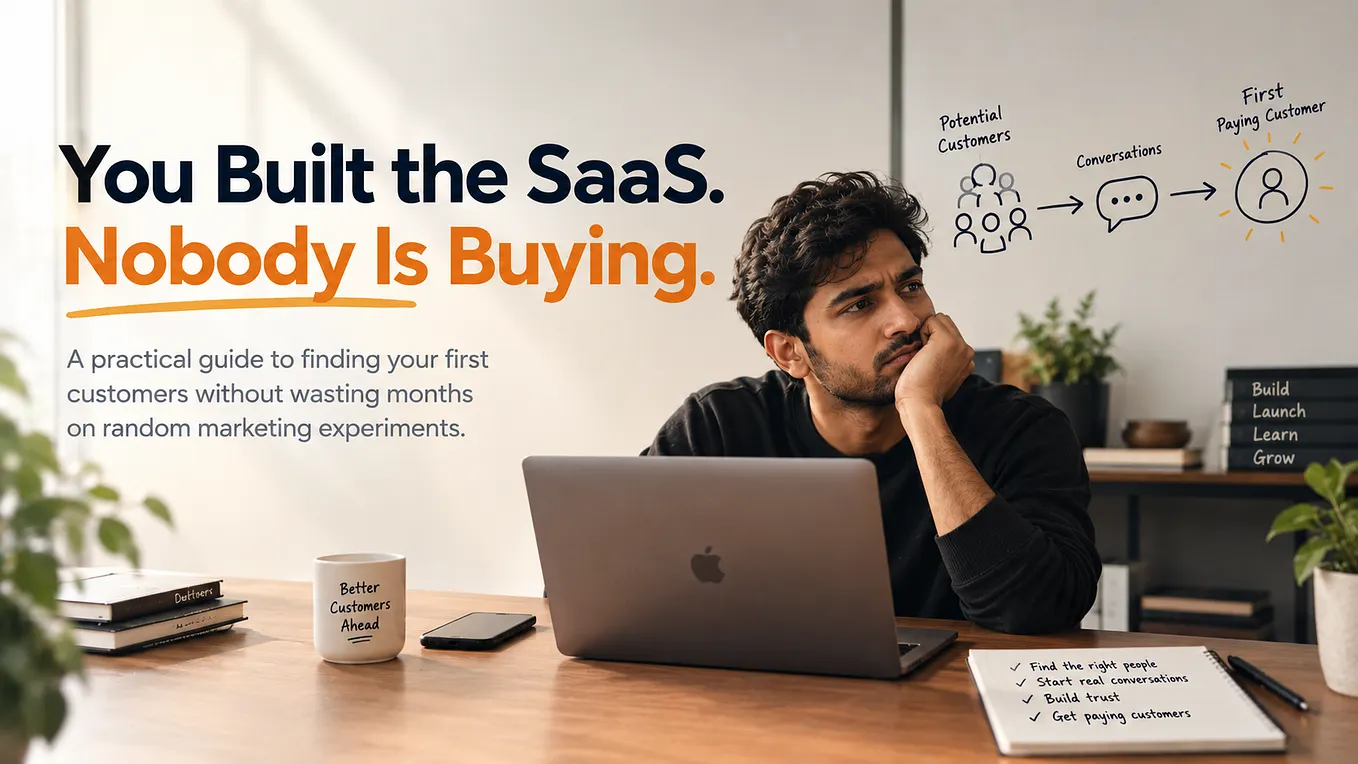
I Built the Product. Nobody Came. Here’s What Early-Stage Founders Should Do Instead.

You can build an MVP in a weekend. Getting one stranger to pay for it is a completely different challenge.
Imagine spending three months building your SaaS.
You finally launch.
You share it on X. You post in a few communities. You tell yourself that if the product is good enough, people will eventually discover it.
A few people visit your website.
Some like your idea.
Maybe a few even sign up.
But nobody pays.
Now you’re wondering:
Is the product bad? Is the pricing wrong? Do I need more features? Should I rebuild the landing page?
Before you change anything, consider another possibility.
Maybe your biggest problem isn’t your product. Maybe not enough of the right people know it exists.
This is one of the most frustrating stages of building a startup. And it’s a problem worth discussing more honestly.
Building has become easier. Distribution hasn’t.
AI coding tools have changed what a solo founder can build.
You can prototype an idea, create a landing page, build an MVP, and automate parts of your workflow faster than ever.
That’s a huge advantage.
But it creates a new challenge: more people can build products, which means more products are competing for the same limited attention.
Shipping another feature is something you can often do yourself.
Getting a potential customer to notice your product, trust you, and pay for it requires something different.
You need to understand a real problem, reach people who experience it, communicate your value clearly, and give them a reason to act.
And none of those things happens automatically when you deploy your application.
The ability to build a product is not the same as the ability to build a business.
What recent founder stories reveal about getting the first customer
A few recent examples are worth paying attention to.
In October 2026, a founder shared a story about getting their first paying customer after two years of building an AI video editor. Their account highlighted SEO, GEO, and discovery through ChatGPT as part of the acquisition story.
Another analysis published in August 2026 examined 70 solo-founder first-customer stories. Of the 59 founders who identified an acquisition channel, 20 attributed their first customer to an existing community.
These are individual stories and relatively small datasets, not proof that one channel will work for every startup.
But they suggest something important.
Early customers don’t necessarily arrive because a founder launches on the biggest platform or has the most impressive product.
Sometimes they arrive because the founder finds the right conversation, community, or search query at the right time.
That’s a more useful starting point than blindly chasing views.
1. Stop asking how to get more traffic. Ask where your customers already spend time.
This is the first change I’d make.
Instead of asking, “How do I promote my SaaS everywhere?” ask:
“Where are people already talking about the problem my product solves?”
For example:
- A tool for developers might find early users in developer communities, technical forums, or relevant GitHub discussions.
- A tool for marketers might benefit from marketing communities, professional discussions, and practical educational content.
- A tool for freelancers might find opportunities in communities where freelancers discuss client management, repetitive work, and business growth.
The important part isn’t the platform itself.
It’s the connection between the audience and the problem.
A community with 2,000 people who experience your problem can be more valuable than a platform with 200,000 people who don’t.
What to do this week
Choose one specific customer type.
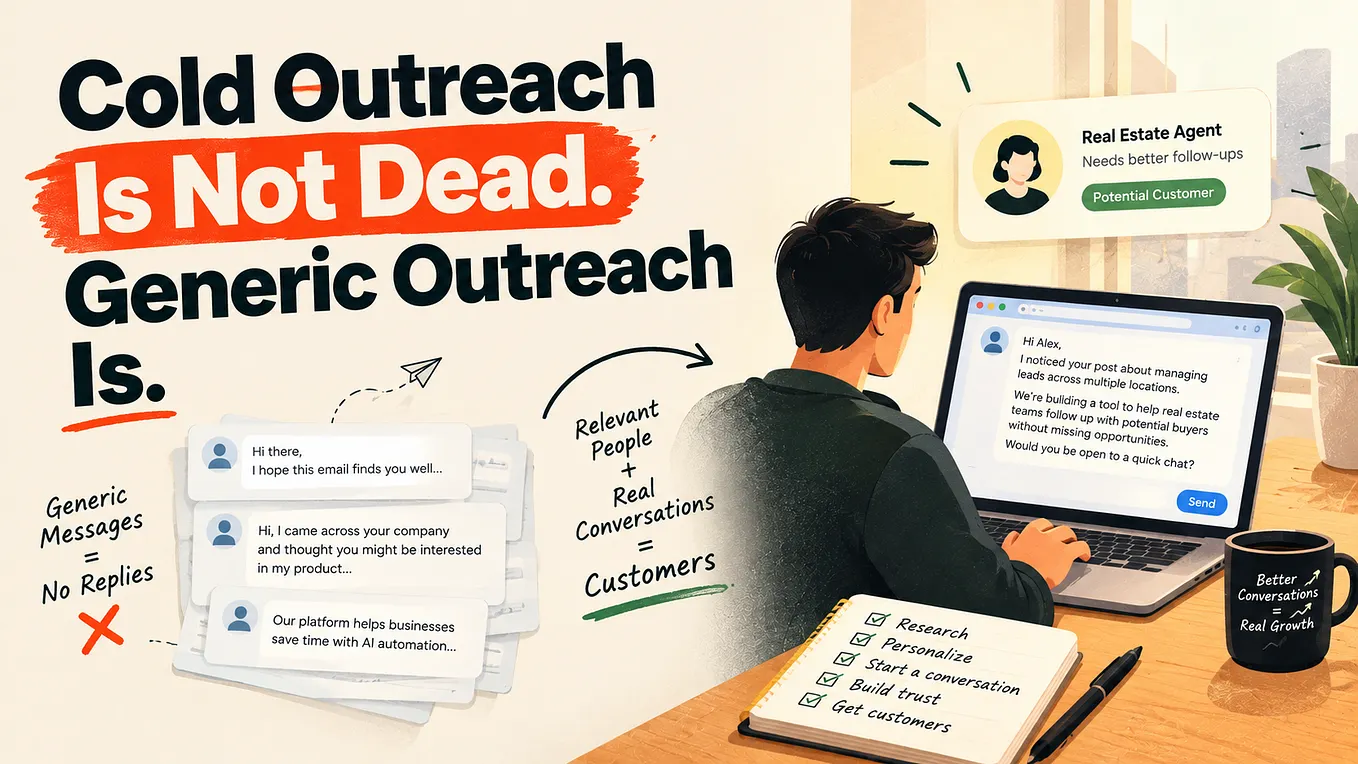
Find 20 discussions where people describe a problem related to your product.
Read the comments. Notice the words people use. Look for repeated frustrations, workarounds, and questions that remain unanswered.
Don’t immediately pitch your product.
Participate in the conversation. Give a useful answer. Ask a thoughtful question when appropriate.
Your first goal is to understand the people you’re trying to serve.
Your second is to become someone they recognize as helpful.
2. Talk to potential customers before building another feature
Founders often respond to slow growth by building more.
A new dashboard. Another integration. More AI functionality. A redesigned onboarding flow.
Sometimes those changes are necessary.
But sometimes the founder is improving a product without understanding why potential customers aren’t buying it.
Before adding another feature, speak to people who match your target audience.
Ask questions such as:
- How do you currently solve this problem?
- What is the most frustrating part of that process?
- How often does it happen?
- What have you already tried?
- What would make you switch to a different solution?
Pay attention to their actual behavior, not just whether they say your idea sounds interesting.
Someone saying “That’s a great idea” is encouraging.
Someone agreeing to test your product, introducing you to a decision-maker, or paying for a solution provides a stronger signal.
And if people aren’t interested, that’s useful information too.
You might discover that the problem isn’t painful enough, your audience is too broad, or your offer isn’t clear.
Those discoveries can save weeks of unnecessary development.
3. Don’t confuse free users with paying customers
Free signups can help you learn.
They can reveal usability issues, show which features people use, and help you improve onboarding.
But free users don’t automatically validate a business.
A person may sign up because your tool looks interesting without having any intention of paying for it.
That’s why early-stage founders should test willingness to pay as soon as they can offer a credible solution.
You don’t necessarily need a perfect product.
You do need a clear promise and an honest explanation of what the customer will receive.
Try this:
- Identify a problem that costs your target customer time, money, or missed opportunities.
- Explain the outcome your product provides in one sentence.
- Show how your solution works.
- Offer a paid pilot, an early-access plan, or a clearly defined paid version when appropriate.
- Ask people who decline what prevented them from buying.
Don’t invent demand by collecting waitlist signups and treating them as sales.
Get Sam’s stories in your inbox
Join Medium for free to get updates from this writer.
A waitlist is a useful early signal. A real payment is stronger evidence that someone values the solution enough to spend money on it.
4. Pick one acquisition channel and work on it consistently
One mistake early-stage founders make is trying everything simultaneously.
Monday: X.
Tuesday: Reddit.
Wednesday: LinkedIn.
Thursday: SEO.
Friday: Product Hunt.
The founder ends the week exhausted, with little information about what actually worked.
A better approach is to choose one primary channel based on your audience and run a focused experiment.
For example, spend the next 30 days testing a channel that lets you reach potential customers directly.
Your experiment might look like this:
Week 1 — Understand the audience
Study relevant discussions, interview potential users, and identify the problems that appear repeatedly.
Week 2 — Create useful content
Publish practical answers, explain common mistakes, and share lessons that help your target audience even if they never buy your product.
Week 3 — Start relevant conversations
Respond to people discussing the problem. Offer product access only when it genuinely fits the conversation.
Week 4 — Review the evidence
Track meaningful conversations, qualified visitors, product trials, activation, and paid conversions.
Then decide whether to improve your approach, continue testing, or try another channel.
Thirty days won’t guarantee customers. The goal is to replace random promotion with a measurable experiment.
5. Treat distribution as part of product development
This is probably the most important lesson.
Many founders think the process looks like this:
Build → Launch → Market → Get customers.
But what if distribution started before the product was finished?
Imagine talking to potential customers while you’re still defining the problem.
You learn how they describe it. You discover what solutions they already use. You test your positioning before writing a hundred lines of code.
When you finally release the MVP, you aren’t introducing a completely unfamiliar idea to strangers.
You’ve already started building relationships with people who understand the problem.
This doesn’t mean every conversation will become a customer.
It means you’re learning about the market while you’re building, instead of waiting until launch day to discover whether anyone cares.
Distribution isn’t just about getting attention for a finished product. It’s also a way to learn what product deserves to exist.
6. Use AI to move faster, not to avoid talking to people
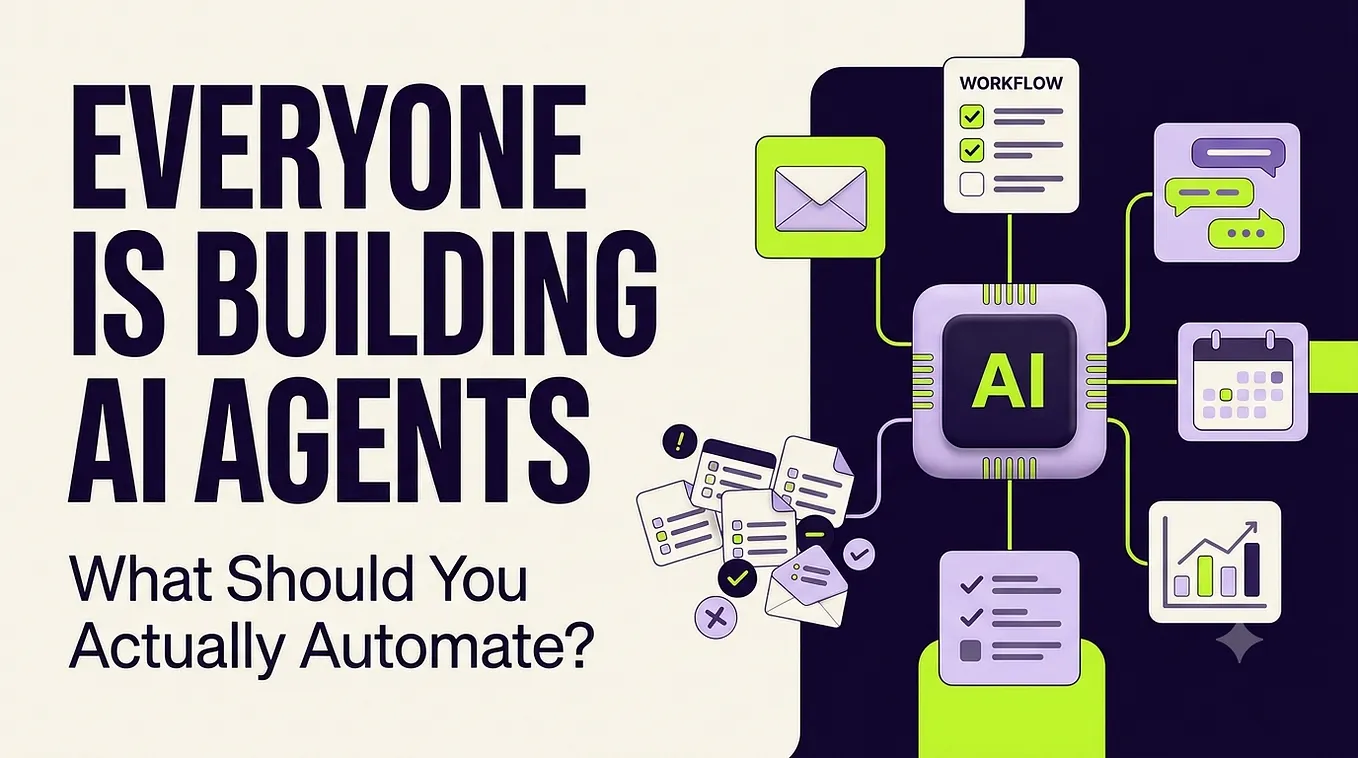
AI can help founders research markets, analyze feedback, draft content, build prototypes, and automate repetitive tasks.
Use it.
But don’t let it become another way to stay busy without speaking to potential customers.
You can generate 50 marketing posts in minutes and still have no idea why someone would pay for your product.
You can build a sophisticated AI-powered feature and discover that your target customer doesn’t need it.
You can optimize your landing page for hours without knowing whether you’re attracting the right people.
AI makes execution faster.
It doesn’t automatically give you customer understanding, trust, or product-market fit.
The founders who benefit most will combine faster execution with real-world feedback.
A simple challenge for founders who still have zero paying customers
If I were starting from zero today, I would focus on this challenge for the next seven days.
- Choose one specific customer segment.
- Find 20 people who fit that segment.
- Have at least five genuine conversations about their problems.
- Identify one problem that people already spend time or money trying to solve.
- Show a small, relevant solution to the people who expressed interest.
- Make a clear offer and ask whether they’re willing to pay.
- Record what happened, including rejections and objections.
These are targets for an experiment, not a formula that guarantees your first sale.
If nobody buys, don’t immediately conclude that you’re a bad founder.
Investigate the evidence.
Maybe you’re talking to the wrong people. Maybe the problem isn’t urgent. Maybe your offer is unclear. Maybe the solution needs work.
Each possibility requires a different response.
That’s why real conversations and measurable results are more valuable than vanity metrics alone.
The real milestone isn’t launching. It’s learning why someone buys.
Getting your first paying customer is exciting because it proves that at least one person is willing to exchange money for the value you’re offering.
But the deeper lesson is understanding why they bought.
What problem were they trying to solve?
What made them trust you?
Where did they discover your product?
What almost stopped them from purchasing?
Could you find ten more people with the same problem?
Those answers give you a foundation for repeatable growth.
Your first customer may come from a Reddit discussion, an X post, a search result, a personal introduction, or a direct conversation.
The channel matters.
But understanding the customer and repeating what works matters more.
Building a product is an achievement.
Building something people want, finding those people, and earning their trust is the beginning of a business.
One question for founders
If you’re building a SaaS, micro-SaaS, or side project right now, I’d genuinely like to hear your experience.
What’s your biggest challenge today?
- Building something people actually want
- Getting your first 10 users
- Converting free users into paying customers
- Finding a marketing channel that consistently works
And if you’ve already landed your first paying customer, how did you get them?
I’m especially interested in real experiences from founders who are still in the early stages — not just stories about scaling to millions in revenue.
Because the journey from zero to one deserves just as much attention as the journey from one to a thousand.