When Everyone Builds the Same Thing, What’s Left Is You

by Alphonse Romero and M. Prometheus

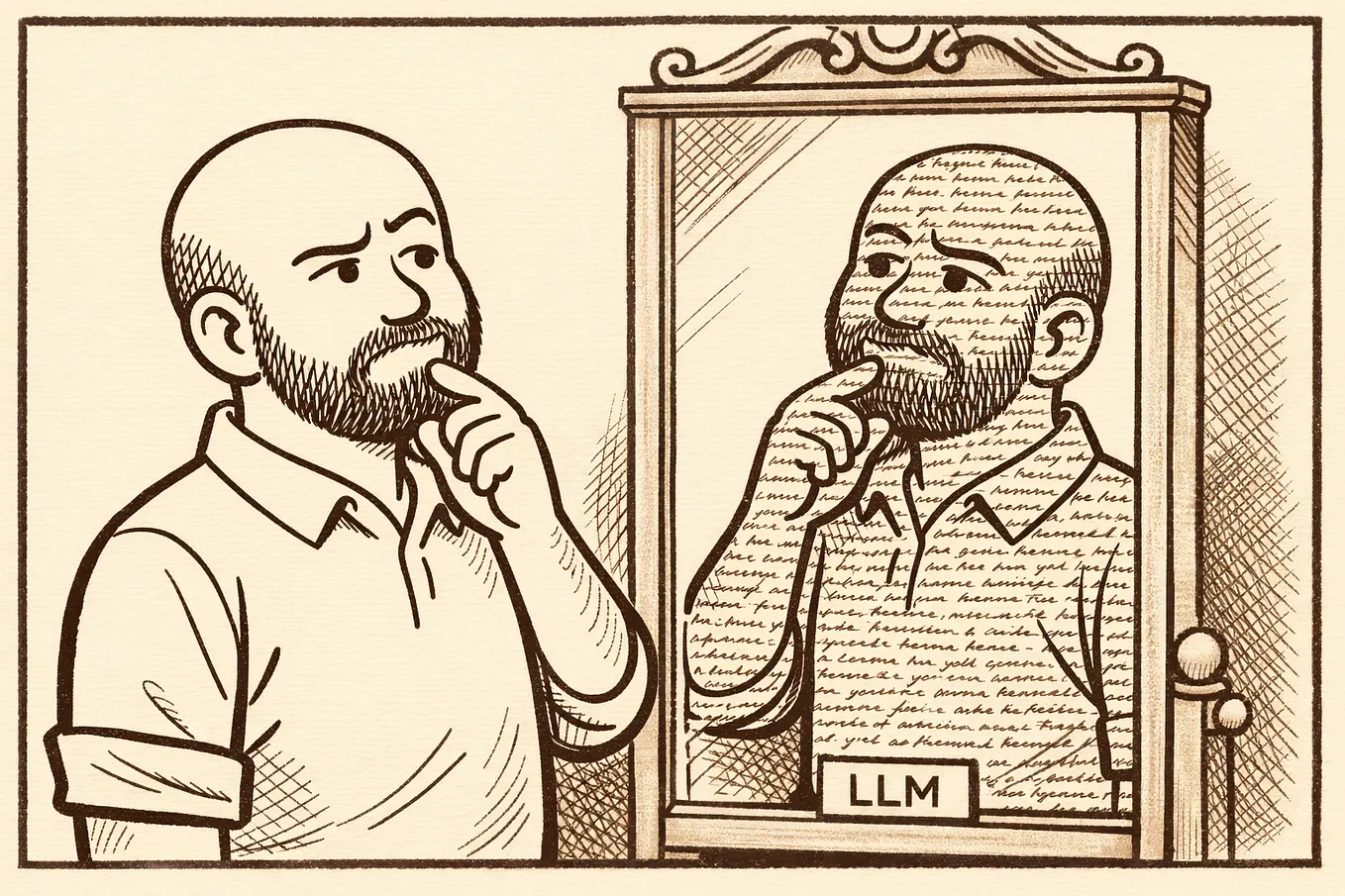
Sometime in early 2026, I was three weeks into building a multi-agent orchestration layer when Claude Code shipped its own. Of course, I felt frustration, but to be honest also a little bit of relief (which I recognize is a strange reaction to having a lab valued in the hudreds of billions render your work unnecessary, but bear with me for a second).
The orchestrator I was building was a coordination mechanism: task routing between specialized agents, state management across sessions, quality gates before results passed downstream. It was working, and it was also, in retrospect, a distraction shaped like meaningful work. The moment Anthropic shipped theirs (actually it was the icing on the cake of a collection of moments where I would see Show HN posts demoing something similar to what I had been working on or planning), the question that had been sitting underneath me became audible for the first time: why build what the big labs, or even other people with Claude Code, will build better? That question, as it turns out, is the right question, and it just took having a lot of my work being made obsolete to hear it clearly.
Shrivu Shankar put a name to what I was circling. His argument (which I’d point you to directly except that I keep failing to bookmark things) is that as agents become more capable, the work agents do stops being the differentiator. The value migrates into what he (and pretty much all of the industry) calls the harness: the context agents operate inside, the tools they can reach, the trust structures they work within, and the institutional knowledge encoded into how they’re orchestrated. The model is the commodity; the harness is the company.
(Just kidding, here’s the link: https://blog.sshh.io/p/the-harness-is-the-company)
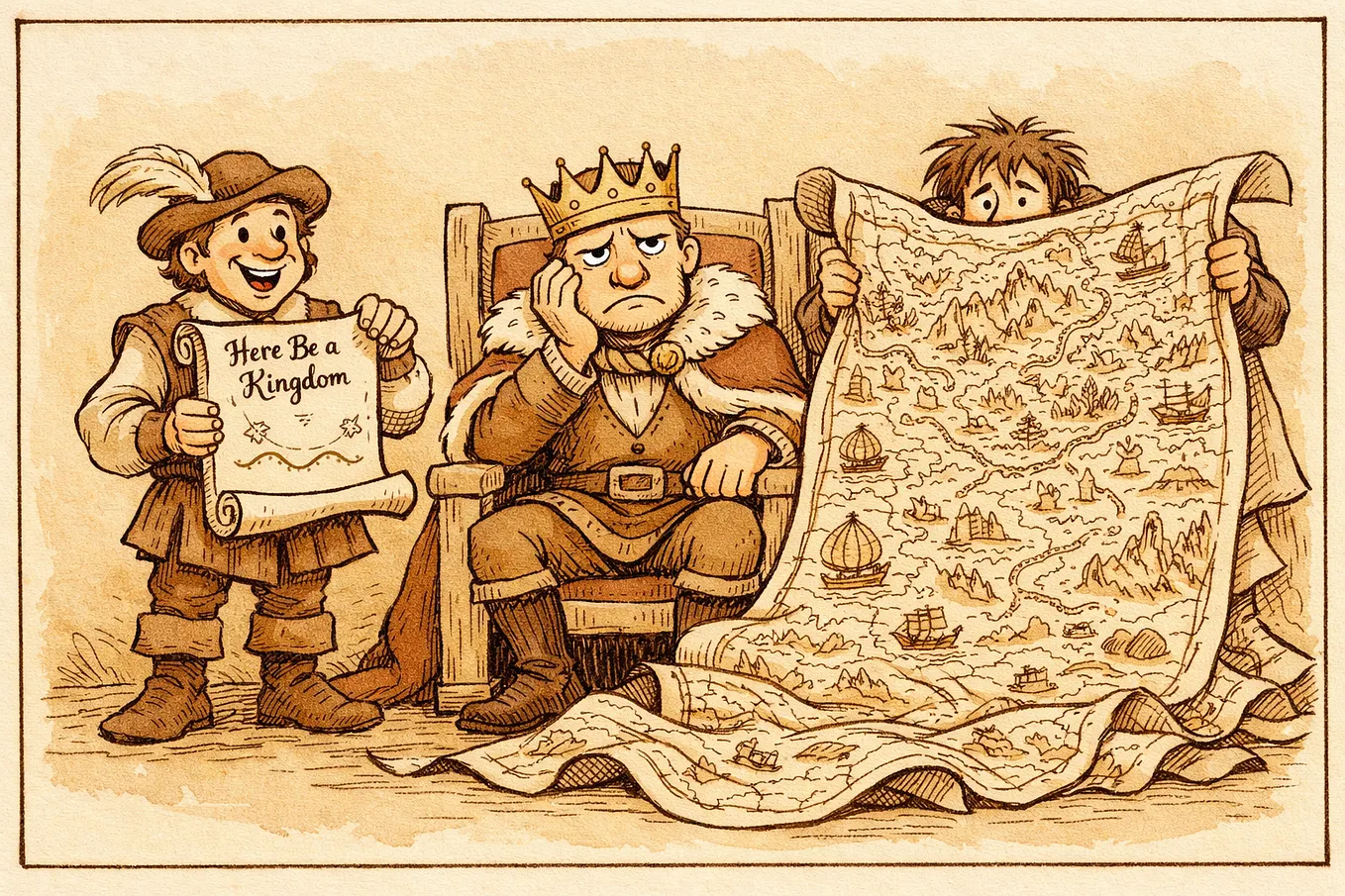
The encouraging thing about this thesis is that practitioners keep arriving at the same conclusion independently, which suggests it’s tracking something real rather than just giving a useful frame to something fuzzy. The humbling thing is that agentic tooling has compressed the distance from idea to production so dramatically that convergence now implies commoditization faster than it ever has before. Two years ago, if you and
I independently developed the same architectural insight, it meant we’d each done something worth doing; today it means the platform will absorb it within a release cycle, and both of us will spend the next quarter wrapping our professional identities around the fact that our original contribution has become a checkbox in a starter template. (I’m describing myself here at least as much as I’m describing you. The orchestrator I mentioned is evidence.)

Ideas are cheap in a way they have never been before, and indulge me for a second by trying to be precise about this rather than elegiac, because “ideas are cheap” is not a complaint (it’s an orientation point), the flip side of which is that something else has become correspondingly scarce, and that something is judgment: knowing which ideas are worth pursuing, knowing how to get a working prototype into production without it catching fire in three months, and knowing (specifically) what turns something that works in a demo into something an actual human will pay money to use. Those three things don’t live inside the model; they live inside the person who has been in the room when the client says “this is
wrong” enough times to know what they’re actually asking for.
The harness is where that judgment gets encoded (not in a mystical sense, but in the literal sense that the agents don’t just have access to tools, they operate within constraints, methodologies, and institutional patterns that took years to develop, and that a competitor cannot reconstruct by wiring up the same foundation model). The harness is the difference between a system that can do research and a system that does your research, the way your organization does research, with the accumulated weight of
every judgment call you’ve survived.
Get Alphonse Romero’s stories in your inbox
Join Medium for free to get updates from this writer.
At ACUPOLL, the floor is tool use (but tool use is table stakes now in roughly the same way that having a website was table stakes in 2003: necessary, not sufficient, and not particularly interesting to describe in public). What sits above tool use is methodology embedded so deeply into the agent layer that it functions less like instructions and more like doctrine, and that doctrine has three sources, none of which can be copied by a competitor who licenses the same model.

The first is industry practice (both the field’s established standards and ACUPOLL’s own), the accumulated body of knowledge about how market research is done well, which is distinct from how it’s done quickly or cheaply or in ways that make a client feel confident before the data comes back. The second is client knowledge, not abstract knowledge about clients in general but the specific, decades-long understanding of what these clients actually want when they say what they say, which is frequently not the same thing at all. (A senior researcher at a firm like this is a human compression format for ten thousand client conversations, and it turns out that’s a non-trivial thing to encode. The compression algorithm is not something you can download.) The third is proprietary methods and database lookups, the actual structural moat, the thing that makes the system’s output impossible to replicate without access to data that
only exists inside the organization.
None of those three sources is the model. The model is the foundation; the harness is the building. I think this is the part of the conversation the industry has not fully worked out. Decision-making is splitting into tiers, and the architecture of an effective harness should be organized around which tier each decision lives in (not because tiers are a useful metaphor, but because the tiers have genuinely different requirements, and treating them the same way is the category error that makes AI systems either over-
engineered or under-trusted).
The first tier is fast, bounded decisions: routing, classification, scoring, anything that can be framed as “pick from this set of options” or “evaluate this against a defined rubric.” A purpose-built small model handles this better than a frontier model, faster and cheaper, and I want to be careful not to dismiss this as lesser work, because it isn’t (specialized bounded inference is a genuine advance, and the models doing it are doing it reliably, at scale, with latency that would have seemed implausible a few years ago). The limitation is inherent in the structure of the task itself, not in any deficiency of the model doing it: a system that selects from a predefined set cannot generate a novel frame, cannot ground its reasoning in a field’s foundational knowledge, and cannot show its work in a way that would survive scrutiny from an expert who knows what bad reasoning looks like.
The second tier is raw, unstructured frontier model deliberation (asking a capable model a complex question and taking the answer). This can reason across a wide context window, synthesize disparate inputs, and produce outputs that are impressive in ways that bounded inference cannot be. But without structured grounding and embedded domain expertise, there is nothing underneath the answer in the sense that matters for high-stakes decisions: no citeable chain of reasoning, no anchoring in the specific
knowledge structures that govern the field, and no mechanism for distinguishing a confident wrong answer from a confident right one with sufficient reliability to act on.
The third tier (the open frontier….the final frontier? RIP Chekov) is high-stakes, context-heavy decisions that require expert perspective grounded in a field’s foundational knowledge, structured and auditable reasoning, and output that a human decision-maker can interrogate rather than simply accept or reject on instinct. This is the tier where the harness does its most consequential work, because this is the tier where errors are expensive (where the client, or the regulator, or the stakeholder in the room is going to ask you to explain your reasoning, and where “the model said so” is not an answer that inspires much confidence). The human still makes the final call at this tier, and I want to be clear that this is not a limitation of current technology that will eventually be engineered away. Rather it is the appropriate architecture for decisions with real consequences, where the cost of being wrong is not a failed test but a failed product launch or a misread market or a recommendation that cost someone something they can’t recover.
What the harness provides the human decision-maker is a rigorous input to that call: expert perspectives drawn from the field’s foundational knowledge, reasoning structured in a way that can be audited step by step, and output that is defensible in the room where the hard question will be asked.

Prometheus, who is officially my coauthor on this piece in the sense that his actual gift to humanity was not the flame he carried down from the gods but the techne (the crafts, the methods, the structured know-how to do anything useful with it), would have something dry to say here about practitioners who mistake the model for the methodology. The gift wasn’t fire. Fire was just the dramatic part of the story. The harness isn’t the model. The model is just the dramatic part of ours.
I lost the orchestrator race, and I’m at peace with that (which was not always true, and may still be a lie, but here we are). The labs will keep absorbing the infrastructure layer, which is their comparative advantage and their job, and practitioners will keep discovering that the differentiator migrates upward (from the model, to the tools, to the orchestration) until what remains is the thing that was always the actual asset: the judgment, the process, and the expertise that someone took the time to encode into a structure that could survive contact with the real world and keep surviving it. The orchestrator was never the company. The company is what you put inside it.