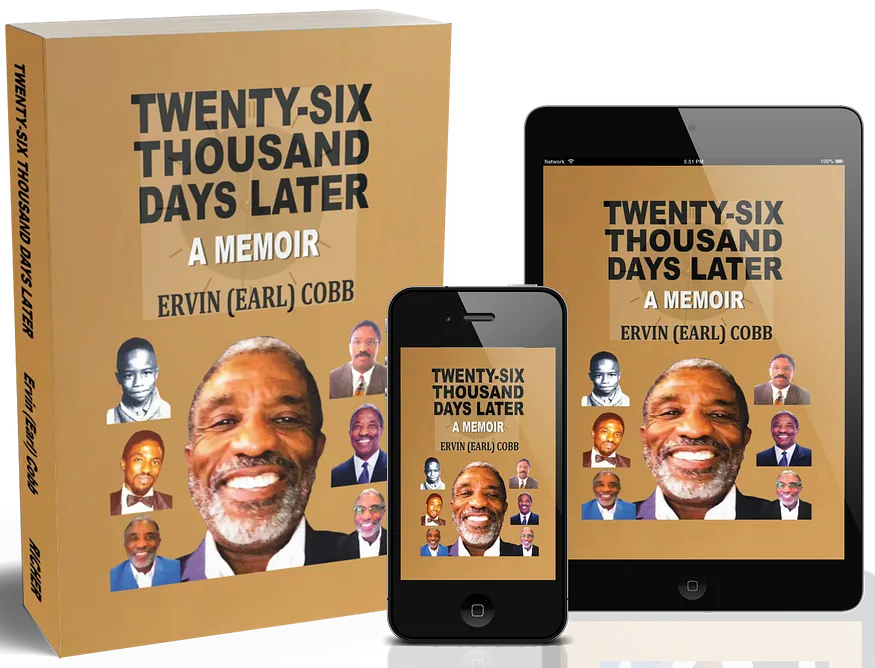
Twenty-Six Thousand Days Later. A Memoir. A Preview of Part Two.


This is a new Forthcoming Book.
Written by Ervin (Earl) Cobb.
All Rights Reserved.
A Preview Reading of Part Two of the new book.
PART TWO.
My Life as a Lifetime Student. Not Getting Stuck On Stupid.
Most Memorable Moment.

My most memorable moment during this stop of my life’s journey was how I was so focused on being the top student in every class in school. Not as an obsession, but as a necessity. It has always meant a lot to me to be a good student.
This started in the first grade and continued through High School and College.
Below is a copy of my 11th grade Performance Report Card. It was required to have it signed by your parents. As you will note, my mother always signed our Report Cards each semester. It also meant a lot to me to have my parents know that I was doing my best. There was no pressure from them. Just unconditional love — and their comfort of knowing that, I was not going to get stuck on stupid, as long as I had the opportunity to improve my intellectual capacity and reasoning skills.

AUTHOR’S NOTE.
Not Getting Stuck On Stupid.
Yes. Part Two discusses my life as a lifetime student.
However, I must share here that as I recently reflected upon this period of my life for this book, I have come to believe that the discussion in this section does much more.
In the broadest sense, by uncovering the two factors which most likely directly contributed to my insatiable thirst to be the top student in all my classes, the following discussion in Part Two personifies two things.
One. The educational environment within which I was able to rise above the perils of normal segregated school standards of the time; and
Two. The coping mechanism I used to battle what I feared the most, which was getting stuck on stupid.
I do recall very early in life when I struggled with understanding the psychological difference between being “ignorant” and being “stupid.” I spent one night flipping through the set of Encyclopedia Britannica that my oldest brother Andrew sent home for the family while he was in the Army.
The definitions which got permanently trapped in my mind were:
Ignorance is simply a gap in knowledge or a neutral starting point that everyone experiences whenever they encounter a new skill, culture, or subject; and
Stupidity often stems from overconfidence, impulsivity, or an inability to connect cause and effect.
For some strange reason, for years I kept telling myself, when I was confronted with a new assignment in school, “Earl, you really got to take the time to understand this — you can not get stuck on stupid.”
Now that you know this little secret and most likely why I became an engineer — Let’s move on to PART TWO.
SECTION ONE OF PART TWO.

From Primary School to High School Coping with My Need to be the Top Student.
The photograph above is of the Vienna High and Industrial School, located in Vienna, Georgia. The marker states that the school was established in 1959.
At the time, I was six-years old, and in the first grade.
The campus not only included the Vienna High and Industrial School, but also housed Primary and Elementary Schools, as well as a small food canning facility.
The canning facility was utilized by the local community in summers to process and preserve collard & turnip greens, peas, butter beans, and peaches — as well as an assortment of jellies.
This large and fully equipped campus was established as a consolidated school for Blacks during legal segregation.
There are “two realities” about this school and campus we should discuss during this second stop of my life’s journey and, in turn, gain an understanding of my need to be the top student.
As I reflect back on this circumstance today, it becomes clear that both of these realities were major factors involved in my thirst to excel.
The First Reality.
As part of Georgia’s massive resistance to federally mandated school integration, politicians and school officials sought to address the blatant geographic and racial disparities in education.
Their answer was to construct hundreds of new (but still segregated) schools across the state during the 1950s.
As you may recall, The U.S. Supreme Court ruling that established and supported the “separate but equal” doctrine was made on May 18, 1896, in the landmark case Plessy v. Ferguson.
The doctrine lasted as a valid constitutional precedent for 58 years.
It was finally overturned on May 17, 1954, when the Supreme Court issued its unanimous decision in Brown v. Board of Education, ruling that state-sanctioned racial segregation was unconstitutional.
This reality was an “enabling factor” and had three dimensions.
The first dimension is obvious.
The decision to build these schools was out of defiance of federal law and to maintain Georgia’s segregated school system.
Yet, on the other hand, the second dimension was the fact that Black residents of Georgia could finally experience an educational opportunity which may come close to being “separate but equal.”
And third, but more importantly for me and my family, since 1959 the Vienna High and Industrial School campus site has been located along the urban stretch of Hawkinsville Road in Vienna, Georgia.
Hawkinsville Road in Vienna is a part of Georgia State Route 27; a Key Junction inside the eastern side of Vienna.
The Second Reality
The house that I called “home” from 1953 until I finished high school and left to attend college at Tennessee State University in 1971 was also located along Hawkinsville Road in Vienna, Georgia.
In fact, the address of the house was 817 Hawkinsville Road.
817 Hawkinsville Road was located directly across from the Elementary School on the Vienna High and Industrial School campus.
Was this a dramatic Irony, a mere coincidence, or a blessing?
As I think back on my Primary to High School education, and what appears to be an insatiable thirst to be the top student in all my classes, the only constant factors which come to mind are:
The first, the proximity of my family home and the schools I attended for twelve years, and
The second, the “enhanced” school facilities, books, teachers, and learning opportunities enabled by the establishment of the new segregated Vienna High School campus erected in 1959.
It seemed like a Godsend.
I remember getting up earlier than I needed to in the mornings during school days when I was in Elementary School.
I had several chores to do before school. It was my job to always take out the kitchen trash before I would run across the street to school.
And, I literally “ran” across the street to school every morning.
Now. In the winter months, before we got the gas heaters in the house, I was also responsible to take additional wood and coal in the house for Mom so she could keep the house warm during the day.
I have vivid memories of these days in my life. It was my goal and it was very important to me to be the first student in my classroom every morning.
Getting to school early allowed me to review my homework to make sure all the answers were correct or discuss problems I may be having with my homework with my teacher.
I fondly remember forgetting to do one of my morning chores one day and getting chastised by my oldest sister Laura when she was home visiting Mom and Dad. She would ask me, “Boy. Why do you have to be at school so early every morning.”
Now, it all rings clear in my mind as to how I coped with my need to be a top student, and why.
Get Ervin (Earl) Cobb’s stories in your inbox
Join Medium for free to get updates from this writer.
In hindsight, getting to school early, closely critiquing my work product, and having no fear of asking questions or for help was a natural academic routine for me.
It was, and still is, a personal means of coping or satisfying a level of mental focus and commitment to excellence.
A hunger and coping mechanism, I have maintained my entire life.
We lost our dear Sister Laura, in 2016, as she was battling kidney failure, at the age of 79.
May she rest in peace.
SECTION TWO OF PART TWO.

Why My Success as a College and Graduate School Student was No Surprise
As we all know, success in college is not a single, one-size-fits-all milestone.
Instead, it combines traditional academic benchmarks with personal growth, well-being, and future readiness.
I am fortunate and thankful that in both my college and graduate school endeavors, I have accomplished all of the traditional and institutional definitions of success.
Of course, the traditional accomplishments include — degree completion, academic achievement and financial viability.
As you might be aware by now, for me, this includes earning a Bachelor of Science with honors in Electrical Engineering from Tennessee State University in 1975; and a Master of Science in Engineering from Arizona State University in 1977.
Also, in hindsight, I believe my personal and professional goals were also achieved, which were intellectual growth, a sense of belonging and work-life balance.
However, as I think back and mentally examine what I now believe were the most significant factors behind my accomplishments and my achievements, three key factors are most prominent in my mind.
Here are the three factors and some insightful details, in my own words, based on the life I have lived.
The first factor was my Early Academic Excellence. This included:
Top High School Honors. I graduated in 1971 from the first integrated class at Vienna High School in Georgia and finished with a near-perfect academic record. I was named the Top Honor Student in my graduating class; and
Consistent Study Habits. I credit my college readiness not to a single last-minute push, but to years of disciplined effort invested in my education starting as early as 1959. Even during my childhood, my family’s Sunday routines regularly concluded with late-night school homework.
The second factor was my Strong Family Values and Support. This included:
Work Ethic and Expectations. I was raised in poverty in a four-room house built by my father. I grew up watching my parents work multiple jobs to keep food on the table, and provide daily school lunch money for eight children. Yet, my home life was filled with faith, love, and high expectations; and
Guidance from Siblings. My older siblings actively paved the way for my transition to higher education. My brother Andrew, an Army veteran already attending Tennessee State, helped me navigate the financial aid and admissions process, while my sister Doris coached me on interpersonal skills and navigating newly integrated environments, and finally
The third factor was my Mental Fortitude and Long-Term Vision, which included:
Overcoming Adversity. Growing up under strict segregation taught me to channel painful experiences — such as being forced into segregated seating or having my high school homecoming coronation canceled due to racial tensions — into motivation to prepare myself educationally and psychologically.
Prioritizing the Future. Before starting college, I worked a summer job as a porter at a G.C. Murphy store in Florida. When offered a promotion and higher pay as a Stockroom Foreman, I turned it down, recognizing that investing in my college education was a far better decision than earning immediate money; and
Commitment to Excellence. I lived by the principle of starting every task the way I wanted it to finish, bringing full energy and teamwork to every role — a mindset that carried me from undergraduate honors through graduate studies at institutions like MIT’s Sloan School of Management and Stanford’s Graduate School of Business.
NOTE: You can learn more about my post-graduate school life by reading the transcript of an Interview I had on April 18, 2023, with Arizona State University and the Ira Fulton Schools of Engineering. The interview was a part of the 2023 Ira Fulton Schools of Engineering Oral History publication, designed to engage ASU alumni through story collection. In the interview I share my personal experiences from my time at Arizona State University, and how the school helped to shape my life since then. The transcript of the interview titled, “Oral History Project Interview” is located in Part Eight of this book.
SECTION THREE OF PART TWO.

Maintaining a Lifelong Learning and Growth Mindset.
As I reflect back today on my focus on lifelong learning, I can draw a strong correlation between being a lifetime student and feeding my personal, professional, emotional and spiritual growth.
So much so, there has not been a need for me to exert any conscious effort to maintaining my lifelong learning and growth mindset.
My growth mindset or frame of mind has seemed to naturally expand with time and deepen throughout a variety of life experiences.
Let me explain, and share a philosophy that has evolved and grown from my early childhood in Vienna, Georgia through the thousands of days I have experienced and absorbed life while actively living, working, and socializing in multiple cities in the United States — including Nashville, Phoenix, Seattle, Scottsdale, Dayton, Charlotte, Gaithersburg, and Savannah.
EARLY IN LIFE.
I learned early in life that if we are serious about our own personal, professional, emotional and spiritual growth, we should also be serious about the concept of learning for life.
We should never stop our insatiable thirst for learning new things and encountering different perspectives.
If we were to cease doing that, our development as a complete person would also cease.
As children it would be unusual to think that we could endure if there were not people to teach us things.
From the moment we are born, we are taught lessons by our parents, family members, relatives and close friends.
These lessons continue through childhood with our parents and teachers all providing us with learning opportunities.
OUR ADULT LIFE.
As adults, it is considered quite acceptable to learn new job skills and obtain qualifications to further our professional careers.
The distinction of a college degree and a post graduate certification reminds others that we have learned more, we know more and we can do more.
But as adults, when it comes to benefiting from experiences of other adults to get even better, [outside of purely academic settings] society tends to have implanted within us a belief that we should not openly acknowledge the need or take the need seriously.
We should simply work things out for ourselves, accept life’s negative outcomes as our destiny and to do this in a quiet and private way.
However, such an approach to life-long learning results in never having the chance to make any important changes in our adult perspectives, our current careers or our present lives.
I believe that life is all about evolving.
Evolving through learning from others and making the changes needed to become an even better person, an even better professional and more of an asset to all of those we touch.
And, those who touch us.
LEARNING FROM OTHERS.
Learning from others also helps us grow emotionally and spiritually. It keeps us from making the same mistakes as others.
The splendor of wanting to learn from others is that we remain open and willing to listen. This, in return, draws others towards us and opens many new doors and experiences.
It should, therefore, not be perceived as any sign of weakness if, as an adult, we openly express our desire to learn how to improve and develop ourselves as human beings more fully by seeking the advice and insights of other more learned people.
I truly believe that learning from others is what nourishes and sustains our own personal, professional, emotional and spiritual growth.
WITHIN AND BEYOND PHILOSOPHY.
Within this philosophy, maintaining a lifelong learning and growth mindset requires pairing intentional daily habits with a resilient attitude toward challenges and feedback.
Yes, I know. This is a philosophy that has evolved along my life’s journey. But, we all have our own unique journey in life.
As I evaluate my journey thus far, I have learned that it is important that we have and benefit from a personal philosophy.
I have found that my personal philosophy acts as a mental compass.
It has helped me make decisions, process hardships, and find meaning through my daily challenges.
However, I am reminded of the wise words of Epictetus — a Greek Stoic philosopher who was born into slavery in ancient Greece.
He once said, “Don’t explain your philosophy. Embody it.”
In other words, your daily actions and character speak far louder than the ideals, principles, morals, and ethics you claim to hold.