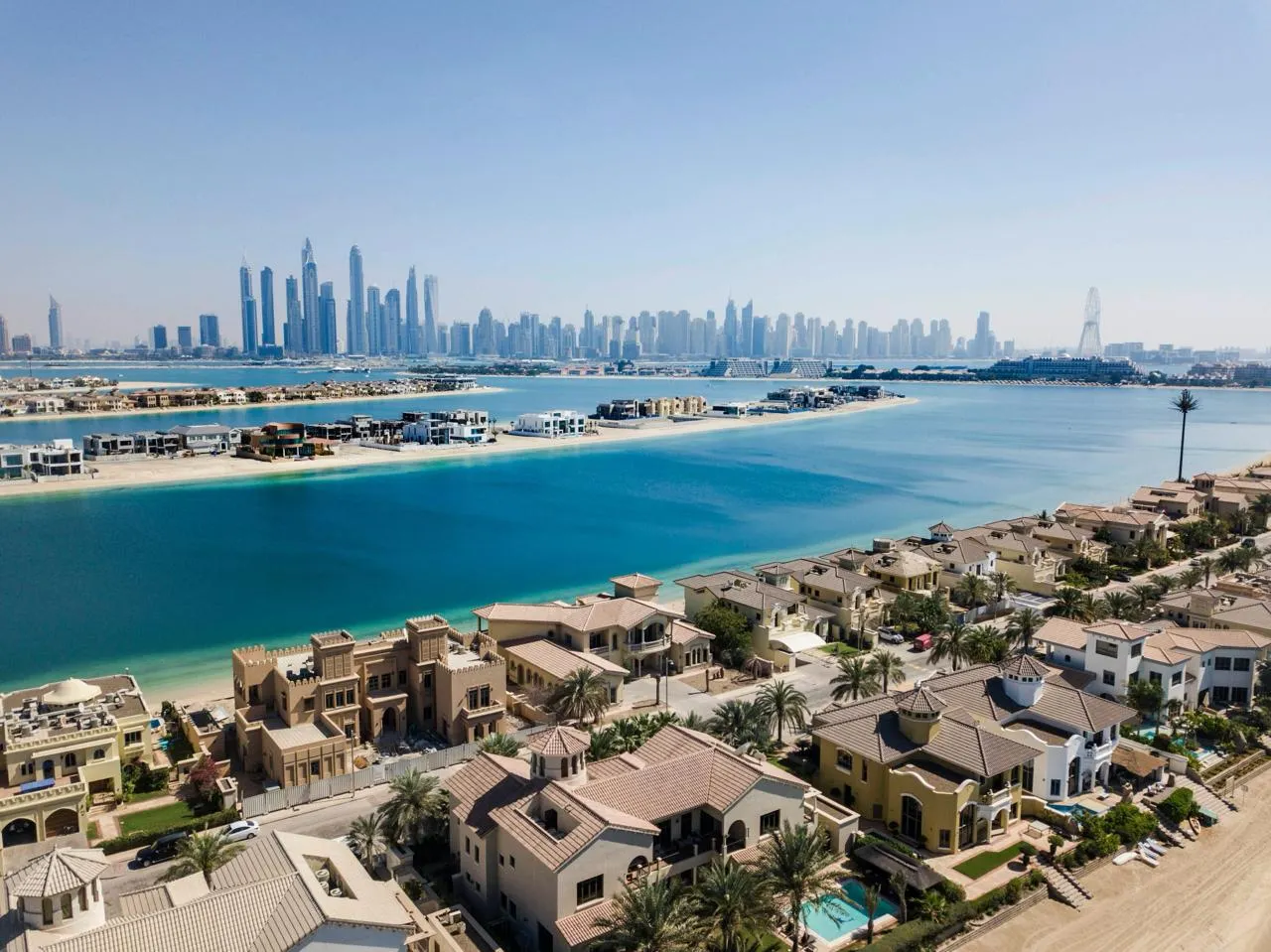
Buying off-plan property in Dubai — what the DLD escrow system means for German buyers

This briefing explains why the escrow system of the Dubai Land Department under Dubai Law №8 of 2007 offers German buyers more security in off-plan projects than most European pre-sale models — and what tax consequences arise under German law when acquiring property in Dubai that has not yet been completed.
Legal status: October 20, 2026
Eisenberg Europe & Middle East — October 2026
Author: Dr. Wolfgang Eisenberg, German specialist lawyer for tax law
Reviewed by: Dr. Fabian Ibel, Corporate and Compliance Lawyer

Disclaimer: This article is for general informational purposes only and does not constitute individual legal or tax advice.
1. What has changed since September 2026?
Since September 3, 2026, the new Oqood 2.0 system of the Dubai Land Department (DLD) has been in effect. Initial registration for off-plan contracts now runs entirely digitally via the DLD REST platform; the previous paper-based Oqood process has been abolished. For German buyers, little changes in terms of substantive protection, but speed improves significantly: registration of a Sale and Purchase Agreement (SPA) now takes hours instead of days.
The legal basis remains Dubai Law №8 of 2007 (Escrow Account Law), administered by the Real Estate Regulatory Agency (RERA) as the supervisory authority. RERA maintains the project register, monitors construction progress, and may, under Article 11 of the law, freeze projects and account withdrawals if the developer violates the escrow requirements. A detailed overview of the current legal framework is available on the Dubai Land Department website.
The market dynamics are reflected in numbers: between January and September 2026, approximately 250 new off-plan projects with a total of 78,376 residential units were registered. Of these, 160 projects — roughly two-thirds — had zero percent construction progress as of the reporting date. For buyers, this means that the escrow rules apply to the majority of properties currently on the market.
2. How does the escrow system work?
The escrow system under Dubai Law №8 of 2007 separates the payment flows of an off-plan project from the developer’s other assets. Every approved developer must open a separate escrow account for each individual project at a bank approved by RERA. Buyer funds flow exclusively into this account; the developer may use them only for construction costs, consultant fees, and administrative expenses of that specific project.
Funds are released based on construction progress. A surveyor appointed by RERA confirms the respective degree of completion; only then does the escrow bank release the next tranche. After completion and handover of the project, a retention of five percent of the purchase price remains in the escrow account. This retention serves as security for defects during the warranty period and is only paid out to the developer after it expires.
For German buyers, the model is comparatively transparent: they know that their money is tied to the project, and they can see in the DLD register how far the project has progressed. Access by the developer to the funds for other projects or for general business expenses is legally excluded.
3. What guarantee must the developer provide?
Before RERA grants a developer approval for off-plan sales, the developer must demonstrate a guarantee of at least 30 percent of the estimated project value. The law provides three methods of proof.
The first method is the construction progress guarantee: the developer demonstrates that it has already completed 30 percent of construction work at its own expense. The second method is a bank guarantee amounting to 30 percent of the project value, issued by a bank licensed in the UAE. The third method is a cash deposit of 30 percent into the escrow account.
In practice, most established developers choose the first method and begin off-plan sales only once the foundation is laid and the first floors have been erected. Smaller or newer developers more frequently rely on the bank guarantee. Which of the three methods the respective developer has chosen is available to investors through RERA.
4. What happens if the project fails?
Articles 16 and 17 of Dubai Law №8 of 2007 govern the scenario in which a developer does not complete its project as planned. RERA monitors construction progress on an ongoing basis. If a project falls behind the contractually agreed schedule, RERA may impose sanctions ranging from fines to revocation of the project license.
Get eisenberg.law’s stories in your inbox
Join Medium for free to get updates from this writer.
If a project is abandoned or the license is revoked, the buyer is entitled to a refund of the funds held in the escrow account. The unwinding is carried out by the escrow bank under RERA supervision. In practice, the unwinding process takes between six and eighteen months depending on the complexity of the project. The developer’s 30 percent guarantee serves as an additional buffer in this case.
The escrow account is maintained at a bank approved by RERA. Whether and to what extent it earns interest depends on the agreement between the developer and the escrow bank. In practice, the accounts are predominantly non-interest-bearing or earn minimal interest; any accrued interest belongs to the developer under the terms of most escrow agreements, as the developer is the economic owner of the account. In the event of an unwinding, the buyer receives a refund of the amounts paid in — without interest, unless the escrow agreement provides otherwise.
By comparison: Abu Dhabi introduced its own escrow regime with Law №2 of 2025, which provides for an escrow rate of 20 percent — ten percentage points less than in Dubai. Both emirates pursue the same approach of project-specific use of funds but differ primarily in the amount of the security deposit.
5. What does this mean for German buyers from a tax perspective?
Anyone acquiring property in Dubai as a person tax-resident in Germany must consider several tax dimensions. The most important concerns the speculation period under Section 23(1) sentence 1 no. 1 EStG.
The ten-year period under Section 23 EStG begins for off-plan purchases with the signing of the Sale and Purchase Agreement (SPA) — not with the completion or handover of the property. This represents a significant advantage for German buyers: anyone acquiring an off-plan property with a construction period of three to four years will have already passed a substantial portion of the speculation period by the time of completion.
Anyone who, by contrast, resells their off-plan contract at a profit before completion — a common practice in Dubai known as contract assignment — will typically still be within the speculation period. A shortening of the period due to use for personal residential purposes is naturally also excluded during the construction phase. The German tax authorities regularly treat the assignment of a property purchase contract as a disposal transaction within the meaning of Section 23 EStG if fewer than ten years have elapsed between execution of the SPA and the assignment.
Since December 31, 2021, there has been no double taxation agreement (DTA) between Germany and the United Arab Emirates. The practical consequence: Germany taxes all income and gains from UAE real estate without crediting any foreign tax, because the UAE does not levy income tax on rental income or capital gains from real estate.
For persons who relocate from Germany to the UAE and become tax-resident there, Section 49(1) no. 8 EStG applies in conjunction with limited tax liability: anyone who disposes of property situated in the UAE within ten years of acquisition may be subject to limited tax liability in Germany on the disposal gain. Without a DTA, the otherwise customary exemption mechanism does not apply.
A further aspect concerns the Golden Visa: since February 2026, a minimum down payment of 50 percent of the property purchase price is no longer required for the Golden Visa. This significantly facilitates access to the long-term residence permit through off-plan properties. However, tax residency in the UAE does not arise automatically as a result; it depends on the number of days spent in the country (at least 90 per year) and other economic and personal connecting factors.
6. The case in numbers
A female investor subject to unlimited tax liability in Germany acquires an off-plan apartment in Dubai Marina in October 2026 at a price of AED 4 million (approximately EUR 1 million). The developer’s payment plan provides for 60 percent during the construction phase, 30 percent upon completion, and ten percent one year after handover. Completion is scheduled for October 2029.
This means: AED 2.4 million (approximately EUR 600,000) flows into the escrow account in several tranches during the construction period. AED 1.2 million (approximately EUR 300,000) becomes due upon completion. AED 400,000 (approximately EUR 100,000) is paid one year later. Of the final payment, five percent — AED 200,000 (approximately EUR 50,000) — remains in the escrow account as a retention.
The ten-year period under Section 23 EStG begins with the signing of the SPA in October 2026. If the buyer were to resell the apartment immediately after completion in October 2029, the gain would be taxable in Germany. A tax-free disposal would only be possible from November 2036 onward. If she were to sell the off-plan contract before completion — for example in 2028 at an increased market value — the speculation tax would likewise apply.
The DLD registration fee (Oqood Fee) amounts to four percent of the purchase price, i.e., AED 160,000 (approximately EUR 40,000), plus an administrative fee of AED 5,250 (approximately EUR 1,313). These ancillary costs are due immediately upon acquisition and are not part of the escrow account.
7. Recommendation
Before acquiring an off-plan property in Dubai, verify the RERA status of the project and the type of 30 percent guarantee the developer has provided. Document the date of SPA execution carefully — it is the decisive point in time for the ten-year period under Section 23 EStG. If you are planning a resale of the off-plan contract before completion, have the tax consequences reviewed in advance. In that review, also consider the economic effects of a disposal after expiry of the speculation period or after a tax-motivated relocation. Bear in mind, further, that without a DTA with the UAE no exemption mechanism applies and Germany retains full taxing rights over real estate gains for persons with German tax residency.
Advice from a specialized law firm
Cross-border matters between Europe and the UAE are complex. The right approach must take into account the legal situation in both jurisdictions — corporate, tax, regulatory, and personal considerations.
Eisenberg Europe & Middle East is a German law firm with offices in Abu Dhabi, Dubai, Frankfurt, Hamburg, and Tel Aviv.
We advise individuals, families, and companies on structuring their affairs between the German-speaking region and the UAE — from relocation planning and company formation to real estate transactions, asset protection, and intergenerational succession.
If you would like to learn which options may suit your situation, we would be pleased to offer you a confidential initial consultation.