THE VTUBER GALORE

Introduction
In the current era, the world of technology and entertainment has evolved so much, that on the internet, we can often find digital avatars appearing on screen like from a movie, but interacting with the viewers like any other streamer. Despite that, much controversy remains around those streamers, on whether they are real, trustworthy or worth it. These streamers are called Vtubers, and the way they do what they do, proves how technology has allowed for digital self preservation, such that more than static text, it has become immersive digital personas that feel like your cartoon characters talking to you or acting like your favourite singers. The virtual avatars they use are not for deception or artifice, but rather to serve as transparent mediums that express identity and connect with audiences more authentically.
Social Media and Identity:
According to Erving Goffman’s dramaturgical theory, daily life is a stage. Individuals act like performers for an audience to shape how others perceive them. This results in impression management when one tries to control the impressions that others form of them. In the front stage, actors follow social norms, stick to scripts, and maintain a specific image, because this is where they are performing. There are cues that tell the status of a person and the role he or she is playing, but there are also different expressions- some are given, through words that a person consciously uses to communicate, and others are given off, like unintended non-verbal cues, body language, and tone that observers use to check if the performance is genuine. Finally, there is the back stage, hidden from the audience, where performers can drop their performance and behave outside their role.

What does this have to do with Vtubers? This is because in physical society, people are constrained by physical bodies, appearances and societal biases. Thus social media allows individuals to curate a “Front Stage” identity. But what further allows them to express themselves without facing bias and discrimination, is the digital avatar that we see when we watch a Vtuber, and this is done as the avatar bridges the gap between inner psychology and outer expression. As they reach out through different social media platforms, like Twitter, Twitch, Instagram, Youtube, Discord and Tiktok, self-perception is influenced as the digital world and modelling sites allow creators to project an idealized and stylized version of their authentic inner identity.
This dramaturgical shift is widely evident across the virtual creator ecosystem. In public debuts and interviews across major agencies and independent circles alike, creators frequently cite past experiences with social anxiety, workplace burnout, or feelings of alienation in traditional physical environments. Within physical social structures, these individuals often experienced severe impression pressure and social fatigue. By adopting a virtual avatar, the technology provides a protective buffer that shields the ‘back stage’ private self while offering a revitalized ‘front stage’ — allowing creators to overcome past social barriers and build supportive, global communities on their own terms.
The dynamic between internal introversion and outer performance is exemplified by creators like Usada Pekora and Minato Aqua. Both creators faced severe social anxiety and found traditional corporate structures or large physical gatherings overwhelming. By performing behind a virtual avatar, the technology provides a low-pressure ‘Front Stage’ — allowing intensely introverted individuals to manage social fatigue while connecting with millions of viewers on their own terms.

Technology, Workflows, and Relationships:
To understand what Vtubers are, we must first understand how they work.
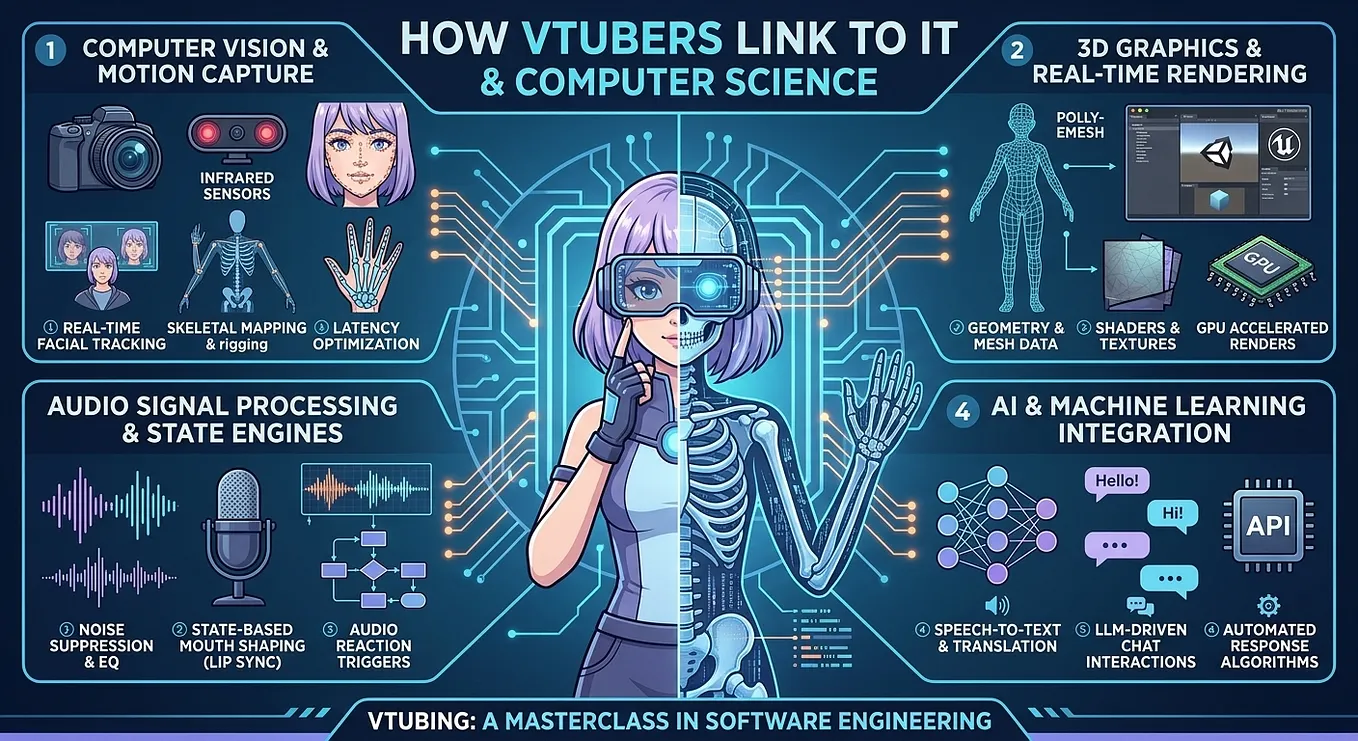
Instead of revealing their physical face on camera, creators project a digital identity through stylized character design, lore, and performance. Technically, this relies on a spectrum of software tools — ranging from 3D modelling in Blender and VRoid Studio to real-time motion capture and audio reactivity. This avatar can be made using modelling software such as Blender, VRoid Studio and Unity. Furthermore, as they are in front of a webcam or phone camera, programs like Vtube Studio or Veadotube use motion capture and facial recognition technology to track facial features and movements, mapping them onto the model. Basic setups rely purely on face/head tracking, while advanced setups use extra hardware, infrared sensors, or full-body motion capture suits to track arms, hands, and footwork. Finally the Live video feed is pulled into broadcasting software like OBS Studio, and streamed to platforms like Youtube and Twitch.
Get Eton Ton’s stories in your inbox
Join Medium for free to get updates from this writer.
As a result, VTubing technology has become significantly democratized, allowing creators to establish an online presence without prohibitive corporate studio expenses, allowing one to foster community bonds based on voices and shared ideas and identities rather than physical appearances. This shift fosters a distinct paradigm of digital relationships between creators and audiences — one grounded in intellectual engagement, voice, and shared storytelling rather than physical appearance. It also helps them to see that an anime character can also be like their favourite heroes and talk to them at the same time, blurring the divide between the imagination and reality.


Community and the Pressure to Succeed:
Now you may wonder: What good do Vtubers do in today’s world? How do they contribute to success and what it means to us, and how do they influence our interactions with others?
Vtubers seem to be controversial to many because of how they are streaming behind an avatar with a live chat. This would make it easy to believe that the mask is a ploy to lure viewers into destruction. But the opposite proves true. Many skeptics believe that Vtubers are mindless distractions or a waste of time, compared to golden standards such as TED Talks and influencers who have written authority or show their faces, who seem to have the best intellectual discourse. In reality, Vtubers offer edutainment- education in entertainment, and are only seen as inferior or superficial because of institutional snobbery and misconceptions on how digital audiences build communities. Creators who use avatars can teach complex subjects to viewers around the world, such as computer science, foreign languages and psychology. The fact that Vtubers are made using various concepts of computer science is also education in itself. According to research in digital pedagogy, learners, especially younger or neurodivergent students, often retain information better and experience less academic anxiety when content is delivered by an approachable, low-pressure virtual persona compared to a rigid classroom setting. Furthermore, compared to a one way broadcast setting in Ted Talks, Vtubers provide a bi-directional learning environment by allowing viewers to ask real-time questions, engage in chat discussions, and participate in collaborative learning. The VTuber model democratizes knowledge transfer, making academic and technical concepts feel conversational rather than intimidatingly institutional.
According to traditionalists and older generations, virtual creation and streaming is a hobby that cannot sustain a career unlike office jobs or manual work. However, this is an inaccurate view from an outdated view of labour in the post-industrial creative economy. In reality, Vtubing is multifaceted and requires a complex set of skills such as 3D design, audio engineering, broadcasting software configuration, brand management and content creation. Both multi million corporate talent agencies and independent streamers use open source tools to make diverse income streams, whether through superchats, digital art commissions and content subscriptions and memberships. This redefines success and financial independence on their own terms. Gawr Gura was the world’s most subscribed Vtuber and earned that title within a year after surpassing subscriber milestones, while Houshou Marine and Usada Pekora draw millions of views and dollars annually worldwide through Superchats. While rejecting traditional corporate pathways and overcoming past workplace and social alienation, Vtubers, both in agencies and independently, can achieve success on their own terms.


But most skeptics also believe that Vtubers are deceitful or insincere, and open the path to scams, brainwashing or radicalism to terrorism, because the creator hides behind a digital avatar. As was covered by Goffman’s theory of self preservation, physical bodies in social spaces often impose discrimination against age, appearance, gender or function. Rather than mask the person, the avatar removes physical barriers and allows the creator’s true personality and intellect to shine without fear of immediate social prejudice. Furthermore, just like the Internet, the avatar is neutral and can be used for both good and bad, as a two edged sword. As such, whether or not an influencer is conducting a scam, radicalisation or misleading path, does not depend on whether they use an avatar or show their face- it depends on malicious individual actors, algorithmic engagement models, and extreme online subcultures. While there is also the risk of parasocial exploitation and manipulation, the Vtuber community has developed strong norms for peer oversight and call-out culture to allow for when creators and viewers are trying to scam or harass each other. As such, the avatar allows for protection as it prevents issues from physical streaming such as doxxing and hate groups. The virtual persona thus serves to protect the viewers and creators from harassment and helps ensure both groups do not step out of line against each other.
Beyond commercial streaming, virtual creation provides a transformative lens through which creators navigate peer pressure, conformity, family dynamics, and institutional expectations. In physical society, individuals often face intense pressure to conform to normative standards of health, age, or lifestyle. The case of Ironmouse — one of Twitch’s most-subscribed female creators — illustrates how avatars serve as critical accessibility tools. Bedridden due to a severe autoimmune condition (CVID), her virtual persona constructed a protective ‘Front Stage’ filter: it allowed her to bypass physical disability stigmas, build a multi-million-dollar career, and mobilize massive fundraising efforts for plasma donation without being defined by her medical condition. Simultaneously, virtual identity allows individuals to reconcile traditional family expectations with personal conviction. For creators in conservative or religious households who face skepticism regarding digital subcultures, family-friendly and faith-based VTubing offers a constructive middle ground. A prominent example is seen in South Korea’s emerging religious digital outreach — as covered in news reports regarding clergy utilizing virtual avatars (such as Catholic and Buddhist VTubers like ‘Father Leon’ or ‘Illegal Monk’) to engage Gen Z and millennial audiences. Other faith based Vtubers include darlingstrawb, Fuawna and JellyStara, who all teach the Bible and engage their audiences by being open about their challenges and journeys in their faith walks. By adopting stylized digital avatars, these creators strip away rigid institutional solemnity and physical biases, allowing them to preach, stream Bible studies, or conduct informal discussions in low-pressure, interactive spaces. Whether overcoming physical isolation, navigating domestic approval, or adapting institutional faiths to modern digital youth culture, the virtual avatar acts as an empowering bridge — allowing creators to redefine community belonging and authentic purpose on their own terms.
Far from being just an entertainment gimmick, the VTuber culture has quietly evolved into a powerful engine for real-world good. On the financial front, creators regularly mobilize their massive communities for philanthropic causes. Ironmouse, for example, has raised hundreds of thousands of dollars for the Immune Deficiency Foundation while advocating globally for plasma donation, using her platform to turn her personal health battles into lifesaving awareness. Beyond charity, virtual avatars are democratizing education and skill-sharing; independent creators use low-pressure 2D setups to teach coding, digital art, software workflows, and foreign languages in ways that feel approachable rather than intimidating. Above all, these streams serve as vital mental health support networks for both creators and viewers alike. In an increasingly lonely digital age, the daily presence of a favorite VTuber offers a safe, comforting background space that reduces feelings of social isolation — proving that virtual identities can build deeply meaningful, real-world impacts.


Conclusion:
As society navigates an increasingly digital era, the rise of VTuber culture challenges conventional definitions of identity, labor, and community. By applying Erving Goffman’s dramaturgical framework, we see that the virtual avatar is not a deceptive mask, but a liberating instrument of impression management. It shields the vulnerable self while allowing creators — whether introverted students, corporate escapees, chronically ill performers, or faith leaders — to project authentic agency. Supported by open-source technical pipelines and driven by genuine community belonging, virtual creators prove that technology can humanize digital spaces, offering a profound sanctuary where imagination and reality beautifully converge.