How to Set SMART Career Goals as a Student
Turn vague ambitions into clear, week‑by‑week actions you can actually track

This article was prepared with AI assistance.
Set a career goal by naming three things: the result you want, the action you can take, and the date when you will review your progress. Start with work that is under your control, such as completing a portfolio project or checking course requirements. Admission offers and job offers also depend on other people’s decisions.
SMART is a useful check on whether a goal is clear enough to act on. It stands for specific, measurable, achievable, relevant and time-bound. New Zealand’s Tertiary Education Commission uses this framework in its Tahatū career goal guidance. The examples here are student planning exercises, not claims about results you will achieve.
Start with the decision behind your goal
Before you write a deadline, ask what decision the goal is meant to support.
- A student who is unsure about a subject needs an exploration goal.
- A student who has chosen a role may need evidence of a skill.
- A student facing an application deadline needs a completion goal.
These goals need different kinds of proof. Reading three course pages can be enough to clarify an entry requirement, but it does not show that you can perform a job task. Completing a practice project produces evidence of how you work, but it does not replace a required qualification.
Write your reason in one sentence, such as:
- “I need this project to find out whether I enjoy working with data.”
- “I need a verified shortlist before paying application fees.”
If you cannot explain the connection between the task and the decision, reconsider the task.
Use SMART as an editing check
Treat SMART as a way to edit a draft goal until it is practical.
- Specific: name the task and its output.
- Measurable: decide what you will be able to inspect.
- Achievable: check your starting point, available hours and resources.
- Relevant: ask whether the task serves the decision you identified.
- Time-bound: set a completion or review date.
A goal can pass this check without becoming complicated. For example:
“Over the next four weeks, I will write two short policy briefs using public sources and ask my tutor to review one for clarity.”
This identifies work, evidence and feedback. The student still has to confirm that a tutor is willing to help.
Get Gaurav Kandari’s stories in your inbox
Join Medium for free to get updates from this writer.
Avoid using a number just because it is easy to count. Sending fifty generic applications is measurable, but a smaller set of carefully matched applications may be more useful. Choose measures that tell you something about preparation or quality, not only volume.
Four adaptable student goals
Here are four situations with example goals and review points you can adapt.
- Unsure about two fields
— Goal: “Within three weeks, compare the daily tasks in two roles using four current job descriptions and one conversation about each field.”
— Review: Which tasks appeal, and which assumptions changed.
- Building a portfolio
— Goal: “Over six weeks, finish a small original project, document the method and revise it after feedback.”
— Review: The finished work and the changes you made.
- Preparing for further study
— Goal: “By the end of this month, check entry requirements for five relevant courses and record any missing prerequisite.”
— Review: A sourced shortlist with unresolved questions.
- Improving interview preparation
— Goal: “During the next fortnight, draft four truthful examples of my work and practise explaining them with a peer.”
— Review: Whether the examples clearly show your contribution.
The numbers here are suggestions for manageable exercises. Adjust them to the complexity of your task and the time you actually have. A student with examinations next week should not copy a schedule designed for a vacation.
Separate outcomes from weekly work
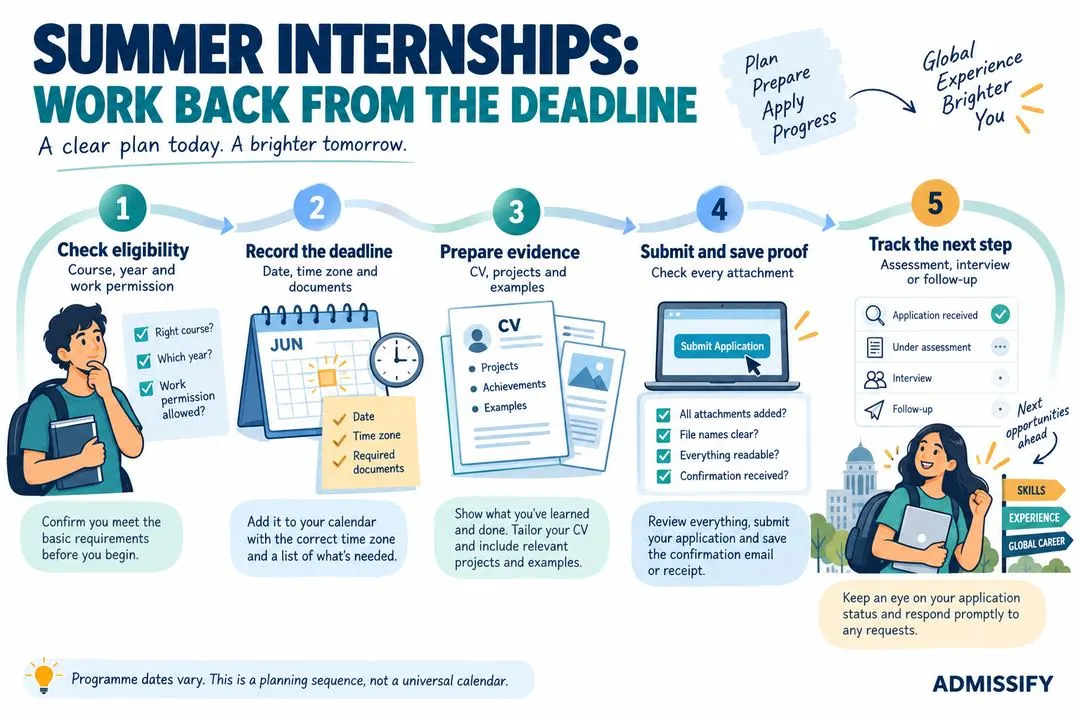
You might want an internship within three months. Keep that outcome visible, then identify actions that support it: finding suitable openings, checking eligibility, preparing relevant evidence and submitting tailored applications by their deadlines.
Track both your actions and the responses. Your action record shows whether you are doing the work. Responses and feedback show whether your approach needs changing. Completing every action does not guarantee the outcome, so leave time to revise your shortlist or seek advice.
For example, a student applies to four suitable roles and receives no interviews. The next goal should not automatically be “send twenty more applications”. First check whether the applications clearly demonstrate the stated requirements and whether the roles are realistic for the student’s stage.
Turn your goal into calendar entries
Copy this short worksheet into your notes and answer each line in plain language:
- The decision or opportunity I am working towards is …
- By this date, I will complete …
- I will know it is done because I can show …
- I can spend this much time each week …
- The resource or help I need to confirm is …
- I will review the goal on …
Then book the first work session. “Research postgraduate courses” might become “Tuesday evening: read the eligibility and curriculum pages for the first two courses.” Give that session a stopping point so that research does not absorb every available hour.
At the review date, decide whether to continue, reduce the scope or replace the goal. You can also retire a goal if the first project shows that the work does not interest you. Moving a date without addressing the reason for the delay is less useful.
Use this process to write one practical, time-bound career goal you can add to your calendar this week.
Read the full guide: https://answers.admissify.com/how-to-set-career-goals-smart-examples-for-students/