The 2,500-Year-Old Jain Doctrine That Still Embarrasses Modern Epistemology


There is a peculiar intellectual habit that defines the present moment: the conviction that having a strong opinion is the same as possessing the truth. Social media rewards it. Cable news manufactures it. AI systems, trained on human argumentation, tend to replicate it. And yet one of the most sophisticated epistemological frameworks ever produced, formulated in ancient India roughly 600 years before the Common Era, insists that every assertion about reality is, at best, conditionally correct from a specific vantage point and nothing more.
This doctrine is called anekāntavāda — “many-sidedness” in Sanskrit, derived from aneka (many) and anta (aspects or ends). It forms the philosophical core of Jainism and was articulated most fully through the teachings of Mahavira, the 24th Tirthankara, whose school produced arguably the most rigorous pre-modern theory of perspectival epistemology. Anekāntavāda is not relativism in the lazy sense — it does not argue that truth is whatever anyone wants it to be. It argues something far more demanding: that reality is structured in such a way that no single proposition, however carefully formulated, can exhaust its nature. Every statement is a naya — a partial standpoint — and claiming otherwise is the philosophical error Jains call ekāntavāda, or one-sidedness.
The practical engine of anekāntavāda is the saptabhaṅgī — the sevenfold predication scheme. It holds that any meaningful claim about a thing admits of seven distinct logical modes: it is (in some respect); it is not (in some respect); it is and is not (successively, from different standpoints); it is inexpressible (simultaneously, where affirmation and negation collide into the limits of language itself); it is and is inexpressible; it is not and is inexpressible; and it is, is not, and is inexpressible. Every proposition is prefaced by syāt — “in some respect” or “perhaps” — not as a rhetorical hedge but as a structural acknowledgment that perspective is always embedded in the claim. The Jain logicians were doing something no Western logical tradition would fully formalise until the twentieth century: building the standpoint into the proposition itself.
This matters historically. During the period when Greek philosophy was developing its own traditions of formal argument, the Jain school was already grappling with the question of whether logical contradiction was always a failure of reasoning or whether it sometimes revealed genuine ontological complexity. Mahavira reportedly told his students to accept both “it is” and “it is not” as valid, qualified by standpoint, rather than forcing every claim into a binary that the structure of reality does not actually support. The later Nyāya school challenged this, arguing that the saptabhaṅgī collapses into incoherence, that you cannot meaningfully affirm and deny the same predicate of the same object. The Jain response — that affirmation and denial hold from different nayas, not from the same one simultaneously — anticipates the modern distinction between logical contradiction and perspectival incompatibility. These are not the same thing, and confusing them is a mistake that contemporary public discourse commits constantly.
Why we are bad at this, and getting worse
The dominant epistemic mode of the current era is not just one-sided — it is one-sided at speed. The structures that filter most people’s information — recommendation algorithms, search personalisation, platform engagement mechanics — are precision instruments for building what the Jain tradition would recognise as a sophisticated ekāntavāda machine. You receive an ever-denser signal confirming the standpoint you already occupy, with competing nayas systematically deprioritised. The result is not increased knowledge but increased certainty — which is a very different thing.
There is an irony here that Jain philosophers would find unsurprising: the more elaborate your informational environment, the more partial your view of reality may become. The hermit who encounters the world randomly, without algorithmic curation, is epistemically better positioned — exposed to more nayas — than the person whose entire conceptual diet has been optimised for engagement. Engagement, it turns out, is largely a measure of how effectively a stimulus confirms existing belief. Truth, as anekāntavāda understands it, is rarely that comfortable.
The AI acceleration of this problem is a distinct concern. Large language models trained on human text inherit its argumentative structure: thesis, support, conclusion. They are, by training, fluent in ekāntavāda. They produce confident prose. They resolve ambiguity rather than dwelling in it. The sevenfold predication — the acknowledgment that the most honest thing one can say about a complex object might be “it is and it is not and it is inexpressible” — is not a pattern that reward functions based on coherence and fluency tend to preserve. The result is that the tools most people now use for sense-making push toward single-standpoint conclusions, often eloquently, and often wrong in ways that are hard to detect because the wrongness is not factual but perspectival.
Avaktavya: the inexpressible as an epistemological category
One of anekāntavāda’s most striking contributions is its formal inclusion of avaktavya — the inexpressible — as a legitimate predicate. This is not mysticism. It is a precise recognition that some attributes of a thing, when affirmed and negated simultaneously, exceed the capacity of language to represent. Mahavira’s teaching that “language returns from truth, and not the other way around” is not a dismissal of language but an account of its structural limits. The map is not the territory; the proposition is not the fact.
Get Grandomastery’s stories in your inbox
Join Medium for free to get updates from this writer.
This is epistemically honest in a way that most modern discourse refuses to be. Contemporary argument culture — in academia, in media, in political debate — treats inexpressibility as a failure. Saying “I cannot fully express what this is” reads as weakness. Saying “this is complex beyond the capacity of any single frame to capture” is often received as evasion. But the Jain position is that treating avaktavya as a genuine category, rather than a failure to articulate, is what distinguishes rigorous from careless thinking. Some things are genuinely not exhausted by any formulation you can produce. Pretending otherwise does not improve your understanding — it forecloses it.
The cognitive sciences have produced a parallel insight under very different framing. Work on integrative complexity — the psychological measure of how well a person recognises and integrates multiple perspectives rather than collapsing to a single one — consistently shows that high integrative complexity correlates with better performance in negotiations, policy analysis, and conflict resolution. Low integrative complexity — the ekāntavāda condition — correlates with rigidity, escalation of conflict, and poor prediction of outcomes in complex systems. The Jain tradition built its epistemology around cultivating the high end of this spectrum centuries before psychometric research described it.
Nayavāda and the politics of partial truth
The subsidiary doctrine of nayavāda — the theory of standpoints — distinguishes between at least seven types of epistemic viewpoint, from the naigama (a general, teleological view that describes things by their intended purpose) to the evambhūta (a highly precise, activity-based view that limits description to what a thing is actually doing at this moment). These are not competing claims about the same fact. They are different levels of resolution, different aspects of the same complex object. A human being, for instance, is simultaneously a collection of molecules, a social role, a biographical narrative, an evolutionary adaptation, and a bundle of intentions. None of these descriptions is wrong. None is complete. And the serious mistake is not using any particular naya but treating any one naya as though the others do not exist.
This has direct implications for how we handle disagreement. Most genuine conflicts — not factual disputes but value, interpretive, and policy disagreements — involve parties occupying different nayas rather than one person being correct and the other wrong. A climate scientist and a coal worker arguing about energy policy are not, in the Jain analysis, simply contradicting each other. They are speaking from different standpoints, both of which capture something real about a complex situation. The failure is not the disagreement; it is the mutual refusal to acknowledge the other’s naya as a genuine partial truth. Anekāntavāda does not abolish the disagreement — it changes what the disagreement is about and makes resolution structurally possible rather than just rhetorically desirable.
What this requires of a thinking person
Anekāntavāda is not comfortable epistemology. It demands sustained tolerance of incompleteness. It requires the capacity to hold a claim provisionally — not because you lack conviction, but because you understand that conviction about one naya does not automatically constitute knowledge of the whole. It requires what the Jain tradition calls ahiṃsā applied to thought: non-violence toward other standpoints, a refusal to destroy a partial truth simply because it is not your partial truth.
This is unusually difficult in practice. The psychological pull toward closure — what cognitive psychology calls the need for cognitive closure — is real and strong. Uncertainty is metabolically expensive. The brain rewards resolution. A well-formed one-sided argument feels better than an honest acknowledgment of structural complexity, and that feeling is rewarded across essentially every feedback mechanism built into contemporary intellectual life. Rating systems, publication metrics, social media virality — all of them tend to reward clarity and confidence over the laborious maintenance of multiple frames.
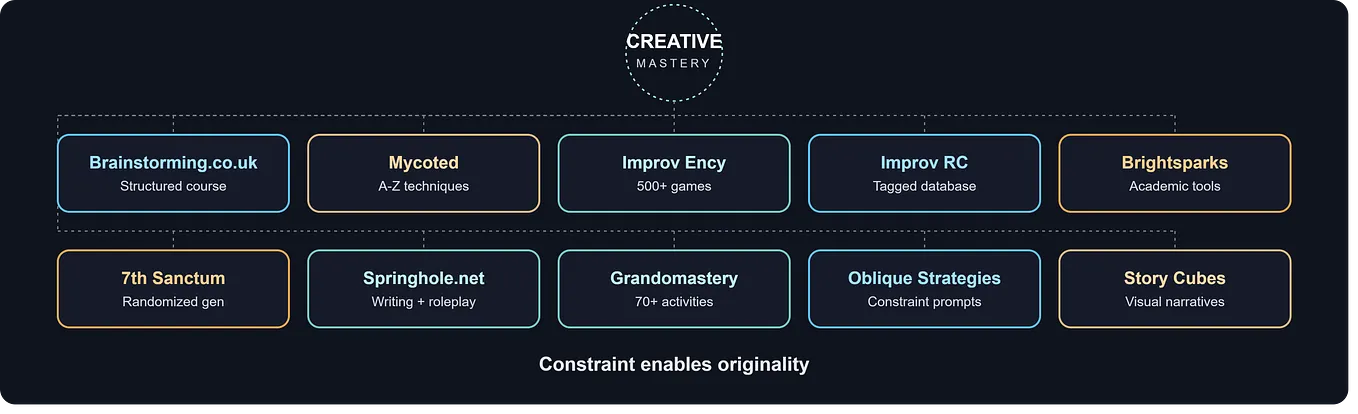
What does the alternative look like in a learning context? One useful framing is the idea of systematic perspective multiplication — not as a rhetorical exercise (“let’s steelman the opposing view”) but as a genuine epistemological practice: identifying the naya you currently occupy, naming it explicitly, then generating a minimum of two other nayas from which the same object looks different, and then asking what a proposition looks like from inside each one. This is cognitively demanding precisely because it requires you to inhibit your own standpoint temporarily — not abandon it, but step out of it far enough to inhabit another. Platforms that work with creative bisociation and forced perspective-shifting, such as Grandomastery, are doing something structurally adjacent to nayavāda practice: using randomised, unrelated conceptual frames to prevent the mind from settling into the single-standpoint comfort that is its default setting.
The sevenfold predication and the theory of standpoints are, in this reading, not just ancient philosophy. They are a training regime for the kind of thinking that the present moment makes simultaneously more necessary and more difficult. The machines around us are getting better at producing single-standpoint fluency. The counter-skill — holding multiple nayas simultaneously, resisting premature closure, staying productively in avaktavya where avaktavya is honest — is one that only deliberate, effortful human practice can develop.
The Jain monks who built this framework were not trying to make thought easier. They were trying to make it adequate to reality. Those are not the same project, and confusing them has consequences.
#anekantavada #Jainism #epistemology #criticalthinking #philosophy #perspectivism #grandomastery #creativity #cognitiveflexibility