Michael, the Pilgrim

The story of a man who, at 90 years of age, stands as the perfect example for the world today.

If I say Μιχάλης Χατζημιχαήλ, it will be — quite literally — Greek to everyone.
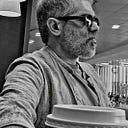
It’s nine o’clock on a spring Saturday morning, the kind of day when the temperature already invites you outdoors. And it is in this setting that I find my smiling host, standing at the door of his home in his native village of Fanes.
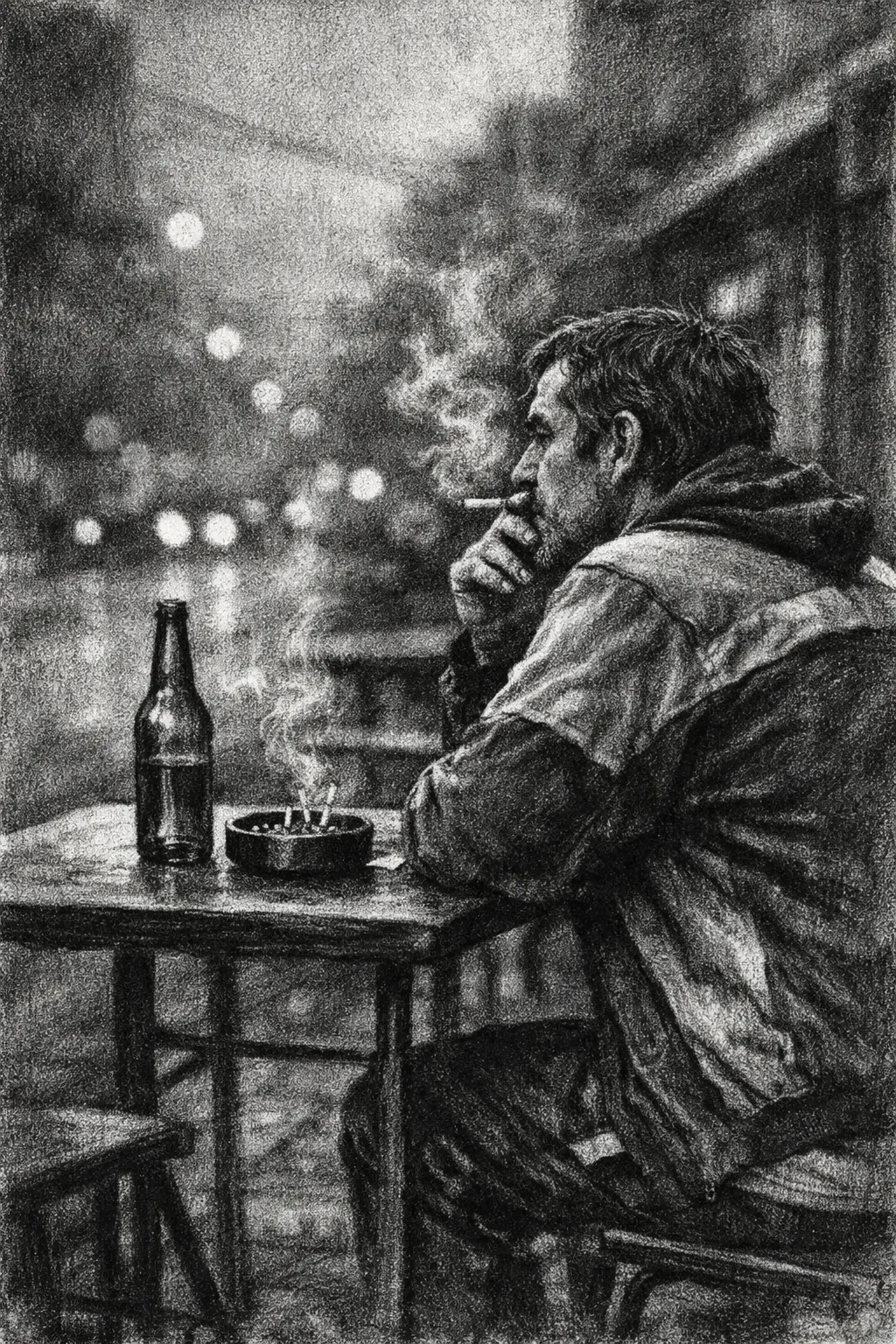
I take the chance to photograph him — the same image that inspired the charcoal engraving that accompanies this article.
His irresistible invitation to share the first coffee of the day, σκέτο (plain), is the perfect way to begin our conversation.
On September 14th, 1935, on the island of Rhodes — then part of the Kingdom of Italy — Michael (Michaelis, in Greek) was born. From that day on, in accordance with Orthodox Christian tradition, he would carry not only the name of an Archangel, but also the surname Hadjimichael, in memory of an ancestor who had made a pilgrimage to the Holy Land during the Middle Ages. It means Michael, the Pilgrim.
It is a surname that fits perfectly someone whose life has been shaped — deeply and unmistakably — by the many stories that make up the book of his existence. A surname that mirrors Michael’s path, illuminating the road he traveled through the tribulations of nine decades.
As we turn the pages of the chapters that define his long journey, one theme rises immediately to the surface: survival.
Rooted deep within Michael’s being, it is the product of generations, running through his veins, passed from father to son.
His father learned the meaning of survival at a young age, when he escaped the relentless campaign of extermination against the Christian population, carried out by the Turkish nationalist movement between 1914 and 1922. According to estimates, around one million Greeks were killed in the massacres.
“One day, the Turks went to my grandfather’s property in Datça [now Turkey, then the Ottoman Empire]. They caught him while he was ploughing with the oxen… They killed him,” he tells me now, at 90 years old, his expression tightening.
This is one of the memories his father passed down to him — one that remains vivid to this day.
With the help of family friends, Michael’s grandmother and her children managed to cross from the mainland to the small island of Symi, where they found refuge in the Monastery of Archangel Michael.
They stayed there until Michael’s father turned 19, when the family moved to Rhodes to work on an Italian-owned vineyard.
“We lived well, in peace,” he recalls of his childhood. “But when the Germans arrived… A barbaric tribe [a reference to the Second World War and the German occupation of the island]… One day, I took a cow out to graze. And at that moment, a German truck carrying dead Italians — on their way to be buried in the cemetery of Kameiros — passed by and ran us over… I managed to escape, but the cow died…” He was nine years old.
The winds of war brought desolation, misery, and hunger to the island.
“We went to a German outpost and asked for bread. A man with a gun shouted ‘Raus con euch!’ (Get out!). I was in shorts, barefoot… We were starving… We climbed a hill full of grenades, I picked one up, pulled the pin, and threw it into the air… The Germans were furious…,” Michael remembers.
Get Hugo Egling’s stories in your inbox
Join Medium for free to get updates from this writer.
But that is not the only emotional scar he carries from that time.
“I remember when the Italians were captured… The Germans put them in carts and took them to a ship… To be burned alive in furnaces in Germany. But a Greek submarine fired a torpedo and sank them, and they all fell into the sea… They drowned. We were at my grandmother’s house… The burning ship could be seen across the water, and everyone was shouting ‘Aiuto!’ (Help!).”
It is estimated that around nine thousand people died on the island of Rhodes between 1943 and 1945 as a direct result of the German occupation.
The post‑war years also bring back memories of hardship.
“And when the Italians left, I remember they were collecting clothes in a house… I went with my brother Manolis, and we found a big box of foreign rusks, the ones they [the Italians] used to dip in milk… I told my brother: ‘Wait until I bring the donkey so we can carry the box’… But a couple passed by and asked: ‘What are you doing? There’s nothing inside that box, leave it there,’ so they could take it themselves… But someone else came by and said to them: ‘Aren’t you ashamed to trick children?’ In the end, we got the rusks…,” he recalls with a smile — a smile that softens the portrait of despair that once engulfed his island.
After the Second World War, the Dodecanese archipelago was integrated into Greece, and around six thousand Italian settlers were forced to return to Italy.
The end of the war, marked by devastation, also marked the beginning of a great migratory exodus. Around one million Greeks left their homeland in search of better lives. This too had a profound impact on young Michael.
“Everyone was leaving, looking for work… And I wanted to go too. I wanted to go to Australia… But my father didn’t allow it, so I stayed.”
Then came the 1960s, bringing with them the first signs of tourism on Rhodes.
“They were building hotels in the Elli area, and I went to work there with the stonemasons… From there, through my brother, I was taken to work in public construction,” he says — this period bringing to mind a very particular episode involving a major figure in Greek political life, affectionately known by the Greek people as the “Old Man of Democracy.”
“One day old Papandreou [Georgios Papandreou] came to Rhodes… And we had to set up a scaffold for him so he could speak to the people of the island. When we were leaving, in our work clothes and carrying blankets, Papandreou climbed onto the scaffold… And he asked us: ‘Where are you going?’ We answered: ‘We’re going to clean ourselves.’ ‘I won’t speak unless you stand beside me… I want you by my side,’” he recalls fondly.
Michael’s life is like the trunk of a sturdy tree, its rings pronounced — each one a different story, all fitting together perfectly.
“Since I was little, I heard that my grandfather had beehives… One day, when I went hunting with a cousin, I saw bees coming out of the trunk of an olive tree… I thought about taking them… I became a great beekeeper and ended up with more than a hundred hives… My wife even helped me after midnight, unloading the hives… I worked three jobs… That’s how we grew and educated our three children,” he concludes — almost as if closing the book — when we are interrupted.
“Είναι μεσημέρι (it’s noon). Time for my father to have lunch and rest.”
My time with Michael unfolded calmly and without interruption.
He guided our conversation with the mastery of an opera conductor, for I listened far more than I spoke.
Michael, the Pilgrim, is forged from a different metal.
A man who lived through the worst of the twentieth century, and yet still offers humility with the sweetness of someone who never lost his humanity.
In an age where everything is forgotten quickly, Michael is the perfect example of what we should all aspire to be.
*This story began with an article from a regional newspaper; what follows is interpretation, memory, and its own voice.