The Book of Enoch: Watchers and Jewish Beliefs

The Book of Enoch was not in my Bible growing up. It probably wasn’t in yours either. And yet, the authors of the New Testament read it, quoted it, and assumed their audience knew it. Jude references it directly, and Peter alludes to it. The imagery of fallen angels, a heavenly court, and divine judgment saturates the theological world in which Jesus and his earliest followers lived. So why do most modern readers know almost nothing about it?
I want to walk you through one of the most important ancient texts outside the Bible and show you how it transforms your understanding of the New Testament.
A Book Hidden In Plain Sight
The First Book of Enoch, also called Ethiopic Enoch, is not a single document. It’s a compilation of several books, each carrying its own title and conclusion. The five sections include the Book of the Watchers (chapters 1–36), the Similitudes or Parables (chapters 37–71), the Book of the Luminaries (chapters 72–82), the Book of the Dreams (chapters 83–90), and the Epistle of Enoch (chapters 92–105). All five survive together only in the Ethiopic version.
To me, the most fascinating segment of 1 Enoch is the Book of the Watchers because it functions as a vital key for unlocking an entire layer of New Testament theology that often feels cryptic without it.
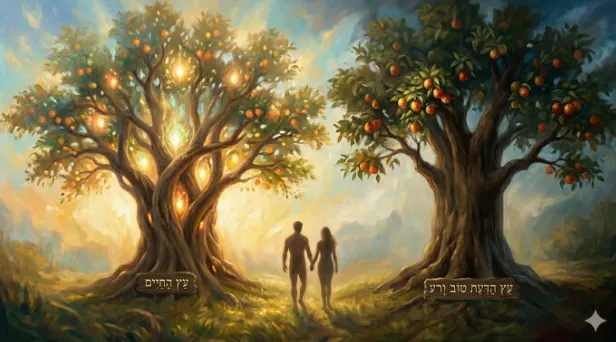
The text frequently mirrors the Hebrew Bible by featuring Adam, Eve, and the conflict between Cain and Abel, alongside the disruptive unions of angels and human women. However, the specific ways this narrative expands upon the Genesis account reveal the evolving religious mindset of Second Temple Judaism. Such deviations offer a direct window into the intellectual environment that shaped the apostolic writings.
The Story Genesis Barely Tells
In Genesis 6:1–4, the story of the “sons of God” taking the “daughters of men” as wives occupies only a few verses. Most readers skim right past it. In the Book of the Watchers, however, that brief mention becomes the central narrative. Chapters 6–9 expand the story into a dramatic account of angelic rebellion.
Here is a portion of 1 Enoch 6–7:
“And when the sons of men had multiplied, in those days, beautiful and comely daughters were born to them. And the watchers, the sons of heaven, saw them and desired them. And they said to one another, ‘Come, let us choose for ourselves wives from the daughters of men, and let us beget for ourselves children.’… Then they all swore together and bound one another with a curse. And they were, all of them, two hundred, who descended in the days of Jared onto the peak of Mount Hermon.”
The Watchers (עִירִין, irin in Aramaic) are the angels of Genesis 6. According to 1 Enoch, their sin was not merely sexual. They taught humanity forbidden knowledge: metalworking, cosmetics, astrology, and weapons. Their transgression involved the premature disclosure of divine secrets, knowledge humanity was not ready to receive, given to serve the Watchers’ own desires.

Why Second Temple Jews Blamed The Watchers
Here is where the story gets truly important for anyone who reads the New Testament.
If you asked a modern Christian, “Why is the world so wicked?” the answer would almost certainly be “the Fall.” We have been shaped by centuries of church teaching to look only to Genesis 3 for our theology of evil. But if you asked a Jew living during the Second Temple period the same question, the answer would have been dramatically different.
The unanimous testimony of Second Temple Judaism is that the Watchers are responsible for the spread of evil on earth.
Get Dr. Eli (Eliyahu) Lizorkin’s stories in your inbox
Join Medium for free to get updates from this writer.
Yes, sin entered God’s good world in Eden. Nobody denied that. But the proliferation of evil, the deep corruption of human civilization, was traced back to the rebellion of the Watchers. Their union with human women produced the giants, and the giants brought devastation. In Chapter 10 of 1 Enoch, God finally intervenes, and the familiar story of Noah begins.
The brilliant scholar Dr. Michael Heiser explored the importance of the Watchers’ story in his book Reversing Hermon: Enoch, the Watchers, and the Forgotten Mission of Jesus Christ. I highly recommend it. His work helped me understand a critical point: for Second Temple Jews, the coming of the Messiah meant undoing the damage caused by the Watchers, not only reversing the curse of Adam.
Reading The New Testament Differently
The New Testament writers belonged to Second Temple Judaism. The Watchers tradition had to be part of their theological framework. And once you see it, you can’t unsee it.
The judgment of the Watchers, bound in chains, imprisoned in darkness, awaiting final judgment, becomes a template in the New Testament for describing demonic powers and the binding of evil. Read Jude 6:
“And the angels who did not keep their own position, but left their proper dwelling, he has kept in eternal chains in deepest darkness for the judgment of the great day.”
Or consider 2 Peter 2:4:
“For if God did not spare the angels who sinned, but cast them into hell and committed them to chains of deepest darkness to be kept until the judgment…”
Knowing the Enoch background, both passages open up in ways that are simply unavailable without it. Jude and Peter are not inventing new theology. They are drawing on a tradition their readers already knew well.
I am not arguing the Book of Enoch is Scripture. I am arguing it is the cultural and theological air the New Testament breathes. Ignoring it means reading the New Testament partially blind.
The Forgotten Mission Of Jesus
Understanding the Watchers tradition reshapes how we see the mission of Jesus. For the New Testament writers, the coming of Jesus represented a multi-layered victory. He came to reverse the curse of death brought upon humanity through Adam’s sin. And he also came to undo the depravity introduced by the rebellion of the Watchers.
Such perspective shows that the work of Jesus centered on a total cosmic restoration instead of a narrow focus on personal piety. Every exorcism and act of authority over dark powers functions as a direct strike against the spiritual rot described in ancient Enochic literature. The New Testament authors viewed Jesus as the promised figure who would fulfill the decree of 1 Enoch 10, executing the final binding and judgment of every rebellious spiritual force.
Why The Background Matters
No New Testament text can be fully understood outside its historical and cultural context. We miss so much if we read it without knowledge of the prevailing theologies of the day or without understanding who else shared the space alongside the earliest followers of Jesus. The Jewish landscape during this era was a complex mix of competing ideas and intense debates regarding angels, the nature of evil, and divine justice.
The Book of Enoch is one of the most important keys to recovering that world.
Exploring the Jewish roots of these scriptures often involves looking at the original languages and the intellectual climate of the Second Temple period. Scholars at the Israel Institute of Biblical Studies offer courses in Biblical Hebrew, Greek, and Jewish thought that can provide a clearer perspective on these texts.
Have you ever read a New Testament passage and felt like something was missing from the picture?