The Rent-Seeking Squeeze: Gaming’s Shift from Ownership to Access.

How Sony’s disc cutoff, Xbox’s quiet pivot, and a disc-less GTA VI are converging on the same outcome — a gaming industry increasingly built around digital and recurring monetization.
The Economics of Access
The economics of gaming are changing in a way that’s easy to miss as you look at individual product launches.
Take Grand Theft Auto VI for example. Even the physical version of the game won’t have disk, just a box and code to download. But the more interesting question is not why one publisher chose digital delivery, but why physical distribution is becoming less economically attractive industry wide.
My thesis is that gaming is gradually shifting from one-time transaction product toward recurring digital monetization, allowing publishers and platform holders to capture more lifetime revenue per user while reducing the costs and leakage associated with physical distribution and secondary-market resale.
The argument does not rest on GTA VI alone. It comes from a collection of different different independent public signals across the industry.
The Hardware Squeeze
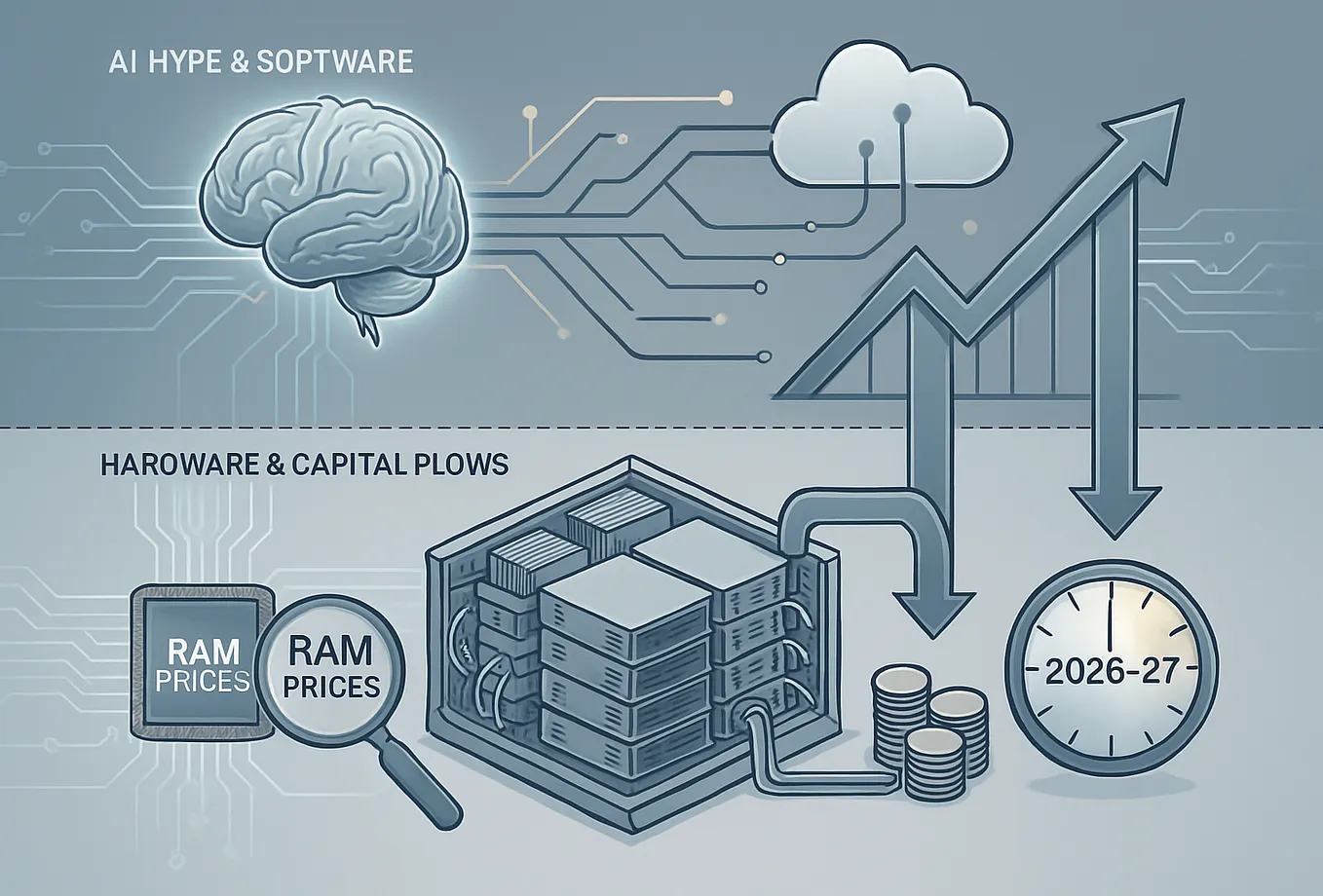
The cost of the hardware is becoming harder to ignore. Trend Force expects conventional DRAM contract prices to rise 13–18% QoQ in 3Q26, while NAND Flash prices are expected to increase 10–15%. AI and data-centre demand are drawing more semiconductor capacity toward higher-value applications, putting additional pressure on components used across consumer electronics.
For console makers, this creates a difficult trade-off. Higher component costs can be passed on through higher hardware prices, but that could slow console adoption. Keeping prices competitive supports the installed base, but leaves less room to recover those costs from the hardware sale itself.
That makes what happens after the console sale increasingly important.
Sony’s FY2025 numbers show why. Digital software and add-on content generated ¥2.29tn, while network services contributed ¥670bn, compared with ¥1.58tn from hardware and others. Sony is also targeting higher PS Plus revenue and higher average revenue per user on the PlayStation Store.
The console gets the user into the ecosystem. The installed base is where the recurring economics build.
3Q26 Memory Price Expectations
- DRAM: +13–18% QoQ
- NAND Flash: +10–15% QoQ
Sony G&NS Revenue Mix: Digital Monetization Outpaces Hardware
Sony FY2025 G&NS external-customer revenue by category.
The next question is how platform holders can improve these economics further. Sony’s planned 2028 end to physical-disc manufacturing is one concrete example.

Sony’s 2028 Cutoff
Sony has decided its shift away from physical game discs. From January 2028, Sony Interactive Entertainment plans to stop producing physical discs for new games releasing on PlayStation consoles. New titles will instead be distributed through the PlayStation Store and through retailers in digital formats.
The important part is what Sony isn’t saying. Existing physical games won’t suddenly become unplayable, and disc production won’t disappear entirely for titles that were already released or scheduled for physical release before January 2028. Sony has also clarified that publishers can continue ordering discs for qualifying existing releases after the cutoff.
So this is less about shutting down physical gaming overnight and more about setting a clear direction for future releases. Sony is effectively putting a deadline on new games moving away from disc-based distribution.
The timing also fits with the economics discussed earlier. If rising hardware and component costs put pressure on the console ecosystem, moving new software distribution toward digital formats removes part of the physical supply chain while allowing Sony to keep monetizing its installed base through games, add-on content and network services.
Sony’s own numbers show that the shift is already well underway. In FY2025, 78% of full-game software units sold on PS4 and PS5 were digital downloads, up from 76% in FY2024. The ratio reached 85% in FY2025 Q4.
Full-Game Software Digital Download Ratio
- FY2024: 76%
- FY2025: 78%
- FY2025 Q4: 85%
The 2028 deadline, then, isn’t creating a digital market from scratch. It’s putting a formal date on a transition that is already happening.
Sony is putting a date on the transition. But the same platform’s exclusive hold on digital distribution is now facing scrutiny of a different kind.
The Legal Read
The shift toward digital distribution isn’t just an economic story anymore. It also raises a legal question: what happens when the platform that controls access to digital games also becomes the main — or only — place where those games can be bought?
The first major step came in April 2019, when Sony Interactive Entertainment stopped allowing U.S. retailers such as Amazon, Best Buy, GameStop, Target and Walmart to sell PlayStation-specific game vouchers. Consumers could still buy PlayStation Store gift cards from those retailers, but game-specific digital vouchers were moved exclusively to Sony’s own digital storefront.
Caccuri v. Sony
That decision became the basis of a U.S. antitrust class action filed in 2021. The original complaint was dismissed in July 2022 because the court found that the plaintiffs had not adequately pleaded anticompetitive conduct. The judge, however, allowed them to amend the complaint.
The revised complaint survived Sony’s second dismissal motion in February 2023. Judge Richard Seeborg found that the plaintiffs had adequately pleaded the elements of their theory, including allegations that Sony had previously operated a profitable retail distribution model before ending third-party sales. The order said the complaint alleged that Sony had “sacrificed short-term profits for long-term gain” after removing third-party game-card sales.
That distinction is important: the court was allowing the case to move forward based on the allegations. It was not ruling that Sony had violated antitrust law.
The case later moved toward settlement. Sony agreed to provide $7.85 million to eligible consumers without admitting wrongdoing. The court granted preliminary approval in April 2026, with final approval scheduled for October 15, 2026.
The UK CAT Case
The larger test is now playing out in the UK. A collective action representing an estimated 12.2 million PlayStation users is seeking approximately £2 billion ($2.7 billion) in damages. The claim argues that Sony’s control over the PlayStation Store allows it to charge a 30% commission on digital games and add-on content, with the resulting prices allegedly being “out of all proportion” to the cost of providing the service.
The Competition Appeal Tribunal allowed the case to proceed after finding that the proposed methodology behind the excessive-pricing claim was sufficiently credible and plausible for the collective proceedings stage. The trial ran from March 10 to May 8, 2026, and judgment remains pending.
Sony’s defense offers a different view. The company argues that its integrated platform provides consumer benefits and that limiting third-party digital storefront access helps protect security and privacy. Sony has also argued that it invests heavily in hardware and sells consoles at relatively low margins to build the installed base, with digital commissions forming part of that broader economics. It has pointed to similar closed-platform approaches used by Nintendo and Microsoft.
The legal distinction matters.
Neither case has established that Sony unlawfully monopolized digital game distribution. In Caccuri, the allegations survived dismissal and the parties reached a settlement without an admission of wrongdoing. In the UK case, the tribunal has heard the evidence but has not yet issued its judgment.
What these cases establish at this stage is narrower, but still important: Sony’s control over digital game distribution has become the subject of sustained antitrust litigation in two major jurisdictions.
That matters to the broader shift because physical and digital distribution give platforms very different levels of control. A physical game can move through multiple retailers and can potentially be resold or traded. A digital purchase happens inside the platform’s storefront, where the platform controls the transaction, collects the commission and maintains the customer relationship.
If Sony’s closed digital model is already being tested in court, the next question is whether other platforms are moving toward the same structural position.
Xbox’s Quiet Pivot
Microsoft is moving in the same direction, but without Sony’s hard deadline. In August 2026, Xbox introduced a feature that allows owners of eligible physical Xbox games to claim a digital entitlement by inserting the disc into an Xbox One or Xbox Series X console. Once claimed, the game can access digital features such as Xbox Play Anywhere and Xbox Cloud Gaming where supported, while the original disc continues to work as before. Microsoft says the move is part of its broader focus on game preservation as technology, devices and distribution continue to change.
The stated reason is preservation. But the economic implication is worth watching.
Converting an existing physical purchase into a digital entitlement makes the software library less dependent on the physical disc itself. That matters because physical software already plays a relatively small role on Xbox. Xbox accounted for just over 4% of new physical game sales in the U.S. during 2026 YTD, compared with 32% for PlayStation and 63% for Nintendo platforms, according to Circana data shared by analyst Mat Piscatella.
Microsoft is also developing Project Helix, its next-generation Xbox console, with alpha hardware planned for developers beginning in 2027. Microsoft says the system is designed to play both Xbox console and PC games, while Bloomberg reports that Play Anywhere will form the backbone of the next generation.
Get Jay Pradip Chougule’s stories in your inbox
Join Medium for free to get updates from this writer.
That doesn’t prove Microsoft is using the preservation program to prepare users for a disc-less next generation. But it does point to a broader shift: physical media is becoming less central to how Xbox games are distributed and access

GTA VI: The $79.99 Test
Grand Theft Auto VI is arriving as a physical product without an actual game disc. The physical edition comes as a box with a download code instead. Rockstar says the physical version will be available from November 12, 2026 to allow players to pre-load the game ahead of its November 19, 2026 launch. The standard edition is priced at $79.99 in the U.S.
The more interesting signal is in Take-Two’s financials.
In FY2026, 78.1% of net revenue came from recurrent consumer spending, down from 79.4% in FY2025. That decline is worth noting: Take-Two isn’t simply becoming more dependent on recurrent spending every year. But in dollar terms, recurrent consumer spending still rose to $5.20 billion, from $4.47 billion a year earlier. Take-Two defines this category as revenue from virtual currency, add-on content, in-game purchases and in-game advertising.
The distribution mix is even more striking. Digital online revenue accounted for 97.0% of Take-Two’s FY2026 net revenue, compared with just 3.0% from physical retail and other.
So GTA VI’s disc-less physical edition isn’t really a radical departure from Take-Two’s existing business. It’s an extension of an economics that are already heavily digital.
The bigger question is whether that model works for a one-time $79.99 blockbuster purchase at GTA VI’s scale.
Take-Two’s FY2027 outlook gives the launch even more weight. The company is reiterating $8.0–$8.2 billion in FY2027 Net Bookings, explicitly tying that outlook to its confidence around the November 19 launch of GTA VI.
That makes GTA VI more than another example of the shift from physical to digital. It becomes a large-scale test of whether a major premium release can move consumers toward digital delivery while keeping the broader recurring monetization model intact.
And that’s where the reaction becomes important.
The backlash isn’t just noise around the transition. It shows that even as the economics move toward digital, consumer acceptance of that shift isn’t guaranteed.

The Backlash as a Variable
The backlash isn’t really about whether a box contains a disc. It’s about what the buyer actually owns.
A traditional physical copy gives the buyer a transferable object that can potentially be resold, traded or lent. A download code changes that. Once redeemed, the game is tied to the buyer’s digital account rather than existing as a transferable copy. GTA VI also introduces region-specific redemption rules on PlayStation, with Rockstar warning buyers to match the code’s region with their platform account. In Japan, the codes are scheduled to expire 170 days after the November 19 launch because of regional regulations.
The reaction has also reached retailers. At least two specialist retailers, Video Games Plus and Loot Box Gaming, said they would not carry GTA VI if its physical edition remained a code-in-box product. Their objections were specifically about the lack of a disc and what that means for the traditional physical-game model.
The commercial reaction, however, has been less dramatic. Industry analysts speaking to VGC said they do not expect the disc-less format to materially affect GTA VI’s sales potential. Circana’s Mat Piscatella has also described code-in-box releases as an established practice and pointed to the growing share of digital-only consoles. As of the end of May 2026, 52% of Xbox Series consoles and 27% of PS5 consoles sold in the U.S. did not include a disc drive.
That creates an important gap between consumer objection and commercial risk.
The objections are real: less resale flexibility, less ability to lend a game, greater dependence on account-based access and, in some markets, redemption restrictions. But the available analyst commentary suggests these concerns don’t necessarily translate into materially lower demand for a blockbuster release.
For the broader thesis, that gap is important. Consumers can dislike the loss of physical ownership while still buying the underlying product. If that pattern holds at scale, the economic incentive for publishers and platform holders to keep moving toward digital distribution remains intact.
The backlash may therefore affect how quickly the transition happens and how it is presented to consumers, without necessarily changing its broader direction.
If the transition survives the backlash, the next question is what happens when the physical layer disappears altogether — and cloud delivery becomes the next step in the distribution chain.

What the Signals Actually Prove
None of the preceding developments, taken individually, proves that physical gaming is disappearing. Component inflation can change. Sony’s 2028 deadline could evolve. Xbox’s preservation program does not amount to a formal disc cutoff. GTA VI is one game, however large. And consumer backlash can still constrain how aggressively publishers make the transition.
Taken together, however, the signals point in the same direction.
The industry is no longer simply testing digital and recurring monetization. It is increasingly building its economics around it — while physical distribution becomes the layer being removed.
The evidence comes from different parts of the value chain: rising hardware-component costs make post-sale monetization more important; Sony has put a date on physical production for new games; Xbox is making physical purchases increasingly compatible with digital entitlements; Take-Two is releasing its largest upcoming title without a disc while already generating the vast majority of its revenue digitally; and the initial commercial read suggests that the backlash may not materially change demand.
That is the Mosaic Theory point. The conclusion does not depend on one company’s strategy or one product launch. It emerges from independently published public information — company filings, company statements and industry data — rather than privileged or non-public information. Each signal is incomplete on its own; their convergence is what makes the structural direction visible.
Economists use the term rent-seeking to describe situations where a company captures more value by gaining greater control over a transaction, rather than by creating additional value for the buyer. That doesn’t mean Sony, Xbox or Take-Two have done anything unlawful — as the Legal Read section shows, those questions are still being litigated rather than settled. Here, the term is being used to describe the economic mechanism that the broader shift toward controlled digital distribution could create.
Cloud Is the Next Layer
If the physical disc is becoming optional, the next question is whether the hardware itself eventually becomes less important.
Cloud gaming extends the same economic logic one layer further: instead of owning the console and downloading the game, the player pays for access to computing capacity and a library of content delivered remotely. The direction is already visible, but the adoption data argues for caution rather than inevitability.
BCG’s 2025 global gaming survey found that 60% of players had tried cloud gaming, and 80% of those players reported a positive experience. Yet only 27% of gamers were regular or heavy users, while BCG’s survey data shows that just 8% of gamers who use cloud gaming spend more than half their gaming time on it. At the same time, BCG projects global cloud-gaming revenue to grow from around $1.4 billion in 2025 to $18.3 billion in 2030.
So cloud should not be treated as the immediate replacement for consoles. It is better understood as the next possible layer of the same transition: from ownership of a physical product, toward digital access, and eventually toward access that does not require dedicated hardware at all.
The industry-wide pattern is now established. The next question is what that shift means financially for the company sitting at the center of this thesis: Take-Two.

Take-Two: The Economics Behind the Shift
For Take-Two, the shift from physical to digital isn’t really about removing discs. It’s about what happens to the economics of a blockbuster release when more of the transaction moves through digital distribution and into the company’s existing recurring ecosystem.
Take-Two is already operating from a heavily digital base. In FY2026, 97% of net revenue came through digital online channels, while physical retail and other accounted for just 3%. Recurrent consumer spending made up 78.1% of net revenue, down slightly from 79.4% in FY2025, but still generating more than $5.2 billion in revenue.
Against that backdrop, the disc-less GTA VI format looks less like an experiment and more like an extension of a business model Take-Two already runs.
There could also be a cost benefit at the transaction level. Industry analyst Serkan Toto of Kantan Games has estimated that a traditional physical sale can involve roughly 30% going to the retailer and another 5% associated with manufacturing, leaving the publisher with around 65% before other costs and platform economics.
Going digital doesn’t mean Take-Two automatically captures that entire 35%. Digital storefront fees, platform economics and other distribution costs still apply. But it can reduce exposure to manufacturing, logistics and retailer economics, while also removing some of the operational issues around inventory, returns and unsold physical stock.
At GTA VI’s scale, those differences become much more meaningful.
Take-Two is forecasting $8.0–$8.2 billion in FY2027 Net Bookings, with management explicitly tying that outlook to its confidence around the November 19 launch of GTA VI.
So, the interesting question isn’t simply whether GTA VI sells millions of copies. It’s what the revenue mix looks like after launch.
What to Watch After Launch
What to watch Why it mattersFY2027 Net Bookings vs. $8.0–$8.2B outlook Tests whether GTA VI delivers the scale built into management’s guidance Digital online mix Shows how economically relevant physical distribution remains Recurrent Consumer Spending Tests whether the expanded GTA VI user base converts into longer-term monetization RCS mix after launch Shows whether recurring monetization remains structurally high rather than being diluted by the initial blockbuster sale Management commentary on margins / cash flow Helps determine whether the shift creates a meaningful economic benefit rather than simply changing the sales channel
This is also where the thesis becomes testable.
A strong GTA VI launch with elevated Net Bookings but little change in recurring engagement would support the digital-distribution argument more than the recurring-monetization argument. If GTA VI expands Take-Two’s user base and is followed by sustained Recurrent Consumer Spending, the evidence for stronger installed-base economics becomes more compelling.
The disc is the visible change. The numbers after launch will tell us whether the economics underneath it has actually changed.
The Shift, in One Box
The GTA VI box captures the shift in its simplest form: a physical product can still sit on a retail shelf even when the game itself no longer needs a disc.
That small change connects the bigger picture explored throughout this piece — rising hardware costs, platform strategy, legal scrutiny and publisher economics all point toward the same broader shift: from physical ownership toward digital access, with more of the value generated after the initial sale flowing through the platform and publisher ecosystem.
That transition isn’t inevitable. Consumer resistance, cost pressures and regulation can still change how quickly it happens and where it stops.
But the direction is becoming harder to ignore.
Thanks for reading! Subscribe for free to receive