AI Didn’t Write My Book — But It’s Helping Me Build It

The Reality of AI-Assisted Long-Form Fiction

Let’s cut through the noise. No, AI can’t write your book for you. Anyone telling you otherwise is trying to peddle trash. But AI can be a powerful tool in your writing arsenal — if you’re willing to do the actual work.
I’m writing a trilogy. The first book is called Reversal of Fortune, and I’m deep in the first draft right now. This isn’t a quick process. This isn’t AI generating chapters while I sit back. This is me, as a writer, using AI as a construction tool while I remain the architect, the builder, and the quality inspector of my own work.
Here’s what that actually looks like.
The Foundation Came First
Before I touched AI, I spent years building my world. I’m talking about detailed character sheets with arcs, physical descriptions, skills, talents, and speech patterns. Location guides. Motifs that function as characters in their own right. A timeline spanning decades. Reference materials that could fuel stories for years to come.
This was all me. Just my imagination and endless tweaking. I’m an expert in trucking logistics, not bioengineering or political subterfuge, so I had to learn, research, and figure out how those worlds work. That foundation — that’s what makes these stories mine.
About a year ago, I started using AI. First ChatGPT to help organize my ideas. My organizational skills were trash, honestly. AI helped me take the chaos in my head and structure it into something workable. It also helped me flesh out concepts outside my expertise without spending months becoming a bioengineering scholar.
But something changed with ChatGPT, and I needed to expand. That’s when I found Claude and realized different AI models excel at different things.
How I Actually Use AI in My Writing Process
I use different AI models strategically. Claude Opus helps me dig into structure and make things work. Claude Sonnet helps me build the skeleton. I keep it simple at first — just the bones, the interior supports of what the story should be.
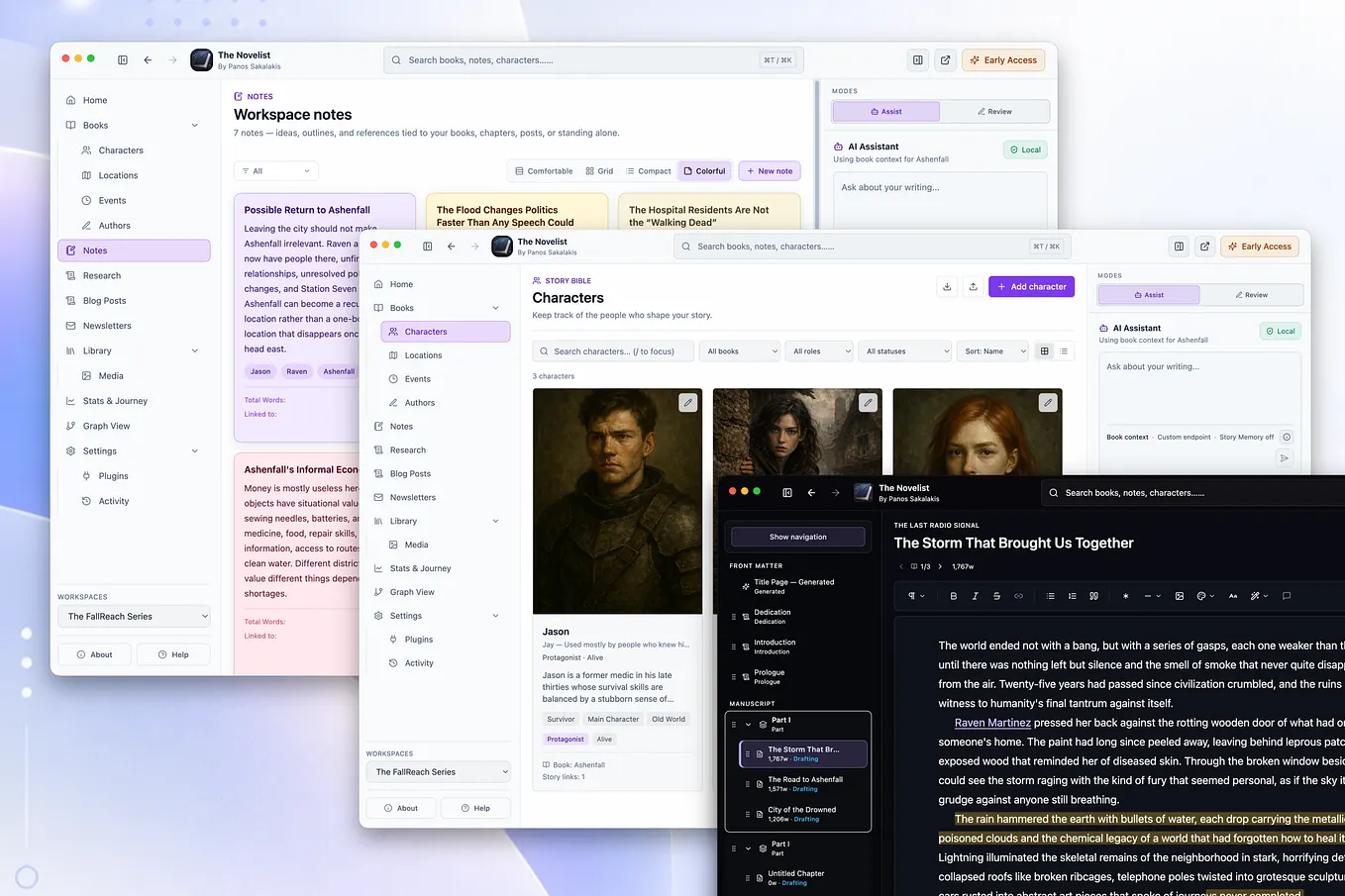
I draft plot ideas by picking moments in my timeline and figuring out who is where and what they’re doing. I use Scrivener to organize everything, with each scene labeled and tagged. As I get closer to round two, this becomes vital for maintaining continuity when I start connecting scenes.
Once I have the skeleton built, I start finding flaws. Claude and Grok are good at this. We tackle it from a broad perspective and narrow it down to find specific issues. We fix them. Then comes the real work — full prose. This is where we add muscle, fiber, blood, and skin to those bones. We make the script live and breathe.
After that, we layer in the atmosphere and cosmetics of the world. We ensure proper timeline consistency and that the story hits what I’m trying to accomplish. These stories revolve around my main characters — Peri, Kitt, and Wynne — and their journeys. Every scene needs to serve their arcs.
Then we edit. And edit. And edit. We make sure dialogue is consistent with who each character is. We maintain proper point of view in each scene — and I have very specific rules about priority and pecking order. Transitions are still a challenge for me, so that’s an area where I’m actively growing.
Finally, we reach the final draft phase. This is where we go line by line, looking for repetition, fragments that slipped through, POV breaks, characters who know too much, anything that disrupts the immersion. This process is not quick. Anyone who claims otherwise is lying.
The Hard Truths About AI in Long-Form Writing
AI is not perfect. It drifts. It repeats itself. It lacks imagination. It gets confused about details. All of these problems happen when you use AI for long-form writing, and you have to actively manage them.
I’ve found workarounds. For example, I create separate projects just for certain sections of the books to maintain a tighter focal point. I provide detailed context about what happened before and what I’m aiming for. This helps prevent drift and confusion.
The hardest part is maintaining my own voice. These are my stories. My characters. My ideas. I’m not Robin Hobb. I’m not Jeffrey Archer or David Eddings. I love those authors and the styles they brought to fiction, but that’s not who I am. I have to constantly check that the prose sounds like me, not like a generic AI output.
A Concrete Example: From Skeleton to Living Scene
Let me show you what this actually looks like in practice.
Get JT Baldwin | Blackwood Press’s stories in your inbox
Join Medium for free to get updates from this writer.
I have a scene in Reversal of Fortune called ‘The Spillway.’ It’s a pivotal moment where my protagonist Peri confronts her mentor Kataero, and everything she’s been running from comes to the surface. This scene went through multiple iterations with AI helping me build it layer by layer.
I started with the skeleton: Kataero challenges Peri to spar at dawn. She’s confident, cocky even. He defeats her easily, repeatedly. Then he confronts her about why she’s really running every morning, why she took unnecessary risks on a job. She breaks down, admits she feels like a charity case, throws her sword into the canal, and runs into the hills.
That’s the bones. The structure. The emotional beats I knew had to happen.
Then I used AI to help flesh it out. Not to write it for me, but to help me build the atmosphere, find the right physical details, strengthen the emotional progression. We added the stopwatch — a physical object representing her obsession with measurement and proof. We developed the setting — the spillway platform, the lock gates, the sunrise painting warning colors across the sky. We layered in the sparring exchanges to show not just that he beats her, but how effortlessly, how patiently.
The result is a scene that breathes. That has weight. Where you can feel Peri’s desperation and Kataero’s measured concern. Where the morning setting mirrors her internal state — starting confident in the pre-dawn, ending shattered under a red sky warning of storms.
But here’s the key: I built that skeleton. I knew those characters. I understood what emotional truth needed to emerge. AI helped me construct it scene by scene, layer by layer, but the foundation was mine.
AI also helped me see a bigger structural problem. My original plan was three separate trilogies, each focused on one character. As I worked with AI to develop the narrative, I realized that approach would fragment the story. We restructured it into a single trilogy with multiple POVs running parallel — different stories happening simultaneously that eventually converge. That was a major pivot that saved me from a fundamental structural flaw.
What You Can Try: The Projects Strategy
If you’re working on long-form fiction with AI, here’s the single most valuable technique I’ve found: use separate projects for different sections of your book.
This is a game changer. Instead of trying to maintain context for an entire novel in one conversation (which leads to drift, confusion, and AI forgetting critical details), break it down. Create a project just for Act One. Another for a specific character arc. Another for a particularly complex scene sequence.
In each focused project, provide the essential context: what happened before this section, what you’re trying to achieve, who the key characters are. Then work within that smaller scope. The AI can maintain consistency and quality much better when it’s not trying to juggle your entire 300-page manuscript.
This approach lets you go deep on specific sections without losing the thread. You can always connect the pieces later, but the quality of each individual section will be dramatically better.
Why Quality Matters More Than Speed
I own these stories. The quality reflects on me as a writer and crafter of tales. I mostly focus on the emotional journeys because we need to invest ourselves in these characters. If we don’t care about them, why should readers?
AI has been a blessing for me. It’s a tool that helps me build what I would normally struggle with. But it’s not a shortcut. It’s not a replacement for craft. It’s not the storyteller — I am.
My process is probably more complicated than it should be, but it’s making my dream become a reality. Every layer, every editing pass, every careful decision about POV and dialogue and transition — that’s what separates a real book from AI-generated slop.
The Bottom Line
If you’re a writer considering AI tools, understand this: AI can help you organize, brainstorm, and construct. It can be a tireless editing partner that helps you spot inconsistencies and smooth rough edges. But it cannot create the heart of your story. It cannot develop your voice. It cannot craft genuine emotional resonance.
That’s on you. That’s always been on you. AI is just the hammer and the saw. You’re still the craftsman.
My trilogy is taking shape because I’m putting in the work. Because I spent years building the foundation. Because I’m treating this like the serious craft it is. AI is part of my toolkit now, but the stories? The characters? The emotional truth?
Those are mine.
Writing with AI is a taboo subject, and a stigma I am eager to overcome and prove wrong. I’m willing to put in the time and do this right. Reversal of Fortune — Book 1 of Ironforged will be out in early 2026. Follow the adventures of Peri, Kitt, and Wynne as they uncover a world that was hidden in plain sight. I am eager to share this with all of you. Coming soon! In the meantime, go read The Palisade Journals… some hidden gems in there for what is to come.