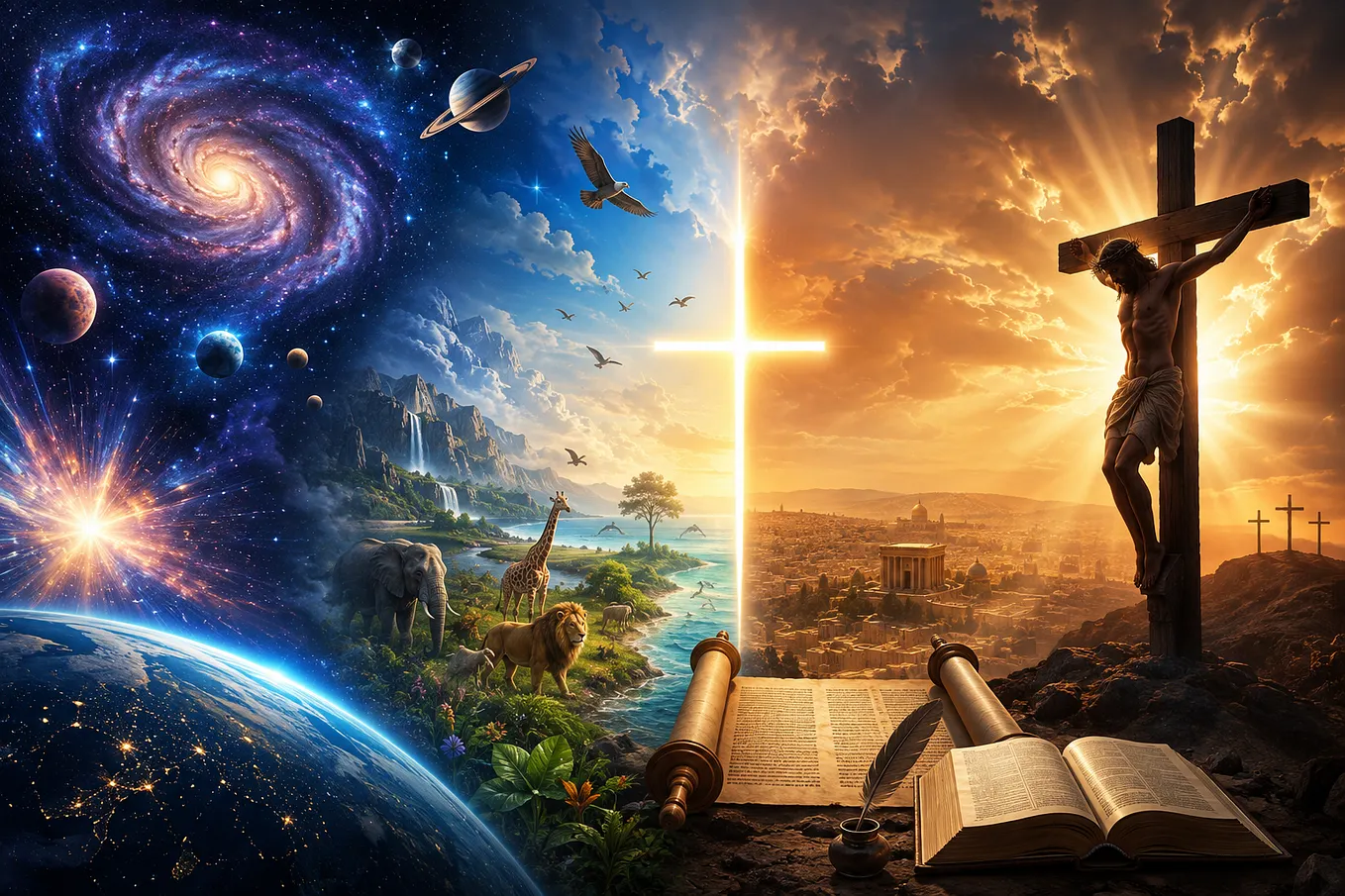
What If the Bible Got It Right?


Can the Bible be trusted
Much of what we believe as Christians about God, Jesus Christ, salvation and eternal life comes from the Bible. That makes the reliability of the Bible enormously important. If we are going to trust what it tells us about things as important as our relationship with God and what happens to us after we die, we should have good reason to believe that the book itself can be trusted.
The Bible certainly makes some extraordinary claims. God created the universe, Genesis describes creation in six days, Adam and Eve were placed in the Garden of Eden, Noah built an enormous Ark and survived a catastrophic Flood, Moses parted the Red Sea, Jonah survived inside a great fish, and Jesus performed miracles and ultimately rose from the dead. To many people today, some of these accounts sound more like fairy tales than history.
So there are really two questions we need to answer. Do we have essentially the same Bible that was originally written, and if we do, can we believe what it says?
Do We Have the Bible That Was Originally Written?
The Bible was written by numerous authors over many centuries. The Old Testament was written primarily in Hebrew, with some Aramaic, while the New Testament was written in Greek. We no longer have the original handwritten manuscripts, but we have thousands of ancient manuscript copies and fragments that allow scholars to compare one manuscript with another and determine with remarkable accuracy what the original writers wrote.
As these manuscripts were copied by hand, occasional differences naturally occurred. A word might be misspelled, repeated or omitted, and occasionally a comment written in the margin found its way into a later copy. A good example occurs in John 5 at the Pool of Bethesda. Some later manuscripts include an explanation that an angel periodically stirred the water and that the first person entering afterward would be healed. The explanation helped readers understand why the sick were waiting beside the pool, but comparison with earlier manuscripts showed that it had apparently been added later.
The important part of this example is that it was caught. Because so many ancient manuscripts survived from different times and different parts of the world, scholars can compare them and identify where these differences occurred. Rather than the variations making the Bible less reliable, the enormous number of surviving manuscripts gives scholars the ability to identify many of the changes that occurred during centuries of hand copying and determine what the earliest text said.
What About All the Different Translations?
Walk into a Christian bookstore and you will find the King James Version, New King James, NIV, ESV, NASB and many others. This can make it appear that there are many different versions of the Bible, but these are not different Bibles. Modern translations generally go directly back to the ancient Hebrew, Aramaic and Greek manuscripts rather than simply translating an earlier English Bible.
Languages do not always translate perfectly word for word. The English word love, for example, can represent several Greek words expressing different aspects of love. That is why pastors and Bible teachers sometimes return to the original Hebrew or Greek, often using tools such as Strong’s Concordance, to better understand the meaning behind a particular English word. Different translations may choose somewhat different English wording, but they are working from the same ancient writings and communicating essentially the same message.
Who Decided What Belonged in the Bible?
There is a popular story that the Roman emperor Constantine essentially created the Bible at the Council of Nicaea in AD 325, deciding which books would be included and which would be left out. That simply isn’t what happened. Long before Constantine, Christians throughout the Roman world were already reading and circulating the Gospels, Paul’s letters and other writings they considered authoritative.
By about AD 180, Irenaeus was already writing about Matthew, Mark, Luke and John as the four Gospels. Around the time of Constantine, the historian Eusebius described which Christian writings were already widely accepted, and in AD 367 Athanasius listed the same 27 New Testament books contained in our Bibles today. The Bible wasn’t suddenly created at a meeting three hundred years after Jesus. These writings had already been copied, circulated and read by Christians spread throughout the ancient world.
Taken together, the enormous manuscript record and the early circulation of these writings give us good reason to believe that the Bible we read today faithfully communicates what its original writers intended to tell us. But that only answers our first question. The much more interesting question is whether we can believe what those writers actually said happened.
From History to Faith — and Back to Science
The people who first heard many of the accounts recorded in the Bible were much closer to the events themselves than we are. They lived in cultures where history and family traditions were commonly passed from one generation to another by word of mouth. The Exodus, the settlement of Israel, the kings, the prophets and eventually the life of Jesus became part of the history and tradition of the people receiving these accounts.
As centuries passed, however, we became farther removed from those events. Modern science then appeared to make some of the Bible’s most extraordinary claims increasingly difficult to believe. A universe created by God, six days of creation, Adam and Eve, a worldwide Flood and an enormous Ark increasingly sounded impossible, and for many Christians accepting these accounts became largely a matter of faith.
But something rather remarkable has happened. The same science that once seemed to make the Bible more difficult to believe has begun providing discoveries that make some of its most questioned claims considerably easier to understand. Some of the very accounts that once caused people to dismiss the Bible as a collection of impossible stories are now worth taking another look at.
Can We Believe What Is in the Bible?
In the Beginning
The Bible begins with one of the most extraordinary sentences ever written:
“In the beginning God created the heaven and the earth.” — Genesis 1:1
For thousands of years no one could scientifically demonstrate that the universe actually had a beginning. Most people, including many scientists, believed that the universe had simply always existed. Modern science dramatically changed that picture. In the 1920s, astronomer Edwin Hubble, using the powerful new telescopes of his day, discovered that distant galaxies were moving away from us and that the universe was expanding. If the universe is expanding, scientists realized that we could essentially run the clock backward. The farther back we go, the smaller and denser the universe becomes, until we arrive approximately 13.8 billion years ago at the beginning of our universe — the event we now call the Big Bang — and ultimately at the initial state generally referred to as the singularity.
Thousands of years before modern cosmology, the first three words of Genesis had already taken us to exactly the same place:
“In the beginning…”
Dr. Stephen Meyer, a Cambridge-educated, world-renowned scientist and director of the Discovery Institute, has written extensively about the implications of the beginning of the universe. If space, matter, energy and time themselves had a beginning, then whatever caused the universe to exist could not simply have been another physical object within the universe. Genesis provides its answer in the remainder of that very first sentence: “God created the heaven and the earth.”
What About the Six Days?
Having arrived at a beginning, Genesis immediately presents us with another problem. Modern science tells us that the universe is approximately 13.8 billion years old, while Genesis describes creation as taking place over six days. At first those numbers appear completely incompatible.
One of the most fascinating arguments supporting the Genesis account of creation comes from physicist Gerald Schroeder. Schroeder does not simply redefine a Genesis “day” as some unspecified period of millions or billions of years. He argues that the six days can be six actual days measured from the cosmic perspective he believes Genesis is using, while those same six days measure approximately 14 billion years from our perspective today.
The key to his argument is the expansion of the universe. As the universe expanded, the wavelengths of radiation traveling through it were stretched, and that expansion can actually be measured. Schroeder took the published scientific measurements for the expansion of the universe and combined them with Einstein’s equations of relativity to calculate how time measured from the perspective of the early universe would appear when measured by our clock today.
That distinction is important. Schroeder did not begin with six days and then simply assign millions or billions of years to each day until the numbers came out right. The expansion measurements already existed. Einstein’s equations already existed. Schroeder applied the mathematics to them and did the calculation. When he did, the result came remarkably close to the scientifically measured age of the universe.
When Schroeder applies those calculations to the six days of Genesis, something remarkable happens. The six days are not equal-sized periods when translated into the years we measure today:
Day One — 7.1 billion years
Day Two — 3.6 billion years
Day Three — 1.8 billion years
Day Four — 890 million years
Day Five — 450 million years
Day Six — 230 million years
Together they total approximately 14 billion years — remarkably close to modern science’s estimate that the universe is approximately 13.8 billion years old.
Genesis and modern cosmology may therefore not be giving us two contradictory ages for creation. They may be describing the same passage of time as measured from two very different perspectives.
What About Adam and Eve?
This brings us to another apparent conflict between Genesis and modern science.
The genealogies recorded in Genesis 5 and Genesis 11 have traditionally been used to place Adam approximately 6,000 years ago. Yet scientists have discovered remains of Neanderthals and other humanlike populations that existed tens or even hundreds of thousands of years earlier. Neanderthals, for example, are generally dated from approximately 400,000 to 40,000 years ago.
That leads us to an interesting question:
Does the Bible actually require Adam to have been the first creature that looked human?
Genesis tells us:
“So God created man in his own image, in the image of God created he him; male and female created he them.” — Genesis 1:27
Being created in the image of God cannot simply mean looking physically like God, because the Bible tells us that God is spirit. Perhaps the important difference between Adam and the creatures that existed before him was not simply physical.
The Bible presents human beings as more than biological machines. We possess a physical body, but Scripture also speaks of the soul and the spirit. The body is our physical vessel. The soul encompasses such things as our personality, emotions, character, affections and memories. The spirit gives us the capacity for a relationship with God.
That led us to consider another possibility.
Perhaps Neanderthals and other ancient humanlike populations possessed remarkably human bodies, intelligence, emotions, social relationships, tools and culture. But with Adam, God created something new — the first complete man as God intended mankind to be: body, soul and spirit, created in the image of God and capable of knowing and having a relationship with his Creator.
Genesis then tells us something important. God did not simply release Adam into the general population. He placed him in the Garden of Eden. There Adam enjoyed a unique relationship with God, and there God created Eve to be with him.
When Adam and Eve disobeyed God, however, they were expelled from the Garden and entered the world outside Eden. If other humanlike populations already existed outside the Garden, Adam’s descendants could eventually have encountered and intermarried with them.
There are passages in Genesis that make this possibility especially interesting. After Cain murdered Abel, he said:
“Every one that findeth me shall slay me.” — Genesis 4:14
Cain subsequently had a wife and built a city. Genesis does not tell us that these people came from a pre-Adamic population, but Cain’s fear raises an obvious question about who else inhabited the world outside his immediate family.
Genesis may give us another intriguing clue. Only a few chapters after Adam, it speaks of:
“mighty men which were of old, men of renown.” — Genesis 6:4
Who were these “men of old”? The Bible does not tell us. Could this be a reference to people descended from populations that had inhabited the earth long before Adam — perhaps even descendants of the Neanderthals or other ancient human populations?
We cannot know, but when considered alongside Cain’s fear of other people and his building of a city, it raises an interesting possibility that the world outside Eden may have been more populated than we sometimes imagine.
Interestingly, after considering this possibility, I discovered the work of computational biologist Dr. S. Joshua Swamidass. In his book The Genealogical Adam and Eve, Swamidass demonstrates scientifically how a relatively recent historical Adam and Eve could have existed in a world already populated by other humans and, through intermarriage over subsequent generations, eventually become genealogical ancestors of everyone alive today.
His model is not identical to the body-soul-spirit idea I have described, but it demonstrates something very important: the scientific evidence for ancient human populations does not necessarily eliminate the possibility of a relatively recent historical Adam and Eve.
Perhaps science has not disproved Adam and Eve.
Perhaps we have simply assumed that Adam had to be the first creature that looked like us.
Noah’s Ark
Before we consider the evidence for the Flood itself, perhaps we should first look at the Ark.
Genesis does not simply tell us that Noah built a large boat. It gives surprisingly specific instructions:
“The length of the ark shall be three hundred cubits, the breadth of it fifty cubits, and the height of it thirty cubits.” — Genesis 6:15
A cubit was an ancient unit of measurement whose exact length varied. While a common cubit is often estimated at about 18 inches, Answers in Genesis and the Ark Encounter use a 20.4-inch royal cubit, based upon measurements used for major construction projects in the ancient world. Using that measurement, the Ark would have been approximately 510 feet long, 85 feet wide and 51 feet high — an enormous vessel, particularly for the ancient world.
But perhaps even more remarkable are its proportions. The Ark was six times longer than it was wide. Its purpose was not speed or maneuverability. It needed to remain stable, carry an enormous load and survive extremely rough seas.
Modern engineers have actually put the dimensions given in Genesis to the test. A team of Korean researchers did more than simply examine the numbers on paper. They built a 1:50 scale model of Noah’s Ark based upon the biblical dimensions and used it as part of an engineering study examining stability, structural strength and performance in waves.
Their research found that the proportions described in Genesis provided an extraordinary balance of the characteristics needed for the Ark’s particular purpose. It was not designed for speed or maneuverability. It was designed to remain stable, carry an enormous load and survive severe seas.
That raises an interesting question:
How did people living thousands of years ago know how to design such a seaworthy vessel?
Then there is the question almost everyone asks:
How could Noah possibly have put all those animals on the Ark?
The answer may be considerably simpler than we sometimes imagine.
The Bible does not say Noah took two of every breed or even two of every species as we classify animals today. Genesis repeatedly says that the animals came “after their kind.”
Get Jespaulding’s stories in your inbox
Join Medium for free to get updates from this writer.
Noah would not have needed two German shepherds, two Labradors, two poodles and two wolves. He would have needed representatives of the original dog kind, from which the many varieties we see today could subsequently develop.
Researchers have spent considerable time studying how many animals would therefore have been required and whether they could actually fit aboard the Ark. Estimates vary depending upon how a biblical “kind” is defined, but detailed feasibility studies have concluded that the enormous three-deck vessel described in Genesis could have provided sufficient room for the animals, their enclosures, food and water.
But simply fitting the animals aboard is not enough.
Could the Ark actually sustain that much life?
Thousands of animals would generate considerable heat and enormous amounts of waste. Genesis does not give us the internal engineering plans for the Ark, so we cannot know exactly how Noah handled these problems. But neither problem required modern technology.
The Ark could have been designed with openings and ventilation passages that could have adequately removed the heat generated by the animals. Waste could likewise have been removed using relatively simple systems involving sloped floors, channels and gravity. Researchers studying the feasibility of the Ark have examined these questions along with feeding, watering and caring for the animals and have proposed workable solutions using technology that could have been available at the time.
Has Noah’s Ark Actually Been Found?
There is one more remarkable piece of evidence that deserves our attention.
Genesis tells us that after the waters began to recede, “the ark rested…upon the mountains of Ararat.” — Genesis 8:4
In 1959, Turkish Army Captain İlhan Durupınar was examining aerial reconnaissance photographs of eastern Turkey when he noticed an extraordinary formation in the mountains near Ararat. It had the unmistakable outline of an enormous boat.
The formation, which became known as the Durupınar site, is approximately 515 feet long. Its boat-like shape, enormous size and location in the region identified with the mountains of Ararat immediately attracted attention because of their similarity to the description of Noah’s Ark in Genesis.
The site became even more interesting as modern technology allowed researchers to begin looking beneath the surface.
Electrical-resistivity and ground-penetrating-radar surveys conducted in 2014, 2019 and 2021 detected unusual linear structures and apparent right angles beneath the formation. Later analysis of the radar data identified corridor-like and room-like features within it. Soil testing added another intriguing finding: samples collected from inside the formation contained approximately three times as much organic material as samples collected outside it.
None of these findings by themselves tell us exactly what lies beneath the ground, but taken together they have provided more than enough reason to investigate the site much more thoroughly.
The site has been known for more than sixty years, which naturally raises another question:
If this could possibly be Noah’s Ark, why hasn’t someone simply dug it up?
The answer is more complicated than it might first appear. The site is in a remote region of eastern Turkey near the Iranian border and lies within a protected national-park area. Earlier investigations were limited, and excavation itself presents another problem: once an archaeological site is dug up, its original arrangement is permanently disturbed. Researchers therefore want to understand what is beneath the formation before deciding where, or even whether, major excavation should take place.
An expedition investigated the formation shortly after its discovery. When limited digging failed to reveal an intact wooden ship, interest diminished and the formation was largely regarded as a natural geological feature. But the technology available at that time was nothing like what researchers have available today.
That is why much of the recent investigation has concentrated upon non-destructive methods such as ground-penetrating radar and electrical-resistivity scanning. These technologies allow researchers to examine structures beneath the ground before disturbing them.
And now, after decades of questions, something very significant has changed.
In 2026, the Republic of Türkiye officially authorized a comprehensive scientific investigation of the Durupınar formation, directed by Professor Cenker Atila of the Department of Archaeology at Sivas Cumhuriyet University. Because the site lies within a national park, the project required authorization from the appropriate Turkish government agencies. Fieldwork began in June 2026 with approximately twenty scientists and students from five countries participating.
The new investigation is proceeding methodically. Researchers are creating detailed maps and three-dimensional models of the formation and conducting high-resolution ground-penetrating-radar surveys. After the radar results are evaluated, selected areas are scheduled for deep core drilling, allowing researchers to remove narrow samples from beneath the surface without first excavating the formation. Those samples can then be subjected to detailed laboratory analysis.
This may finally provide an answer to a question that has remained unresolved since that unusual boat-shaped formation was first noticed in an aerial photograph in 1959\.
We certainly cannot yet say that Noah’s Ark has been found. But consider what we do have. In the mountains of Ararat, where Genesis tells us the Ark came to rest, there is an enormous boat-shaped formation whose dimensions have been compared with those given for the Ark in Genesis. Beneath it, modern scanning has detected unusual linear and right-angle features, while soil samples from inside the formation contain considerably more organic material than the surrounding soil. And now, for the first time, a comprehensive international scientific investigation has been officially authorized to determine what is actually there.
If that investigation should ultimately discover the remains of a massive ancient vessel beneath the formation, it would be one of the most extraordinary archaeological discoveries in history.
For now, we wait to see what the science reveals.
Put all of this together and something remarkable begins to emerge.
The Ark described thousands of years ago was not merely a boat large enough to float. Its dimensions produced an extraordinarily well-designed vessel for the specific job it was required to perform. It could remain stable in severe seas, carry an enormous load and provide the capacity necessary to sustain the life aboard it.
Earlier we looked at the extraordinary fine-tuning of the universe — the remarkable way in which so many different requirements come together to make life possible.
On a vastly smaller scale, Noah’s Ark presents us with an interesting parallel. Its dimensions, proportions, capacity and purpose all come together in a remarkably well-designed vessel.
So how did people living thousands of years ago know how to design it?
They didn’t. But God did.
Was There Really a Worldwide Flood?
The story of Noah building an Ark to God’s specifications would be interesting, but it wouldn’t make much sense unless there was a reason for the Ark.
Obviously there was.
God intended to destroy most of what He had created while preserving a core from which to build a new world. In modern computer terms, God was about to reset and reboot the earth.
The Bible tells us that the Flood accomplished exactly that.
But did the Flood really happen as the Bible describes?
If a worldwide catastrophe of this magnitude actually occurred, we would expect it to have left enormous evidence behind.
And that is exactly what we find.
Much of the surface of the earth is covered with sedimentary rock — layers of material that at some point had to be transported and deposited. Within these layers we find billions upon billions of fossils, including enormous fossil graveyards where animals were buried together. We find marine fossils far above present sea level, including in some of the highest mountain ranges on earth. We also find delicate creatures preserved as fossils and immense deposits containing animals that had to be buried rapidly before they could decay or be destroyed by scavengers.
There are even large fossilized trees standing upright through multiple layers of sedimentary rock. These are sometimes called polystrate fossils because a single tree passes through more than one sedimentary layer. Whatever interpretation we place on the surrounding formation, the sediment around these trees had to accumulate rapidly enough to bury and preserve them before the exposed portions of the trees rotted away.
Then there are the enormous coal deposits found throughout the world. Coal represents tremendous quantities of vegetation that were accumulated, buried and compressed. A catastrophe capable of stripping forests from the land, transporting enormous masses of vegetation, concentrating that material and rapidly burying it beneath additional sediment provides an intriguing explanation for how some of these enormous deposits could have formed.
The rock layers themselves tell another remarkable story. Some sedimentary formations extend not simply for a few miles but across enormous portions of continents. In the Grand Canyon we see thousands of feet of sedimentary layers stacked one upon another, many containing marine fossils. Whatever deposited these enormous formations involved quantities of sediment and water operating on a tremendous scale.
The Grand Canyon itself raises another fascinating question. We are accustomed to thinking that geological formations of this magnitude must require millions of years to develop. Yet we now know from observed catastrophic floods that enormous amounts of water can reshape landscapes with astonishing speed. The catastrophic Ice Age floods that swept across the northwestern United States carved enormous channels, moved gigantic boulders and dramatically reshaped thousands of square miles of terrain. Given enough water and enough energy, geological change can happen very quickly.
Dr. Walt Brown, an MIT-trained mechanical engineer and author of In the Beginning, spent decades examining evidence such as this and asking a fascinating question: What physical event could possibly have produced a catastrophe on the scale described in Genesis?
Brown began with something in the biblical account that is often overlooked. The Bible does not say that Noah’s Flood was caused simply by forty days of rain. Genesis tells us:
“The same day were all the fountains of the great deep broken up, and the windows of heaven were opened.” — Genesis 7:11
The “fountains of the great deep” are central to Brown’s Hydroplate Theory.
Brown proposed that before the Flood enormous quantities of water existed beneath the earth’s crust under tremendous pressure. When the crust ruptured, that pressure forced water violently upward through the break. He compared the rupture to tearing open the seam of a baseball. As the rupture spread, tremendous fountains of water, rock and debris were blasted high above the surface while enormous quantities of water poured onto the earth.
Brown believes that one of the remnants of this tremendous rupture can still be seen in the enormous Mid-Atlantic Ridge and the worldwide system of mid-ocean ridges of which it is a part. The earth today is literally encircled by a vast system of underwater mountain ranges extending tens of thousands of miles along the ocean floor.
In Brown’s model, the rupture did much more than release water. Once the crust had been broken, enormous sections of the earth’s surface began moving. As they moved and encountered resistance, the crust was compressed, buckled and pushed upward, producing great mountain ranges. At the same time, other portions of the earth sank and enormous ocean basins deepened.
This provides an intriguing answer to one of the most obvious questions about Noah’s Flood:
Where did all the water go?
It may not have gone anywhere.
Today approximately 71 percent of the earth’s surface is covered by oceans, while only about 29 percent is dry land. Those oceans are also extraordinarily deep. If the pre-Flood earth had lower mountains and shallower ocean basins, water could have covered vastly more of its surface. As the catastrophe reshaped the earth, mountains rose and ocean basins deepened, creating enormous reservoirs into which the Flood waters could retreat.
There is a remarkable passage in Psalms that seems almost to describe such a process. After describing the waters covering the mountains, Psalm 104 says:
“The mountains rose; the valleys sank down to the place which You established for them. You set a boundary that they may not pass over, so that they will not return to cover the earth.” — Psalm 104:8–9
The picture is striking. The mountains rise, the valleys sink and the waters retreat into the places prepared for them.
This also helps us understand something important about the Ark. The geological catastrophe that produced the Flood did not have to continue at its original violence throughout the entire time Noah remained aboard. Genesis tells us that eventually “the fountains also of the deep and the windows of heaven were stopped.” The source of the catastrophe subsided, but the water did not disappear overnight.
Instead, Genesis tells us that “the waters returned from off the earth continually.” The Ark eventually came to rest in the mountains of Ararat while substantial water still covered the surrounding world. The waters continued to decrease until other mountain tops became visible. Noah then waited as the land continued to drain and dry. The biblical account describes a gradual recession lasting months, which fits remarkably well with a world whose newly formed and deepened ocean basins were receiving enormous quantities of water draining from the continents.
Brown takes the violence of the fountains one extraordinary step further. He calculated that when the crust first ruptured, some of the highly pressurized water, rock and debris could have been blasted completely through the atmosphere and into space. He proposed that some of this material may ultimately have contributed to the formation of comets, asteroids and meteoroids. It is an extraordinary idea, but it gives us some appreciation for the magnitude of the event Brown believes Genesis is describing when it says that “the fountains of the great deep were broken up.”
When we put the pieces together, the Flood described in Genesis begins to look very different from the children’s-book picture of Noah floating peacefully while it rained for forty days. Genesis describes a catastrophic disruption of the earth itself. The fountains of the great deep broke open. Water overwhelmed the land. Vast quantities of sediment and living things were buried. The surface of the earth was dramatically reshaped. Mountains rose, deep ocean basins provided a place for the waters to retreat, and the waters gradually receded until the Ark finally rested in the mountains of Ararat.
Today we live on a planet covered predominantly by water, with enormous sedimentary formations, vast fossil deposits, marine creatures entombed in rocks now high above the oceans, towering mountain ranges and ocean basins miles deep.
Thousands of years ago, Genesis described a catastrophe involving water on precisely this enormous scale.
So, Did the Bible Get It Right?
We deliberately took on some of the largest obstacles to believing the Bible. We looked at creation, the six days of Genesis, Adam and Eve, Noah’s Ark and the Flood. These are some of the accounts that people have pointed to as reasons the Bible simply cannot be true.
But after looking at the evidence, I find that these supposed problems are not really problems at all. In fact, I believe that many of the things that have been used to argue that the Bible must be wrong actually support the fact that the Bible has had it right all along.
The most important evidence pointing me in that direction is creation itself. In my estimation, creation points directly to the existence of an all-powerful God who created our universe. We live in a universe so finely tuned for life that I find it impossible to explain without a Creator whose intellect and power are far beyond anything we can humanly imagine.
We are talking about a Creator who exists outside the universe He created — a universe that includes space, matter, energy and time, along with the natural laws that govern them. Those laws apply to His creation; they do not limit Him as the Creator. And for me, that Creator is God.
If you can bring yourself to believe that God created the universe, then that must change the way you look at all the other miracles in the Bible. It really doesn’t take much more to believe that He could part the Red Sea, provide manna, preserve Jonah inside a great fish or heal the sick.
I believe creating the universe was the greatest demonstration of God’s supernatural power. But the miracle of Jesus Christ is right there with it. God became man in the person of Jesus, humbled Himself, allowed Himself to be tortured and crucified, rose from the grave, appeared to His followers and, forty days later, ascended into Heaven.
Jesus is also one of the strongest reasons I believe the Bible can be trusted. Jesus repeatedly referred to the Scriptures as true. He spoke of Adam, Noah and the Flood, Moses and Jonah as real people and real events. If I believe that Jesus was God in human form and that He rose from the dead, then I have to take seriously what He said about the Scriptures.
Nor do we have to depend entirely upon the Bible to establish that Jesus actually existed. The first-century Jewish historian Josephus wrote about Jesus and His crucifixion under Pontius Pilate. The Roman historian Tacitus also wrote about Christ and confirmed that He was executed under Pontius Pilate. Christianity did not begin hundreds of years later with stories about someone who might never have existed. It began in the first century with followers of Jesus proclaiming that the man they had watched die was alive again.
For me, Jesus validates the Bible, and the Bible tells me who Jesus is.
And this brings me back to why I believe we have the Bible in the first place. If this all-powerful God created us and wants to have a relationship with us, it would make little sense for Him to create us and then leave us on our own with no way to understand who He is, why He created us or how He expects us to live.
I don’t believe He did. I believe He gave us the Bible.
The Bible tells us who God is. It tells us why we are here. It tells us what separates us from God and, most importantly, it tells us what God did through Jesus Christ so that our relationship with Him could be restored.
So, did the Bible get it right?
After looking at the evidence presented in this paper, I believe it did.
In fact, I believe the Bible had it right all along.
NOTE: The Author developed the ideas, arguments, and conclusions in this article, with AI assistance in research, fact checking, editing, and presentation