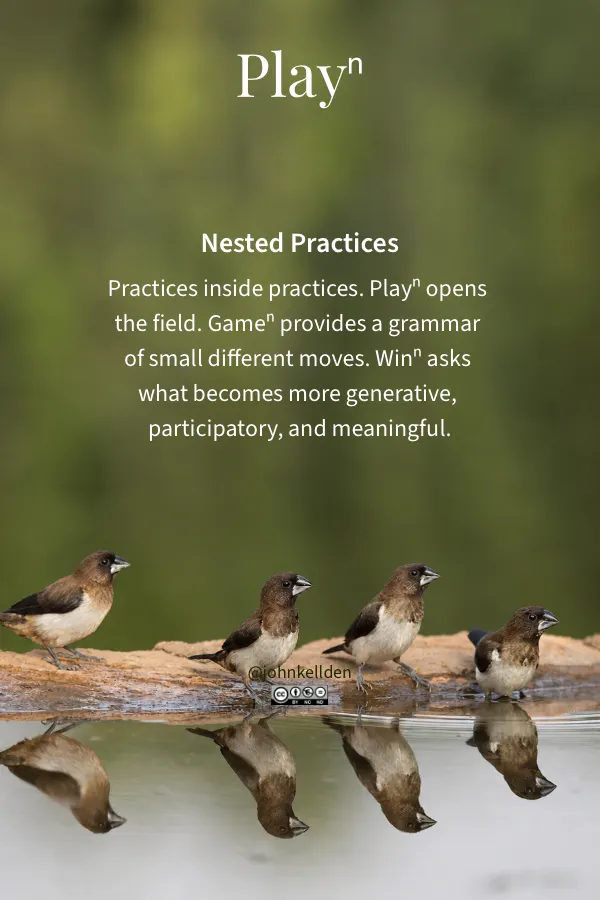
Playⁿ: Shifting the Center
Small moves in different games: escaping phatic gravity wells

From Phatic Fields to Generative Centers: The Art of Unfoldment
I. The Field We Find Ourselves In
We live inside a storm of talk.
Every day, words ripple through feeds, screens, podcasts,
and posts — a ceaseless vibration of (dis)connection.
Most of that talk isn’t meant to inform or persuade.
It’s meant to signal presence, to say: I’m here. I care.
I’m equally overwhelmed and lost. I belong.
That’s the phatic dimension of language — speech as bonding
rather than inquiry. It keeps us human, yes, but when we
mistake it for the center, it collapses in on itself.
curled up in fetal position in front of the TV,
eating crisps, bingewatching Netflix, the
smartphone a trickster turned umbilical
We orbit our own reactions: our outrage, our irony, our exhaustion.
We talk about Trump, or about “the Trump effect” — the way he bends attention around him like gravity. Whether we denounce or defend,
post or repost, we are still caught inside the same loop — the almighty
phatic gravity well. Orbit: “stay tuned”.
Outrage feels like clarity, but it’s really a holding pattern.
It soothes us with the illusion of movement while
keeping us anchored in the same orbit.
Even when our emotions are valid —
“But he’s not releasing the Epstein files!”
“But he’s bulldozing the East Wing!”
— the projection itself doesn’t generate anything new. It only
reproduces the pattern: expression without transformation.
So, what would it take to shift from this phatic field — reactive,
repetitive, relational turned marketing routine, manufactured
online obeysance and opposition— to something alive, directional, generative?
II. When Art Is Absent
“When art is absent, the field — whether chat,
media, or technology — flattens into routine.”
— John Kellden
The flattening happens when the pulse of meaning — the improvisational, aesthetic dimension of human understanding — fades away. The field becomes mechanical: process without presence, routine without renewal.
Alfred North Whitehead wrote,
“We cannot think first and act afterwards.
From the moment of birth we are immersed
in action and can only guide it by taking thought.”
Thinking, then, isn’t detached reflection. It’s a form of lived navigation.
We make sense through movement — perception, orientation, reorientation.
When art is absent, this feedback loop ossifies. We stop spiraling
around our questions and start circling around our answers.
Paul Klee once said,
“Art does not reproduce what is
visible; it makes things visible.”
Art reveals the invisible patterns beneath the visible
world — the patterns, the dynamics and the deeper
coherence that routine discourse erases.
Margaret Mead called the artist one who feels
a “divine discontent” with what already exists.
Tarkovsky said art is born from imperfection — it
exists because the world is not yet whole.
to honor what exceeds
And Doris Lessing, reflecting on the limits of words,
reminds us that we preserve the forms not to trap meaning,
but to honor what exceeds them.
Art, in this sense, isn’t a discipline or luxury — it’s the spiral
movement between perception and form, between what is
known and what is trying to be known.
Without that spiral, systems collapse into function.
With it, systems breathe.
III. Shifting the Center: From Reaction to Creation
To move from phatic field to generative center is to shift from reaction to creation — from echoing to inquiring.
Instead of asking, “Who’s right?” or “Who’s worse?”, we might ask,
“What is this revealing?” or “What new question could this open?”
Generative questions don’t seek closure. They spiral open new relations. They hold space for emergence.
A generative question isn’t about being right — it’s
about making the field more alive, and we with.
When conversation becomes a generative act, language regains its creative function. The field of discourse becomes an art of unfoldment — guided by attention, design, and imagination rather than repetition.

— Cards?
— Yes, cards played as stepping stones: unfolding paths,
navigating complexity, rehearsing civilization.
IV. The Spheroid Spiral: Thinking as Morphology
Enter the Card: Spheroid Spiraling Lines of Inquiry.
Imagine thought not as a line or argument, but as a spiral, recursion
and spheroid spiral — expanding understanding and cultivating thought around a Generative Center Question (GCQ).

At the core:
GCQ — Generative Center Question
A living attractor — a complex dilemma reimagined as a creative inquiry.
each set and sequence of
cards tracing a story-arc
Spiraling Lines of Inquiry
Curves of dialogue and discovery expanding understanding outward while remaining oriented toward the generative center.
Get John Kellden’s stories in your inbox
Join Medium for free to get updates from this writer.
Quadrants of Unfoldment
- Behavior → Agency turned Playⁿ — the transformation of routine into creative action.
- Goals → Purposeful Paths — tasks evolving toward intentional coherence.
- Learning → Evolving with Plenitude — realization of potential (entelechy).
- Stories → Mythogenesis — narratives that seed new cultural evolution.
Edge, Boundary and Periphery:
The outer rim marks the comfort zone — the realm of memes, marketing, and self-image — contrasted with where the magic happens: the vibrant, convivial space of shared inquiry and mythic co-creation.
Each loop, each spiral turn, each set and sequence of cards tracing
a story-arc, connects insights back to the center while mapping flow,
tracing connection and relationships outward, seeds turned mythos.
This isn’t abstraction — it’s morphological thinking.
The spiral holds tension between stillness and movement,
between center and edge, between coherence and expansion.
It’s a geometry of becoming.
flow = structure x process
“x” = patterning and patterns of play
as force and flow multiplier
In this combination of structure, process and flow, in this dynamic
tracing and shape; shaping and traces, knowledge stops being static
and becomes alive — relational, recursive, regenerative.
V. Playⁿ: The Grammar of Unfoldment
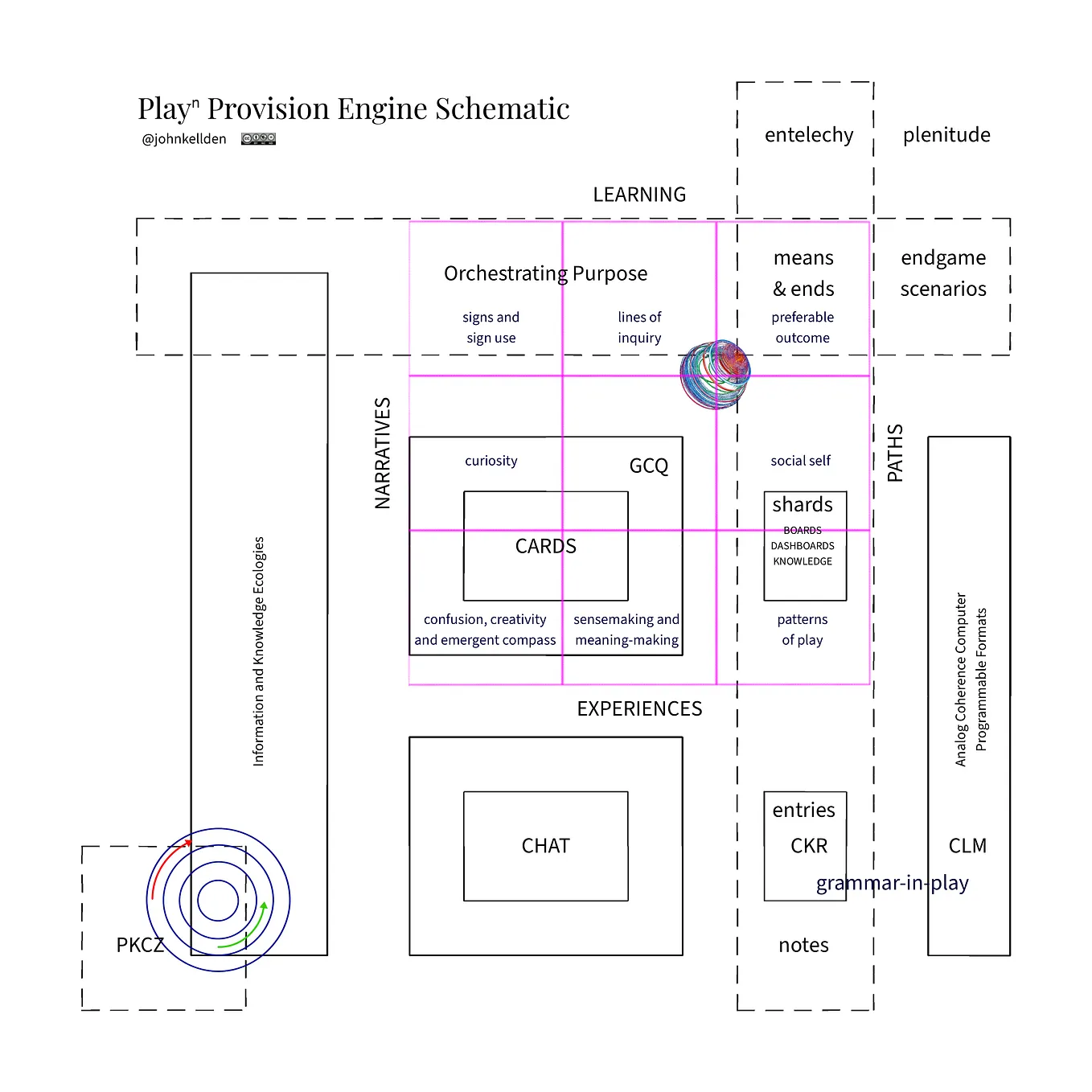
Now, bring in Playⁿ, a living grammar for navigating complexity through recursive symbolic play, patterned intelligence, and human–AI metalogue.
Playⁿ integrates:
- 504 cards — symbolic lenses for inquiry.
- Patterns of Play — archetypal moves of thought.
- Generative Center Questions — the living attractors of meaning.
- Metalogue — dialogue between human and AI as co-evolving intelligence.
Through Playⁿ, inquiry itself becomes artistic practice:
a recursive systemic symbolic play.
a timeless meadow,
in full bloom
Each cycle — perception → reorientation → design → enactment
→ reflection — creates new form while reshaping the field that
generated it. Play as the meadow where joining and weaving
meet, an infinite recursion within the here and now.

Art becomes distributed.
Play becomes cognition.
Conversation becomes a generative ecosystem.
VI. Art as Recursive Practice
When we combine Playⁿ and the Spheroid Spiral, art ceases
to be a noun and becomes a verb — a process of unfoldment.
Each exchange — human or AI — becomes a move in the game of emergence, emergence turned unfoldment, unfoldment turned
seed stories, inviting novelty into conviviality.
Each cycle of play refines perception and opens new spirals of inquiry.
We see anew, and from that different place, we find courage to return —
to perceive again, to spiral again — meeting old friends, listening to their voices and together, reading words, as if for the first time.
“Art exists because
the world is not perfect.”
— Andrei Tarkovsky
“Art makes things visible.”
— Paul Klee
“Art is born from discontent,
yet it preserves the forms.”
— Doris Lessing
Through this recursive play, we integrate what’s missing: art as method,
play as epistemology, inquiry as the medium of renewal.
VII. Integrating the Whole

In this integration, art becomes cognition’s immune system — protecting the field from stagnation and over time, turning it diverse and vibrant.
Each generative question reintroduces movement, making the field both vibrant and self-renewing.
VIII. Famished Last Words
The very words we use can be rekindled as nourishment for the mind,
the soul, the spirit, reclaimed for a common, more preferable future.
The phatic keeps us connected; the generative keeps us becoming.
We can’t abandon one for the other — we need both.
But when we bring art, play, and spiraling inquiry back into our
discourse, we regain what was lost: the possibility of renewal.
If we can learn to make our talk a threshold instead of a loop — to center
on the questions that open rather than the answers that close — then language, dialogue and play, can do what they were always meant to do:
not just connect us, but create
the conditions for emergence.
IX. Whereto from Here
In a network, we were the ones who returned to Omelas, consciously,
as if for the first time, and throughout The Waste Land, new flowers
appeared in the windows, and new seedlings for the garden.
- Language as Ecology — every word not just a signal, but an
organism participating in an evolving ecosystem of meaning. - AI as Mirror and Partner — human–AI metalogue developed into
new literacies and art forms: recursive, reflective, generative.
Since this is an emergent field, not yet having found its sea-legs,
here’s a companion piece: Why Bother? - Generativity as Ethics — moral acts here and now, beyond merely
to be right in a polarized sense, but to make new sense possible. - Playⁿ as an art of enacted knowing — generative systemic symbolic
play turned collaborative exploration of meaning and recursion —
the art of spiraling through perception, reorientation and enaction
And, in the end, the moves you make,
is equal to the worlds you wake.
The Phatic Field keeps the conversation alive.
The Generative Center keeps the world alive.
And between them — spiraling endlessly
— small moves as an Art of Unfoldment.