I WATCHED SEATTLE DIE

$EATTLE TOOK ITS PLACE
🌀JTSUNRISE🐾

A witness account of music, money, memory, and the long conversion of a city that was sold.
⸻
EPIGRAPH
A city without room for failure can afford only people with money to experiment.
⸻
EDITOR’S WARNING: THIS IS NOT A TOURIST MAP
Do not read this as a postcard from the good old days. There were no good old days for everybody. Seattle was never innocent. Its wealth had roots in land taken from Native peoples, extracted timber, maritime trade, industrial labor, speculative property, and the unequal power to decide who belonged where. The rain did not wash those facts away. Neither did a distorted guitar.
This is a book about a later injury: what happened when the city that made room for strange people, cheap experiments, unprofitable music, and accidental communities learned to sell that very strangeness as a premium amenity. The transformation did not occur on one terrible night. No mayor signed a death certificate. No wrecking ball struck the entire city at once. There was a lease that would not be renewed, a room nobody could afford, a bar that became a memory, a building whose value increased after the people who gave it character had gone.
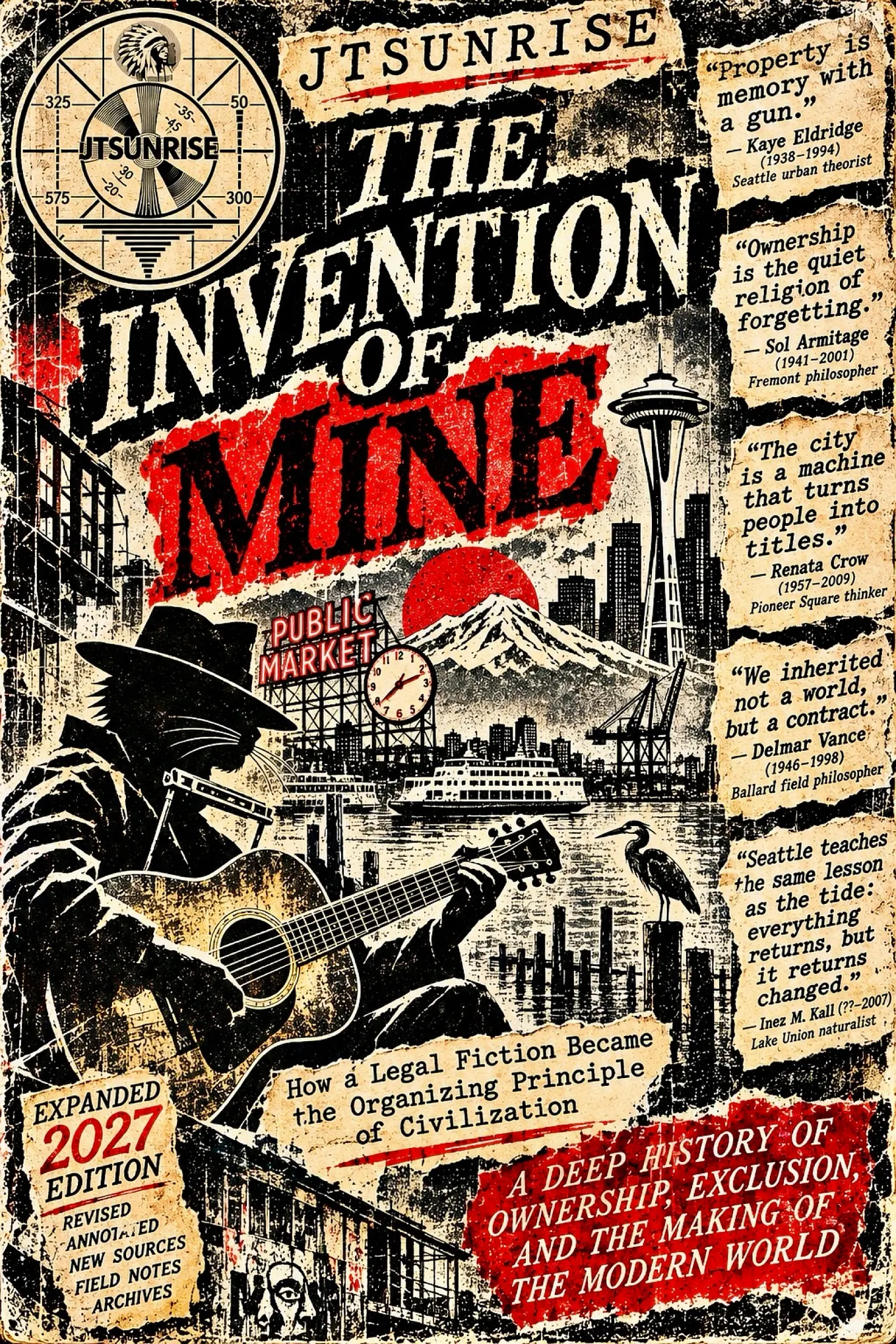
The witness is JTSUNRISE. Not a superhero. Not a historian appointed by the city. Not a mascot for a vanished decade. The cat-headed bluesman is an artistic creature assembled from a working musician’s long encounter with the street, the song, and the machinery that would like to package both. His face is feline because the usual human portrait would misdirect the inquiry toward the private individual. This is the testimony of an artistic identity, not the professional résumé or public-service history of somebody else.
THE CITY WAS STILL BREATHING
I arrived in Seattle in 1992, when the name of the city was being exported faster than most of its musicians could have imagined. The world had discovered a sound. Record companies, magazines, television crews, and tourists discovered a place. Some of the people who made the music were already exhausted by the attention. Others wanted a share of it. Some wanted nothing to do with it. Most still had to pay rent.
I was not standing at the center of a revolution. I was carrying songs, looking for places to play, and learning a city through the ordinary geography of musicians: a sidewalk, a tavern, a stage, a doorway, a bus stop, a room where the audience might listen or might talk straight through the set. Pike Place Market was not a myth to me. It was pavement. It was weather. It was people with somewhere else to be. It was the difficult freedom of playing for an audience that had not purchased a ticket and could walk away without explanation.
The OK Hotel. Art Bar. Sit & Spin. Lake Union Pub. These names do not belong here as decorative relics. They were parts of a working circuit of rooms and relationships. They held music that never became a product, arguments nobody archived, performances that could not be reconstructed from a surviving flyer. Some nights were glorious. Some were lousy. A city worth living in has room for both. Failure is not the opposite of culture. It is one of the conditions that makes culture possible.
THE LONG GAME
The change had many authors and no single mastermind. Technology fortunes altered the market for land. Property owners responded to prices and opportunities. Governments made choices about zoning, streets, transportation, housing, and public investment. Employers recruited workers. Workers needed homes. Investors wanted returns. Clubs faced rising costs, changing audiences, changing laws, and the fragile economics of keeping a room open after midnight. The city grew richer by some measures and less accessible by others. These mechanisms should not be flattened into a cartoon of villains in towers and saints in taverns.
But neither should complexity become an alibi. When a neighborhood becomes valuable because artists, workers, immigrants, musicians, and oddballs have made it worth inhabiting, who receives that value? Who owns the building? Who can renew a lease? Who gets to stay when the place is advertised as authentic? Who is hired to perform at the opening party for the expensive replacement? Who is told that displacement is merely progress, as though the people displaced were a regrettable rounding error?
$EATTLE is my name for the city that learned to sell the image of its underground while making the underground harder to sustain. The spelling is crude on purpose. So were the photocopiers. So were the staple guns and felt-tip markers that carried arguments across town before every argument had to pass through a platform’s machinery. A zine was not automatically truthful because it looked ugly. It was not automatically radical because it offended somebody. But it could be made by people who did not need a corporation’s permission to print their own account of what they saw.
THE CAT IS NOT THE HERO
I play a 1934 Kalamazoo KG-11 called Maggie of Memphis. She was old before this city’s latest reinvention began. A guitar like that does not care what a square foot of real estate costs. It has a different economy: a string under tension, a wooden body, a hand that has practiced, an ear willing to hear. The instrument does not abolish money. It does not pay a musician’s bills. It cannot bring back a vanished club. It can, however, make a sound that no press release can manufacture on command.
STRING MOVES AIR. That is not a slogan for a lifestyle brand. It is a stubbornly literal proposition. The string vibrates. The air changes. Somebody may stop. Somebody may keep walking. The musician has to live with either answer. There are no guaranteed likes on a sidewalk, no algorithm obliged to reward the chorus, no publicist who can make an indifferent stranger care. There is only the attempt, and whatever happens when the attempt meets the world.
HOW TO READ THE THREE MOVEMENTS
The first movement returns to 1992: the streets, the clubs, the working city, the musicians who were not famous, and the freedom to make something before anybody knew whether it would sell. It is not an invitation to reenact a decade. It is an inquiry into the conditions that allowed imperfect art to exist.
The second movement follows the sell-off. It asks how buildings, leases, wages, land values, cultural prestige, and corporate investment altered the ecology of music. It refuses the comforting fiction that one villain killed the city, and the equally comforting fiction that nobody made consequential choices.
The third movement finds the cat still playing in 2026, with an old guitar and no immunity to age, technology, or error. It asks whether an artist can use the machinery of modern attention without becoming its obedient supplier, and whether remembering a city is any use unless the memory changes what we are willing to protect now.
I watched Seattle change until I no longer recognized enough of it to use the old name without qualification. I watched culture become an advertisement for the property beneath it. I watched the memory of rebellion grow more marketable than the conditions that once allowed rebellion to happen. I was not everywhere. I did not see everything. I cannot speak for every musician, worker, neighbor, or person who arrived before or after me. I can tell you where I stood, what I played, and what I watched disappear.
That is the limit of my authority. It is also the beginning of this book.
If that sounds insufficient, you have understood the situation.
The next chord is not a solution. It is proof that the witness is still here. The street remembers.
⸻

MOVEMENT I
1992: THE CITY BELONGED TO THE LIVING
I did not arrive in Seattle to attend its funeral. I arrived with a guitar, a woman I loved, and the unreasonable expectation that a person could still make a life by making something. The city was wet. The city was loud. The city smelled of diesel, salt water, coffee, old beer, fish, and the damp wool of people waiting for a bus. It did not look like a monument to its own importance. That was part of its lie.
I had come northwest after my last show in Tempe, leaving behind the desert and the machinery of a life that had begun to feel too small. Seattle was not a blank slate. It was already occupied by histories I had not lived and by people who had every right to distrust the arrival of another musician looking for room. I had to learn the city by walking through it. I had to learn where the music was, who listened, who worked, who owned the rooms, and which doors opened only after somebody recognized your face.
By 1992 the outside world had discovered Seattle. A record store could become a pilgrimage site. A flannel shirt could also become a costume. The word underground had acquired a commercial address. Cameras came looking for authenticity and found people who had been playing before the cameras arrived. The business was not entirely imaginary: bands were making extraordinary music, and some of them deserved every dollar they earned. But the speed with which a living scene became a marketable story should have frightened anybody paying attention.
A scene is not a sound. It is a set of relationships. It is the person who unlocks the club, the person who runs the board, the musician who lends an amplifier, the bartender who remembers what happened last Thursday, the stranger who tells another stranger where to go tonight. It is the bad set followed by a great one. It is the argument outside. It is the ride home. It is the room available next week even if nobody made money this week. Remove enough of those relationships and the music may survive, but the scene does not.
I played Pike Place Market. That sentence sounds romantic only to somebody who has never tried to hold a song together while a truck backs up, tourists shout over the chorus, and the weather reaches inside the guitar case. The Market was work. It was also a school with no diploma and no guarantee of advancement. You learned whether your opening line had any weight. You learned that a familiar song could make a person stop and an unfamiliar one could make that same person stay. You learned that the sidewalk belongs to everybody, including people who do not want to hear you.
That is the difference between a street audience and a captive one. Nobody owes a busker the dignity of pretending to listen. A person can leave in the middle of the finest passage you have ever played. Another can stand there for twenty minutes and offer nothing but a nod. A child can be more attentive than an entire nightclub. The street gives an immediate and frequently merciless account of the work. I loved it for that. I still do.
There were rooms beyond the Market. The OK Hotel. Art Bar. Sit & Spin. Lake Union Pub. Say the names slowly, not as a list of collectible souvenirs but as places where ordinary people put their bodies in the same air and waited to see what would happen. A room does not need to be beautiful to be necessary. Sometimes the ceiling is low, the floor is sticky, and the sound system is held together by tape and a technician who understands its particular illnesses. Sometimes the room is nearly empty. The emptiness is part of the story too.
A musician needs places to be bad before becoming good. Not every experiment deserves applause. Some deserve a second attempt on a different night. Some should never be repeated. But if the only stages left are expensive stages, and the only performers allowed onto them are those already capable of selling tickets, the city has cut the ladder out from under its own culture. You cannot demand a thriving underground and then remove the inexpensive rooms in which people learn to make one.
Seattle was never an egalitarian paradise. Poverty was real. Racism was real. Displacement had not begun with software companies. The city stood on Indigenous land and carried the accumulated violence of its settlement, its industrial development, and its decisions about who could live where. To say there was room for some of us to experiment is not to claim that room was offered equally to everybody. The memory becomes useful only when it includes the people whose opportunities were narrower than mine.
Still, there was a kind of rough possibility in the city I knew. A person could stumble into music without first purchasing an identity. A handbill could reach the right people. Somebody might invite you to play because they heard you, not because a dashboard predicted engagement. A song could travel by memory. A musician could be known in a neighborhood and invisible everywhere else. Invisibility was not always a failure. Sometimes it meant the work had not yet been captured and sold.
My guitar, Maggie of Memphis, was already nearly sixty years old when I arrived. A 1934 Kalamazoo KG-11 is a stubborn companion for a city intent on reinvention. Its wood had lived through other economies and other fashions. It did not need a new logo. It needed strings, attention, and hands willing to work. The harmonica around my neck made the arrangement even less fashionable. Good. Fashion was moving too quickly to be a reliable guide to anything.
I had learned something years earlier from hearing Snooks Eaglin play on the street in New Orleans: an American songbook does not respect the little fences erected by marketing departments. Blues can sit beside gospel. Country can converse with jazz. A song everybody knows can become unfamiliar through the way it is played. A great musician can be funny without becoming a joke. That freedom traveled with me into Seattle, and it mattered more than the decade’s approved vocabulary of rebellion.
I did not know that I was watching the beginning of a long goodbye. Nobody does while the doors are still open. A club closes and another seems likely to take its place. A musician moves away and somebody else arrives. A building changes hands and the city keeps moving. Each loss can be explained separately. The danger lies in what those explanations conceal when they accumulate. One less cheap room. One less place to fail. One less stage that can survive a slow Tuesday. One less reason for an unknown musician to remain.
By the time the old places became objects of nostalgia, the mechanism had already done its work. People who had never heard a set in those rooms could purchase their image. The city could celebrate a cultural past without making equivalent space for a cultural future. The photographs grew more valuable as the conditions that produced them became harder to find. Seattle had begun to confuse remembering the underground with allowing one to exist.
I was not a prophet. I was a musician who kept showing up. That is a smaller claim and a more useful one. I can tell you what it felt like when a room was alive. I can tell you that not every song was recorded and not every important person became famous. I can tell you that the freedom to play badly tonight is part of the possibility of playing beautifully tomorrow. And I can tell you that a city which prices that freedom out of existence will eventually find itself selling tickets to a memory.
The city did not ask me to preserve it. I did not know preservation would become part of the job. I came to play. Years later, the old names would sound like evidence, and the spaces between them like missing teeth.
⸻

MOVEMENT II
THE $EATTLE SELL-OFF
The city did not die because the music stopped.
The music stopped in certain rooms because the city had discovered a more profitable use for the space.
That distinction matters. It identifies the machinery instead of merely mourning the result.
Seattle was not murdered by a single corporation, mayor, developer, landlord, or billionaire. It was transformed by thousands of transactions, public decisions, private investments, rising land values, changing industries, and an increasingly familiar proposition: that the highest financial return on a piece of property was also its highest and best use.
I watched the proposition become architecture.
I watched it become rent.
I watched it become a city.
The first trick was to rename what had happened. A neighborhood did not become unaffordable; it became desirable. A cheap room did not disappear; the property was repositioned. A building full of peculiar tenants did not lose its people; it was revitalized. The vocabulary was so clean that you could hardly see the wreckage through it. Nobody had been displaced. They had simply failed to remain competitive with the new value of the land beneath their feet.
I remember when a musician could look at a club and imagine playing there. Later, it became easier to look at the same address and imagine a financing package. One imagination was not necessarily more intelligent than the other. But only one could borrow against the future price of the dirt. The guitar had to make its case tonight. The property could make its case in dollars it expected to collect tomorrow.
Here is the economic mechanism, stripped of its expensive vocabulary. People make a place interesting. Other people discover that it is interesting. Demand rises. Owners can charge more. The people who made it interesting must either earn more, accept less space, move farther away, or leave. The place retains the reputation after the people who built it have departed. The reputation becomes part of the sales pitch for the next development. Culture produces value; ownership determines who captures it.
This does not happen in every building or to every person. Some owners hold rents down. Some new businesses make genuine contributions. Some artists purchase property and benefit from rising values. Some old venues close because their operators are exhausted, their audiences vanish, or their finances fail. A city is not a morality play with two costumes. But exceptions do not erase the larger pattern. If the price of participating in a neighborhood rises faster than the resources of the people who animate it, the neighborhood changes its population and eventually its character.
The strangest part was watching rebellion become an amenity. A city that once made room for noisy, unmarketable people began selling the memory of those people as a sign of sophistication. A hotel could decorate a lobby with the visual language of an underground it had never supported. A new restaurant could borrow the name of a vanished landmark. A real estate advertisement could promise grit, authenticity, and creative energy in a building whose rents excluded most of the people likely to produce those things.
The old flyers became wallpaper. The bands became heritage. The neighborhood became a lifestyle. Somewhere, somebody was paid to explain that this was a celebration of local culture. Perhaps it was, in the narrow sense that a taxidermied animal celebrates wildlife. The fur is still there. The eyes are carefully arranged. The creature no longer moves.
I knew the OK Hotel, Art Bar, Sit & Spin, and Lake Union Pub as places, not historical references. Their circumstances were not identical, and it would be dishonest to invent one common explanation for their disappearance. Yet together their names trace a geography of lost possibilities. They remind me that a scene is not a playlist. It requires rooms, schedules, neighbors, equipment, workers, and enough economic slack for something unexpected to happen.
Economic slack is an ugly phrase for a beautiful necessity. It means the rent is low enough that a band can play to twelve people. It means a bartender can take a chance on an unfamiliar act. It means the audience can afford to arrive without calculating whether the evening will justify a hundred-dollar bill. It means failure does not automatically trigger eviction. That slack is where experimentation lives. Remove it, and the city’s cultural life begins to resemble a hiring process in which applicants must already have the experience they are applying to acquire.
I watched the skyline climb while the street became harder to inhabit. I watched the language of opportunity become inseparable from the language of exclusion. I watched people praise the city’s cultural history while treating the conditions that produced it as economically obsolete. The irony was not subtle. The musicians had helped make Seattle recognizable to the world. Then recognition became part of the machinery that made Seattle less accessible to musicians.
And so I began writing the dollar sign into the name. $EATTLE. Not because the old spelling had become false, but because the new one exposed a transaction hidden inside the civic mythology. It was a crude little typographic act, the kind you could print with a marker and a photocopier. It made no claim to economic sophistication. It simply refused to let the word Seattle pass without reminding the reader that the city had become extraordinarily valuable to people who might never have heard its music outside a commercial.
The underground deserves better than a profitable tantrum. It deserves names, dates, addresses, records, testimony, and the humility to discover that an appealing story was wrong. It deserves attention to the people who lived in Seattle before the musicians arrived and to those who continue making culture now. The city is not a corpse. New artists are working here. New communities are forming. To declare every living thing dead would repeat the same erasure I am trying to describe.
What died was not every song, every neighborhood, or every possibility. What died, piece by piece, was a particular ecology of access: the affordable, imperfect, unsupervised network in which a person could arrive with an instrument, find a room, and begin without already being a commercial proposition. That is a loss worth naming precisely, because precision gives the next generation something more useful than nostalgia. It gives them a condition they might fight to restore.
A city is more than the sum of its real estate. It is the capacity of people to meet without first proving they are profitable. It is the possibility of an unknown voice reaching another human being. It is the permission, granted not by a corporation but by the practical conditions of life, to try something that might fail. When those conditions disappear, the city may continue to grow taller while becoming smaller in the only dimension that matters to an artist: what a person can still do there.
The real question is not whether Seattle should have changed. The question is who had the power to shape the change, who could afford to remain afterward, and whether the city valued living culture enough to preserve places where it could be made without permission. A skyline cannot answer us. A ledger just might.
I was there when Seattle had more of that room. I was there as the room narrowed. I am here now, looking at the price of admission to a culture that once lived in the cracks. The city has not finished changing. Neither have I. But I know this much: if you want the next underground, you cannot merely buy photographs of the last one. You have to make space for people who have not yet earned your approval.
⸻

MOVEMENT III
THE CAT WHO OUTLIVED HIS CITY
The city is still standing. That is the first thing I must admit before telling you what survived it.
Seattle did not vanish into the Sound. Its streets remain crowded, its buildings occupied, its musicians working. New songs are being written in rooms I have never entered. A younger musician may find a community here that I cannot see, just as I found one in 1992 that the city’s official storytellers scarcely understood. When I say I watched Seattle die, I am describing the death of a particular arrangement of possibilities. I am not issuing a death certificate for everybody still alive inside the city limits.
I have outlived some rooms, not the people who passed through them. That distinction has become important. Memory is a treacherous landlord. It raises the rent on yesterday until the present seems too shabby to inhabit. I refuse to become another old musician standing outside a closed club explaining that everything worth hearing happened before the listeners were born. That would be the final victory of $EATTLE: turning the survivors into unpaid tour guides for a culture it can no longer afford to host.
So I keep playing. At Pike Place, the experiment remains brutally simple. I arrive with Maggie of Memphis, my 1934 Kalamazoo KG-11, and the harmonica around my neck. Sometimes a cedar flute opens the space before the guitar enters. I do not need a committee to tell me whether the air moved. I can hear the note. I can see the stranger stop. I can also see the stranger keep walking, which is an equally useful report from reality.
The cat-headed bluesman is not a costume designed to make that stranger buy something. The cat is a deliberate refusal to offer the usual human portrait as the central evidence of the work. I am not asking to be admired for having an interesting face, an approved life story, or a marketable collection of opinions. I want the attention to land on the song, the street, and the city that made this encounter possible. The cat has eyes, but no claim to see everything. It has claws, but no power to scratch a vanished room back into existence.
The image is dangerous in its own way. Give a creature a name, a silhouette, a slogan, and enough repetition, and the creature becomes a brand. I know this because I have watched entire neighborhoods undergo the same operation. The strange thing is photographed, simplified, packaged, and sold. Before long, the representation is more valuable than the activity it represents. A cat-headed musician can become just another collectible symbol of dissent, suitable for a coffee mug in a shop where nobody can afford to play for tips.
There is no magic exemption for artists who dislike corporations. I use digital platforms. I prepare applications for festivals. I make recordings and put selected performances on SoundCloud. I assemble press materials because an organizer who has never heard me needs some way to decide whether to invite me. These are practical choices, not declarations of surrender. The test is whether the machinery helps the music find a listener or begins telling the musician what kind of music deserves to exist.
A recording is useful and incomplete. It can carry a performance across an ocean, introduce me to a festival, or preserve a night that will never happen again. It cannot reproduce the weather, the smell of a room, the tension before the first note, or the freedom of an audience that has not yet decided to stay. Nor does a stranger’s ability to record me establish an unlimited moral right to turn my performance into material for an account I do not control. The camera is a tool. It is not the owner of the event.
The platform offers a more elaborate bargain. It promises access to people I could never reach from a sidewalk, then measures the encounter in impressions, views, likes, and the fraction of a second before somebody swipes away. Those numbers can tell me something about distribution. They cannot tell me what happened to the listener. They cannot distinguish a person moved to tears from a person who paused because a cat looked peculiar. The dashboard is not the audience. It is a report generated by somebody else’s machine.
At Renton in 2026, I brought a short set into a competition with judges, time limits, and a schedule. Banjo Tony helped make the equipment work. I began with flute and moved toward the force of guitar and harmonica. I remember laughter, cheering, and applause. I remember the crowd more vividly than the judging. That is my testimony, not a certified verdict. The distinction matters. I do not need to invent a victory to describe a moment when the room answered the music.
The same principle applies to this book. I can describe what I saw at Pike Place and the rooms where I played. I can name the losses that shaped my own life. But I cannot honestly pretend that every closing had the same cause, that every new building displaced a musician, or that everybody who profited from Seattle’s growth intended to destroy its culture. An angry story becomes stronger when it refuses easy falsehoods. The dollar sign in $EATTLE is a provocation, not a substitute for evidence.
There are days when the whole project feels absurd. I want to write histories, make zines, travel to festivals, learn more songs, keep my equipment working, and still find time to play. My ideas multiply faster than the calendar. I can become impatient with collaborators, interfaces, and my own unfinished plans. I can confuse exacting standards with the belief that the world owes me a perfect result. These are not charming defects supplied to make the portrait seem honest. They cost time. Sometimes they cost opportunities.
Age makes the arithmetic less forgiving. There are only so many evenings left to play an unfamiliar room, only so many journeys that can be postponed, only so many chances to hear another musician teach an old song a new trick. I cannot complete every zine or investigate every forgotten corner of Seattle. A finished imperfect work can meet the world. A flawless work imagined forever cannot. The cat must sometimes stop sharpening its claws and open the door.
I think about the musicians who are gone and the ones still working without much notice. The history of Seattle cannot belong only to the acts whose names survived in magazines. It belongs to the people who opened the doors, ran the sound, made the food, swept the floors, lent the cables, listened in the rain, and gave a young performer enough attention to try again.
I do not want a monument to the old city. I want a city in which somebody can still begin. A room with a manageable rent. A stage that can tolerate an empty Tuesday. A street where music is possible without an elaborate transaction. An audience free to leave. A musician free to risk embarrassment. The right to fail cheaply is not a luxury. It is infrastructure for whatever comes next.
I watched Seattle become $EATTLE. I cannot reverse the transactions by singing at them. I cannot summon the OK Hotel out of a photograph or make a landlord accept yesterday’s rent. I can refuse to confuse a memorial with a living culture. I can keep telling the difference between what I witnessed and what I merely suspect. I can make work that invites disagreement without asking permission to exist.
And I can play. Not because the song will save the city, but because the city is not saved by forgetting how to sing. The cat is still here not as the last witness, not as the last real musician, and certainly not as the owner of the Way. Just another creature on the sidewalk, with an old guitar and a limited amount of time, making an offer to strangers.
Nobody owns memory. The string moves. The air answers. Whether anybody stays is up to them.
⸻

END MATTER
THE AIR IS NOT FOR SALE
A FINAL DISPATCH FROM THE SIDEWALK
They can buy the buildings.
They can buy the land beneath the buildings. They can buy the old tavern signs, the photographs, the concert posters, the names of vanished clubs, and the carefully distressed typography that once announced a show nobody expected to make any money.
They can buy the story.
They can hire somebody to rewrite it, somebody else to illustrate it, and a third person to explain why the resulting product represents the authentic spirit of Seattle.
They can put the story behind glass.
They can charge admission.
They can sell it back to the children of the people who lived it.
But they cannot make 1992 happen again.
Neither can I.
That is the part of this story that hurts.
I cannot bring back the OK Hotel. I cannot walk into Art Bar as it was, sit down at Sit & Spin, or recover an evening at Lake Union Pub by staring long enough at an old photograph. The people who occupied those rooms have grown older, moved away, changed, or died. The conversations ended. The bands broke up. The bartenders went home. Somebody turned off the lights for the last time, probably without understanding that a small piece of the city had just become history.
The past is not waiting behind a locked door.
It is gone.
And nostalgia, however beautifully packaged, is not resurrection.
I have spent enough years playing old songs to understand this. A song can survive its original singer. It can travel through generations and acquire new meanings in new hands. But the original performance does not return. The people who first heard it do not return. The world in which it was sung does not return.
The song survives because somebody living chooses to sing it.
That is the distinction between preservation and embalming.
A museum can preserve a guitar. A collector can preserve a recording. A corporation can preserve the trademark of a vanished music venue. A city can commission a plaque explaining that important cultural activity once occurred at an address now occupied by something considerably more expensive.
These things may have value.
But none creates a living music scene.
For that, you need people.
You need time.
Get JTSunrise’s stories in your inbox
Join Medium for free to get updates from this writer.
You need rooms.
You need places where the economics of the evening do not demand that every experiment succeed.
You need the possibility that a musician nobody has heard of will walk through a door, play something unexpected, and change the direction of somebody else’s life.
You need the freedom to be terrible.
And the opportunity to become good.
You cannot manufacture an underground by commissioning its appearance.
You must permit the conditions under which one might emerge without your approval.
That is a much more difficult proposition for a city that has become accustomed to measuring success in property values, investment, visitor spending, and the number of people willing to pay extraordinary amounts of money to inhabit its most recognizable neighborhoods.
Those measurements describe real things.
They do not describe everything worth keeping.
A city can grow wealthier while becoming poorer in possibilities. It can attract enormous investment while losing the inexpensive spaces in which its next generation of artists might discover what they are capable of doing. It can become internationally celebrated for a culture that increasingly survives as an image.
The problem is not that money exists.
The problem is what happens when money becomes the final authority on what deserves to exist.
I have no interest in pretending that musicians are exempt from economics. We need instruments, transportation, food, housing, and sometimes medical care. Clubs need insurance, electricity, staff, maintenance, and customers. Somebody must pay for the rooms.
But a city makes choices about which activities it supports, which burdens it imposes, and which kinds of value it is willing to recognize.
Those choices are not laws of nature.
They are political, economic, and cultural decisions made by people.
They can be examined.
They can be challenged.
Some can be changed.
Others cannot be undone.
Seattle’s history does not belong exclusively to the people who became wealthy during its transformation. It does not belong exclusively to the musicians who remember it differently. It belongs to the people who lived it, worked in it, built it, endured it, and continue trying to make a life inside it.
No single witness can tell the whole story.
Certainly not a cat.
The cat is an unreliable-looking narrator for a reason. His head is too strange for an official portrait. His opinions are too sharp for a chamber-of-commerce brochure. His instrument is too old to qualify as an innovation strategy. He has a habit of laughing when respectable people become excessively pleased with themselves.
He is also capable of being wrong.
He remembers selectively, like everybody else. He becomes impatient. He sometimes mistakes an elegant explanation for a complete one. He can spend more time improving the presentation of an idea than testing whether the idea deserves to survive.
That is why the facts matter.
The dates.
The addresses.
The leases.
The ownership.
The closures.
The people who were there.
The people who were excluded.
The difference between something witnessed and something repeated.
A city does not become more understandable because its history has been reduced to a satisfying accusation.
If $EATTLE is to mean anything beyond an angry dollar sign, it must describe a mechanism that can be investigated, not merely a villain that can be booed.
And if JTSUNRISE is to mean anything beyond a clever image, the cat must remain willing to have his story corrected.
That is the bargain.
The art may be furious.
The evidence must remain answerable to reality.
NOTES FROM THE LAST FREE STAGE
There is a particular kind of silence before a street performance.
It is not the respectful silence of a concert hall.
It is the ordinary noise of a city that has not yet noticed you.
Somebody is unloading a truck. Somebody is late for work. Somebody is looking for lunch. Somebody is arguing about money. Somebody is thinking about a person they will never see again.
Nobody has come specifically to hear your opening chord.
You begin anyway.
The guitar is a 1934 Kalamazoo KG-11 called Maggie of Memphis. The harmonica is waiting in its neck rack. The fingers find the strings. The wood answers.
A note enters the air.
For a moment, nothing changes.
Then somebody turns.
Perhaps they recognize the melody. Perhaps they are curious about the instrument. Perhaps the sound interrupts a thought they were carrying through the Market.
Perhaps they stop.
Perhaps they don’t.
The freedom to leave is part of what makes the encounter honest.
I have played for audiences that cheered. I have played for people who laughed at the right moment. I have played for people who listened so carefully that I could feel the room changing around the song.
I have also played for people who wanted nothing to do with me.
The street contains all of them.
That is why I return.
There is no algorithm capable of making the encounter happen in advance. There is no promotional campaign that can guarantee the particular expression on a stranger’s face when an old song suddenly becomes personal.
The event belongs to the people present.
It belongs to the moment.
Afterward, a recording may preserve part of it. A photograph may preserve another part. Somebody may tell a friend about the cat-headed musician who played a song they hadn’t heard since childhood.
But the air has already moved on.
The performance cannot be repossessed.
The sound has disappeared into the world.
This is not a tragedy.
It is the condition of living music.
A NOTE TO THE NEXT UNDERGROUND
Do not mistake my anger for a demand that you rebuild my Seattle.
You cannot.
And you should not have to.
Make your own.
Find the rooms nobody has discovered. Make the flyers. Borrow the equipment. Learn from musicians older than you and argue with them when they deserve it. Listen to people whose music does not fit your expectations.
Do not wait for a corporation to recognize your scene before deciding that it exists.
Do not confuse an audience with a follower count.
Do not confuse a recording with a performance.
Do not confuse commercial success with artistic achievement, or commercial failure with artistic virtue.
Get paid when you can.
Help somebody else get paid.
Make room for beginners.
Protect the places where people can afford to fail.
And when somebody tells you that the only reasonable future for a room full of musicians is a more profitable use of the building, ask who gets the profit, who loses the room, and what the city will have to purchase later to replace what it allowed to disappear.
Then make some noise.
Not because noise is automatically rebellion.
Not because rebellion is automatically art.
But because a living culture must be made by living people, and somebody has to begin before the outcome is guaranteed.
THE LAST CHORD
I arrived in Seattle in 1992.
I watched the city become famous for things it had not invented in a boardroom.
I watched those things become valuable.
I watched the value change the city.
I watched the rooms disappear.
I watched the photographs remain.
I watched Seattle become $EATTLE.
And I am still here.
Not because I defeated the machinery.
Not because I preserved the city.
Not because I possess some final truth about what Seattle was or what it ought to become.
I am here because there are still songs to play.
There are still stories worth investigating.
There are still strangers worth meeting.
There are still things I do not know.
And there is still a difference between a living city and a profitable picture of one.
I cannot recover the past.
I can refuse to falsify it.
I cannot guarantee the future.
I can participate in making it.
I cannot make the audience listen.
I can play something worth hearing.
The cat has no final victory to announce.
He has an old guitar.
He has a sidewalk.
He has whatever time remains.
And he has one more song.
The city changed.
The song didn’t ask permission.
STRING MOVES AIR.
⸻
🌀🐾
The Sidewalk Saint
Keeper of the Way
Celestial Nexus Church
Seattle / $EATTLE
1992 — 2026