Hokum (The Veil Is Thin And The Spirits Are Hungry)


Hokum is the third feature film from Irish Folkloric director, Damien McCarthy (Caveat, Oddity) and stars Adam Scott (The Monkey, Severance) as Ohm Bauman: an author who travels to Ireland to scatter his parents’ ashes.
The film opens in a desolate, desert landscape, where a man and a young boy have reached the climax of their harrowing journey.
Here, the screen is flooded with blinding hues of orange and umber, as serpentine dunes carve landmarks in the sand.
The scene abruptly snaps us to the present, and we observe an author writing the climax of his book, from his POV, as heavy rain and darkness looms outside his window.
This visual ruse informs the audience that their narrator is an unreliable one: prone to fantasising inside his own head, and this immediately casts doubt whether what he shows us is real and tangible.
Hokum is a film of juxtaposing images and red herrings.

Damien McCarthy builds his folklore-soaked worlds upon Jungian Archetypes: I’ve noticed that the Hermit appears in each of his features, so far (in Caveat, the Hermit role is fulfilled by the film’s protagonist, Isaac) and Hokum is no different.
In Hokum, when Ohm travels to an isolated Irish hotel, named ‘Billberry Woods’ to lay his parent’s ashes to rest, he happens upon an eccentric Hermit gentleman, named Jerry who offers him Poitín (Irish potato-moonshine) as he divulges some local history-intended as a cautionary warning to the American outsider.

In his script, McCarthy merely presents the homeless man as a sort of messenger: it is left up to the audience’s own decision, and perhaps, their own prejudice if they trust that Jerry’s heart is in the right place when he approaches our protagonist.
When we observe Ohm, we glean that he is not a kind man from how he interacts with the locals.
He is dismissive and downright mean to the hotel’s bellboy, and he apparently has no desire to soak in the local Samhain (Halloween) festivities which the hotel is currently celebrating, commenting upon the village’s local legends as ‘’Hokum.’’
Within the hotel, the staff is populated with oddball characters, who all appear to be hiding something, and this is where we realise that McCarthy is presenting a Murder-Mystery, where we must piece together tidbits of information to ascertain whether, what a character tells us is the truth.
When Ohm first arrives at the lodgings, he walks in on the hotel’s owner, Cob telling a pair of young brothers the story of the Cailleach: the winter hag of Ireland, who supposedly drags naughty children down to the Underworld with her.

Cob’s retelling of the Cailleach myth is an inversion: it is a perversion of the real myth where the Cailleach (meaning: ‘Veiled One’) is a keeper of the Underworld.
However, she does not claim the souls of naughty children, like her Nordic counterpart, Krampus is rumoured to do.
The underlying theme of Hokum comments upon people’s desire to control through fear and their own twisted narratives.
In Hokum, the old landscape holds cautionary tales of witches to scare locals into complacency, and this is utilised in the present day by rich hotel owners and the Garda.
These unjust men weaponize people’s spiritual beliefs and superstitions against them, to keep them complacent.
The film itself is a slow burn, with a meditative buildup, which focuses on long-buried secrets, mythology, and of course; McCarthy’s own brand of Irish Folklore, resulting in some truly beautiful visual scares.
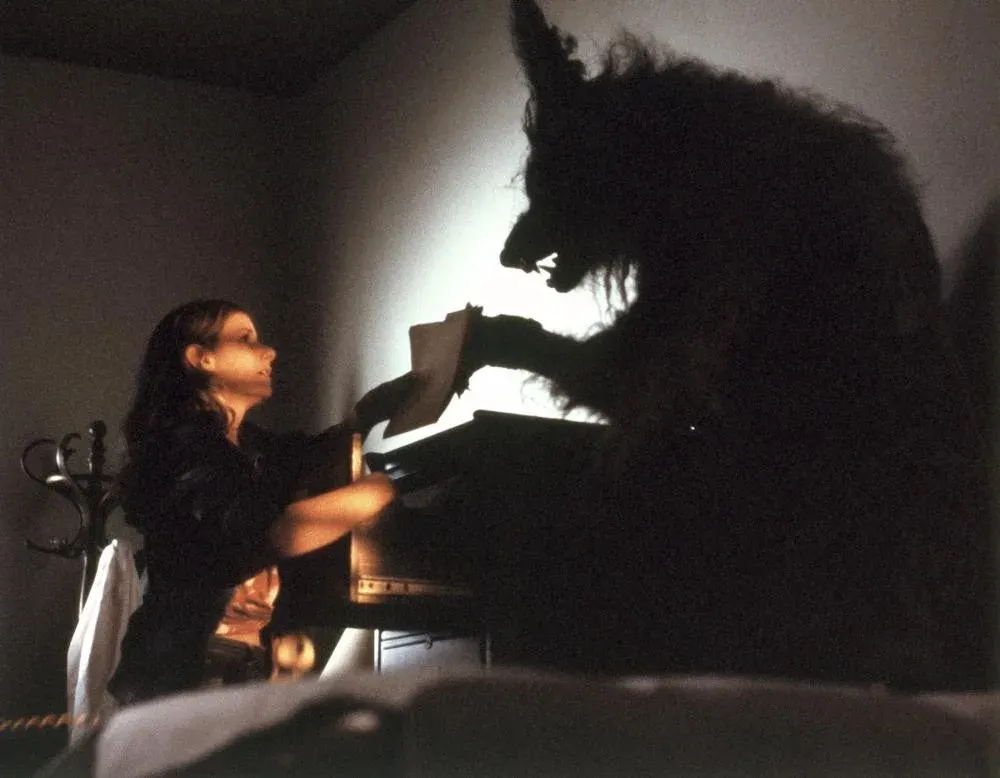
McCarthy’s signature ‘Uncanny Rabbit’ visual, which is a running theme in his other works (a mechanical, wind-up hare figure which haunted us in both Caveat and Oddity) gets an upgrade in Hokum.
Get Wyrd Word Witch’s stories in your inbox
Join Medium for free to get updates from this writer.
It has evolved from a simple wind-up toy to a fully fleshed uncanny rabbit-man: his exaggerated hare ears frame a Minstrelesque face, with exposed teeth and bulging eyes.

The uncanny rabbit-man acts as both a visual jump-scare, and as a pseudo-narrator of Ohm’s childhood: appearing to him during traumatic flashbacks.
McCarthy’s use of unreliable narrators coupled with his inclusion of real world, old Folklore results in a hallucinatory experience.
His repetitive visual signatures oscillate between ethereal and disturbing; the result is a classical feeling ghost story, which is populated by unnatural creatures: the result looks and feels like you are experiencing a childhood nightmare.
Adam Scott injects Ohm with nihilistic curmudgeon, yet he also manages to balance his protagonist with heartbreaking vulnerability and a childlike terror: trapping you alongside him in the subterranean terrors of the Cailleach’s domain.

I caught Hokum at my favourite Arthouse cinema, the Cameo (Edinburgh) on Beltane, no less.
In Scotland and Ireland, Beltane marks the midway point between spring and summer and holds similar energies to Samhain.
This is a time when the Veil between the world of the living and of the dead thins: where the Cailleach slumbers, until Samhain arrives.
The filmmakers gifted us an added meta layer by releasing this on Beltane, and I am currently writing a deeper piece: focusing upon the rich Folklore which McCarthy populates his strange, archaic worlds with.
In both Hokum and in my wee corner of the world, we view the Cailleach as neither good nor evil, but rather as a force of nature (her presence is needed to allow room for death and rebirth, both metaphorically, and physically with the changing of the seasons) and McCarthy cleverly imbues this mirrored symbolism in Ohm.
Ohm’s presence in Ireland may feel unwanted however, it is his arrival which triggers a much-needed death and rebirth of the ‘Bilberry Hotel’- forcing hidden secrets into the light, while granting the dead an autonomous voice from beyond the Veil.
Like the Cailleach, sometimes an opposing, destructive force is needed to allow room for regrowth, and Ohm is symbolic of this disruptive force in Hokum- he exists in opposition to archaic beliefs and his refusal to blend in is what drives the story forward.

Hokum presents its own version of the Overlook Hotel from King’s Shining in the Bilberry: a liminal place where restless spirits lash out, and where the dead are often louder than the living.
The labyrinthian nooks and crannies of the Bilberry Hotel hold unseen horrors: restless spirits with blacked-out faces and glowing eyes of tapetum lucidum, who populate subterranean corridors where no light reaches, and where the haunting face of the Cailleach peers out from the pit of a hidden well.
But at the core of Hokum, there is a warm, beating heart which focuses upon the pain of grief, and of unresolved traumas; lost to the sands of childhood.

Throughout Hokum, Ohm feels the presence of his mother.
At first, she startles and unsettles; frightening us alongside Ohm, until we realise that her grasping hands are not clawing at us, but are reaching for us: protectively as a mother would.
In Witchcraft, we view the Cailleach not as a ‘hag’ or, as a negative force, but rather as the mother of winter: cradling us when the cold becomes too bitter and welcoming us back into the earth to slumber alongside her when it is our time to die.
You may begin Hokum feeling a sense of suffocating cold yet by its cathartic end, you will feel warmth and protection.
What I love most about McCarthy’s storytelling is how he presents his audience with aesthetically disturbing imagery, or ‘shifty characters’- triggering our fears before asking us if what we are seeing is inherently evil, or if we are simply projecting our fears onto people and situations which may appear foreign or unfamiliar to us.
Hokum is a haunted house story, set against the backdrop of old Irish folklore, populated by nightmare rabbits, scorned ghosts, and unreliable narrators which firmly transplants the audience into its strange, mythology-steeped world.
Damien McCarthy returns to Folk-Horror audiences with one simple question: do you believe that your superstitions will protect you against the creatures of the dark…or are they just Hokum?