Identity That Stays Local

Privacy, Accountability and Trust in a Cellular Economy

Every time we interact with a modern organisation, we are asked to identify ourselves. Banks want our identity. Governments want our identity. Utilities want our identity. Insurance companies want our identity. Social media platforms want our identity. Retailers want our identity. The result is that our personal information is copied into hundreds of databases, often without us having any real understanding of who has access to it or how it is being used.
Most discussions about privacy focus on protecting this information once it has been collected. We build bigger databases, stronger passwords, and more complicated security systems. Yet data breaches continue to occur, and concerns about surveillance continue to grow. Perhaps the problem is not that we are failing to protect information after it is collected. Perhaps the problem is that we are collecting and sharing far more information than is actually needed.
Cellular Economics approaches this problem from a different direction. Instead of asking how we can better protect information after it has been distributed everywhere, it asks a simpler question. Why does everyone need to know who we are in the first place?
The Hidden Problem Is Not Identity
Most people assume the privacy problem is that somebody knows their name. In reality, the larger problem is often the ability to connect information from different parts of our lives.
Imagine a car parked outside a golf club every Tuesday morning. The same car appears outside a medical clinic once a month. It is seen outside a political meeting one evening and parked at the same house every night. None of this reveals the driver’s identity, yet over time, a surprisingly detailed picture emerges. The number plate becomes a proxy for the person.
Eventually, somebody connects that number plate to a name. Suddenly, all the observations become attached to an identifiable individual. The problem was not the original observations. The problem was linking them together.
Modern information systems increasingly work in exactly this way. A bank knows one part of our lives. An energy company knows another. A social media platform knows another. A retailer knows another. The real power comes when those pieces are linked together. Once that happens, organisations can build a remarkably complete picture of who we are, what we do, what we believe, where we go, and who we associate with.
The issue is not simply identification. The issue is correlation.
What Cybernetics Can Teach Us
Cybernetics is the study of communication, control, and feedback within systems. One of its most important insights is that healthy systems minimise unnecessary information flows. Information should be processed at the lowest effective level, with only essential information passed to higher levels.
Nature follows this principle constantly. The human body contains trillions of cells, yet the brain does not need to know what every cell is doing every second of every day. Most decisions are made locally. Only information that is relevant to the wider operation of the organism is communicated upward.
This approach creates systems that are both efficient and resilient. They avoid becoming overloaded with unnecessary information. They also avoid creating single points of failure.
Cellular Economics applies exactly the same principle to information and identity. Instead of moving personal information everywhere, identity remains close to where it is needed. Only the information required to coordinate activities is shared with the wider network.
Identity That Stays Local
In a Cellular Economy, people belong to cells that perform particular functions. A housing cell may manage housing. An energy cell may manage community solar and batteries. A banking cell may manage financial services. Other cells may manage recycling, transport, education, or healthcare.
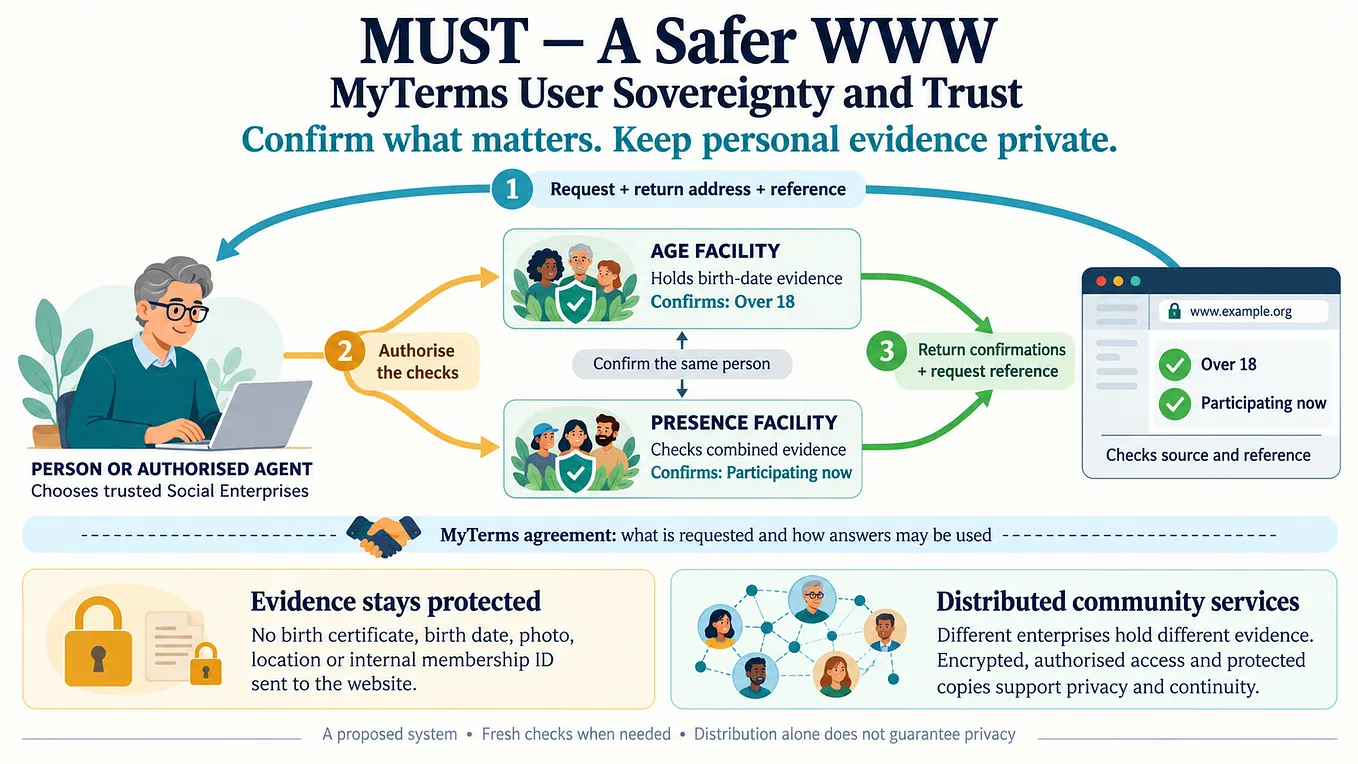
When somebody joins a cell, the cell verifies who they are. After that, most activities do not require continual disclosure of their identity. The system only needs to know that the person is authorised to perform a particular action under the cell's rules.
This may seem like a small distinction, but it fundamentally changes how information moves through the system. Instead of recording that Kevin Cox approved the transaction, the system records that an authorised member of the Ngunnawal Housing Cell did so. The transaction remains valid. The rules remain enforceable. The records remain complete. Yet personal information is not unnecessarily exposed.
The principle is simple. Identity remains local while authority becomes portable.
A Fractal Approach to Identity
The same fractal structure that Cellular Economics applies to governance can also be applied to identity. Local cells cooperate through regional federations. Regional federations cooperate through state federations. State federations cooperate through national federations. Each level trusts the level below it.
Get Kevin Cox’s stories in your inbox
Join Medium for free to get updates from this writer.
In such a system, the local cell knows its members. The regional federation knows the local cell. The state federation knows the regional federation. The national federation knows the state federation. Information becomes increasingly condensed as it moves upward through the structure.
Authority flows upward through the network, but detailed identity remains local. This is precisely how many natural systems organise themselves. Each level handles the information it needs while relying on lower levels to manage local details.
The result is a system that remains accountable without becoming invasive.
Solving the Number Plate Problem
A crucial feature of this approach is that the same identity need not be used everywhere. If a person uses a single identifier across housing, banking, energy, and every other activity, that identifier eventually becomes a number plate that links everything together.
Instead, different cells can recognise the same person through different credentials. The housing cell may know Housing Member A27. The energy cell may know Energy Member E93. The banking cell may know Banking Member B14. Each credential is valid within its own context, yet none of them automatically reveals the whole picture.
This makes it far more difficult for organisations to build comprehensive profiles of people’s lives. Information remains compartmentalised. Activities that belong in one part of a person’s life do not automatically become visible in every other part.
The purpose is not secrecy. The purpose is proportionality. People should reveal only the information that is necessary for the activity they are undertaking.
Privacy and Law Enforcement
Whenever privacy is discussed, somebody eventually asks about criminals. If people are not constantly identified, how can wrongdoing be prevented? How can fraud be investigated? How can society remain safe?
These are important questions, but they often assume that the only way to prevent wrongdoing is to watch everybody all the time. Increasingly, that assumption deserves to be questioned.
In a Cellular Economy, prevention begins with system design rather than surveillance. Members cannot spend what they do not have. They cannot transfer assets they do not control. Significant transactions can require multiple approvals. Unusual behaviour can trigger additional checks. The system is designed to make invalid actions difficult before they occur.
This is similar to a lock on a door. The lock does not need to monitor every person in the neighbourhood. It simply prevents unauthorised entry.
Accountability Without Constant Surveillance
Privacy does not require abandoning accountability. Every transaction still carries a chain of authorisation. If fraud occurs or a crime is suspected, investigators begin with the transaction itself. The transaction identifies the credential. The credential identifies the cell. The cell identifies the member. Through lawful processes, the responsible individual can be identified and held accountable.
The crucial difference is that people are not treated as suspects before anything has happened. Their identities are not continuously exposed simply by participating in society.
This creates a different balance between privacy and accountability. Instead of monitoring everyone in case they might do something wrong, investigations follow evidence when something actually goes wrong.
A person can be identified only with a legitimate reason. They are not continuously identifiable merely because they exist.
A Different Future for Identity
The deeper idea behind Cellular Economics is that information should be treated in the same way as power, governance, and economic activity. Decisions should be made as close as possible to where they matter. Information should remain as local as possible. Only what is necessary for coordination should be shared with wider networks.
This is how nature builds resilient systems. It is how cybernetics designs effective systems. It is also a fundamentally different way of thinking about privacy.
The goal is not to hide people. The goal is to stop the unnecessary linking of information. The goal is not to protect criminals. The goal is to ensure that ordinary people are not treated as suspects every time they interact with society.
In a Cellular Economy, authority flows upward, information stays local, and investigations follow evidence rather than suspicion. Identity remains available when it is genuinely needed, but it is no longer exposed simply because a person wishes to participate in community life.
That is not merely a different privacy model. It is a different relationship between citizens, institutions, and trust itself.