How to Be Saved from Yourself: Practice or Devotion?


Home / The Satsang blog/ The Revelation
All published satsangs are faithful transcripts of audio recordings of public and improvised satsangs. Sometimes one detector rates the same satsang as 100% human, while another rates it as 100% AI. Rest assured: all satsangs are 100% human, inspired by the Holy Name.
How to Be Saved from Yourself
Freeing ourselves from what, within us, leads us astray
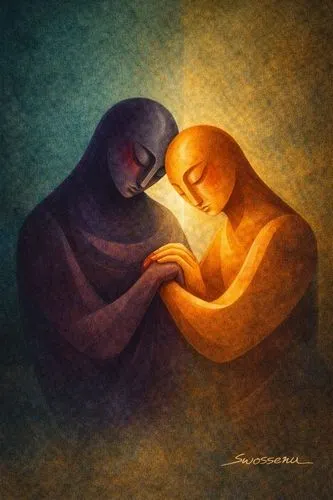
Our worst enemy is ourselves. To be saved from it, we must first have the courage to look our weakness in the face and ask God to save us. Two paths then allow us to draw closer to God: that of spiritual practice, demanding, where we must decide at every moment, and that of devotion, this love for God that purifies and is sufficient unto itself. Whether monk or mother, each of us starts from where we are; and the most beautiful thing in us is this love.
Man often forgets that he needs to be saved. And yet it is true: man needs to be saved, not saved from hell, not saved from death, but saved from himself.
Every man knows the dark side he carries within him, and how much, oh how much, it poisons his life. A lack of lucidity about oneself most often stems from a lack of courage: the courage to face one’s own weakness. That is why man needs to be saved from himself, from his weakness.
And to be saved from one’s weakness, one must acknowledge it. Not invent one for oneself, but agree to look it in the face, agree to look oneself in the face and make the observation that is called for; to say to oneself: “Yes, if this goes on, I’m in trouble, I’m heading straight into a wall, I need someone to save me.” One must ask God to be saved, and for that, make this sincere diagnosis, which is no small thing.
Recognizing that one is sick is already a huge step on the path of redemption. From this recognition onward, one can already be saved from oneself. There are several ways to save one’s soul, to save oneself from oneself, from one’s baseness and weaknesses.
There is the path of practice, of Observance, in the manner of Patanjali, in a spirit of asceticism. There is a plan, there are stages. One must go from stage A to stage B, then from stage B to stage C. One cannot jump straight from A to C; one must not skip stages, one must advance stage by stage.
It is a battle plan, something effective. Effective above all, of course, for someone whom life has released from obligations and responsibilities, who has all the time in the world, whose room and board others provide, and who can thus hold to a particularly rigorous Observance of the sadhana.
And it works, it really works. I have known it myself: it brings extraordinary results. I’m not even talking about samadhi; I’m simply talking about the intensity, the depth of the state of consciousness we find ourselves in every day, and the feeling of Grace that is within us and becomes so dense that we can lean on it to live our lives.
This path is extraordinary. But what it demands above all, because of free will, is to be determined to do it. Determined, truly determined. And not deciding once and for all, not deciding on January 1st for the 365 days to come: it means deciding practically at every moment.
It is a bayonet fight against indecision, at every moment. There is not a single moment when we do not need to decide to be in truth rather than in its opposite, in Observance rather than in non-observance, in unity rather than in the scattering of the fluctuations of the mind, of emotions and thoughts. And that is the hardest part: staying motivated all the time.
Get Benoit Jean’s stories in your inbox
Join Medium for free to get updates from this writer.
We slip away, we go right, we go left, we come back. But it doesn’t matter, we are in no hurry. You must observe the sadhana, be in Observance, in this state of Grace, starting from the real point where you stand, where you are.
You start from a point that is your own: a point of karma, a point of realization, a state of consciousness that is yours, and a set of existential constraints that are yours.
The monk and the nun do not have the same Observance as the mother of a family. That does not make the nun a more beautiful soul than the mother, or the father, or even someone who is neither father nor mother but fully integrated into, fully involved in society.
It is difficult, it is difficult. Stress, commuting, noise, the pace, schedules, obligations: it is very difficult to be in an optimal and truly fruitful Observance when you are in that situation.
It is very difficult, but it doesn’t matter. What counts is to do it sincerely, to start from your inner and outer situation, the one that is yours at the moment you set out on this pilgrimage toward truth, this inner pilgrimage. Start from where you are. You have no one to copy, nor any image you must live up to.
It is a relationship between you and God; it is your relationship. God can read your heart, he knows your sincerity. He knows your weaknesses, and he knows full well that, because of these weaknesses, you cannot do better at any given moment. It will evolve; it evolves with time.
But you do what you can with what you have, and no one is bound to do the impossible. Which does not prevent you from aiming ever further, ever higher, beyond the birds, because it is such goals that pull you forward like a cable. And it is good to be pulled forward, toward God.
And then there is devotion. There is devotion, the love of God, love for God: Bhakti. The love you devote to God, not the love you strive to have, not sanctimonious piety, but the love you have for God, is a grace; not everyone has it. This love, carried to the extreme, can even dispense you from the Observance of the sadhana; it is sufficient unto itself.
This love, this extreme devotion to God, purifies you, washes away your sins, washes you clean of yourself. You shed yourself the way one takes off an old garment. And there you are, you stand there, naked before God.
And you pray to him to free you from your free will, to take you into his love and keep you with him, because you want to be nowhere else but with him, in him, through him. And this devotion is a grace.
It is like the monks and nuns who are called to follow a rule in a monastery, in an abbey. But this love can also be born of Observance: devotion comes through devoting, just as appetite comes with eating. There are bridges between the two: you can be devout and at the same time observe the sadhana, because you love this life, because you love the way it steadies you, the way it makes you physically and psychologically happier.
The two blend together. You can do both at the same time, that is clear. You can meditate with devotion. You can listen to satsang and give satsang with devotion. You can serve, act in non-action, with devotion. It is not forbidden.
Know that the most beautiful thing in man, in human nature, is the love he can bear for God. It is the most beautiful thing in you: the love you have for God. That is the pearl. That is the diamond. That is what makes you beautiful. This beauty, this inner radiance burns everything away; everything else, it burns away. And that is what will save you. That is what is already saving you, saving you from yourself. That is the diamond.
If you have any questions, please write here: madhyama.marga@gmail.com
Originally published at https://observance.over-blog.com on October 13, 2026.