The Illusion of Monopoly and the Coercive Laws of Levelling

Under Capitalism, Capitalists strive to protect super-profits through patents, exclusive technologies, and economies of scale. Native workforces seek to protect their wages through borders, trade unions, and legal protections. Yet the market permits no permanent sanctuaries.
Driven by private self-interest, both capital and labour act as unwitting instruments of objective economic laws. Technological monopolies are undermined by the discipline of competition, while the conflicting interests of expanding capital and dispossessed workers drive the erosion of barriers to labour mobility, turning temporary market frictions into open class struggle.
Marx did not overlook wage differences, super-profits, or unusually high profit margins. These were part of the capitalist system he analysed. His concern was not merely to identify these differences, but to explain how they arise, how they persist, and what forces act upon them. Later economists argued that the growth of monopolies had changed capitalism so much that Marx’s analysis of competition needed to be revised. But the mere existence of wage differences, super-profits, or high profit margins does not prove that competition has ceased to operate.
1. Technological Monopoly and Its Self-Destruction
Karl Marx captures the origin and fate of technological monopoly in Capital:
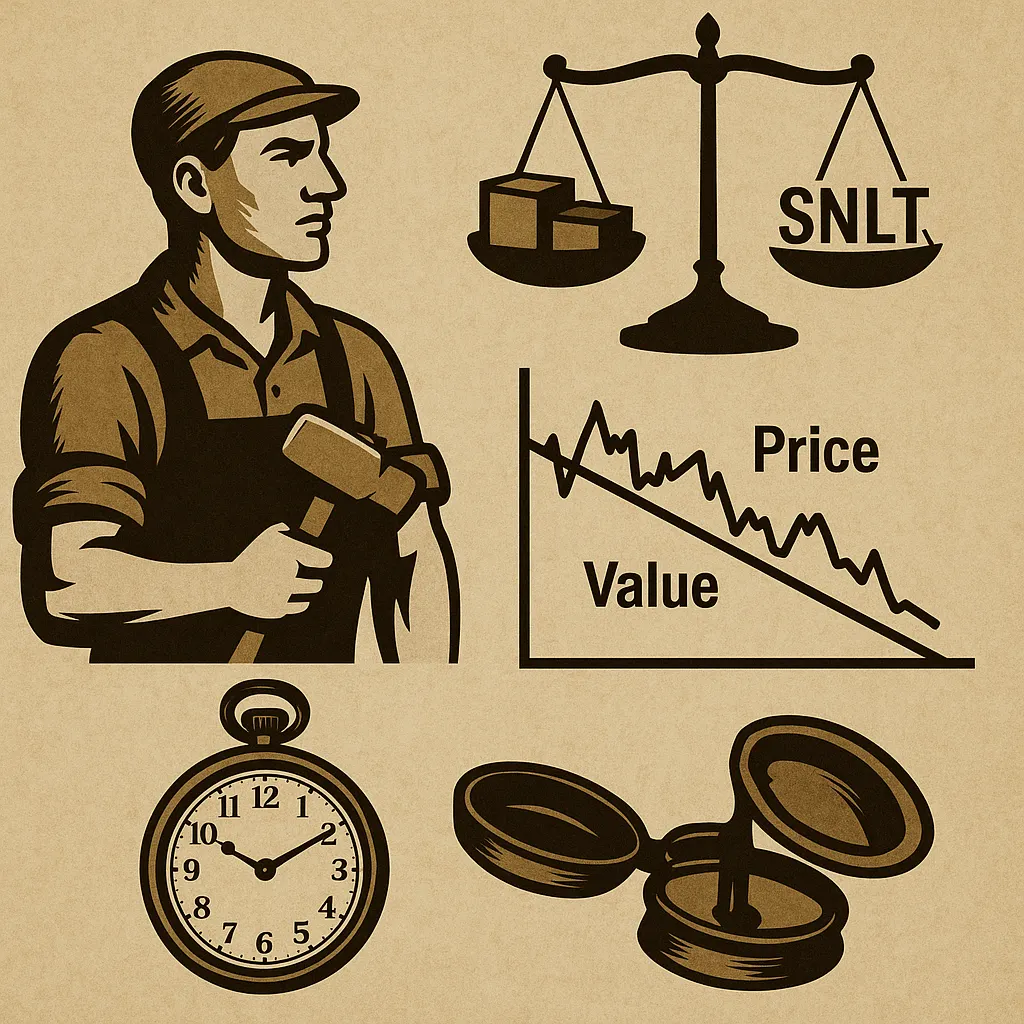
An innovator reduces production costs, bringing the individual value of a commodity below its social value. By undercutting the market price while selling above its individual value, the firm realises extra surplus-value—a temporary super-profit.
Yet this advantage cannot endure indefinitely. Driven by competitive pressure, rivals are compelled to replicate the technology, reverse-engineer machinery, circumvent patents, or develop technologies that match or surpass the innovation. Once increased productivity spreads across the sector, the socially necessary labour-time required to produce the commodity falls to the new baseline. Its social value declines, the super-profit evaporates, and the initial competitive advantage disappears. The capitalist's attempt to secure a permanent monopoly thus contributes to the cheapening of the commodity across the market.
2. Capital Mobility: The Equalisation of Profit
When profits decline in a sector or an industry becomes congested, capital seeks more profitable outlets. In Capital, Marx outlines this process of inter-industry equalisation:
Capital has no loyalty to any particular product; its sole driving force is self-expansion. Competition forces the profit rate to fall, Capital counteracts this discrepancy through its movement between sectors. It withdraws from stagnant, low-yield industries and flows into high-profit sectors. The resulting outflow reduces supply and tends to raise prices in the sector being abandoned, while the influx of capital increases supply and tends to depress prices in the expanding sector. Through this continuous movement, sectoral profit rates tend towards an economy-wide average.
3. Labour Mobility: Class Conflict and the Erosion of Borders
Capital's drive towards equalisation requires labour to be mobile. Regarding the frictions that obstruct this process, Marx observes:
And although the equalizing of wages and working-days, and thereby of the rates of surplus-value, among different spheres of production, and even among different investments of capital in the same sphere of production, is checked by all kinds of local obstacles, it is nevertheless taking place more and more with the advance of capitalist production and the subordination of all economic conditions to this mode of production. The study of such frictions, while important to any special work on wages, may be dispensed with as incidental and irrelevant in a general analysis of capitalist production. In a general analysis of this kind it is usually always assumed that the actual conditions correspond to their conception, or, what is the same, that actual conditions are represented only to the extent that they are typical of their own general case.
Get Lumpen Comrade’s stories in your inbox
Join Medium for free to get updates from this writer.
Geographical isolation, national borders, and craft-based restrictions continually impede the movement of labour. Yet Marx treats such obstacles as historical frictions rather than permanent limits. The equalisation of labour-market conditions is shaped by an enduring conflict of interests:
- Low-wage workers in depressed regions, rural hinterlands, and peripheral nations are often eager to migrate to high-wage centres to escape poverty and secure better living standards.
- Capitalists actively encourage and organise labour mobility. Faced with high domestic wages and trade unions that constrain profitability, employers recruit migrant workers, seek to deregulate hiring, and access cheaper labour pools to reduce labour costs.
- High-wage native workers may resist these developments by supporting legal barriers, restrictive union rules, and border controls to defend their wages against downward pressure.
- The outcome is class conflict. Capital relentlessly seeks to overcome such resistance by lobbying for greater access to labour, challenging restrictive union practices, or relocating production abroad. The pressure to cheapen labour-power can undermine local protections and weaken workers' bargaining power.
The Common Thread: Dialectics in Motion versus the Metaphysical Snapshot
Across all three domains, the central dynamic is similar: subjective self-interest becomes a vehicle through which objective economic laws operate, overcoming historical frictions and driving the formation of broader social averages.
Within an individual industry, the capitalist pursues super-profits by reducing individual production costs. Although patents, trade secrets, and sunk capital create initial barriers, competitors facing the threat of losing market share or being driven out of business are compelled to adopt comparable methods. As the technology becomes widespread, the individual value of the commodity converges towards its social value, expressed through socially necessary labour-time. The super-profit disappears, and the commodity becomes cheaper.
Across different industries, capital moves away from low returns in pursuit of higher profits. Despite barriers such as the difficulty of transferring fixed capital and logistical constraints, capital continuously withdraws from stagnant sectors and flows into more profitable ones. This movement alters supply and demand, tends to reduce disparities in sectoral profit rates, and contributes to the formation of a general rate of profit.
Across the labour market, employers seek to reduce labour costs, while impoverished migrants seek the means of subsistence. Although borders, nativism, and trade union protections can obstruct labour mobility, capital actively seeks to overcome these barriers by recruiting cheaper labour or relocating investment. These pressures can contribute to the equalisation of rates of surplus-value and conditions of exploitation across regions, although such equalisation is neither complete nor automatic.
These three tendencies do not move towards a static target, but a moving one. Social values, profit rates, and wages are continually transformed by technological progress, capital accumulation, and class struggle. Equalisation is therefore not the achievement of a permanent equilibrium, but a continuous process in which every convergence generates new disparities. The system does not move towards rest; it reproduces the forces that keep it in motion.
These are tendencies, not absolute laws guaranteeing a final outcome. Counteracting tendencies may obstruct or reverse their effects. Yet the underlying pressures remain, driving the system towards equalisation without necessarily ever reaching it. The process is one of continuous gravitation towards a moving target, not the attainment of a permanent equilibrium.
No individual actor necessarily intends the resulting systemic outcome. The innovator seeks a private monopoly, not cheaper commodities for society. The investor seeks higher returns, not a uniform average rate of profit. The migrant worker seeks personal survival, not the dilution of domestic wages. The industrialist seeks lower labour costs, not global wage convergence.
It is easy to point to an instance of an exorbitant profit margin, an apparently unassailable technological monopoly, or an enclave of exceptionally well-paid workers at any particular moment in economic history. However, treating such static snapshots as proof of permanent economic conditions amounts to a metaphysical interpretation of reality. It isolates a particular moment, like a still photograph, and mistakes a temporary condition for an eternal law.
Marxist dialectics, by contrast, analyses reality in motion. When confronted with claims of a permanent super-profit, super-margin, or protected super-wage, dialectical analysis poses two historical questions:
- What existed in the past, and how was this advantage created? In many cases, the answer lies in a specific historical configuration involving substantial initial investment, imperial extraction, state protection, or prolonged trade union struggles.
- Can this advantage be sustained in the future?
The answer, from the perspective of the competitive tendencies examined here, is that no such advantage is guaranteed to endure. A super-profit is not necessarily a stable equilibrium; it can be a temporary signal that attracts the very competitive forces capable of eroding it. High margins attract rival investment, imitation, and technological innovation. High wages can encourage automation, outsourcing, or the recruitment of workers from lower-wage regions.
Frictions exist, but they represent historical obstacles to these tendencies rather than necessarily permanent structural barriers. In the final analysis, capital continually seeks to overcome restrictions on its expansion. Through the restless pursuit of private advantage, it erodes the defences of isolated economic enclaves and drives the wider extension of competitive pressures and socially necessary labour-time across the globe.