The Dark Side of the Belle Époque: Where the Roots of Noir Began
From the glittering boulevards of Paris to the anxieties of contemporary thrillers: a journey through literature, painting, and music, exploring the shadows that progress could never erase.
Paris, When the Light Began to Reveal the Shadows

Paris, in the second half of the nineteenth century.
Boulevards grow wider. Elegant façades line newly constructed streets. Gas lamps illuminate evening promenades. Horse-drawn carriages cross a city determined to become the capital of modernity. Conversations fill the cafés, audiences applaud in the theatres, and department stores celebrate the wonders of commerce.
This is the world that, particularly in the final decades of the century, would come to be remembered as the Belle Époque: an age that still evokes elegance, celebration, and optimism.
But leave the grand boulevards behind, turn into a narrow side street, enter a modest restaurant, or climb the stairs of a boarding house, and another Paris emerges.
Here live clerks with no prospects, women struggling to preserve a respectability that offers them little protection, and men consumed by ambition, jealousy, or fear. Progress promises prosperity, yet poverty, loneliness, and inequality remain.
Within this contradiction, some of the anxieties that would shape the modern novel begin to take form.
When Painters Began to See the World Differently
Painting records the transformation.
The Impressionists leave their studios and turn their attention to streets, cafés, railway stations, and places of entertainment. The modern city becomes a central subject of their work.
Yet alongside the light and movement, something less reassuring begins to appear.
In 1876, Edgar Degas paints L’Absinthe. Two people sit at the same café table. They are physically close, yet seem separated by an unbridgeable distance.
Nothing dramatic happens. Nobody speaks.
And it is precisely this silence that suggests a story of exhaustion, isolation, and defeat.
Gustave Caillebotte, in Paris Street; Rainy Day, portrays an orderly, elegant city where pedestrians move beneath their umbrellas. The streets are broad, the buildings imposing, yet each figure seems enclosed within a private solitude.
Then there is Édouard Manet.
In A Bar at the Folies-Bergère, a young woman faces the viewer while the world of entertainment is reflected behind her. Around her is a crowd seeking pleasure. At the centre stands a woman whose expression remains difficult to interpret.
These are not noir paintings.
But they reveal a sensibility that noir would eventually make its own: the suspicion that behind what we see, something always remains hidden.
The Music of Celebration and the Music of Tragedy
Nineteenth-century Paris is also a city filled with music.
Jacques Offenbach’s operettas accompany fashionable society. Cafés-concerts attract increasingly large audiences. Theatres offer entertainment and spectacle.
Music becomes part of the city’s energy, its desire to live, to celebrate, and perhaps to forget.
But not every melody tells the same story.
In 1875, Georges Bizet’s Carmen reaches the stage.
A woman claims her freedom. A man cannot accept it.
Desire turns into possession, jealousy into violence, passion into tragedy.
Music thus reflects two contrasting images of society: one brilliant and carefree, pursuing pleasure; the other driven by uncontrollable emotions and feelings that become destructive.
These are the same contradictions that several writers would soon bring into their novels.
Émile Zola: The Violence Hidden Within Progress
In 1890, Émile Zola publishes La Bête humaine (The Beast Within).
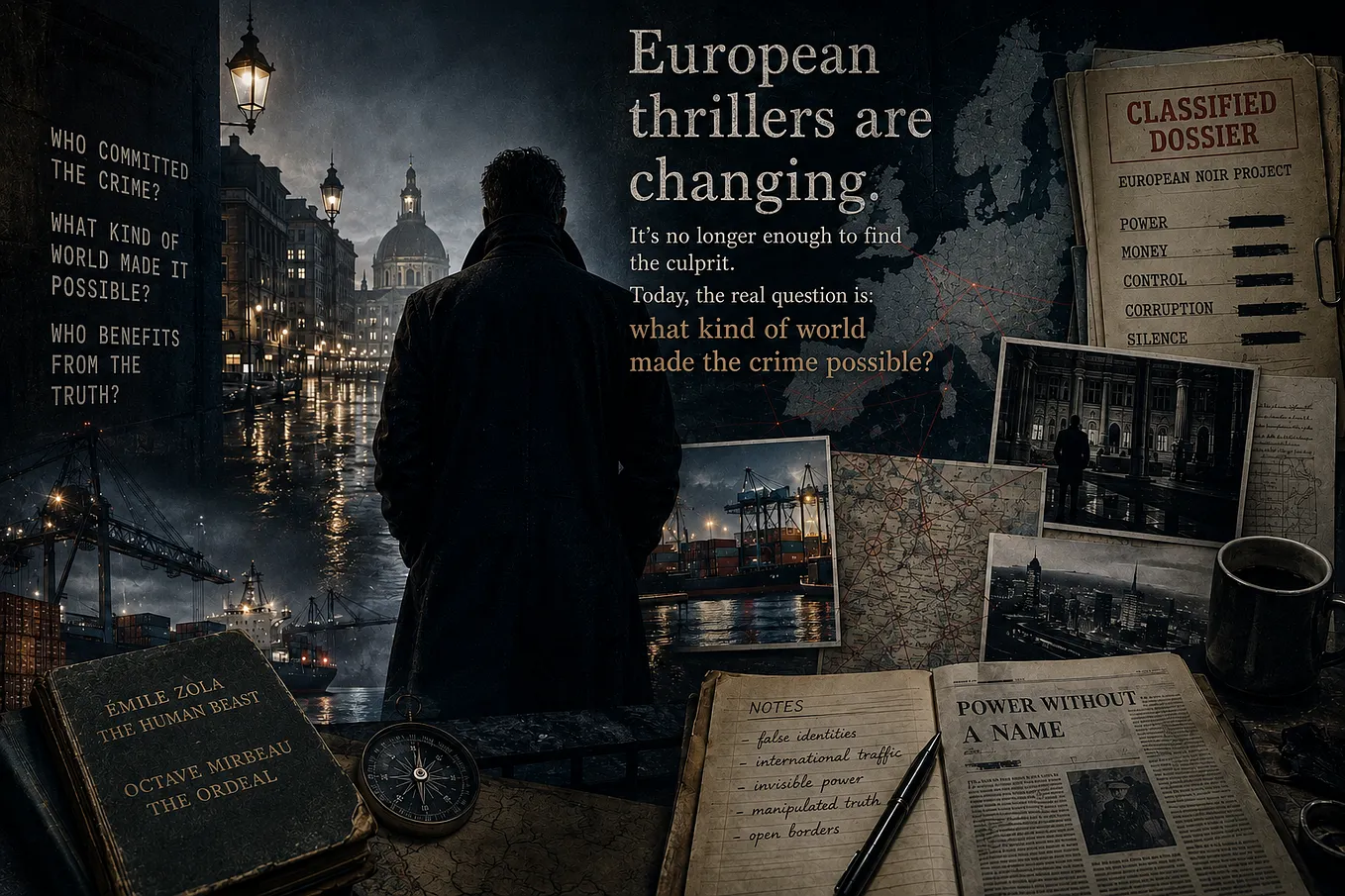
The railway, one of the great symbols of industrial progress, runs through a world dominated by dark passions, crime, and violent impulses.
Locomotives race forward. Distances shrink. Technology seems to promise humanity mastery over nature.
And yet human beings remain driven by forces they struggle to understand or control.
Zola is not writing noir in the modern sense of the word.
His novel belongs to Naturalism, with its emphasis on heredity, environment, and social conditioning.
But within its pages we encounter crime, tension, suspicion, investigation, and the darker dimensions of human nature.
Above all, we encounter a disturbing question:
How secure is the civilisation we have built if primitive impulses continue to stir beneath its surface?
Octave Mirbeau: When Love Becomes a Prison
A few years earlier, in 1886, Octave Mirbeau had published Le Calvaire (Calvary).
Here, the central subject is neither machinery nor industrial progress, but an intimate relationship.
A love that imprisons rather than liberates. A jealousy that consumes. An emotional dependency that gradually deprives an individual of the ability to recognise himself.
Violence does not always need to take the form of murder.
It can infiltrate thoughts, gestures, and the obsessive need to possess another person. It can transform affection into a source of daily suffering.
Get Mauriziopreti’s stories in your inbox
Join Medium for free to get updates from this writer.
Mirbeau leads the reader into territory that would become central to the psychological thriller: emotions escaping control and an identity slowly coming apart.
Joris-Karl Huysmans: The Dark Side of Ordinary Life
Joris-Karl Huysmans follows a different path.
In À vau-l’eau (Downstream), he portrays the life of a Parisian clerk struggling with disappointing meals, repetitive days, and increasingly modest expectations.
In Croquis parisiens (Parisian Sketches), he observes fragments of the city: its inhabitants, settings, habits, and behaviour.
In Un Dilemme (A Dilemma), he exposes the cruelty that can hide behind money, the law, and bourgeois respectability.
At first glance, this world seems far removed from noir.
There are not necessarily murderers to identify, pursuits to follow, or mysteries to solve.
Yet something connects these stories to the darker territories of modern fiction.
It is the feeling that everyday life itself can become a trap.
That society’s rules do not necessarily guarantee justice.
That even apparently insignificant lives may conceal humiliation, resentment, and small acts of cruelty.
Huysmans looks for drama where we rarely think to search for it: in routine, disappointment, respectability, and indifference.
From Nineteenth-Century Shadows to Contemporary Noir
Zola, Mirbeau, and Huysmans belong to a literary era that preceded the emergence of modern noir.
Their works differ profoundly in style, purpose, and artistic vision.
Yet they anticipate several of its central concerns: crime, obsession, power, deception, loneliness, and the hidden regions of human consciousness.
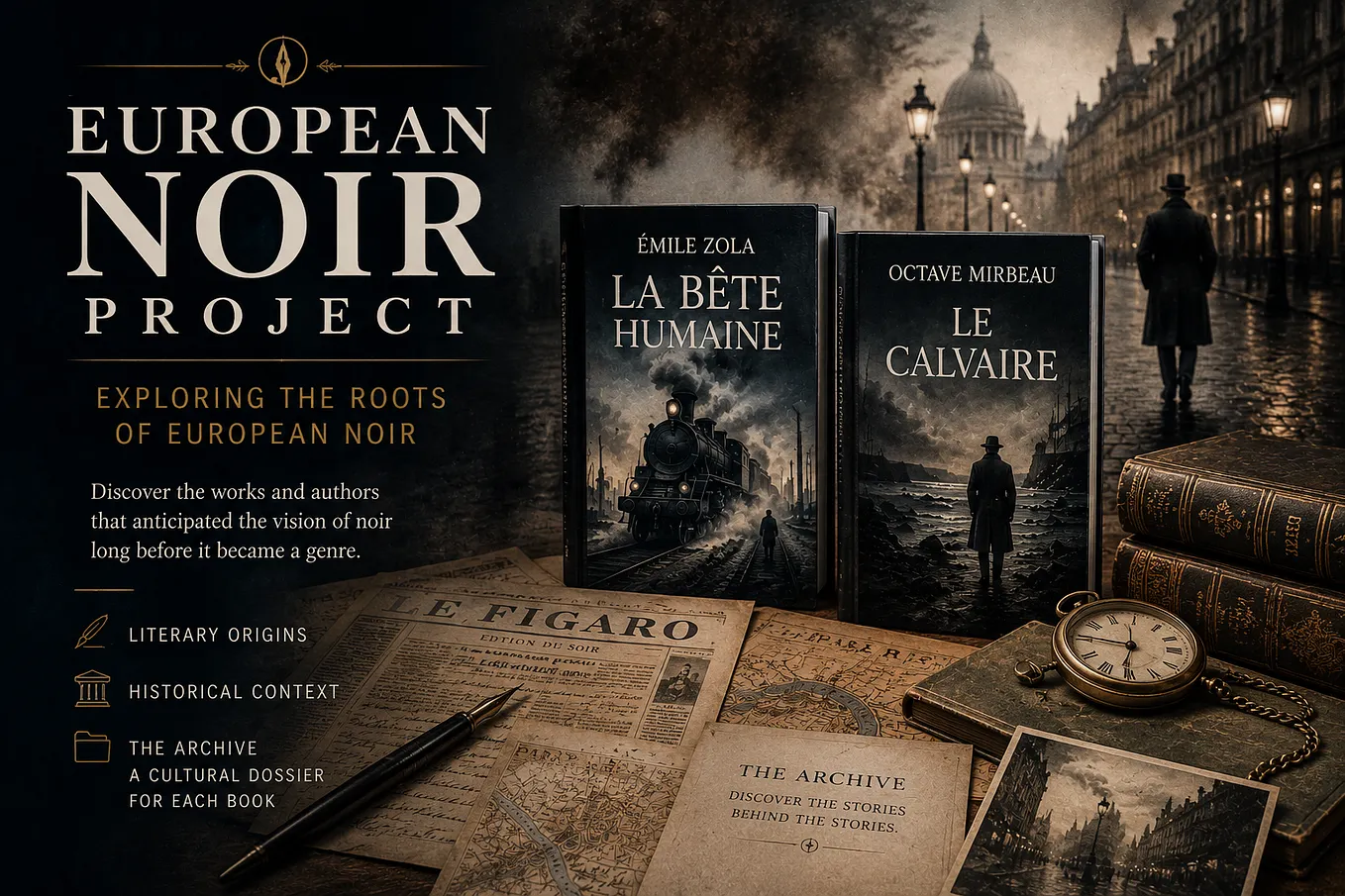
These connections inspired THE BLACK DOSSIER, a section of my literary project, THE ARCHIVE, dedicated to rediscovering the cultural roots of noir.
The project follows a particular editorial approach.
Works by Émile Zola, Octave Mirbeau, and Joris-Karl Huysmans are revisited through narrative rewritings that reinterpret them from the perspective of modern noir while seeking to preserve their essential spirit and themes.
These are reinterpretations, not reproductions of the original texts.
Each work is accompanied by a separate, complementary dossier.
The dossiers take readers beyond the narrative. They reconstruct the historical setting, examine social contradictions and cultural movements, and explore the anxieties running through the works, highlighting their connections with contemporary noir.
They are not merely introductions or literary commentaries.
They are journeys of discovery, offering readers a way to understand what lies behind the story.
Two complementary reading experiences: the novel invites us into the narrative; the dossier explores its origins and deeper significance.
Because the shadows did not disappear with the end of the nineteenth century.
Cities have changed. Horse-drawn carriages have given way to cars, gas lamps to electric lights.
Digital networks connect the world. Science explores territories once unimaginable. Information reaches almost every corner of the planet.
But ambition, fear, jealousy, and the hunger for power have not vanished from human nature.
The stories we tell have changed.
The forces that make those stories possible have not necessarily changed with them.
The Journey Continues in THE ARCHIVE
This is where the past meets the present.
In my contemporary thrillers, those enduring anxieties take on new forms and unfold in different settings.
In The Code of Waves, questions of science intersect with power and the limits of human knowledge.
The Last Mission and The Magic Formula belong to the same contemporary body of fiction, exploring a world in which appearances, choices, and the search for understanding remain essential to the reading experience.
These novels are not continuations of nineteenth-century literature.
They are independent stories, written in another age, shaped by different circumstances and narrative possibilities.
Yet they belong to a fictional universe in which human beings continue to confront secrets, uncertainty, and the consequences of their decisions.
THE ARCHIVE brings these different paths together.
On one side are the classics explored in THE BLACK DOSSIER, accompanied by their historical and cultural investigations.
On the other are contemporary novels, scientific mysteries, investigations, stories of power, and psychological unease.
An archive of stories to explore, not simply to read.
Because perhaps the question that haunted the Paris of Zola, Mirbeau, and Huysmans is still the question facing the protagonists of today’s thrillers:
How much do we really know about the world around us — and, more importantly, about ourselves?
Discover the cultural roots of noir through THE BLACK DOSSIER, then continue the journey among the novels and literary dossiers of THE ARCHIVE.
Maurizio Preti
Author of crime fiction, psychological thrillers, and science-driven mysteries.
Explore THE ARCHIVE