If a Hypothetical Alien von Neumann Probe Burned Up Over Prehistoric Earth, Can We Still Isolate its Dust Today?
Our search tested for known rocket signatures with real contemporary re-entries of known spacecraft acting as controls. The by far most promising prehistoric candidate, row 23312 of sample 184TG-P170, comes from Antarctic ice that formed 10,000 years ago.

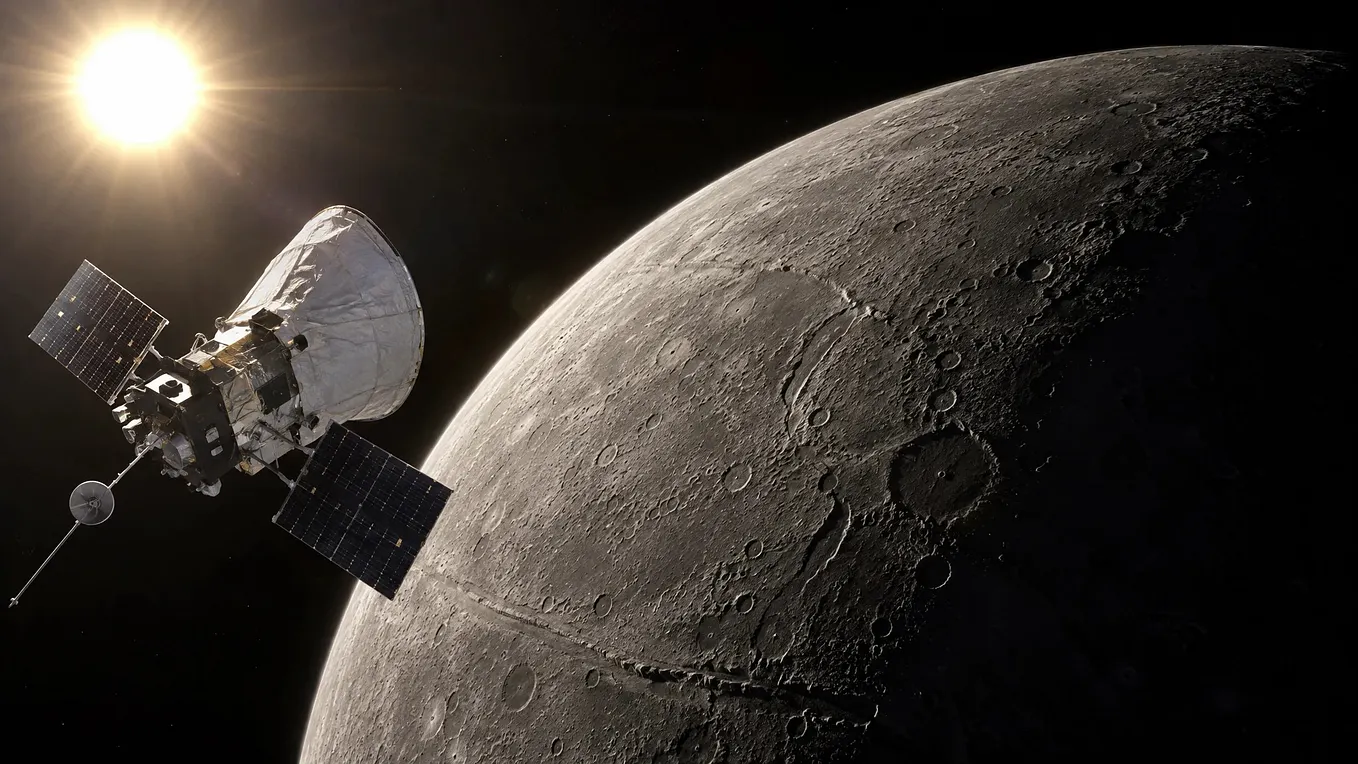
Imagine a probe crossing interstellar space in radio silence. It gets the last manoeuvre wrong. The craft breaks up in Earth’s upper atmosphere, and some of its metal vaporises and ends up in particles drifting through the stratosphere.
Weeks later, a research plane flies through that air. Its mass spectrometer records a pattern of peaks from one of those particles and moves on. Could I pick that speck out of the archive?
For my new preprint I sifted through more than 1.3 million measurements collected to study the upper atmosphere and the dust trapped in Antarctic ice. My literature search turned up no published search for extraterrestrial intelligence in the Taylor Glacier particle archive. I could start from my desk.
Start with a rocket nozzle
In 2023, Daniel Murphy and colleagues reported a chemical signature from human spacecraft reentry. Two metals, niobium and hafnium, occurred together in some stratospheric particles, consistent with a known rocket-nozzle alloy. Those particles often also carried extra aluminium. (Murphy et al.)
That gave me a way to test the search on hardware whose chemistry we knew. I built a rule around the niobium and hafnium peaks, fixed it, then ran it on 416,903 spectra from NOAA’s SABRE campaign. I’d set those flights aside while developing the rule. It flagged 59 spectra on nine flights.
Aluminium gave me a check using a separate measurement. Among particles with enough iron for the comparison, 53 of 58 flagged spectra passed the aluminium enrichment test. About one in five of the other spectra did. The combination that Murphy’s team had reported showed up again in flights the screen hadn’t seen during development.
That’s the empirical starting point. An instrument flying to study the stratosphere had already sampled the residue of engineered material. The public archive retained enough of that chemistry for a fixed rule to recover a known reentry signature.
Two leads over the Arctic, 417 kilometres apart
I tried five other pairs of metals. Only one yielded hits at the main threshold. Patterns consistent with molybdenum and tungsten turned up in 38 spectra across ten flights. Twelve still passed a stricter screen.
Would the two patterns land in the same spectrum this often if they occurred independently? I reshuffled their assignments in five-minute stretches of each flight, grouping spectra by their iron signal and keeping each pattern’s frequency fixed. Across 20,000 simulations, the most joint matches I got was four. In the real data, the pairing persisted at 14 to 18 kilometres when I left out each flight in turn.
There were 36 matches in that altitude band in 2023. The same screen found zero in 51,242 spectra from 48 earlier flights at comparable altitudes. Air masses and instrument response can vary across campaigns. I want to see whether the pattern turns up in another high-altitude archive.
Two spectra caught my attention. The plane measured them about two hours and 417 kilometres apart on the same Arctic flight. Both carried the molybdenum-like and tungsten-like patterns plus a third set of peaks consistent with molybdenum monoxide. I reanalysed a published spectrum recorded on a different instrument in 2017 and found the same three patterns there. The team that collected it considered aircraft exhaust a possible source.
That gives the follow-up a place to start. The archived spectra sort ions into mass bins, and cadmium ions can land in the same bins as molybdenum monoxide ions. In the two Arctic cases, the peaks in that mass range fitted molybdenum monoxide better than cadmium alone. Human reentry debris, aircraft material and mixtures of atmospheric particles are all plausible sources. I’ve published the exact record IDs so anyone can inspect the peaks. A flight with enough mass resolution to tell those ions apart could test whether similar particles contain the same metals.
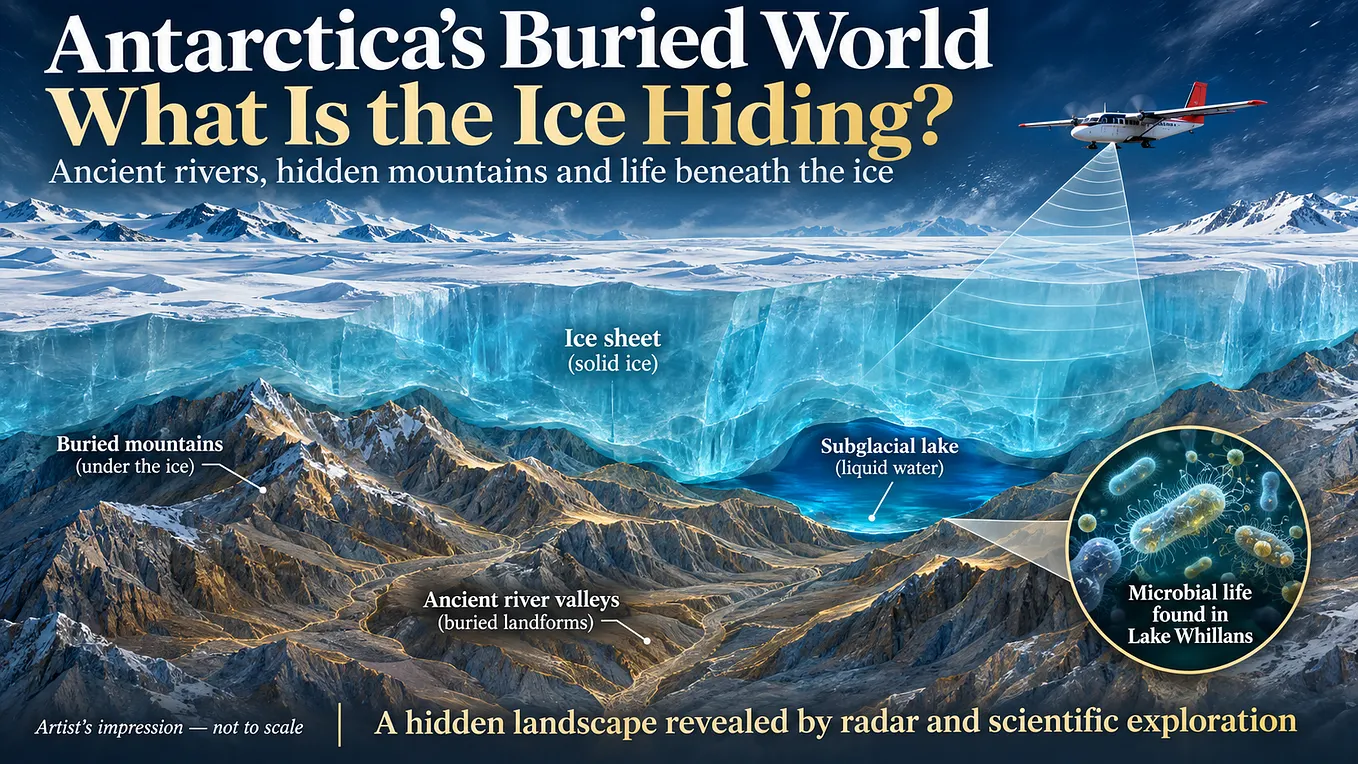
One candidate in a sample of prehistoric ice
The most intriguing ice record came from Taylor Glacier, Antarctica. The sample, 184TG-P170, came from a layer dated to about 10,000 years ago, in the early Holocene. Across the 26 ice samples set aside for testing, 168 records contained chromium, nickel and molybdenum together. This was the only one where the three made up more than half the detected mass. They accounted for about 99% of the reported total. The three readings were 4.7 to 7.3 times their published detection limits.
Get Maximilian von Liechtenstein’s stories in your inbox
Join Medium for free to get updates from this writer.
That combination occurs in some modern corrosion-resistant alloys. The proportions in the ice record differ from the alloy I used for comparison, and the instrument reported elemental masses without telling us how those elements were arranged. The tungsten reading was just 10% above its detection limit. The archive estimates a diameter of 156 nanometres for the particle, below the cutoff NOAA uses in its count summary. The strongest part of the lead is the chromium, nickel and molybdenum together.
Here’s how far the wider ice search got. Across 898,648 particle records, 21 showed both molybdenum and tungsten. Six contained at least 1% of each by detected mass. Three of those came from samples whose downloaded record counts matched the published totals exactly. In all three, at least one of the two metals fell short of twice its detection limit. The chromium, nickel and molybdenum record is one of those three.
The date belongs to the ice layer. If the particle was trapped as that layer formed, it was there roughly 10,000 years ago. A trace from a tool used to prepare the sample could also end up in a measurement of ancient ice. I’d pull the original instrument traces for that record, then have a separate piece of the same layer prepared and measured. Running clean ice through the same procedure would help test whether the preparation itself leaves a similar metal signature.
Rare Earth or a probe on every street corner?
Peter Ward and Donald Brownlee’s Rare Earth hypothesis allows for a cosmos rich in microbes and poor in complex life. David Kipping’s Cool Worlds episode asks how much we can learn from the one planet we know produced observers. In a separate study, his analysis of Earth’s early life and late-arriving intelligence modestly favoured rapid beginnings for life under Earth-like conditions. It offered only weak support for intelligence being rare. Rare Earth · Cool Worlds on Rare Earth · Kipping’s analysis
Kipping and Geraint Lewis took that uncertainty in a different direction. In their model, if technological civilisations arise too slowly to replace those that disappear, almost all the available worlds sit empty. If the rates tip strongly the other way, most of the available places fill. Under their statistical assumptions, both extremes are easier to reach than the middle. A cosmos with just a few neighbours would put us in the narrow transition between the two. Kipping and Lewis
Now give one of those civilisations a machine that builds copies of itself from the materials it finds en route. Send off a single von Neumann probe and its descendants can keep spreading without another launch from home. In one version of Kipping’s Hart–Tipler model, those waves spread at a tenth the speed of light. If only about one galaxy in a million has ever launched such a wave, the waves reach roughly half the volume of the universe by today. Increase the launch rate and the share of space reached rises steeply. Kipping’s Hart–Tipler model · Cool Worlds on self-replicating probes
If technological intelligence is common and copying and spreading work for long enough, our neighbourhood has had a lot of time to accumulate visitors. If durable, self-replicating missions are exceedingly rare, the heavens could be empty. A fleet with a short life or a limited range could leave just an occasional visitor. My favourite scenario needs only a handful of probes to pass through the Solar System when dinosaurs were alive. One goes wrong and burns up. The others move on. How much of that one machine would make it into a layer we can still sample?
The Silurian hypothesis and the dinosaur smartphone
Picture a smartphone dropped into a river in the age of dinosaurs. Fast-forward a hundred million years. Where would you look for the factory that made it? Gavin Schmidt and Adam Frank’s Silurian hypothesis asks what an earlier industrial civilisation on Earth could leave in the geological record. They argue that even a short period of widespread industry might survive as a thin layer of sediment with shifts in carbon isotopes, metal concentrations or the residues of industrial compounds. Schmidt and Frank
A natural carbon release can change isotope ratios too. The case would get stronger if several independent signs of industry lined up in the same dated layer across multiple sites. A brief visit from space suggests a different search. One reentry might scatter a few distinctive grains in an otherwise ordinary deposit. I’d look for the chemistry and structure of individual grains, and ask whether independently prepared samples from that layer tell the same story.
The Taylor Glacier archive goes back about 44,000 years. The next step there is to establish whether a specific particle really belongs to its early-Holocene layer. A dinosaur-era search would need far older sediments and a way to test what survives millions of years of burial. The same question keeps coming back. What can we actually recover once the original object is gone?
Searching a dark forest
Liu Cixin’s The Dark Forest imagines a universe where telling strangers your address might be the last mistake you make. If that premise is even close to right, deliberately broadcasting your location to unknown listeners is a terrible bet for any civilisation. That kind of transmission is called METI, or messaging extraterrestrial intelligence. Why make the search depend on someone being willing to take that bet? The Dark Forest · Berkeley SETI on METI
Radio SETI can still listen for stray transmissions. In a dark forest I’d put my money on the strange molecules and metal particles that technology leaves by accident. A single failed manoeuvre can put that material into the atmosphere even if the machine has never broadcast a word. The difficult part has always been finding a dataset that lets us test for that residue. We now know that publicly archived particle measurements can recover a chemical signature from our own reentries. That gives us something concrete to build the next search around.
Drake started with two stars
In 1960, Frank Drake pointed a radio telescope at Tau Ceti and Epsilon Eridani and listened in a narrow band. The search yielded static and an early false alarm, probably aircraft radar. Within a year, a meeting at Green Bank introduced the Drake equation. (SETI Institute)
I keep coming back to the scale of Project Ozma. Drake took a huge question and found an experiment small enough to run. I can now measure how often my own screen catches a particular signature. When I added simulated molybdenum and tungsten peaks to real background spectra at half a per cent of the signal apiece, the rule recovered about three quarters of the injected patterns. We can run the same kind of test as we move into other archives and older deposits.
The current leads may all yet transpire to have perfectly ordinary explanations. But the new search method itself seems rather worthwile. I’ve put the code, the exact record IDs and links to the 203 input files online. You can pull up the two Arctic spectra, or go straight to row 23,312 in the Taylor Glacier sample.
Read the preprint and download the code on Zenodo
An Archival Search for Technosignatures in Atmospheric Entry Debris