Processing Information Reports at Meetings


I’m occasionally asked how to handle ‘information reports’, i.e., reports on the agenda that are submitted for information only, as distinct from ‘action reports’ that contain recommendations to be voted on. The agendas for many meetings contain a mix of both kinds of reports, and it is not unusual to see more information reports than action reports in some organizations.
Questions that arise include: do these reports need a motion to receive or adopt them, even if there is no ‘action’ item; despite their status as ‘information’ reports, is the content open to discussion or debate, or is it restricted to questions only; does there need to be a motion on the floor before you can have debate; how does the chair deal with questions from members beyond the scope of the report; and can members move motions from the floor to deal with the content of information reports?
Let’s start by considering the purpose of an information report and why it is included on an agenda. Executive officers and committees often report on their activities since the last meeting (of the board or of members), or offer a progress report on specific initiatives, or provide a monthly or quarterly statistical update, with the objective of keeping members informed on the work of the body or organization. Such reports may be oral (if they are very brief), but should be provided in writing in advance of the meeting. If they are true information reports, they will not include any recommendations or other motions to be voted on (although it is conceivable that some reports might contain one section for information items and another part recommending action on other topics).
Why are these reports even on the agenda if they are not action items? After all, isn’t the purpose of a business meeting to make group decisions? Although the main purpose of many bodies is indeed to make decisions, debating and voting don’t occur in a vacuum. Decision-making requires information, and sometimes that information is provided to members over an extended period of time, at a succession of meetings, before a recommendation is finalized. An information report might flag an issue at a preliminary stage so that, when the members are ultimately asked to make a decision on the matter, they already have sufficient context and don’t feel they are being blindsided by something they knew nothing about.
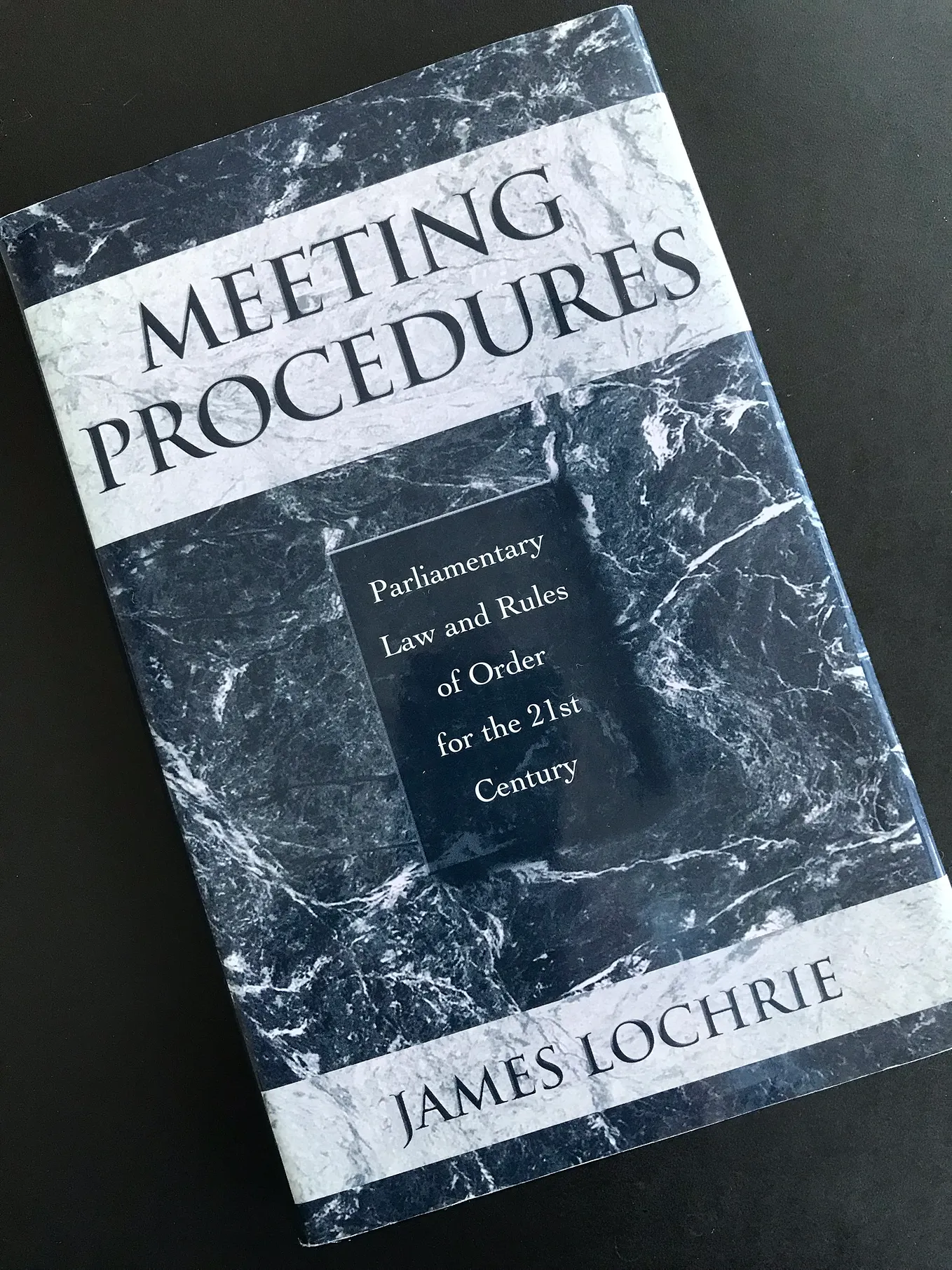
As my colleague, Jim Lochrie, puts it so well in his 2003 book Meeting Procedures, ‘A meeting generally trades nothing except information. It is the currency by which decisions are made; appropriate and reliable information must be available if the decisions are to be effective.’
In addition to educating members, information reports are an accountability mechanism. In reporting on their activities, officers and committees can provide members with an assurance that those in leadership positions are fulfilling their responsibilities.
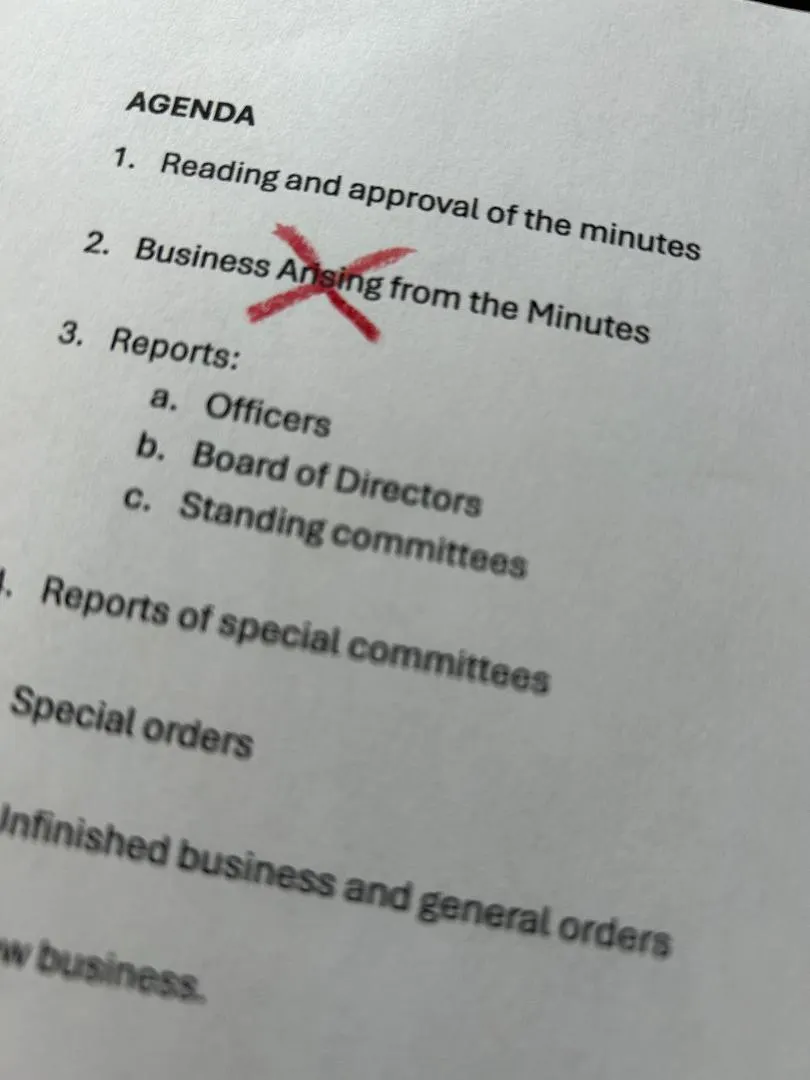
Reports that are included on an agenda are there because they are specified in the order of business that the body has adopted for its meetings (usually contained in the bylaws or in a special rule of order). As discussed previously, the order of business lists the categories of business, and their sequence, to be considered at each meeting, including reports of officers and committees. Two quick comments, however:
1. Officers and committees should only be reporting if they actually have something to report. Robert’s Rules of Order Newly Revised (RONR) makes clear (in 41:13) that for meetings other than the annual meeting, ‘the chair calls only on those who have reports to make’. Just because the order of business may list each officer and each committee, the specific agenda for each meeting should only list those officers and committees who have a report to present at that meeting, and the others shouldn’t feel they have to report every time just for the sake of reporting.
2. Not all reports are ‘equal’; some reports will generate more discussion, and require more time, than others, which is why organizations should make effective use of a ‘consent agenda’ to group together uncontentious items (probably including many information reports) that are only discussed if a member specifically asks to add it to the regular agenda. Members are still expected to read the information reports on a consent agenda (preferably before the meeting), but they often do not need time to be discussed.
If an information report is on the agenda for consideration, the presiding officer of the meeting should call on the officer or committee chair to present the report. If the report is in writing and has been pre-circulated, the officer or committee chair should provide a brief introduction and summarize the highlights without reading the entire document. If the report has been pre-circulated, members will have had an opportunity to read it themselves (and they should have done so!).
Role of the meeting chair
The chair of the meeting (who I will refer to as the presiding officer to avoid confusion with the chair of a reporting committee) should then open the floor to discussion by asking if there are any questions.
Questions from members about the report should be directed to the presenter (the reporting officer or committee chair) through the presiding officer of the meeting (see RONR 3:12). The presenter also responds to questions through the presiding officer. This level of formality (which can be relaxed somewhat in meetings of smaller boards or committees) is important for three main reasons:
- Insisting that members address all remarks to the presiding officer helps elevate the discussion (including questions and answers) to a more professional, and less personal, level, helping to reduce potential breaches of order, such as offensive or irrelevant questions or answers.
- If members are asking questions through the presiding officer, he or she can monitor them to try to avoid one or two questioners from dominating the discussion, to the possible exclusion of other members. It is important that someone other than the presenter is responsible for recognizing questioners and doing so in a fair and equitable way.
- With the presiding officer handling questions, it makes it clear to members that he or she continues to actually preside during the presentation and discussion of the report, with an obligation to impartially enforce the rules. I’ve seen some organizations allow presenters, particularly committee chairs, to take over the chair during the consideration of their reports, enabling them to recognize and respond directly to questioners. Even if there are no motions in the report, however, a meeting always requires a neutral presiding officer, which is not a role that should be delegated to or expected of the presenter of a report. Indeed, Robert is clear that ‘the practice in some organizations of permitting the chairman of a committee to preside over the assembly . . . during the presentation and consideration of the committee’s report violates numerous principles of parliamentary law . . .’ (47:12, emphasis added).
Are there limits to the questions that can be asked?
Get Michael Mouritsen | RP’s stories in your inbox
Join Medium for free to get updates from this writer.
Questions raised about the content of a report essentially are Requests for Information, which falls under the category of ‘Requests and Inquiries’ in Robert. According to Standard Descriptive Characteristic #1 in 33:2, requests and inquiries can be made at any time, including ‘when no question is pending’. In other words, there does not have to be a motion on the floor in order to ask a question.
Members’ questions must, however, be germane to the content of the report, in the same way that debate on a motion must be germane (i.e., relevant) to the motion. The presiding officer may need to remind members of this requirement and to rule some questions out of order if they do not pertain to items in the report. Questions cannot be asked that are outside the scope of the report. A Request for Information is ‘a request directed to the chair, or through the chair to another officer or member, for information relevant to the business at hand . . .’ (33:6, emphasis added).
In addition to asking questions that are relevant to the report, and addressing all remarks through the chair, it is worth noting that the other rules governing decorum in debate (RONR 43:19–43:28) also apply to the asking (and answering) of questions, even if there is no motion on the floor, as in the case of an information report. This includes: refraining from attacking a member’s motives, refraining from criticizing a prior action of the organization, and refraining from disturbing the meeting with disorderly behaviour. Members have an obligation to treat other members with courtesy and respect at all times during a meeting, including when they are asking or responding to questions.
Is an information report open to discussion or only questions?
The general rule, of course, is that debate (as distinct from questions) should only be permitted if there is a motion on the floor, primarily to focus discussion and expedite decision-making. Robert does, however, permit the presiding officer to exercise discretion to allow limited informal discussion without a motion on the floor. An information report should not be an opportunity for members to debate the content of the report, but some brief discussion of the content might be permitted, particularly in smaller meetings, if the presiding officer believes it would be helpful, and provided it doesn’t get out of control. If it does, the presiding officer must be prepared to intervene quickly and firmly.
If an information report doesn’t contain a recommendation or motion, can a member move a motion from the floor related to the content of the report?
Robert states (in 51:53) that a report containing only information, whether ‘an account of work done or a statement of fact or opinion’, should simply be filed: ‘no action on it is necessary and usually none should be taken’ (emphasis added). It seems to me, however, that in using the word ‘usually’, Robert is anticipating that, depending on the circumstances, it might be possible for a member to move a motion in response to the content of an information report. The AIP Standard Code of Parliamentary Procedure makes this possibility explicit: ‘If a committee presents information that a member feels should lead to action, but the report includes no such recommendation, a new main motion germane to the content of the report may be offered and considered’ (AIPSC, 31.62[9]).
In my recent blog post on ‘Making Decisions Without Motions or a Vote’, I cited as an example a meeting in which members wanted to endorse an action reported for information (and in that particular case, the presiding officer assumed a motion and members voted in favour of endorsing the action). Any such motion from the floor, of course, must be germane to the content of the report, and a presiding officer is entitled to rule the motion out of order if it is not germane.
The problem with unscheduled motions moved from the floor during consideration of an information report is that they can effectively hijack an agenda, potentially eating into the time needed for more urgent agenda items. If a motion from the floor is germane, and appears likely to take up quite a bit of time, there are ways to manage the situation. The presiding officer might suggest that the member raise the motion later in the meeting under New Business (particularly if there is more important business on the agenda). This could be done using unanimous consent if the mover is agreeable. Alternatively, the member’s motion could be laid on the table (with majority support), to be taken from the table at a later time in the meeting once the more urgent business has been finished. The motions to Refer or Postpone could also be employed.
The bylaws of some organizations, however, prohibit the introduction of any substantive motions unless prior notice has been given; in such organizations, it would not be possible for a member to move a motion from the floor related to an information report.
Should we be voting to adopt, accept or receive information reports?
As noted earlier, an information report should simply be filed. No action is required, which means there is no need for a motion on it at all.
In 51:13, Robert states that a motion to adopt an entire report (as distinct from its recommendations, if there are any) means ‘endorsing every word in the report’ and ‘is seldom wise’. The meeting can’t amend or otherwise change an information report, and, in any event, to defeat the motion to adopt the report would be meaningless; the report is still the report. Some organizations believe that voting to accept an information report is a benign alternative, but Robert points out in 51:14 that ‘accept’ is equivalent to ‘adopt’. Avoid both.
Other organizations have a practice of voting to receive information reports, in the mistaken belief that it is necessary either (a) before the report can be considered or (b) after the report was given, to formally record that the report was, in fact, considered. A report is already ‘received’, however, at the time it is added to the agenda; a motion to receive it at the meeting is ‘meaningless and is therefore not in order’ (51:15). To repeat: No. Motion. Is. Required.
Conclusion
You are now armed with information on how to take inaction on information reports!
The author is a professional parliamentarian based in Ontario, Canada. More resources can be found at MichaelMouritsen.ca. Feedback (including pushback!) is always welcome.