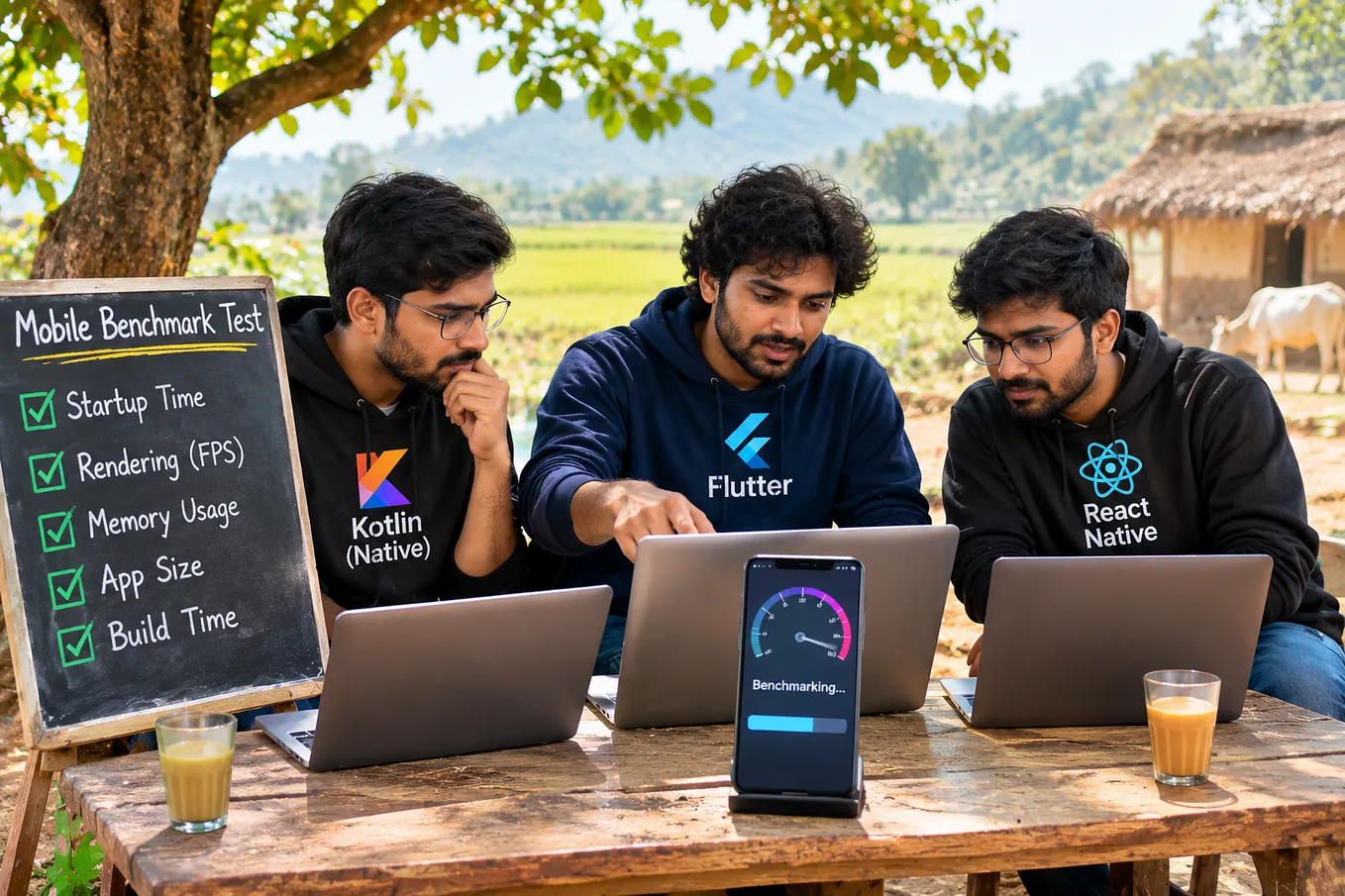
Flutter vs React Native vs Native: What Should a Founder Choose for a New Mobile App? A Detailed Discussion
Flutter vs React Native vs Native: What Should a Founder Choose for a New Mobile App?
Forget the framework wars. If you’re a founder planning a mobile product, the real question is how to build it efficiently, maintain it affordably, and keep your options open.
If you’re a founder planning to build a mobile app, you will eventually face a question that sounds technical but is actually a business decision:
Should we build with Flutter, React Native, or native technologies?Developers can debate this for hours.
They’ll talk about rendering engines, JavaScript, Dart, Kotlin, Swift, performance benchmarks, architecture, community size, and thousands of other technical details.
But as a founder, you probably don’t care about most of that.
You care about something much simpler:
How do I build a good product without wasting time and money?
That’s the question this article is about.
And if I were advising a founder starting a new mobile product today, Flutter would be my first choice in most cases.
Not because Flutter is perfect.
Because it offers a very practical balance between development cost, speed, UI quality, performance, maintainability, and access to both major mobile platforms.
Let’s look at why.
Start With the Business, Not the Technology
Before choosing a framework, understand what you’re actually building.
Most startup applications don’t require operating-system-level innovation.
They’re usually things like:
- Ecommerce apps
- Food delivery apps
- Ride-sharing apps
- Booking platforms
- Fintech products
- Social applications
- Marketplaces
- SaaS applications
- Education platforms
- Healthcare platforms
- Internal business applications
These applications typically need:
- Authentication
- APIs
- Payments
- Push notifications
- Maps
- Chat
- File uploads
- Forms
- Search
- Profiles
- Dashboards
- Notifications
- Analytics
None of these automatically require two completely separate native applications.
This is where the conversation changes.
Instead of asking:
“What’s the most powerful technology?”
A founder should ask:
“What’s the most efficient technology for the product I am actually building?”
Option 1: Native Development
Native means building separately for each platform.
For iOS, you might use:
Swift + SwiftUI/UIKit
For Android:
Kotlin + Jetpack Compose/Android APIs
This gives you excellent platform integration.
If your application needs highly specialized functionality, native can be the right decision.
But there’s an obvious business consequence.
If you want both Android and iOS, you’re maintaining two applications.
That can mean:
Two implementations.
Two development environments.
Two sets of platform-specific bugs.
Two release processes.
And potentially:
Two teams.
This doesn’t mean native is bad.
It means native can become expensive when your product doesn’t actually need separate implementations.
For a startup trying to validate an idea, that distinction matters.
Option 2: React Native
React Native takes a different approach.
Instead of building completely separate applications, you can build much of the product using React and JavaScript/TypeScript while integrating with the native platforms.
For teams already invested heavily in React, this can be an excellent option.
If your company already has:
- React web developers
- TypeScript expertise
- React infrastructure
- React Native experience
then React Native can make a lot of sense.
But if you’re starting from zero, you should compare it against the alternatives rather than assuming that React Native is automatically the cheapest option.
Because the question isn’t:
“Can React Native build the app?”
Of course it can.
The question is:
“Which technology gives my team the cleanest development and maintenance experience for this particular product?”
That’s a different question.
Option 3: Flutter
Flutter approaches cross-platform development differently.
Instead of primarily depending on the platform’s native UI components, Flutter provides its own widget system and rendering architecture.
This has a major advantage for product teams:
You have a lot of control over the interface.
If your designer creates a custom interface, you can build that interface consistently across Android and iOS.
If you create a custom button, animation, navigation experience, card, modal, or transition, you aren’t constantly redesigning it because the underlying platform renders it differently.
That consistency is particularly valuable for startups.
Your application has one visual identity.
You want that identity to remain consistent.
Flutter makes that relatively straightforward.
The Biggest Business Advantage: One Product, Multiple Platforms
Imagine you’re launching a startup.
You need:
Android
and
iOS
You could build both separately.
Or you could use a cross-platform framework.
With Flutter, a significant portion of the application can be developed from one shared codebase.
That doesn’t mean:
“Write code once and never touch native code.”
That’s marketing.
Real applications sometimes need platform-specific integrations.
You may need Kotlin or Swift.
You may need native SDKs.
You may need platform-specific configuration.
That’s completely normal.
The important point is that you don’t need to build the entire application twice.
And for a startup, that can have a significant impact on both time and budget.
Think About Your MVP
This is where I think founders should pay particular attention.
Suppose you have an idea for a marketplace.
You want to launch:
- Login
- User profiles
- Product listings
- Search
- Cart
- Checkout
- Payments
- Notifications
- Order tracking
Your first goal isn’t to build the perfect five-year architecture.
Get Muftianas’s stories in your inbox
Join Medium for free to get updates from this writer.
Your goal is to answer:
Does the market want this product?
You need to get the MVP into users’ hands.
Every month spent building duplicated functionality is another month without meaningful user feedback.
Flutter can be a strong choice here because you can target both major mobile platforms without maintaining two completely separate UI codebases.
That can help reduce the time between:
Idea → MVP → Users → Feedback → Iteration
And for a startup, that loop is extremely important.
But What About Performance?
This is usually where the conversation becomes unnecessarily complicated.
Someone will say:
“Native is faster.”
Technically, native gives you the most direct access to the platform.
That’s true.
But ask a more useful question:
Does your application actually need that advantage?
A typical:
- Booking application
- Ecommerce application
- Delivery application
- Social application
- Business application
- Marketplace
- Chat application
doesn’t necessarily need every part of its UI to be implemented natively to deliver an excellent user experience.
Flutter is designed to deliver high-performance rendering and compiles Dart code to native machine code for native platforms.
For most business and consumer applications, the performance is more than sufficient.
And that’s the important distinction.
You don’t need the theoretical maximum.
You need excellent performance at a reasonable engineering cost.
The Hidden Cost Founders Forget: Maintenance
Building the first version is only one part of the cost.
The bigger cost often comes later.
Your application will change.
You will add:
- New screens
- New payment providers
- New APIs
- New features
- New designs
- New authentication methods
- New notifications
- New analytics
- New business rules
And operating systems will change too.
A technology decision should therefore be evaluated over the lifetime of the product, not just the first release.
This is one of Flutter’s strongest arguments.
A large portion of your application can remain in one shared codebase.
When you change a shared component, you can propagate that change across platforms.
When you fix shared business logic, you don’t have to implement the same conceptual fix twice.
When your design system changes, you have one primary UI architecture to update.
That can reduce long-term engineering friction.
What About Hiring?
This is a legitimate concern.
You don’t want to build a product using a technology that makes hiring impossible.
Fortunately, Flutter has an established ecosystem and a large community of developers.
More importantly, Dart and Flutter provide a relatively coherent development model.
A developer working on the application can understand:
UI → State → Business Logic → API → Platform Integration
within one ecosystem.
For a startup, reducing unnecessary technical fragmentation can be valuable.
That doesn’t mean hiring should never influence your decision.
If you already have an excellent React Native team, React Native may be the better choice.
But if you’re hiring from scratch, Flutter deserves serious consideration.
What If We Need Native Functionality Later?
This is one of the biggest misconceptions about cross-platform development.
Choosing Flutter does not mean giving up native development.
Flutter provides mechanisms for communicating with native platform code.
So your architecture can look something like this:
Mobile Application
                         │
                  Flutter / Dart
                         │
             ┌───────────┴───────────┐
             │                       │
        Shared Product          Platform-specific
            Code                    Features
             │                       │
       ┌─────┴─────┐             ┌───┴────┐
       │           │             │        │
     Android      iOS          Kotlin   Swift
Most of your product can remain shared.
When you encounter something that genuinely needs native implementation, you add native code.
That’s a much better approach than assuming you must choose between:
100% native
or
100% cross-platform.
Real-world applications are often a combination.
The point isn’t:
Flutter for everything.
The point is:
Don’t pay the cost of native development unless your product actually benefits from it.
A Simple Decision Framework for Founders
If you’re starting a new mobile product, I would think about it this way:
Your situationConsiderHighly platform-specific applicationNativeDeep hardware/OS integrationNativeExisting large React/TypeScript organizationReact NativeExisting React Native infrastructureReact NativeNew startup with Android + iOSFlutterCustom UI-heavy productFlutterFast MVP developmentFlutterSmall engineering teamFlutterOne shared mobile codebaseFlutterAndroid + iOS + potential desktop expansionFlutter
It’s not a scientific scoring system.
It’s a practical starting point.
The Question Founders Should Actually Ask
Don’t ask your development team:
“Which framework is the best?”
Ask them:
“Which technology lets us build, launch, and maintain this product with the least unnecessary complexity?”
That’s a much better question.
Because the goal isn’t to win a technology debate.
The goal is to build a successful product.
My Recommendation
If you’re a founder starting a new mobile application and you need both Android and iOS
I would put Flutter near the top of the list.
In many cases, I’d make it the default starting point.
You get:
- One primary codebase
- Strong UI control
- Cross-platform development
- Good performance
- Fast iteration
- Native integration when required
- A mature ecosystem
- A strong developer experience
- The possibility of expanding beyond mobile
Most importantly, you avoid unnecessarily maintaining two completely separate mobile applications when your product doesn’t require it.
That’s a meaningful business advantage.
Final Thought
Technology should serve the business.
Not the other way around.
If you’re building an application whose primary value is the product experience — not some highly specialized operating-system capability — then you probably don’t need to start by paying the cost of two independent native applications.
You need to build.
You need to launch.
You need users.
You need feedback.
And you need to iterate quickly.
For that type of product, Flutter is a very strong choice.
Not because Flutter is magically better than everything else.
Not because native is obsolete.
Not because React Native can’t build serious applications.
But because for a founder who wants to build one product for multiple platforms without unnecessarily multiplying the engineering cost, Flutter offers a very compelling balance.
Build once where it makes sense.
Use native where it matters.
Spend your engineering budget on the product — not on solving the same problem twice.

If you’re a founder planning to build a mobile app and deciding between Flutter, React Native, or native development, feel free to reach out. I’d be happy to discuss your idea, recommend the right technical approach, and help you turn it into a scalable product.
Let’s talk →
https://www.linkedin.com/in/muhammadanasmufti/
muftianas97@gmail.com
- 92 313 15 73 023