Rewiring Global Trade: How Geopolitics and Digitalization Are Transforming the Modern Supply Chain

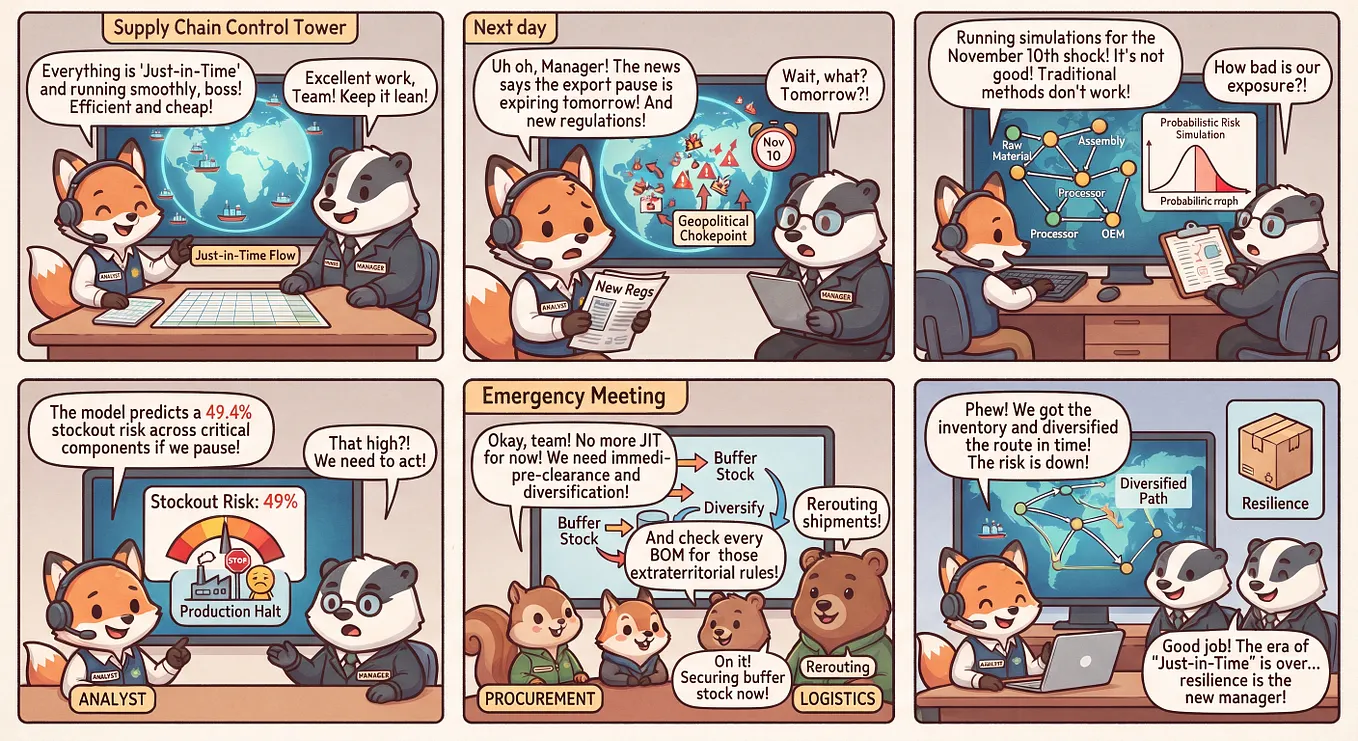
For decades, global trade operated under a single primary imperative: producing goods where labor and materials were cheapest and delivering them just in time. Today, that model is undergoing a fundamental transformation. A succession of geopolitical conflicts, trade disputes, and economic shocks has pushed international logistics into what industry leaders describe as a state of permanent reset. Rather than treating disruption as an isolated shock, corporate executives increasingly view volatile geopolitical conditions as their standard operating backdrop.
In a global survey of 6,000 exporting companies conducted by Allianz Trade, 65% of businesses identified geopolitical and political risk as their primary operational concern, placing it ahead of general supply chain complexity. The financial toll of this friction is substantial: the economic cost of global supply chain complexity reached $4.7 trillion in 2025, more than double its 2017 level. Furthermore, in an Allianz survey of more than 3,000 risk professionals, 51% cited geopolitically driven supply chain paralysis as the most plausible “black swan” threat facing their organizations over the next five years, followed closely by a global internet outage at 47%. Analysts estimate that a systemic supply chain failure on the scale of recent major conflicts could trigger cumulative global GDP losses of $1.5 trillion.
The Geographic Shift: Multi-Hub Networks and Regionalization
The restructuring of global manufacturing does not signal an end to globalization, but rather its redistribution across new pathways. The traditional trade corridor connecting manufacturing centers in the East to consumer markets in the West is no longer the sole anchor of international commerce. Instead, trade is expanding across a broader network connecting Asia, the Middle East, and Africa — a corridor often referred to as the “trade crescent”.
To insulate operations from tariffs and trade friction, companies are increasingly shifting toward regionalization and diversification. Rather than relying on single distant manufacturing hubs, businesses are moving production closer to their primary consumer markets, such as North American firms expanding facilities in Mexico or European companies investing in Eastern Europe. National industrial policies, tax incentives, and export restrictions — such as export controls on critical rare earth materials — are compelling companies to build alternative operating paths.
The pressure to relocate varies significantly across industries:
- High Disruption: Industries such as electronics, machinery, and semiconductors face the strongest near-term pressure to realign production due to geographic concentration and high import dependency.
- Medium Disruption: Pharmaceuticals and chemicals face moderate restructuring as governments introduce grants and regulatory pathways to onshore critical drug manufacturing.
- Low Disruption: Resource-dependent sectors like agriculture, mining, and energy remain less mobile due to natural asset location, though investments in facilities like liquefied natural gas terminals are shifting to avoid vulnerable maritime chokepoints.
Digital Rails: AI, Data Integrity, and Trade Finance
Get Koh Niak Wu, Ph.D.’s stories in your inbox
Join Medium for free to get updates from this writer.
As physical trade routes split into regional networks, digital infrastructure is becoming as critical as physical transport lines. Corporate leaders identify emerging technologies, global growth patterns, and tariffs as equally critical factors shaping international trade over the next three to five years.
Digital Economy Agreements (DEAs) — such as the Digital Economy Partnership Agreement (DEPA) involving Singapore, Chile, New Zealand, and South Korea — are establishing binding standards for cross-border data flows, electronic invoicing, and mutual recognition of digital identities. Within corporate operations, advanced data analytics and artificial intelligence are deployed to model tariff exposure, track shipments, and anticipate policy changes.
However, industry experts emphasize that automated tools and AI algorithms are only as reliable as their underlying data. Because many supply chains still rely on fragmented manual channels like emails and paper spreadsheets, businesses are adopting blockchain-based audit trails and verified digital identities to eliminate digital blind spots and prevent trade fraud. Concurrently, tightening trade finance has led 43% of surveyed exporters to anticipate deteriorating payment terms, prompting a shift in commercial contracts toward terms like Free On Board (FOB) to maintain direct control over logistics costs and tariff risks.
Emerging Vulnerabilities: Cyber Risks and Blind Spots
The rapid digitization of trade corridors has introduced complex new vulnerabilities, particularly regarding cybersecurity and supply chain visibility. A widespread operational challenge for global manufacturers is the lack of visibility beyond direct, tier-one vendors; a majority of organizations report having limited awareness of risks residing deeper in their supply networks at tier-two and tier-three levels. To manage this uncertainty, many companies resort to holding excess inventory buffers, an expensive tactic that consumes cash and working capital.
At the same time, the convergence of physical logistics and digital infrastructure has expanded the attack surface for cyber threats. Strategic manufacturing and shipping hubs — such as Malaysia, positioned along the vital Strait of Malacca trade route — have become prime targets for both state-aligned cyber espionage and opportunistic ransomware operations. Threat groups target advanced electronics and semiconductor sectors to collect intelligence and intellectual property, while financially motivated cybercriminals employ phishing, social engineering, and distributed denial-of-service (DDoS) attacks against critical infrastructure and financial networks.
Building Long-Term Resilience
Navigating this rewired trade environment requires organizations to move from reactive crisis management to proactive, continuous network adaptation. Leading enterprises are establishing centralized analytics units to simulate trade scenarios, adjust factory production capacity dynamically based on material availability, and implement multisourcing strategies across multiple continents. By integrating verified data foundations, diversifying physical suppliers, and reinforcing cyber defenses, businesses are reshaping supply chains to maintain operational stability in an increasingly multi-hub world.