Top 15 OKR Software I Personally Evaluated Before Choosing One for My 200-Person Company
OKR Software

I sat through 22 demos. Ran 6 pilots. 90 days of my own time — because the last time I delegated this decision, I spent six figures on a tool that produced PowerPoint reports and zero execution change.
The slide decks looked great. The key results didn’t move.
So this time I evaluated every OKR software myself. Same rubric across all 16 tools. Same questions every time:
How does this tool enforce that OKRs actually get updated?
What happens when a key result stalls — who finds out, and how fast?
Does the CEO see the problem before the deadline, or after?
16% of knowledge workers feel their company’s performance process motivates them — Gartner
2.5x outperformance for companies that execute with aligned OKRs — Harvard Business Review
8% of leaders are strong at actually executing their stated strategy — PwC Strategy&
Most companies pick OKR tools that report on goals instead of tools that drive execution. Different products. Most people don’t realize that until they’ve already signed.

The Evaluation Criteria — Same Rubric, All 15 Tools
Every OKR management tool on this list was scored identically:
Enforcement — Does the tool force updates, or just ask nicely?
Escalation — When a KR stalls, who gets notified automatically?
Execution depth — Can I see why a KR is stalling, not just that it is?
30-day adoption — Without admin pressure, what % still use it?
Pricing transparency — Tools requiring a sales call to get a number were penalized
Setup to first insight — Days from sign-up to meaningful execution data
The 15 OKR Software Tools — Ranked and Reviewed
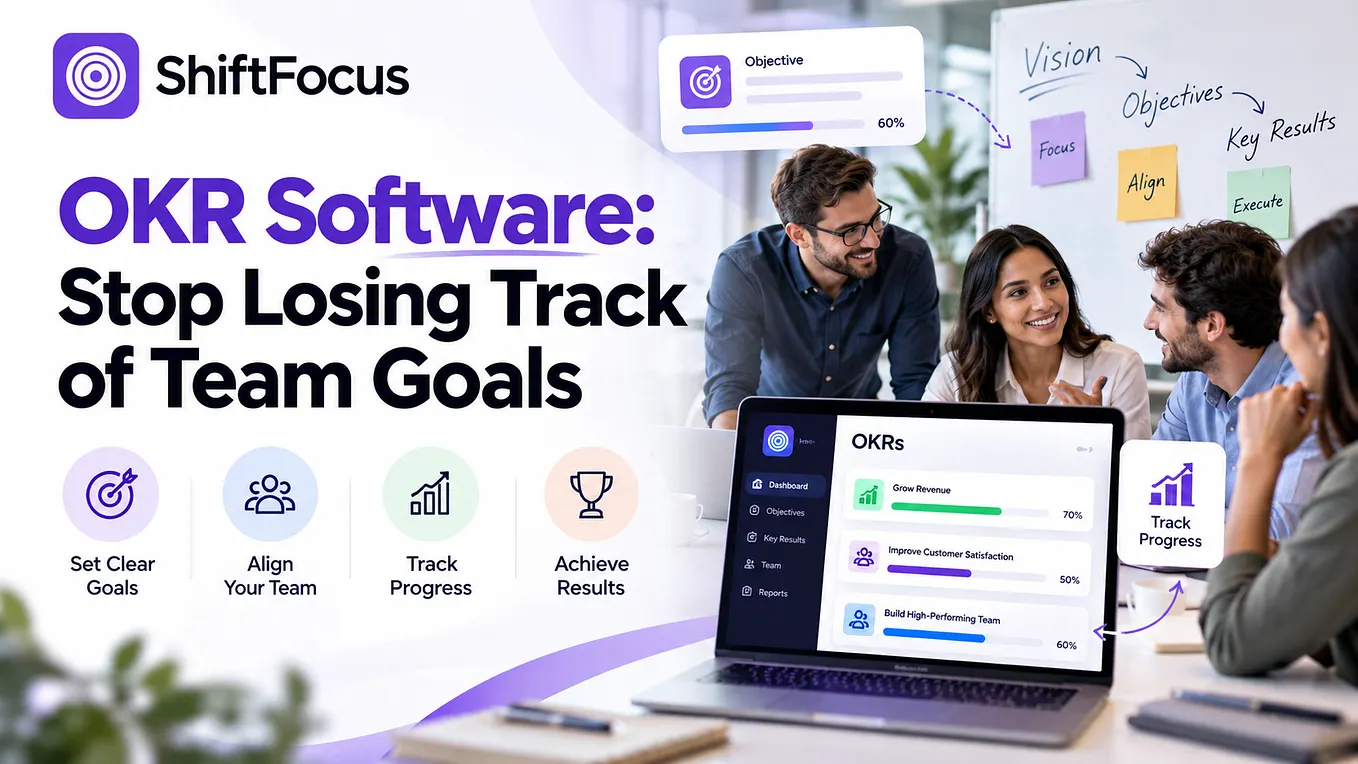
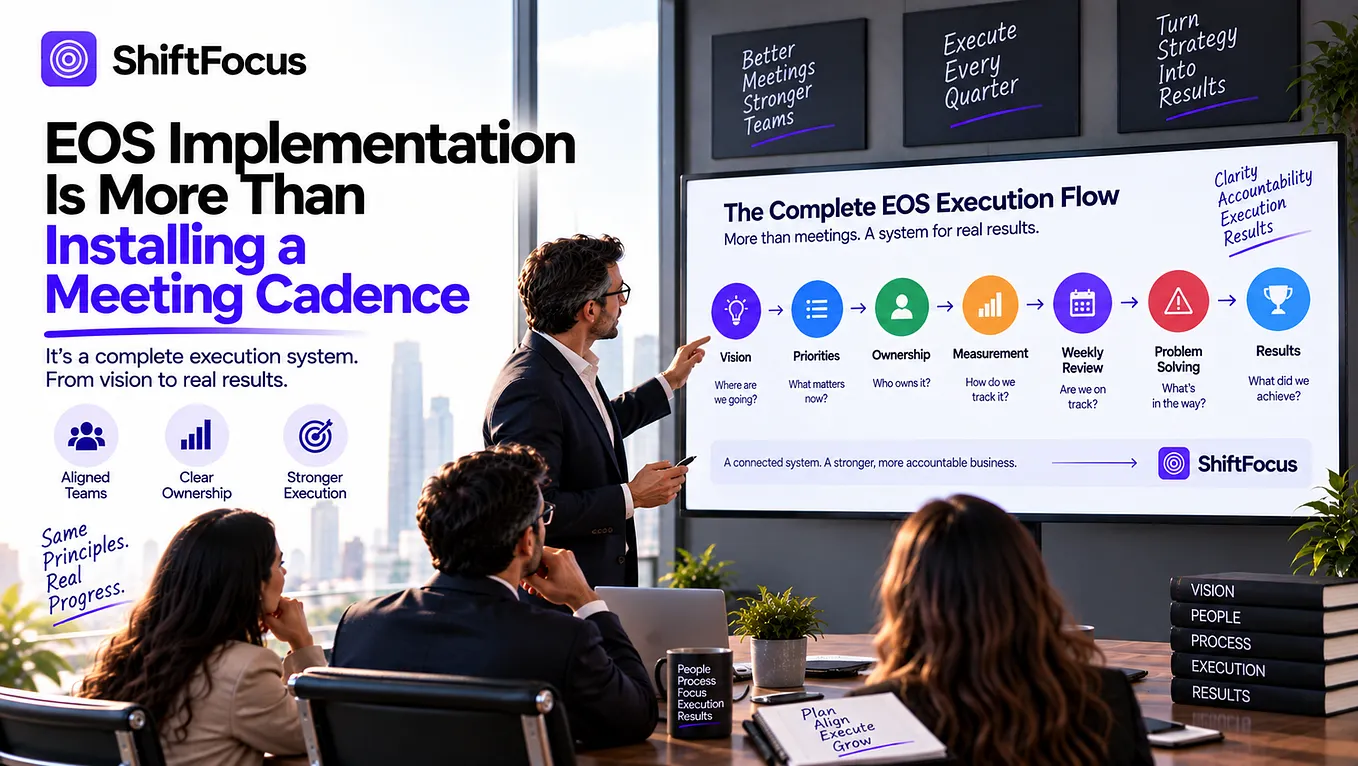
#01 Shift Focus OS
💰 Custom pricing — contact sales for a quote
⏱ Live in 48 hrs — no consultant needed
I almost didn’t include it. A late addition that changed my final decision entirely.
Most OKR tools help you set goals. Shift Focus OS makes sure those goals actually get done. That sounds like a small difference. It is not. Every task connects to a goal in real time. When something slows down, the tool tells you before you have to ask.

↳ Enforcement
• Every task needs one owner — one person, not a team
• If a task has no update after 48 hours, the owner gets an automatic reminder
• After 72 hours of no movement, it shows up as a red flag in the manager’s view
↳ Escalation
Three steps happen automatically — no human needed.
Step 1: Owner gets a nudge at 48 hours.
Step 2: Manager sees a flag at 72 hours.
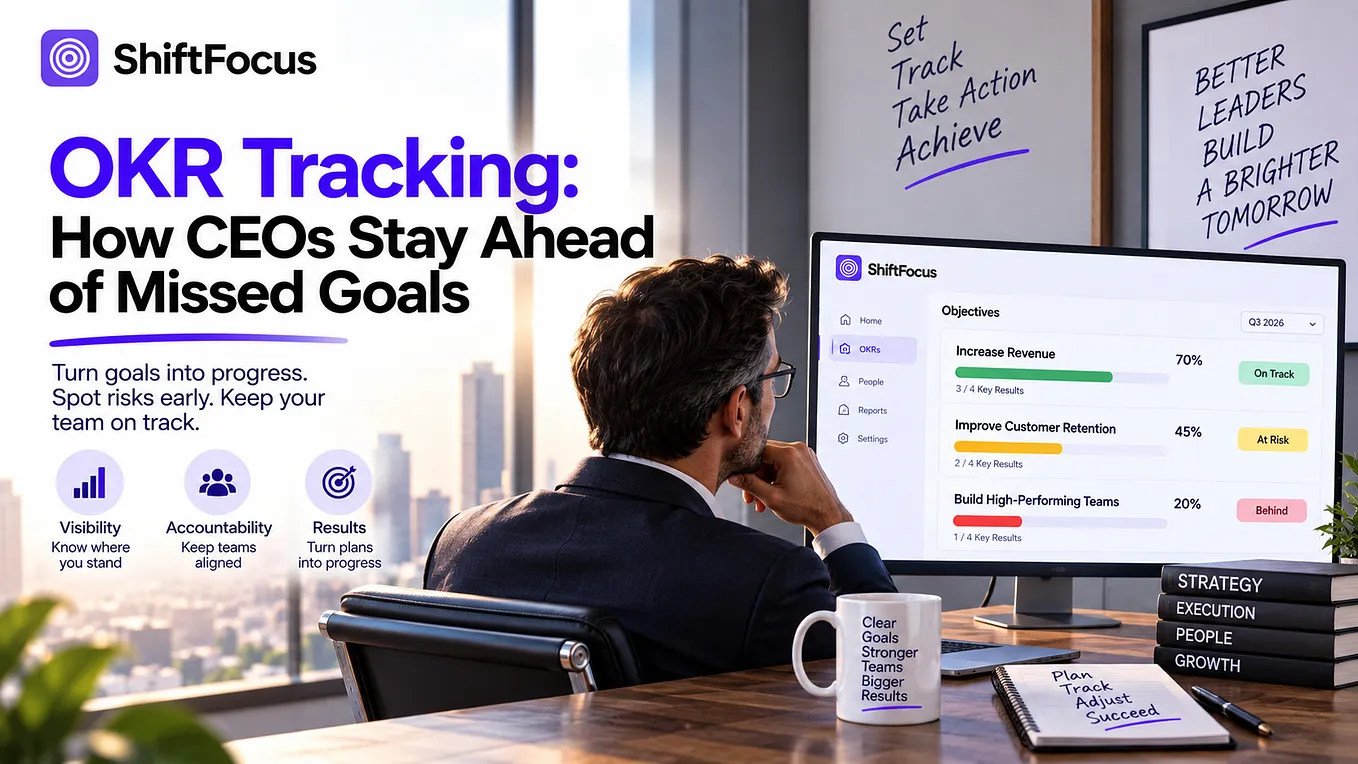
Step 3: If a key result is going to miss its target, it shows up in the CEO dashboard on its own. I tested this by leaving a task untouched for 5 days on purpose. It reached my dashboard without anyone telling me. That is exactly what I was looking for.
↳ What Works
• Every goal connects to actual tasks — you can see what is blocking progress in real time
• Salesforce alignment signals built in — sales activity connects directly to OKR progress
• One person owns every task — no confusion about who is responsible
• 200 people were using it within 48 hours — no long setup, no external help needed
• Three-level automatic escalation — problems reach the right person without anyone flagging manually
↳ What Doesn’t
• Custom pricing only — you need to talk to their sales team to get a number
• No SAML SSO out of the box — this is on their roadmap
Verdict: This is the tool I chose. It is the only OKR software that changed how my team actually works every week — not just how we talk about goals at the end of the quarter.
#02 Lattice
💰 $11/user/month. Jumps to $15–17 above 150 seats
⏱ 2–3 weeks with HR admin
Beautiful. Polished. The OKR module stops exactly where you need it to start.
Lattice tells you a key result is at 40% completion. It will not tell you why. No execution layer. No blocker detection. I kept clicking for the next level of detail and hitting a wall.

↳ Enforcement
• No automated enforcement — depends entirely on manager discipline
• Teams can go 2+ weeks without updating — no system intervention
• 35% of key results untouched after 4 weeks in our pilot
↳ Escalation
None. Weekly digest emails exist — but they are reports, not alerts. By the time you read it, the deadline may already be gone.
↳ What Works
• Best performance review + OKR integration — single HR platform
• Highest UX quality tested — strong HR team adoption
• Solid 1-on-1, feedback, and engagement modules
↳ What Doesn’t
• Zero automated enforcement — entirely human-dependent
• No escalation mechanism for stalled OKRs
• Pricing jumps sharply at scale
Verdict: Strong OKR management tool for HR-led cultures with disciplined managers. If you need automated enforcement or escalation — wrong tool.
#03 Quantive
💰 $10/user/month base. Enterprise: $18–25/user (custom)
⏱ 3–5 weeks minimum — needs dedicated admin
Most technically capable tool I tested. Also the most demanding to operate.
80+ integrations — Salesforce, HubSpot, Jira, Snowflake. OKRs update automatically from live data. We spent 3 weeks just configuring the CRM integration. Worth it only if you have RevOps capacity.

↳ Enforcement
• Enforcement is data-driven — connected KRs update automatically
• Qualitative OKRs (milestones, deliverables) have no enforcement mechanism
• Ownership assignment available but not mandatory
↳ Escalation
Configurable threshold alerts — but requires upfront admin setup per scenario. Nothing automatic out of the box. A CEO sees stalled OKRs only if an alert was pre-configured for that exact case.
↳ What Works
• 80+ native data integrations — auto-updates KRs from live business data
• Best analytics layer tested — OKR health scoring and trend analysis
• Enterprise-grade security and audit controls
↳ What Doesn’t
• 3–5 week implementation — not for teams needing fast deployment
• No default escalation — everything requires configuration
• Pricing opacity on enterprise tier
Verdict: The most powerful OKR tracking software for data-mature companies with dedicated ops. Wrong tool if you need to move fast or lack technical admin.
#04 Perdoo
💰 $8.99/user/month (Growth). $11.99/user/month (Enterprise)
⏱ 1–2 weeks — guided OKR coaching built in
The most OKR-faithful tool on this list. Framework-perfect. Operationally rigid.
Perdoo enforces the OKR hierarchy correctly — Company → Department → Team → Individual. Key results must be measurable. The tool teaches the methodology as you use it. 3 of my team leads found it constraining by week 3.

↳ Enforcement
• Structural enforcement — can’t create a KR without a metric and a target
• Weekly check-in reminders sent to individuals
• Manager dashboard shows which teams missed check-ins
↳ Escalation
Limited. Reminder → Reminder → Manager notices manually.
No automatic path from stalled KR to leadership alert. Works for disciplined methodology-led orgs. Not enough for fast-moving ops.
↳ What Works
• Most accurate OKR methodology implementation on the market
• Built-in OKR coaching layer — teaches as teams use it
• Transparent pricing — no enterprise mystery tiers
↳ What Doesn’t
• Rigid cadence — sprint-based teams find it constraining
• No automated escalation to leadership
• Smaller integration ecosystem
Verdict: Best OKR software for first-time OKR rollouts or methodology-driven cultures. Limiting for operators who need flexibility and real-time escalation.
#05 Betterworks
💰 Custom only — typically $15–22/user at scale
⏱ 8–12 weeks — dedicated PM + consultant required
Most comprehensive platform tested. Right for 1,000 people. Overkill for 200.
Full suite — OKRs, performance management, engagement surveys, manager coaching. The analytics depth is unmatched. But 8–12 week implementation and enterprise-only pricing made it the wrong size for us.

↳ Enforcement
• Automated weekly manager summaries with color-coded health indicators
• Teams below threshold trigger automatic manager alerts
• Check-in completion tied to manager’s team health visibility
↳ Escalation
Multi-tier escalation available — but requires full upfront configuration during onboarding. Works well if you have the bandwidth to set it up properly with their CS team.
↳ What Works
• Full-suite OKR + performance + engagement platform
• Strong multi-tier escalation (when configured)
• Dedicated customer success manager included
↳ What Doesn’t
• 8–12 week implementation — too slow for most
• Enterprise-only pricing — no self-serve
• Feature density creates adoption friction below director level
Verdict: The right tool at 1,000+ people with dedicated HR ops. Wrong size, wrong price, wrong timeline for a 200-person company.
#06 Profit.co
💰 $9/user/month (Growth). $15/user/month (Enterprise) — transparent
⏱ 1–2 weeks — pre-built templates accelerate setup
Template library is the best I tested. The execution depth isn’t.
Pre-built OKR templates for Sales, Marketing, Engineering, HR, Finance — dramatically cuts setup time.
KPI tracking alongside OKRs is genuinely useful. But I could see a KR at 35% without knowing which specific task was blocking it.

↳ Enforcement
• Automated weekly reminders to KR owners
• Check-in completion rate tracked at team level
• Configurable nudge frequency as deadlines approach — reminder-based only
↳ Escalation
Basic. Missed check-ins show as flagged in manager dashboard. Manager digest email when direct reports go dark. No automatic path to CEO or leadership without manual escalation.
↳ What Works
• Best OKR template library — fastest structured first-time rollout
• KPI tracking alongside OKRs in one view
• Transparent, competitive pricing
• Responsive customer support during pilot
↳ What Doesn’t
• No execution tracking below OKR level
• Enforcement is reminder-based — doesn’t surface the execution problem
• No automatic CEO-level escalation
Verdict: Solid for first-time OKR rollouts. Affordable, fast, well-supported. You will outgrow the execution depth quickly at 200+ people.
#07 Weekdone
💰 Free up to 3 users. Flat team pricing from $90/month
⏱ Under 1 week — pure self-serve
Nobody does the weekly check-in workflow better. Nobody.
Plan-Do-Report every week. OKR progress updates automatically from weekly completions. Highest first-two-week adoption of any tool tested. But reviewing 200 individual weekly plans as a CEO is not sustainable.

↳ Enforcement
• Automated reminders for weekly plan and report submissions
• Manager dashboard shows submission completion rate per person
• Enforcement is submission-based: did you fill in the form? Not: is the work progressing?
↳ Escalation
None above direct manager. If a KR stalls, it stays invisible to leadership until a manager manually reports it. No aggregate CEO view. No at-risk detection at the executive level.
↳ What Works
• Best weekly check-in workflow tested — lowest friction
• High early adoption rate
• Affordable flat pricing
↳ What Doesn’t
• No escalation above direct manager
• Doesn’t scale past 50 people without creating management overhead
• OKR module is secondary to weekly reporting engine
Verdict: Best OKR software for small teams building weekly discipline. Scale past 50 and the model breaks.
#08 Workboard
💰 Custom — mid-market typically $15–20/user/month
⏱ 3–4 weeks — requires executive sponsor
Best executive alignment dashboard tested. Worst below-director adoption.
The CEO-to-IC cascade view is the most impressive of any tool I evaluated. You can drill from company OKR to any team in two clicks.
Get OKR Hive: Set Goals. Track Progress. Win.’s stories in your inbox
Join Medium for free to get updates from this writer.
By week 4 of pilot, the middle management layer had stopped updating consistently — and the beautiful dashboard started showing stale data.

↳ Enforcement
• Configurable reminders and manager check-in alerts
• Business Rhythm feature forces updates before scheduled reviews
• Enforcement is light outside of scheduled review cadence
↳ Escalation
Escalation exists but requires manual manager flagging. I left a KR at 0% for 10 days in pilot. It didn’t surface in my executive view until a manager flagged it manually on day 11. That’s the gap.
↳ What Works
• Best executive alignment visualization tested
• Business Rhythm creates structured review cadence
• Strong strategy-to-OKR mapping
↳ What Doesn’t
• Escalation requires manual flagging — not automatic stall detection
• Heavy interface — adoption drops sharply below director level
• Pricing opacity
Verdict: Strong OKR management tool if your executive team drives it consistently from the top. Falls apart without that pressure.
#09 Microsoft Viva Goals
💰 $6/user/month or included in M365 E3/E5
⏱ 1–2 weeks for Microsoft-native orgs
Ally.io was great. Post-acquisition, product velocity has visibly stalled.
Teams integration is genuinely seamless — check-in reminders arrive in the chat your team already uses.
Feature development has slowed significantly since Microsoft acquired Ally.io. Support quality has declined. The product feels in maintenance mode.
↳ Enforcement
• Check-in reminders via Teams messages — higher open rate than email
• OKR completion tracking in Teams dashboard
• Enforcement stops at reminder + visibility — no escalation path
↳ Escalation
Basic — at-risk OKRs can trigger a Teams channel notification to manager. Multi-tier escalation to CEO requires manual admin configuration. Limited sophistication compared to purpose-built tools.
↳ What Works
• Native Teams integration — highest adoption in Microsoft orgs
• Included in M365 E3/E5 — no additional cost
• Clean familiar interface — fast learning curve
↳ What Doesn’t
• Feature development visibly slowed post-acquisition
• No multi-tier automatic escalation
• Limited value outside Microsoft ecosystem
Verdict: Solid for Microsoft-native orgs already paying for Viva Suite. If you’re not in that ecosystem, better options exist at the same price.
#10. 15Five
💰 $14/user/month (Engage). $19/user/month (Perform, includes OKRs)
⏱ 2–3 weeks — HR-led implementation
The only tool that showed me a team’s disengagement before their OKRs crashed.
When a team’s KR completion is dropping AND their weekly engagement score is declining — that’s a leading indicator, not a lagging one.
15Five surfaces that correlation. In pilot, a product team’s OKRs stalled in week 3. Their engagement had been declining for 5 weeks. The OKR miss was a symptom.

↳ Enforcement
• Weekly check-in cycle enforced strongly — high submission rate
• OKR updates embedded inside existing check-in habit
• Manager alerts when direct reports miss weekly submission
↳ Escalation
No automatic escalation for stalled OKRs. Engagement data can serve as indirect escalation signal — but it’s a proxy, not a direct alert path.
↳ What Works
• Engagement + OKR correlation — unique signal not available elsewhere
• OKR updates embedded in weekly check-in — strong habit formation
• Useful early warning system via engagement data
↳ What Doesn’t
• OKR module lacks operational depth — no task-level tracking
• No automatic escalation from stalled KRs to leadership
• Expensive as a pure OKR tool
Verdict: Buy 15Five for people health + OKR correlation. Don’t buy it if deep execution tracking is the primary need.
#11 Culture Amp
💰 $5–8/user/month (Engage). OKR module — separate conversation
⏱ 2–3 weeks — people-ops led
Best people analytics in the market. OKR module was clearly added to compete, not built to lead.
The engagement benchmark data in Culture Amp is genuinely unmatched — compare your scores against industry, company size, and high-growth benchmarks simultaneously. The OKR module is six months of product development behind dedicated platforms.
↳ Enforcement
• OKR reminders exist but are not a primary product mechanic
• Notification infrastructure built around engagement surveys — not OKR cadence
• In practice: if managers don’t ask for updates, OKRs sit untouched
↳ Escalation
None for OKRs. The engagement data can be an indirect signal — low scores may correlate with OKR struggles — but the platform doesn’t connect these into an actionable alert.
↳ What Works
• Best-in-class engagement benchmarking and people analytics
• Strong psychological safety measurement tools
• Excellent customer success support
↳ What Doesn’t
• OKR module is shallow — competitive addition, not core product
• No enforcement specific to OKR cadence
• Zero escalation for stalled KRs
Verdict: Buy Culture Amp for people analytics — it’s the best. Don’t use it as your primary OKR software.
#12 Asana Goals
💰 Included in Asana Business ($24.99/user/month)
⏱ Under 1 week for Asana-native teams
Theory is perfect. Data quality in practice breaks down fast at 200 people.
Tasks connect to KRs — OKR progress updates automatically as your team ships. In pilot, 40% of tasks were not connected to any KR by week 2. The OKR dashboard showed 45% completion on a KR that was actually at 70%. Stale data looks identical to live data in Asana Goals.

↳ Enforcement
• Strong task-level enforcement — owners get notified, managers see overdue tasks
• No OKR-specific enforcement — a KR can sit at 0% for 6 weeks, nothing triggers
• Enforcement is task-based, not OKR-based
↳ Escalation
None for OKRs. Asana escalates task issues. Stalled KRs at the objective level generate zero automatic alert. A CEO is reviewing whatever data the team has manually maintained.
↳ What Works
• Zero incremental cost for existing Asana Business customers
• Task-to-goal connection is powerful when maintained correctly
• No additional tool adoption — familiar interface
↳ What Doesn’t
• OKR data quality requires consistent task tagging — breaks at scale
• No OKR-specific enforcement or escalation
• Not a substitute for purpose-built OKR software at 200+ people
Verdict: Convenient for Asana-native teams. Not serious OKR tracking software. Data governance becomes a full-time job.
#13 Monday.com
💰 Included in Monday Work Management Pro ($19/user/month)
⏱ Under 1 week — but inconsistency scales with team size
Beautiful boards. Zero standardization. 15 different OKR formats by week 6.
Everyone builds their OKR board differently in Monday. Engineering tracks OKRs as sprints. Sales as pipeline.
Marketing as campaigns. None of these talk to each other. Getting a cross-functional CEO view means manually navigating 15 incompatible board formats.

↳ Enforcement
• Automation can be configured to send update reminders — requires admin build
• No out-of-the-box OKR enforcement
• Maintaining consistent enforcement across 15 board formats = full-time ops job
↳ Escalation
None native. Any escalation requires custom automation built on top of Monday — which requires a dedicated admin to build and maintain indefinitely.
↳ What Works
• Highest visual flexibility — best for teams that think in boards
• Included in existing Monday subscription
• Strong automation layer if you build it
↳ What Doesn’t
• No standardized OKR framework — every team builds differently
• No native escalation
• Not designed as OKR software — it’s project management used as one
Verdict: Flexible tool, poor OKR software. At 200 people without a dedicated ops admin, Monday Goals produces beautiful boards and unreliable execution data.
#14 Koan
💰 Free up to 5 users. $6.75/user/month (Growth)
⏱ Under 1 week — pure self-serve
Best reflection prompts of any tool tested. Not an operational tool. A journal.
The weekly reflection questions in Koan are genuinely thoughtful — confidence level, blockers, lessons learned. For a 10-person team where the CEO reads every response, this produces real signal.
At 200 people, there’s no aggregation, no cross-team view, no escalation. It’s a very good journal.
↳ Enforcement
• Email reminders for weekly reflection submissions
• Manager can see who submitted and who didn’t
• Enforcement is submission-based — did they write a reflection? Not: is the KR moving?
↳ Escalation
None. Low confidence signals sit in individual reflections with no path to manager or CEO alert. No aggregate executive view. No at-risk detection of any kind.
↳ What Works
• Most thoughtful weekly reflection prompts tested
• Genuinely builds OKR reflection habits in small teams
• Simple, affordable, low-friction
↳ What Doesn’t
• No scalability beyond 50 people — no aggregation layer
• No execution tracking below weekly self-reporting
• No escalation of any kind
Verdict: Excellent for early-stage teams building the OKR habit. You’ll outgrow it before Series A.
#15 Trakstar
💰 Custom — mid-market typically $6–10/user/month
⏱ 2–3 weeks — HR-led
Good performance review tool. Average OKR tool. Don’t confuse the two.
The OKR-to-annual-review connection in Trakstar is genuinely well designed — clean paper trail from objective setting to performance assessment. But OKR updates happen around review dates, not continuously. Mid-cycle execution tracking simply isn’t the product.
↳ Enforcement
• Reminder architecture built around performance review calendar
• Between review cycles: minimal OKR enforcement
• No mechanism for prompting weekly or bi-weekly OKR updates outside formal cycles
↳ Escalation
None mid-cycle. Trakstar alerts go out when review windows open and close. A KR that’s off-track in month 2 of a quarter will not be flagged until the quarterly review is triggered — which may be too late.
↳ What Works
• Clean OKR-to-performance review integration
• Good for orgs using OKRs as direct performance inputs
• Reasonable mid-market pricing
↳ What Doesn’t
• Enforcement tied to review cycles — minimal between dates
• No mid-cycle escalation or at-risk detection
• Interface feels dated
Verdict: Reliable HR tool with a functional OKR module. Right if OKR-to-review alignment is your primary need. Wrong if you need real-time execution tracking.
Why I Chose Shift Focus OS — 90 Days of Real Numbers
I want to be direct about this.
Every other OKR tracking software I tested showed me a number. A percentage. A status color. Green, yellow, red.
Shift Focus OS showed me what was actually happening — which task was stuck, who owned it, and how many days it had been sitting untouched.
That is a completely different product. And it changes how you run your week.
I left a task untouched for 5 days on purpose to test it. Day 2 — owner got a nudge. Day 3 — manager saw a flag. Day 5 — it was in my CEO dashboard. Nobody told me. The system did it on its own.
One more thing worth mentioning: Shift Focus OS has Salesforce alignment signals built in. When your sales team’s activity in Salesforce changes, it connects directly to your sales OKRs. You don’t need to manually update anything. The numbers move on their own.
Pricing is custom — you need to speak to their sales team to get a number for your company size.
What changed in 90 days — same team, same goals, different visibility:
34% → 71% OKR completion rate — nothing else changed except the tool
6 days earlier we found blockers before they became problems
2.5 hrs → 50 min weekly leadership meeting — everyone came in with the same data
60% fewer manual escalations — the system flagged issues before managers had to
McKinsey research says teams with clear ownership are 3.5x more likely to hit their targets.
Shift Focus OS forces one owner on every single task. You cannot create a key result without naming one person responsible.
That one rule changed everything about how my team talks about accountability.
Which OKR Software Is Right for You
Team under 50, first time using OKRs:
Start with Perdoo or Profit.co. Simple, affordable, and they teach you the basics.
HR-led company, 100–300 people:
Lattice or 15Five. Your OKRs will live inside your HR process and that is fine.
Company with a strong data and ops team:
Quantive. Nothing else comes close on integrations.
Large enterprise, 1,000+ people:
Betterworks. Built for that scale.
Already using Microsoft 365:
Viva Goals. It is already included. Start there.
CEO who needs to see execution clearly, not just goal reports:
Shift Focus OS. It is the only OKR software that tells you what is blocked, who is responsible, and escalates to the right person automatically.
Most OKR tools look good. Very few actually change how your team executes. Know which one you are buying before you sign.