RAG Explained: How Enterprise Applications Can Turn Company Data into AI Intelligence

From documents and databases to grounded AI responses : a practical guide for .NET and Azure developers
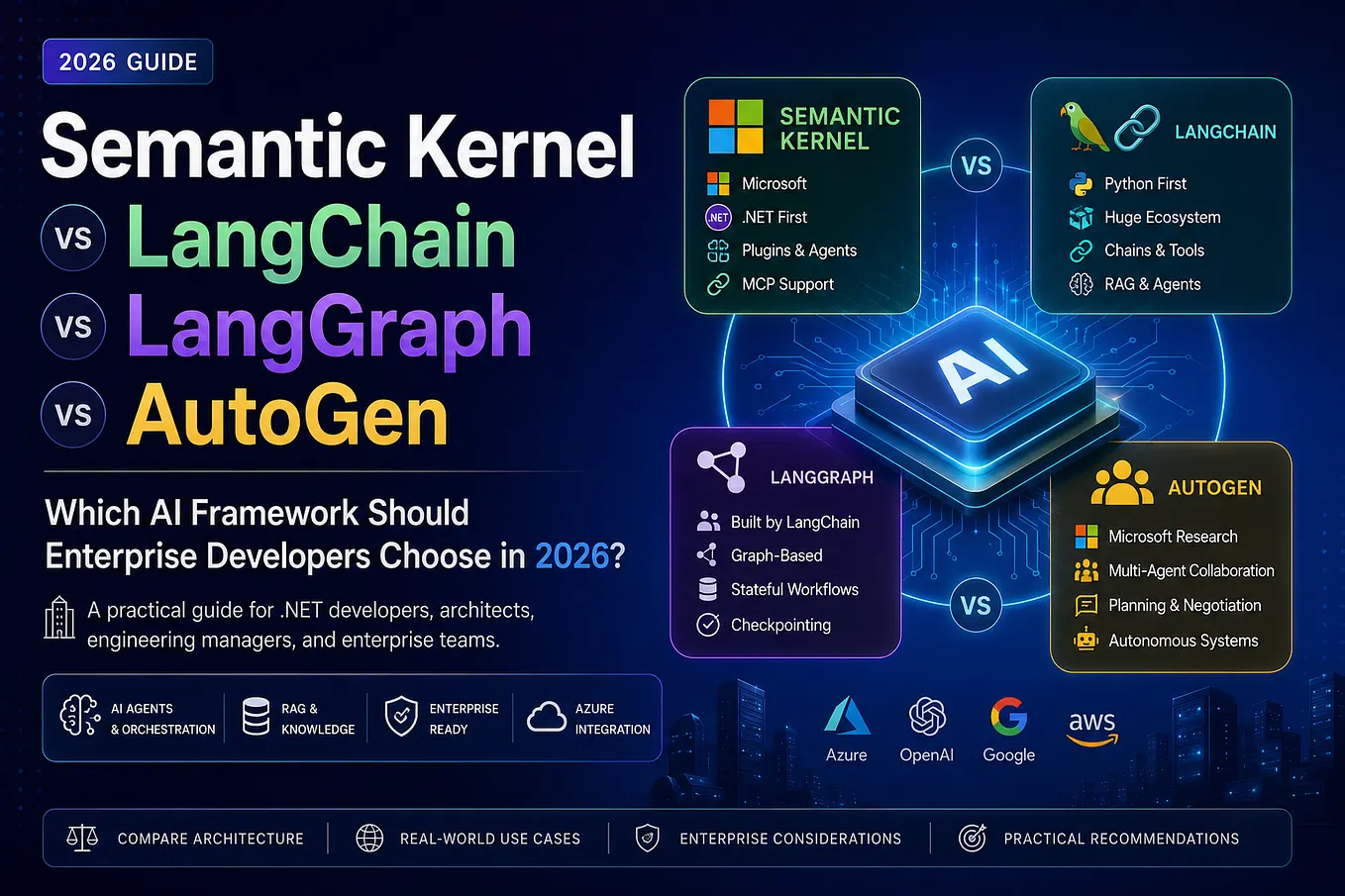
If you have been following my AI learning journey, you may have noticed a pattern.My first article was about why experienced .NET developers should start learning AI.The second was about the growing ecosystem of AI frameworks:
Semantic Kernel
LangChain
LangGraph
AutoGen
But after exploring AI frameworks, I came across a much more fundamental question: How do we actually connect AI with an enterprise’s own data?
Because most businesses don’t want an AI assistant that only knows what was included in its training data.
They want an AI assistant that can understand:
Company policies
Customer information
Product documentation
Healthcare records
Contracts
Invoices
Knowledge bases
Internal applications
Databases
Reports
Business processes
And this is where one of the most important concepts in Enterprise AI comes into the picture:
Retrieval-Augmented Generation.
RAG.
What is RAG?
At a high level, RAG means: Retrieve relevant information first. Then ask the AI model to generate an answer using that information.
Instead of asking an LLM:
“What is our company’s reimbursement policy?”
we first retrieve the relevant company documents and provide the relevant content to the model.
The architecture becomes:
User Question -> Retrieve Relevant Enterprise Data -> Provide Retrieved Context to LLM ->Generate Grounded Response
The important point is this:
RAG does not retrain the AI model.
It gives the model access to relevant information at query time.
That distinction is extremely important.
RAG Through a Traditional Software Engineering Lens
Coming from more than 13 years of building .NET APIs, microservices, databases, Azure applications, and enterprise systems, RAG was one of the AI concepts that immediately made sense to me.
Why?
Because underneath the AI terminology, I could still recognize familiar engineering concepts:
Data
Search
APIs
Business Logic
Security
Caching
Monitoring
Observability
The difference is that we are now putting an LLM into the middle of that architecture.
And that changes almost everything.
The Basic RAG Architecture
A simplified RAG architecture looks like this:

Behind this simple flow are several engineering components.
Let’s break them down.
1. Data Ingestion
Before the AI can retrieve anything, we need to get enterprise information into our knowledge system.
The source could be:
PDF documents
Word documents
Web pages
SharePoint
SQL databases
CRM systems
ERP systems
Application APIs
Cloud storage
Internal knowledge bases
For example:
SharePoint
     ↓
Document Processing
     ↓
Text Extraction
     ↓
Chunking
     ↓
Metadata
     ↓
Embeddings
     ↓
Search Index
This is the ingestion pipeline.
And this is where many RAG implementations begin to become real engineering projects.
2. Document Chunking
A common mistake is to take a 100-page document and treat it as one giant piece of text.
That doesn’t work particularly well for retrieval.
Instead, documents are usually divided into smaller chunks.
For example:
Company Policy.pdf
     ↓
Chunk 1
Employee Eligibility
     ↓
Chunk 2
Leave Policy
     ↓
Chunk 3
Work From Home Policy
     ↓
Chunk 4
Reimbursement Policy
Each chunk can then be indexed independently.
The goal is simple:
When a user asks a question, retrieve the smallest useful pieces of information rather than an entire document.
But chunking isn’t just:
“Split every 500 characters.”
Good chunking should consider:
Document structure
Paragraph boundaries
Headings
Tables
Sections
Semantic relationships
Metadata
Poor chunking can lead to poor retrieval.
And poor retrieval usually leads to poor AI responses.
3. Metadata Is Extremely Important
Suppose we have a document chunk:
Employees can claim travel reimbursement within 30 days.
That text alone isn’t enough.
We may also want metadata such as:
DocumentId
DocumentType
Department
CreatedDate
ModifiedDate
Version
Department
Country
Product
SecurityGroup
Source
Now imagine the same policy exists for:
India
USA
UK
Germany
Metadata allows the retrieval system to narrow the search.
Instead of:
“Find reimbursement information.”
we can potentially perform:
“Find reimbursement information for employees in India.”
This is where traditional database thinking becomes extremely useful for AI engineers.
4. Embeddings
This is where things start becoming more interesting.
How does a computer understand that these two questions are related?
“How much can I claim for business travel?”
and
“What is the company’s travel reimbursement limit?”
The exact words are different.
But the meaning is similar.
Embeddings help represent text as numerical vectors.
Conceptually:
Text
 ↓
Embedding Model
 ↓
Vector
A vector might look conceptually like:
[0.021, -0.342, 0.781, ...]The actual vector is much larger than this example.
The important idea is that semantically similar content can have vectors that are closer together in vector space.
This enables semantic retrieval.
6. Keyword Search vs Vector Search
This is an important architectural decision.
Keyword search looks for matching terms.
Vector search looks for semantic similarity.
Consider:
“What is the employee vacation policy?”
A keyword search may look for:
“vacation”
A vector search may understand that:
“annual leave”
“time off”
“holiday entitlement”
could also be relevant.
But vector search isn’t always better.
Consider:
Product IDs
Invoice numbers
Employee IDs
Error codes
Technical identifiers
Exact names
For these scenarios, keyword search can be extremely useful.
This leads us to another important concept.
7. Hybrid Search
Instead of choosing between keyword search and vector search, why not use both?
That’s the idea behind hybrid search.
                 User Query
                     ↓
              ┌──────┴──────┐
              ↓             ↓
        Keyword Search   Vector Search
              ↓             ↓
              └──────┬──────┘
                     ↓
                Result Fusion
                     ↓
              Relevant Results
Azure AI Search supports hybrid search by running full-text and vector queries together and merging the results using Reciprocal Rank Fusion.
This is particularly useful for enterprise applications because enterprise queries often contain both:
Meaning
and
Exact identifiers.
For example:
“Show me the warranty policy for product ABC-123.”
We need semantic understanding of “warranty policy.”
But we also need exact matching for “ABC-123.”
This is why hybrid retrieval is such an important pattern.
8. Reranking
Retrieving documents is only half the problem.
What if we retrieve 20 potentially relevant chunks?
Which ones should be sent to the LLM?
This is where reranking can help.
Conceptually:
User Query
    ↓
Initial Retrieval
    ↓
Top 20 Results
    ↓
Reranking
    ↓
Top 5 Most Relevant Results
    ↓
LLM
The objective is to improve the quality of the context provided to the model.
The better the retrieved context, the better the opportunity for the model to generate a grounded response.
Azure AI Search supports semantic ranking as part of its search capabilities and recommends hybrid retrieval for many RAG scenarios.
9. Context Construction
Now we have relevant information.
But we still need to construct the prompt.
For example:
System Instructions
You are an enterprise assistant.
Use only the provided context
when answering questions.
Context:
Document 1:
...
Document 2:
...
Document 3:
...
User Question:
What is the reimbursement limit?
The orchestration layer creates this context and sends it to the LLM.
This is where frameworks such as:
Semantic Kernel
LangChain
LangGraph
can become useful.
They can help manage orchestration, tools, retrieval, memory, workflows, and other application logic.
I discussed these frameworks in detail in my previous article.
10. Generation
Now the LLM receives:
User question
Relevant enterprise context
and generates the response.
Conceptually:
Question
   +
Retrieved Context
   ↓
LLM
   ↓
Grounded Answer
This is the “Generation” part of Retrieval-Augmented Generation.
And this is where the two worlds come together:
Traditional enterprise systems
Generative AI
The Complete RAG Pipeline
Putting everything together:

                             Enterprise Data
                                    ↓
                            Document Processing
                                    ↓
                                Chunking
                                    ↓
                                Metadata
                                    ↓
                                Embeddings
                                    ↓
                              Search Index
                                    ↓
                        ┌──────────────────────┐
                        │                      │
                    User Query      →    Query Processing
                        │                      │
                        ↓                      ↓
                     Keyword Search + Vector Search
                                    ↓
                              Hybrid Retrieval
                                    ↓
                                Reranking
                                    ↓
                              Relevant Context
                                    ↓
                              Prompt Construction
                                    ↓
                                   LLM
                                    ↓
                             Grounded Response
This is the basic RAG architecture.
But enterprise RAG introduces another dimension.
Security.
Enterprise RAG Security
This is one of the areas where I believe traditional enterprise engineering experience becomes extremely valuable.
Imagine an employee asks:
“Show me the salary information for the engineering department.”
The RAG system finds a document containing salary information.
But should the user see it?
Not necessarily.
The search engine finding a document does not mean the user is authorized to access it.
This is why authorization must be part of the retrieval architecture.
A secure pattern looks like:
                             User
                               ↓
                            Identity
                               ↓
                            Authorization
                               ↓
                      Security-Aware Retrieval
                               ↓
                      Only Authorized Documents
                               ↓
                              LLM
                               ↓
                           Response
The LLM should never be your authorization boundary.
The application and data access layers should enforce authorization before sensitive information reaches the model.
Azure AI Search now provides several approaches for document-level access control and security trimming, including permission metadata and query-time enforcement capabilities. Some of the newer enforcement features are currently in preview, so production designs should carefully distinguish GA capabilities from preview features.
This principle is critical:
Never rely on the LLM to decide whether a user is allowed to see data.
Authorization belongs in the application and data access architecture.
RAG and Enterprise Applications
This is where RAG becomes especially interesting for developers like me.
Imagine an existing enterprise architecture:
                          React / Angular
                                ↓
                          .NET Web API
                                ↓
                          Business Services
                                ↓
                          SQL Server
                                ↓
                          Enterprise Applications
We don’t necessarily need to throw this architecture away.
Instead, we can introduce an AI layer.
                     ┌───────────────┐
                     │   LLM / AI    │
                     └───────┬───────┘
                             │
                      AI Orchestration
                             │
                         RAG / Tools
                             │
        ┌────────────────────┼────────────────────┐
        ↓                    ↓                    ↓
   SQL Database       Search Index          Business APIs
        ↓                    ↓                    ↓
                   Enterprise Applications
This is a much more realistic view of Enterprise AI.
AI doesn’t necessarily replace the existing architecture.
It becomes another capability within it.
RAG + .NET
For .NET developers, this opens up an interesting learning path.
You can continue using the technologies you already understand:
C#
ASP.NET Core
Web APIs
Dependency Injection
Microservices
Azure
SQL Server
REST APIs
Authentication
Authorization
Observability
And add:
LLMs
Embeddings
Vector Search
RAG
AI Agents
AI Orchestration
This creates a powerful combination.
.NET + AI
rather than
.NET vs AI.
RAG + Semantic Kernel
Semantic Kernel is particularly interesting for Microsoft-oriented enterprise environments.
A typical architecture might look like:
                          .NET Application
                                 ↓
                          Semantic Kernel
                                 ↓
                          RAG / Plugins / Agents
                                 ↓
                          Azure AI Search
                                 ↓
                          Enterprise Data
                                 ↓
                                LLM
The important thing is not the framework itself.
The important thing is the architecture surrounding it.
Get Sudhir Patil’s stories in your inbox
Join Medium for free to get updates from this writer.
Authentication
Authorization
Data access
Prompt management
Observability
Evaluation
Cost management
Error handling
Governance
These remain engineering responsibilities.
RAG + LangChain and LangGraph
The same architecture can be implemented using other frameworks.
LangChain can provide components for retrieval and LLM application development.
LangGraph becomes particularly interesting when the RAG process becomes a workflow.
For example:
                            User Question
                                  ↓
                            Classify Intent
                                  ↓
                            Retrieve Documents
                                  ↓
                            Evaluate Retrieval
                                  ↓
                            Need More Information?
                                  ↓
                                 Yes
                                  ↓
                            Additional Search
                                  ↓
                            Generate Response
                                  ↓
                            Human Approval
                                  ↓
                            Execute Action
At this point, we are moving beyond simple RAG.
We are entering Agentic AI.
And that will be the subject of a future article in this series.
RAG Is Not Just About Documents
One of the biggest misconceptions I see around RAG is:
“RAG means chatting with PDFs.”
PDF chat is only one use case.
Enterprise RAG can work with many sources.
For example:
Documents
Databases
APIs
Knowledge Bases
CRM
ERP
SharePoint
Application Logs
Product Catalogs
Internal Wikis
The retrieval layer becomes an abstraction over enterprise knowledge.
This is where RAG starts becoming much more powerful.
RAG vs Fine-Tuning
Another common question:
“If I want my AI to know my company data, shouldn’t I fine-tune the model?”
Not necessarily.
RAG and fine-tuning solve different problems.
RAG is generally useful when the model needs access to changing or private knowledge.
Fine-tuning is more about changing or adapting model behavior for particular tasks, styles, or patterns.
A simplified comparison:

In many enterprise scenarios, RAG should be considered before jumping directly to fine-tuning.
When RAG Isn’t the Right Answer
This is another important lesson.
Not every AI problem is a RAG problem.
Suppose a user asks:
“What is the current balance of my account?”
Searching documents isn’t necessarily the right approach.
We should probably call a business API.
                                User
                                 ↓
                                AI
                                 ↓
                         Business Tool / API
                                 ↓
                           Account System
                                 ↓
                           Current Balance
Similarly:
“Book a meeting for tomorrow.”
That’s an action.
We need a tool or API.
So a modern enterprise AI application may use:
RAG for knowledge
APIs for live data
Tools for actions
LLMs for reasoning and natural language
This is a much more powerful architecture than RAG alone.
Common RAG Problems
Building a RAG demo is relatively easy.
Building a reliable enterprise RAG system is much harder.
Here are some common problems.
1. Poor Chunking
If chunks are too large, retrieval becomes noisy.
If chunks are too small, important context can be lost.
2. Poor Metadata
Without useful metadata, filtering becomes difficult.
3. Irrelevant Retrieval
If the wrong documents are retrieved, the LLM receives bad context.
4. Too Much Context
More context doesn’t automatically mean better answers.
Large amounts of irrelevant context can actually reduce answer quality and increase cost.
5. Outdated Data
If the source data is outdated, the AI response may also be outdated.
6. Duplicate Content
Multiple versions of the same document can create conflicting context.
7. Permission Leakage
This is one of the most serious problems. A user should never receive information simply because the search engine found it.
8. Hallucination
Even with RAG, an LLM can generate information that isn’t supported by the retrieved context.
9. Missing Citations
For enterprise applications, users often need to know:
“Where did this answer come from?”
Source citations can significantly improve trust and traceability.
10. Poor Evaluation
A RAG application should not be evaluated only by asking:
“Does the demo look good?”
We need measurable evaluation.
How Do We Evaluate RAG?
This is where Enterprise AI starts looking much more like traditional software engineering.
We need metrics.
For example:
Retrieval relevance
Did we retrieve the correct information?
Context precision
How much of the retrieved information was actually useful?
Context recall
Did we retrieve the important information?
Answer relevance
Did the response actually answer the question?
Groundedness
Is the answer supported by the retrieved context?
Citation quality
Can the answer be traced back to reliable sources?
Latency
How long did the entire pipeline take?
Token consumption
How much did the request cost?
Failure rate
How often does the system produce unusable responses?
These metrics can become part of an AI application’s testing and observability strategy.
RAG Observability
Traditional applications already have:
Application Logs
Metrics
Distributed Tracing
Exceptions
Performance Monitoring
AI applications need additional telemetry.
For example:

This gives us visibility into where the system is failing.
Was the problem retrieval?
Was the prompt too large?
Was the model incorrect?
Was the data outdated?
Was the wrong document selected?
Without observability, debugging an AI system becomes extremely difficult.
The Architecture I Would Aim For
If I were designing an enterprise RAG platform today, I would think about it as several layers.


Around all of these layers I would add:
Security
Observability
Evaluation
Governance
Cost Management
That is the difference between:
“Let’s build a chatbot.”
and
“Let’s build an enterprise AI platform.”
When RAG Isn’t the Right Answer
Not every AI problem is a RAG problem.
Sometimes, an AI application needs to retrieve knowledge. Sometimes, it needs to access live data or execute an action. And sometimes, it needs to reason through a complex workflow using multiple tools.

RAG retrieves enterprise knowledge, tools and APIs access live systems and perform actions, and AI agents orchestrate reasoning and tasks. Enterprise AI applications often combine all three.
Suppose a user asks:
“What is the current balance of my account?”
Searching documents isn’t necessarily the right approach. We should probably call a business API.
What RAG Taught Me About Enterprise AI
As I continue my transition from traditional enterprise software engineering into AI, RAG has been one of the concepts that connected the two worlds for me.
The terminology is new.
Embeddings
Vectors
Semantic Search
Grounding
Context Windows
Retrieval
Reranking
But the underlying engineering principles are familiar.
We still need:
Good architecture
Good data
Strong security
Reliable APIs
Scalability
Performance
Monitoring
Testing
Governance
AI doesn’t eliminate software engineering.
It makes good software engineering even more important.
The Most Important Lesson
I would summarize RAG with one simple statement:
RAG doesn’t give an AI model your company’s intelligence.
It gives the model access to the right information at the right time.
And the engineering challenge is making sure that information is:
Relevant
Secure
Current
Accurate
Traceable
Authorized
Observable
That is where the real Enterprise AI engineering challenge begins.
Where I Am Going Next
My AI learning journey started with a simple question:
“Should experienced .NET developers learn AI?”
The answer for me was yes.
Then came another question:
“Which AI frameworks should I learn?”
That led to Semantic Kernel, LangChain, LangGraph and AutoGen.
Now another question has emerged:
“How do we build AI systems that actually work with enterprise data?”
That led me to RAG.
And the next natural question is:
“What happens when the AI doesn’t just retrieve information, but can reason, use tools, make decisions and execute actions?”
That takes us into:
AI Agents.
Coming Next
In the next article, I’ll explore:
“AI Agents Explained: From Chatbots to Autonomous Enterprise Systems”
We’ll look at:
AI Agents
Tools and Function Calling
Planning
Memory
Agent Orchestration
Human-in-the-Loop
Multi-Agent Systems
Agentic Workflows
MCP
Enterprise Architecture
And most importantly:
Where should we actually use agents?
Because just like RAG, I believe the goal shouldn’t be to use AI everywhere.
The goal should be to use AI where it creates real business value.
Final Thought
We are entering an interesting period in software engineering.
For developers who have spent years building APIs, databases, distributed systems, cloud platforms and enterprise applications, AI doesn’t necessarily mean starting from zero.
It means adding another powerful capability to everything we already know.
The future may not be:
.NET vs AI
Cloud vs AI
Software Engineering vs AI
It may simply be:
Software Engineering + AI.
And I believe that combination is going to define the next generation of enterprise applications.
About me
I’m a technology leader and software architect with 14+ years of experience designing, developing, and delivering enterprise software solutions across healthcare IT, industrial automation, retail, shipping, and logistics.
My technical journey began with hands-on software development using the Microsoft .NET ecosystem. Over the years, I’ve evolved from building applications and backend services to designing scalable architectures, developing microservices, integrating cloud services, and leading engineering teams.
My core expertise includes C#, .NET, ASP.NET Core, SQL Server, REST APIs, microservices, software architecture, design patterns, SOLID principles, Azure services, API Management, messaging, and cloud-based enterprise systems. I’ve also worked on technical leadership responsibilities spanning architecture decisions, code reviews, proof of concepts, delivery planning, engineering quality, and team development.
But technology never stands still.
After spending years building traditional enterprise applications, I’ve started my next learning journey: combining my software engineering and architecture experience with Artificial Intelligence.
I’m actively exploring Generative AI, Large Language Models (LLMs), Retrieval-Augmented Generation (RAG), AI agents, agentic workflows, Semantic Kernel, LangChain, LangGraph, Model Context Protocol (MCP), and Microsoft Foundry, with a particular focus on building secure, scalable, and production-oriented AI solutions for enterprise environments.
I’m also exploring AI-assisted software development tools and applying these evolving practices to the way I think about engineering productivity, architecture, and product development.
Alongside my technology leadership journey, I’m building entrepreneurial initiatives and exploring how emerging technologies can solve real-world business problems.
Through this blog series, I share practical insights, architectural perspectives, technical comparisons, and lessons from my ongoing transition from traditional enterprise software engineering to AI-powered application development.
My belief is simple:
Strong AI engineering starts with strong software engineering.
The future belongs to engineers who combine sound architectural thinking, deep technical fundamentals, and the curiosity to continuously learn and build.
Let’s explore that future together.
#AI #GenerativeAI #RAG #RetrievalAugmentedGeneration #AzureAI #AzureAISearch #DotNet #CSharp #SemanticKernel #LangChain #LangGraph #AgenticAI #EnterpriseAI #AIEngineering #SoftwareEngineering #CloudArchitecture