What PBL Actually Taught Me About Student Autonomy

I have worked in two schools in South East Asia that took project-based learning seriously, and they taught me completely different things.
The first was implementing Understanding by Design, the framework developed by Grant Wiggins and Jay McTighe. UbD starts from the end. You identify what you want students to understand, design the assessment first, then build the learning backwards toward it. The Performance Tasks at the heart of UbD are meant to be authentic, real problems requiring real thinking. In theory this is PBL. In practice, at that school, most of the tasks were about ninety-five percent synthetic. Students were simulating real world problems rather than actually engaging with them. They knew it and so did I.
The exception was when I took the work outside. When my students created actual art exhibitions in the city, when the public came and the work had to hold up in a real context rather than a classroom one, something shifted. I will write more about that specifically another time. But that experience taught me the first thing PBL has to offer: authenticity is not a feature you can fake. Students know the difference between a real audience and a performed one.
The second school was something else entirely. No letter grades. No year groups. Cohorts instead of classes. No standard core lessons. Just projects, running for three months at a time, with the core curriculum woven into the project rather than taught separately alongside it. This was pure PBL and it was where the practice came alive.
The exoplanet colony
One project has stayed with me more than any other. Students were tasked with designing a human colony on an exoplanet. Not a fictional one. They had to research real exoplanets, choose one, and justify the choice in depth. Then they had to work out everything: how to get people there, what resources to bring, how to build the ship, what governance structure the colony would use, and what the place would actually look like. They built virtual mockups that visitors could explore using VR headsets at the final showcase.
Six sections of work, each genuinely complex, each requiring research into real scientific and social problems. And all of it their own choices.
What happened in that project that would not have happened in a conventional lesson? The students came to the final showcase knowing they had done it themselves. Not that they had answered the questions correctly. Not that they had met the mark scheme. That they had built something. The joy in that room was not the joy of relief at finishing. It was the joy of authorship.
I know some of you might say, well, they did not actually go to the exoplanet. And you would be right. But they pretty much did. They had to solve every problem that a real mission would face, with real science, real governance questions, and real consequences for the choices they made within the project. That is arguably more interesting than what NASA starts out doing, which is years of theoretical planning before anyone goes anywhere near a launchpad. These students got to the launchpad in three months.
But I need to be honest about what getting there looked like, because PBL writing tends to skip this part.
Time evaporates
When you give students genuine open choice, time disappears. This is the part nobody warns you about adequately. A student who has been told what to do every day of their school life, who has always been given the formula and asked to apply it, does not know what to do with genuine autonomy at first. They freeze. They defer. They ask you what they should choose, which is the one question you cannot answer for them.
The teacher’s role in that moment is not to direct. It is to aid decisiveness. To help the student trust their own instinct enough to commit to a direction and start moving. This is a specific skill and it is almost the opposite of what traditional teacher training prepares you for.
Get Piran Lowe’s stories in your inbox
Join Medium for free to get updates from this writer.
I noticed something about age here that surprised me. The older cohorts, high school age, were better at working as autonomous teams. They could organise themselves, divide responsibilities, hold each other accountable. But the younger students, when they felt safe enough, were braver. They had not yet learned to fear looking bad in front of their peers. They would propose genuinely outlandish ideas with a confidence that older students had lost somewhere along the way. Autonomy does not increase linearly with age. It depends on what the school has already done to the student’s relationship with risk.
The morning standup
One of the structural changes that made the biggest difference was something I borrowed from Agile project management. Every morning, before the teams went to work, we did a standup. Each student said what they had done yesterday, what they were doing today, and what was blocking them. Three questions. Five minutes maximum. Then everyone dispersed.
This did several things simultaneously. It gave students a daily framework for self-direction. It created natural accountability within the team. And it surfaced the blockers, the places where students were stuck or avoiding something, early enough to do something about them. It also created hierarchy in a natural way, not imposed by the teacher but emerging from demonstrated ability and reliability within the team. The students who consistently knew what they were doing and followed through became the ones others oriented around.
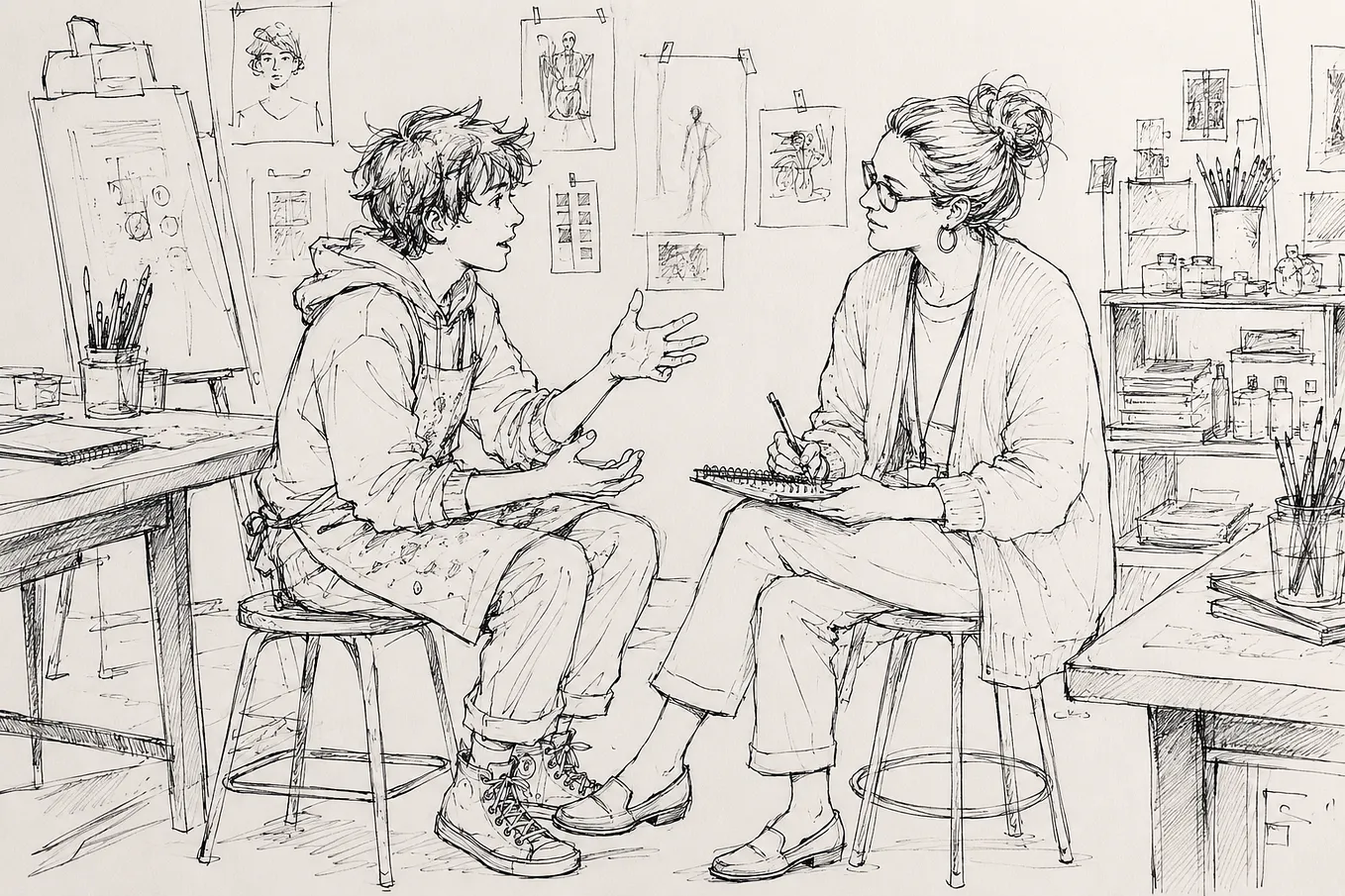
I think about that standup now when I think about the Studio Thread practice I have developed since. The standup was a team version of the same instinct: create a regular, structured moment for students to speak about their own thinking and their own progress. The Studio Thread is the individual version, one teacher, one student, every five or six weeks across the full course. I suspect one grew from the other without me realising it at the time.
What PBL never quite solved
I want to be honest about the problems because PBL writing is often dishonest about them.
Reading and arithmetic are hard to embed genuinely in a three month project without the seams showing. We tried. Sometimes it worked. Sometimes it still needed individual time outside the project sessions for students at the lower end. That is not a failure of the approach but it is a reality of it, and pretending otherwise does not help teachers who are trying to implement it.
The tension with formal qualifications was real. Students still needed IGCSEs. We handled this with self-directed study using online platforms for a couple of hours each day, and honestly it worked better than I expected. It showed how capable students are of directing their own content-based study when they are not being managed through it lesson by lesson. But the tension between a PBL philosophy and a qualification system that is still fundamentally about individual performance under examination conditions does not fully resolve. Anyone who tells you it does is selling something.
The formula question
The single thing PBL taught me about students that I could not have learned any other way is this.
When you give students a genuine problem, they will find a way to solve it that you did not think of. They create their own formulas. They do not remember the formula. They build one.
Traditional schooling, at its most reductive, is about learning the formulas that previous generations developed and applying them accurately. That made sense in a world where the problems were stable and the formulas were reliable. We are not stepping into that world. We are stepping into one where the problems are new, the old formulas are increasingly inadequate, and the person who can construct a working approach from scratch, fail at several attempts, and find one that holds, is the person who will navigate it.
I do not think I need to tell you which student is better prepared for what is coming.
In the next piece I will go deeper on what happened when we took the work outside the school and into the city, and why a real audience changes everything.
Piran Lowe writes practical guides for Cambridge IGCSE Art and Design teachers. The MEA toolkit is available at meatoolkit.gumroad.com.