[Deep Dive] Are AI Agents Really Changing Consumer Behavior?
Part 2: Limits vs Potential
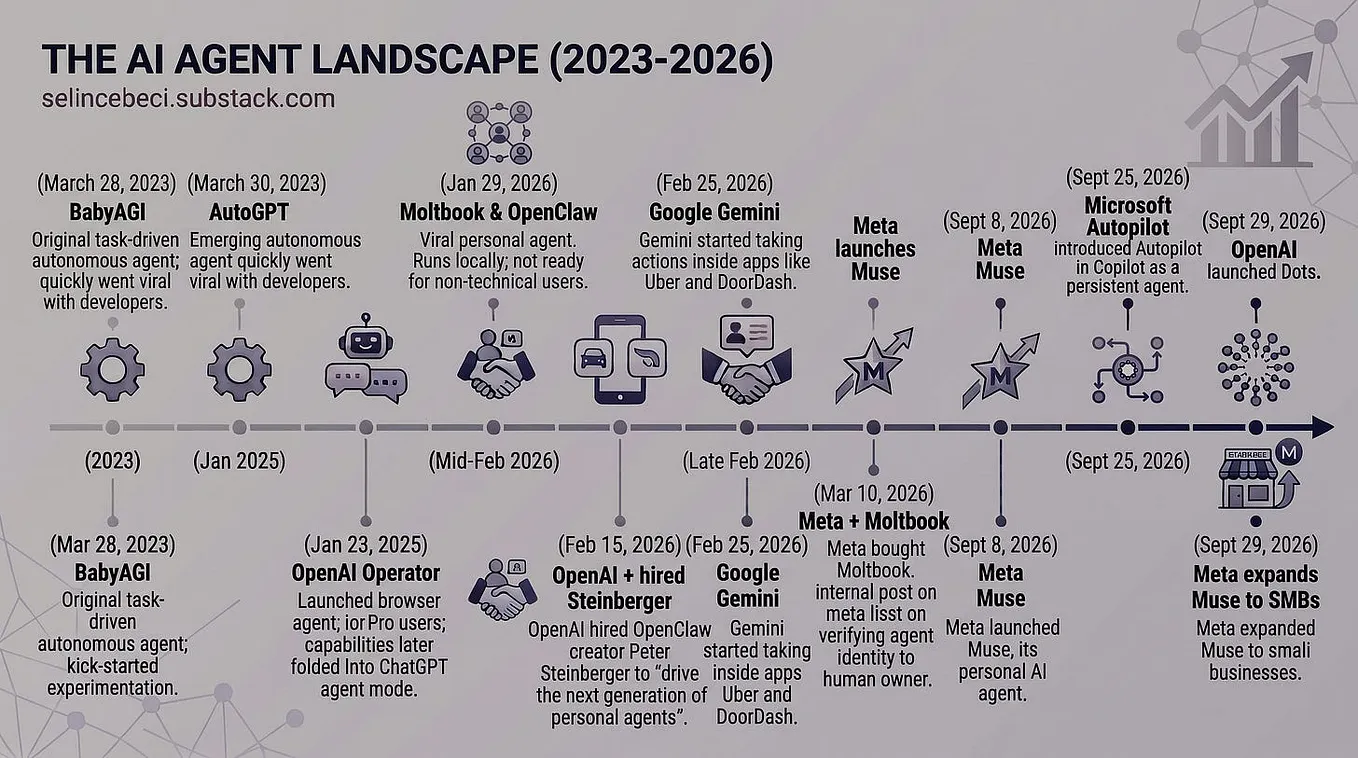
OpenAI, Meta, Anthropic, and xAI are racing to put a personal AI agent in every pocket. Last week, I explored whether that’s hype or reality. The answer: some of it is hype. Real change is happening at the edges, but not yet at scale. Here’s a quick recap:

This week, I look at both sides. The limits: where agents fall short of the conditions for wider adoption, and what holds people back. The potential: how much of daily life agents could realistically take on, measured against the burdens people feel most. Then I preview what it means for marketers, ahead of a deeper look in Part 3.
The Limits: How Do AI Agents Measure Up Against the Conditions for Wider Adoption?
As I explored last week, AI agent adoption depends on four conditions: Usefulness, Reliability, Trust, and Cost. Agents need to deliver value, work reliably without supervision, earn enough trust to be given access, and remain affordable. To assess early user sentiment against these four conditions, I reviewed 48 Reddit threads (~2,500 comments).

Each agent hits its limits in a different place. None fully meets all conditions yet.
- Grok Bot: trust grows with use, reliability weakens over time
- Muse: privacy concerns overshadow actual experience
- Dots: mixed trust, weakest reliability
- Duet: high trust through limited autonomy
The Limits: Where Do AI Agents Fail?
To understand the limits, I first looked at where agents fail among early users and what goes wrong once people start using them.

→ Agents stall. 72% of failure comments describe an agent that could not log in, was blocked, or ran out of usage. Dots and Duet users report this most.
→ Agents get it wrong quietly. 24% describe an agent that forgot something or gave a wrong answer. For Grok Bot, 69% of failure comments are about forgotten rules and routines after weeks of use.
The Limits: What Holds People Back From AI Agents?
Next, I looked at what keeps people from using AI agents in the first place. Among non-users, cost and privacy hold people back the most. Based on a scan of the barriers raised on Reddit, cost and usage limits account for 31% of mentions and privacy for 27%.

→ Fear of the vendor, not the agent. Privacy and distrust of the company outweigh fear of mistakes, and Meta draws most of it.
→ “No clear need” is the barrier nobody is fixing. It’s the smallest share (8%), yet no agent is answering it. Many people still don’t see what an agent would do for them.
In my view, there is no clear winner in the AI agent race yet. None has found the right balance of usefulness, reliability, trust, and affordability needed for mass consumer adoption. That doesn’t mean agents aren’t delivering value. Early adopters are already finding them useful in different ways.
The Potential: What Makes Personal AI Agents Useful Today?
Looking across the reported agent use, consumers find value in four ways: saving time on repetitive tasks, reducing the mental load of everyday life, expanding what people can do, and making decisions easier without giving up control.

→ Saving time on repetitive tasks. Managing emails, calendars, documents, scheduling and administrative work. People delegate routine tasks that take time but require relatively little judgment.
→ Reducing the mental load of everyday life. Managing household finances, meal planning, health routines, family responsibilities and reminders. The value goes beyond saving time to keeping track of things that would otherwise demand attention.
→ Expanding what people can do. Coding, building apps, creating content and completing tasks that would otherwise require technical expertise. Agents aren’t just replacing work; they’re enabling new capabilities.
→ Making decisions easier without giving up control. Researching products, comparing prices, finding deals and planning travel. Agents handle the time-consuming research and preparation, while users often retain the final decision.
Get Selin Cebeci’s stories in your inbox
Join Medium for free to get updates from this writer.
In my view, the value of AI agents today isn’t necessarily full autonomy. It’s reducing the time, effort, and expertise required to get things done. People appear more comfortable delegating the work behind a decision than the decision itself. That’s still a powerful signal of their potential, because anything that saves people time or eases the burdens of daily life has a strong foundation for wider adoption.
The Potential: How Much of Daily Life Could AI Agents Actually Take On?
Once agents move past today’s limits, their potential to reach a wider audience will depend on how much of everyday life’s burden they can take on.
To explore this, I built a Burden Index using the US Bureau of Labor Statistics’ American Time Use Survey (2025), which tracks how Americans spend their time across roughly 350 activities. I combined it with the survey’s well-being data, which measures the stress, sadness, tiredness, and pain associated with different activities. I then assessed which tasks AI agents could realistically take on, comparing the time people spend on them with the burden they experience.

→ Work is the biggest burden. Combining time spent with above-average task burden, work ranks highest. Yet most people can’t use personal AI agents inside their workplace systems unless they work at small businesses or for themselves.
→ Outside work, the weight is concentrated. 81% of the remaining excess burden falls on seven activities: health self-care, cleaning, homework, class, medical visits, thinking/relaxing, and household planning.
→ Heaviest does not mean agent-friendly. Of those seven, only household planning rates high for agents, while cleaning rates low.
Burden shows where life hurts. It does not show what an agent can fix, so I kept only the tasks an agent could take on, excluding work, and scored them the same way.

→ People delegate what they can, not what weighs most. Comparing the Burden Index with reported Reddit AI agent use cases reveals a gap. Email appears in 40% of Duet’s real-use comments and 32% of Dots’, money admin in 30% of Grok Bot’s, and shopping in 26% of Muse’s. These are common uses, but none ranks among the heaviest daily burdens.
→ The heaviest burdens see far less use. Health self-care and homework carry the most burden among tasks where agents could help. Yet research, the closest match to homework, appears in only 7% to 12% of each agent’s real-use comments, compared with up to 40% for email. Health-related use is concentrated in Grok Bot (25%), against 1% to 8% for the others.
→ Habits form on low-stakes tasks first. Delegation that starts with email, bills and groceries builds the routines that make heavier handoffs more likely later. Brands in those categories meet the agent before they meet the shopper.
Bottom Line: Limits vs Potential
So, are AI agents really changing consumer behavior? Last week’s answer still holds: at the edges, yes. At scale, not yet. This week offers a clearer picture of the limits holding back adoption at scale and the potential for those edges to expand. In my view, the limits are real, but the potential extends well beyond how people use AI agents today.

→ Why are the limits real?
- For early users: Agents still stall, lose context, and fail to finish tasks, but tech-savvy early adopters are more willing to tolerate these limitations than mainstream consumers.
- For non-users: Cost, privacy, and unclear value keep many people from trying them at all.
- The barrier to entry is higher than for AI chatbots, with additional costs (except Muse), setup requirements, and a less obvious value proposition.
→ Why is the potential bigger than today’s use?
- Competition will help clarify the value proposition. As agents compete and improve through real-world use, product marketing will make it clearer to consumers what agents are for.
- The time-saving potential is hard to ignore. Americans spend 71 minutes a day, or about 35.5 hours a month, on 27 tasks personal AI agents could help with. Simpler tasks like shopping, groceries, and related trips alone account for 24 minutes a day, or 12 hours a month.
- Every burden removed has value. Even tasks with below-average burden are finding their way into early AI agent use. Consumers don’t need agents to tackle life’s biggest burdens to see the value in delegating.
- Reducing life’s burdens has emotional value. People naturally seek relief from stressful or tedious tasks, even when the time savings are modest.
- Consumer behavior will shift one task at a time. Low-stakes tasks build the trust needed for bigger responsibilities and wider adoption.
What It Means for Marketers
Marketers should prepare for AI agents to enter the customer journey, and not always in the most expected ways. Agents won’t only show up at checkout. They sort inboxes, compare prices, book appointments, and manage subscriptions, often before a customer sees a brand at all.
Three shifts matter most:
→ Exposure: Agents arrive through burdens, not categories, so unexpected brands get pulled in.
→ Visibility: Awareness now has to work on two audiences, the person and the agent.
→ Selection: Price, data, and proof decide which brands make the agent’s shortlist.
I planned to go deeper into each shift here, but Substack let me know this post was getting too long! So the full breakdown, with the latest research from McKinsey, Gartner, BCG, and Bain and the actions brands should take now, gets its own post in Part 3.
Thank you for reading!