The Mathematics of Financial Ledger Integrity: Designing Accounting Systems That Cannot Double-Spend

Why the reliability of modern financial infrastructure depends on mathematical invariants, atomic state transitions, and concurrency controls that make accounting correctness an enforceable property.
By Shavez Ahmed Siddiqui
Fintech Entrepreneur | Financial Systems & Infrastructure
The Most Important Property of a Financial System Is Not Speed
Modern financial infrastructure is increasingly designed around instant transfers, continuous availability, and high-volume transaction processing.
A financial application can receive thousands of payment instructions in seconds. Distributed services can process requests concurrently, update balances, and communicate with external settlement networks.
But speed introduces a fundamental engineering question:
How can a financial system guarantee that the same available funds cannot be spent twice?
Consider an account containing $100.
Two payment instructions arrive almost simultaneously. One attempts to transfer $80 to one recipient, while the other attempts to transfer $70 to another.
If both requests independently read the original balance, both may conclude that sufficient funds are available.
Each transaction appears valid when evaluated alone.
Together, they request $150 against an account containing only $100.
The problem is not arithmetic. It is concurrency.
Preventing this outcome requires a financial architecture in which balance validation, fund allocation, and accounting updates operate under enforceable mathematical rules.
This is the foundation of ledger integrity.
A financial ledger should not merely record what an application believes happened. It should establish which financial state transitions are valid and ensure that competing transactions cannot violate those rules.
1. Financial Ledgers as Mathematical State Machines
A ledger is often described as a collection of account balances and transaction histories.
That description captures its visible output, but not its underlying engineering responsibilities.
A more useful model treats the ledger as a state machine.
Let:
[
S_t
]
represent the complete financial state at time (t).
A transaction (T) attempts to transform that state:
[
S_{t+1}=T(S_t)
]
The transaction should be committed only if the resulting state satisfies all applicable financial invariants.
These invariants are mathematical conditions that must remain true before and after every committed transaction.
For a financial account system, they commonly include:
- Balanced journal entries
- No unauthorized overdrafts
- No duplicate execution of a unique business instruction
- Consistent fund reservations
- Valid account and asset identities
- Controlled transaction-state transitions
The purpose of the ledger engine is to preserve these properties even when requests arrive concurrently, infrastructure components fail, or external messages are delivered more than once.
Correctness Begins With Invariants
The essential design principle is:
A valid financial transaction changes the ledger state without violating the rules that define that state.
An implementation should express those rules explicitly rather than relying on application code to remember them.
This makes correctness testable, reviewable, and enforceable.
2. Double-Entry Accounting: The Foundation of Financial Conservation
Double-entry accounting provides a mathematical structure for recording financial activity.
Each journal entry contains debit and credit postings.
For a balanced journal transaction:
[
\sum \text{Debits} = \sum \text{Credits}
]
In a multi-currency ledger, the equality must be evaluated within each relevant currency or accounting unit.
A journal cannot be considered balanced simply because the numerical value of one currency is offset by an unrelated quantity of another.
Example: Internal Account Transfer
Consider an institution maintaining two customer deposit-liability accounts.
Customer A transfers $75 to Customer B.
Account
Debit
Credit
Customer A liability
$75
—
Customer B liability
—
$75
Total
$75
$75
The institution’s recorded liability to Customer A decreases by $75, while its liability to Customer B increases by the same amount.
The total liability represented by these two accounts remains unchanged.
This is a simplified internal transfer. External transfers, fees, financing arrangements, and foreign-exchange operations require additional accounts and postings appropriate to their economic substance.
Why the Equation Matters
Balanced journal entries prevent an important category of accounting inconsistency.
If a financial movement changes one account without recording the corresponding effect elsewhere, the accounting record becomes incomplete.
Double-entry accounting makes the relationship explicit.
However, balanced journals alone do not prevent double-spending.
Two separate journal entries can each be perfectly balanced while collectively consuming more funds than an account was authorized to spend.
To enforce available-balance constraints, the ledger also needs atomicity and concurrency control.
3. Atomic Transactions: Financial State Must Change as One Unit
Atomicity means that a transaction’s required internal changes commit together or none of them do.
Consider a transfer between two accounts maintained within the same transactional ledger.
The operation may involve:
- Confirming the instruction is authorized.
- Checking available funds.
- Recording the debit.
- Recording the credit.
- Updating the authoritative transaction state.
If the debit commits but the corresponding credit does not, the ledger becomes inconsistent.
A properly designed atomic transaction prevents that partial internal outcome.
The system either commits the complete accounting operation or rejects it.
Atomicity and the Ledger Boundary
Atomicity is strongest when all relevant changes are controlled by a transactional system capable of enforcing a common commit decision.
This is an important architectural boundary.
An internal ledger may atomically record its own journal entries. It generally cannot guarantee that an independently operated external payment network or blockchain will participate in that same database transaction.
Those external operations require their own settlement states, confirmation evidence, and reconciliation procedures.
The distinction keeps internal accounting guarantees precise rather than overstated.
4. Concurrency Control: Preventing the Same Funds From Being Spent Twice
Return to the account containing $100.
Two instructions arrive:
- Transaction A requests $80.
- Transaction B requests $70.
Both are individually affordable.
They are not jointly affordable.
The Read-Modify-Write Problem
A naive implementation might perform:
balance = read_balance(account)
if balance >= payment_amount:
write_balance(
account,
balance — payment_amount
)
Under concurrent execution, both requests could read the same original balance before either update is committed.
Even if both eventually write a balance, the resulting state may not accurately represent the total amount authorized.
This is a classic lost-update or check-then-act problem.
Serializable Execution
One solution is to process conflicting financial state changes under a concurrency model that produces an outcome equivalent to some valid serial ordering.
For the example, a valid execution would be:
Transaction A commits first
- Opening available balance: $100
- Transaction A: $80
- Remaining available balance: $20
- Transaction B: rejected for insufficient funds
The reverse ordering could also be valid:
Transaction B commits first
- Opening available balance: $100
- Transaction B: $70
- Remaining available balance: $30
- Transaction A: rejected for insufficient funds
In either case, only one transaction succeeds.
The account never commits an unauthorized negative available balance.
Practical Implementation Strategies
A financial ledger can enforce this behavior through several techniques.
Account-level serialization: Conflicting transactions affecting the same spendable balance are processed in a controlled sequence.
Database row locking: The relevant account or balance-control record is locked during validation and posting.
Optimistic concurrency control: Transactions update versioned account state and retry when another operation has changed the expected version.
Serializable database transactions: The database detects or prevents schedules that cannot be treated as valid serial executions.
The appropriate mechanism depends on the database, workload, account model, and transaction boundaries.
Importantly, simply enabling a transaction does not guarantee sufficient isolation. Some isolation models permit conflicting business decisions unless the application also establishes the required read-write dependencies and constraints.
5. Fund Reservations: Protecting Balances Before Settlement
Many financial transactions involve a period between authorization and completion.
A payment may be approved before it is submitted to an external network or before its outcome is confirmed.
During this interval, the system must prevent those funds from being independently committed to another payment.
Get Shavez Ahmed Siddiqui’s stories in your inbox
Join Medium for free to get updates from this writer.
This is the purpose of a reservation.
The Available-Balance Invariant
Let:
[
P_a
]
represent the eligible posted balance of account (a), and:
[
H_a
]
represent the total active reservations against that balance.
Then:
[
A_a=P_a-H_a
]
where (A_a) is the available balance.
For an account that is not permitted an overdraft:
[
A_a\geq 0
]
must remain true after every committed reservation or posting.
Suppose an account has:
- Posted balance: $500
- Existing reservations: $200
- Available balance: $300
A new $250 payment may be reserved, leaving $50 available.
A simultaneous request to reserve another $100 must be rejected or deferred unless sufficient eligible funds become available.
Reservation Lifecycle
A reservation should have an explicit state:
Requested → Active → Consumed or Released
A consumed reservation is converted into the appropriate completed accounting effect.
A released reservation returns its previously held amount to the available-balance calculation.
When a payment posts, the system should atomically apply the financial posting and remove or consume the corresponding hold.
Otherwise, the available balance could be reduced twice for the same obligation.
Reservations Require Authoritative Control
Reservations are enforceable only when the system controls the relevant balance or asset-commitment mechanism.
For assets held outside the institution’s transactional authority, a reservation stored in an internal database may represent an intention rather than an enforceable lock on funds.
The architecture must distinguish between internal financial reservations and externally verifiable asset commitments.
This principle is especially important when coordinating payments across independent financial systems.

6. Idempotency: One Instruction, One Financial Effect
Financial systems routinely experience repeated messages.
A client may submit a transfer, lose the response, and retry.
A network component may deliver the same event more than once.
A recovery process may restart after an interruption.
The ledger must prevent these circumstances from producing multiple financial effects for one authorized instruction.
The Idempotency Principle
For a business instruction identified by a unique key (k):
[
T_k(T_k(S))=T_k(S)
]
Conceptually, applying the same authorized instruction again should not create an additional financial movement.
A practical implementation maintains a durable record linking the idempotency key to the original operation and its outcome.
The key must be scoped appropriately to the customer, operation, and relevant financial domain.
Requests that reuse a key with different transaction parameters should be rejected rather than treated as interchangeable.
Financial Exactly-Once Effects
Distributed messaging systems may deliver events more than once.
Therefore, a financial architecture should not depend on the assumption that every message is delivered exactly once.
Instead, it should use durable instruction identifiers, unique transaction constraints, deterministic state transitions, and reconciliation to prevent duplicate business effects within the boundaries it controls.
That distinction is crucial.
Reliable financial outcomes are the product of application-level accounting rules, not merely messaging guarantees.
7. Append-Only Journals and Reconstructable Financial History
An authoritative ledger should preserve the history of committed financial activity.
Rather than silently rewriting past journal entries, the system can use an append-only model.
When a correction is necessary, the ledger records additional entries that explain the adjustment.
This approach improves auditability and supports reconstruction of financial state.
Ledger State as a Sequence of Events
Let:
[
J_1,J_2,\ldots,J_n
]
represent committed journal transactions.
A balance can be derived from the relevant initial state and the ordered postings affecting the account.
In simplified form:
[
B_n=B_0+\sum_{i=1}^{n}\Delta_i
]
where each (\Delta_i) represents the signed effect of a committed posting under the account’s debit-credit convention.
A materialized balance is therefore a projection of the underlying journal history.
The Importance of Reconciliation
An append-only journal provides a strong internal accounting history.
It does not independently establish that external settlement has occurred.
The financial system should reconcile its records against authoritative evidence from the relevant payment network, banking institution, or blockchain environment.
Reconciliation confirms that the recorded financial state corresponds to actual external events and obligations.
8. Distributed Ledgers and the Limits of Atomicity
Modern financial infrastructure frequently spans multiple independent systems.
A transfer may involve an internal account ledger, a payment orchestration service, and an external settlement network.
Each component has its own transaction boundaries and operational state.
A single database commit cannot generally reverse an independently finalized external payment.
Managing Distributed Financial Workflows
A reliable architecture separates internal accounting state from external execution outcomes.
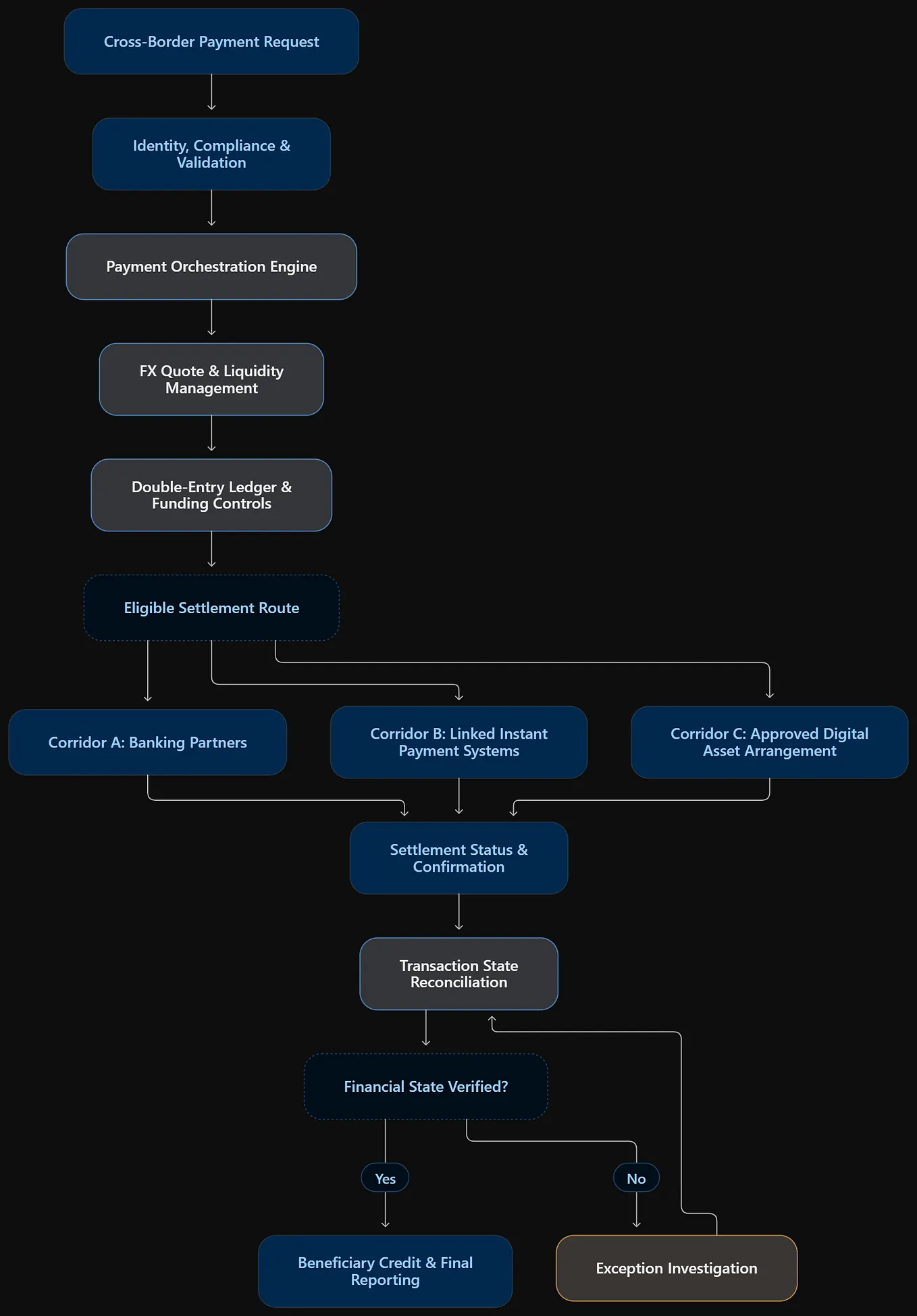
A conceptual lifecycle might be:
Created → Validated → Reserved → Submitted → Settlement Confirmed → Posted → Reconciled
Not every payment system uses precisely this sequence, and some accounting events may need to be posted earlier depending on the underlying financial obligations.
The key requirement is that each state carries a defined financial meaning.
For example, a submitted instruction should not be automatically treated as confirmed settlement.
Similarly, a delayed acknowledgment should not trigger a second value-moving instruction until the original transaction’s status has been established.
Compensating Accounting Entries
When an external transaction cannot complete as intended, the ledger may need a reversal or compensating entry.
Such an entry is a new financial event.
It does not erase the original transaction or imply that an externally finalized movement has been reversed.
This distinction helps maintain a truthful financial record across distributed systems.
9. How to Prove That a Ledger Is Correct
A ledger’s design principles must be converted into verifiable engineering properties.
A strong validation program should test more than whether ordinary transfers succeed.
It should deliberately search for transaction sequences capable of violating financial invariants.
Property-Based Testing
Instead of testing only predetermined examples, engineers can generate many combinations of valid and invalid financial instructions.
For every committed journal, the system should verify:
[
\sum \text{Debits}-\sum \text{Credits}=0
]
For eligible non-overdraft accounts:
[
\text{Posted Balance}-\text{Active Reservations}\geq 0
]
For every unique completed business instruction, the system should verify that it produces no more than one authorized financial effect.
Concurrent Transaction Testing
A concurrency test can initialize an account with a fixed balance and launch many payment requests simultaneously.
The system should verify that the committed total never exceeds the account’s authorized spending capacity.
The results should also be consistent with a valid serial order of accepted transactions.
Failure-Injection Testing
Financial correctness must survive more than normal operating conditions.
Useful scenarios include:
- A process stopping immediately before commit
- A connection failing after commit but before acknowledgment
- Concurrent reservations against the same balance
- Repeated submission of the same payment instruction
- A delayed external settlement confirmation
- Recovery following interruption of a financial workflow
- Replaying journal records to reconstruct balances
The objective is to establish that failures may delay an operation or require reconciliation without creating unauthorized financial effects.
The Difference Between Testing and Proof
Passing a large suite of tests increases confidence, but does not constitute a mathematical proof that every possible failure mode has been eliminated.
For critical financial state machines, formal specifications, invariant checking, and model-based verification can provide additional assurance.
A useful engineering progression is:
Define the invariants → Specify valid transitions → Implement controls → Test concurrency → Inject failures → Verify financial state.
That process transforms accounting principles into system properties that can be independently examined.
10. The Future of Financial Infrastructure Will Be Defined by Correctness
The financial industry continues to move toward faster payments, programmable transactions, distributed processing, and increasingly interconnected settlement systems.
These developments create opportunities to improve financial services, but they also increase the importance of precise state management.
A ledger processing millions of requests is not necessarily reliable because it can handle large transaction volumes.
Reliability depends on whether every committed financial event preserves the rules governing ownership, obligations, and available funds.
Double-entry accounting establishes balanced financial records.
Atomicity preserves complete internal transaction effects.
Concurrency control prevents conflicting instructions from consuming the same available funds.
Reservations protect authorized commitments.
Idempotency prevents repeated instructions from creating duplicate financial movements.
Append-only journals and reconciliation make financial outcomes explainable and verifiable.
Together, these mechanisms form the mathematical and operational foundation of trustworthy financial systems.
The defining achievement of a modern ledger is not that it processes transactions instantly. It is that every transaction leaves the financial system in a state that is consistent, accountable, and correct.
The strongest financial infrastructure treats correctness not as a feature added after development, but as the fundamental condition under which every transaction is permitted to exist.
About the Author
Shavez Ahmed Siddiqui is a fintech entrepreneur and technology leader with interests in financial infrastructure, distributed ledger systems, payment architecture, and institutional financial technology.
Explore his professional background and technical research at shavezahmedsiddiqui.com.
Disclaimer: This article presents technical and educational analysis of financial ledger engineering. The examples are illustrative and do not describe a specific commercial implementation or constitute financial advice.