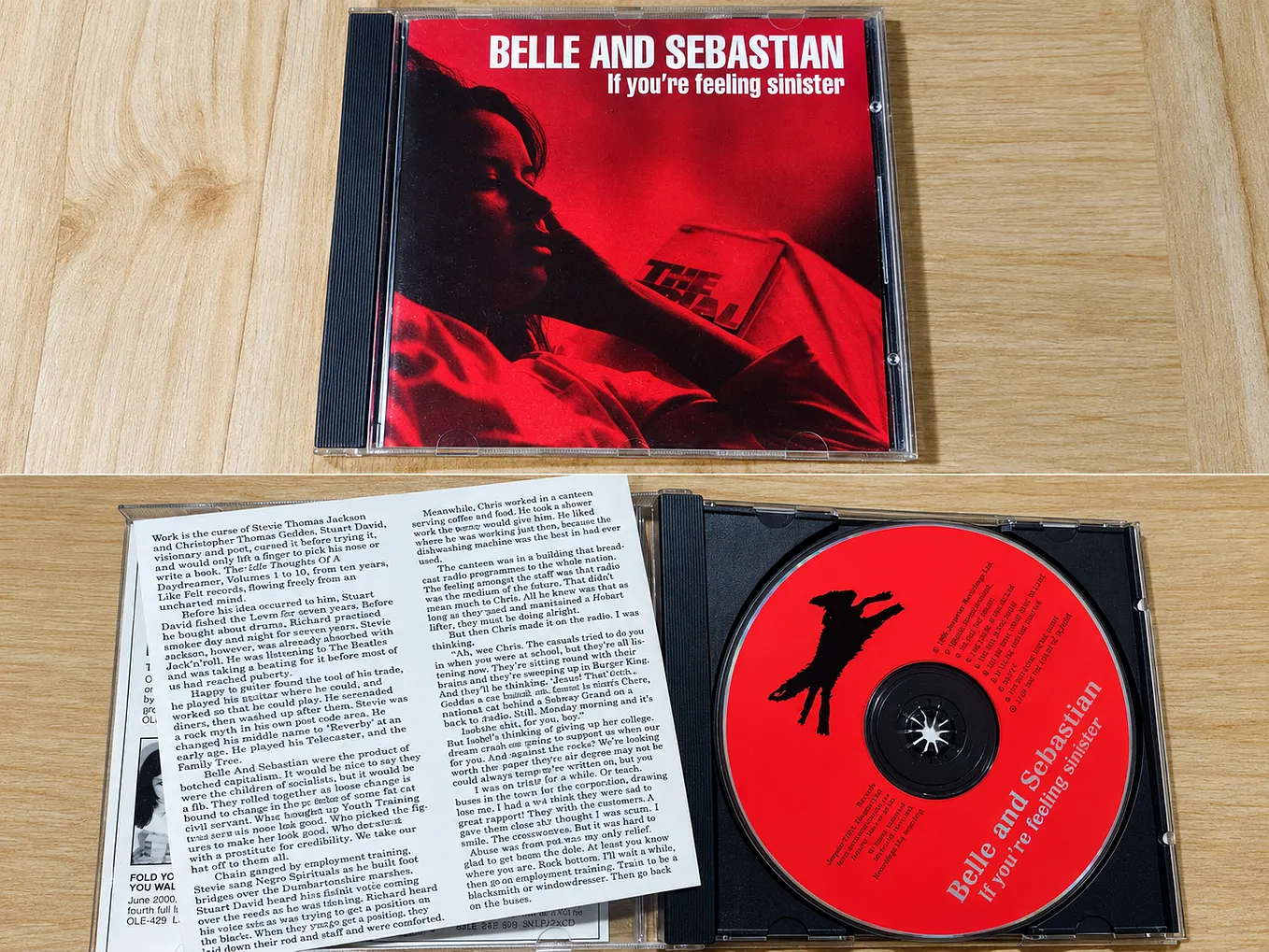
Thirty Years of If You’re Feeling Sinister: A Milestone Night with Belle and Sebastian

A scratched CD, a quick flight from Jakarta, and three minutes that I’ll never forget.
Wedged into a cabin seat with an austerity of legroom, I accepted early on that this seventy-minute hop across the strait would test one’s composure. The aisle seat offered minor solace, as did the mercifully brief flight time. Around me unfolded the ritual commotion of air travel passengers engaged in territorial luggage disputes, flight attendants fielding curious questions with saintly patience — none of which could dislodge the particular reverie occupying my thoughts: my long, strange history with Belle and Sebastian.
People often find my devotion to them curious. Given an exterior sensibility shaped largely by punk rock, heavy metal and aggressive indie rock, a penchant for gentle Glaswegian chamber pop strikes some as an aesthetic contradiction. Yet ever since my university days, I have carried a quiet reverence for that world: Sarah Records artifacts, Blueboy, Another Sunny Day, Boyracer, The Pastels, and Camera Obscura. I played in bands that leaned distinctly toward louder indie rock, but the genre, I have long argued, is little more than a marketing contrivance designed to partition tastes into tidy commercial pens.
Cruising at altitude, my head spun with anticipation. There was the sheer thrill of seeing them after all these years, but more acutely, the privilege of witnessing a shared cultural landmark with the woman I love. Over the years, I had nudged her into this band, song after song, until their songs became hers, too. In truth, this entire voyage largely belonged to her: she was the one who spotted the tour announcement in the first place. For the duration of the flight, we traded conjectures about the setlist, the atmosphere of the hall, and our fleeting hours in Singapore.
Day of Days: Esplanade, Singapore, September 20, 2026

It retains the immediacy of yesterday. We left early for the Esplanade, planning to survey the grounds and have lunch nearby to map our route to the doors and the merchandise counter. The afternoon sun beat down with tropical insistence, though for two people conditioned by the heat and haze of Jakarta, Singapore’s climate felt entirely benign.
When the venue opened, we headed straight for the merchandise stand. There, we struck up conversations with fellow travelers from Jakarta who had also made the trip, given that Indonesia was absent from the band’s tour itinerary. A married couple in line behind us shared in this quiet grievance. Spotting a Happy Mondays T-shirt on the husband, I asked if he had caught their gig in Singapore just days prior. To my astonishment, neither of them realized the Salford legends had performed their historic Singapore debut on September 15th — their sole stop in Asia. The news, it seemed, had slipped quietly beneath the radar.
With our merchandise secured, we posted ourselves before the auditorium doors. A few ushers watched our eager sentry duty with amused expressions. One smiled and ventured, “You cannot wait, yeah?”
Clearly, we could not. We’ve been waiting for a lifetime for this!
When the doors parted, we crossed the threshold as the very first patrons inside the hall. For a fleeting minute or two, the majestic space belonged entirely to us.
Seeing the Belle and Sebastian emblem projected above the stage, seated beside my partner, the realization that an evening a decade in the making was about to commence stirred something profound in my chest. It felt suspended, almost cinematic. As the theater filled and the house lights dimmed, a short archival film illuminated the screen: an interview with the woman on the cover of that seminal red sleeve, tracing the genesis of If You’re Feeling Sinister. Then, one by one, the band emerged into the spotlight.
“Welcome everybody,” Stuart Murdoch said, puncturing the hushed auditorium to an uproar of applause.
“…to the second recording session for this new band called Belle and Sebastian,” he added, his deadpan wit, eliciting collective laughter.
Without a breath, they struck into those indelible opening lines:
Make a new cult everyday
To suit your affairs
…
Whatever reserve I had maintained gave way. Years of longing collapsed into a single, crystalline instant, enriched by the presence of the woman beside me.
The band performed If You’re Feeling Sinister in sequence, pristine and deliberate. Stuart proved an unexpectedly conversational host — bantering with the crowd, parrying affectionate heckles, and sharing the backstories tethered to each song. It felt less like a monumental stadium production and more like an intimate gathering among longtime confidants.
Get ShowSpace’s stories in your inbox
Join Medium for free to get updates from this writer.
Following “Judy and the Dream of Horses,” the ensemble retired backstage for a brief interlude. Returning several minutes later, they launched into a survey of fan favorites. To our delight, they slipped into “Little Lou, Ugly Jack, Prophet John” — my girlfriend’s favorite track. She became visibly moved. The song carries a quiet weight for us, both, evoking an earlier, unsettled period of loneliness when one looked for tenderness in hollow places. Hearing it brought back those distant, clumsy days, especially when Stuart delivered the lines that have lingered with me for years:
Can I stay until the milkman’s working?
Can I stay until the café awakes?
Do you hate me in the light?
Did you get a fright?
When you looked across from where you lay
It was a dizzying emotional arc, one that left me feeling profoundly fortunate to be sitting right where I was. I’m the happiest man on the planet right now!
A word must also be said for the stage visuals, which unfolded with the charm of a graphic novel, framing each lyrical vignette with visual wit.
During “Dressed Up in You,” Stuart descended from the stage, stepping across rows of seats to trade high fives with the front rows. He paused before a young woman holding aloft a CD of The Life Pursuit, took the jewel case into his hands, and displayed it to the theater to warm applause. When “The Boy with the Arab Strap” arrived, the traditional invitation was extended, and a swell of audience members rushed onto the stage to dance alongside the band. I considered joining them, but seeing the stage packed to capacity, I demurred. Being in the room was grace enough.
By the evening’s conclusion, I had exhausted my reserves — singing, clapping, swaying through years of memory. Stuart stepped up to announce the finale.
When they launched into “Sleep the Clock Around,” fatigue evaporated instantly. My fist met the air in celebration, an instinctive gesture of defiance against time and everyday obligations. By the time the final chords faded, my shirt was drenched, my throat raw, and the catharsis was complete.

The house lights came up, denying the crowd’s calls for an encore in keeping with the venue’s punctual schedule. The room began to empty, people stepping back into the humid Singapore night, buoyant with the knowledge that an album recorded thirty years ago during a cold Glasgow winter by a group of bookish youths had endured intact. Looking around, I noticed a striking number of listeners in their early twenties — a generational renewal that eludes so many of their peers.
A small contingent lingered near the stage, hoping to secure setlists. I had brought my own weathered copy of If You’re Feeling Sinister, holding out faint hope for an autograph, though the stage crew’s brisk teardown suggested otherwise. My girlfriend offered to ask the technicians, but I smiled and demurred: “It’s okay. The trip was enough.”
We lingered in our seats, watching the stage turn quiet as instruments were packed away.
Then, the unexpected occurred.
Stuart Murdoch and Chris Geddes walked out from the wings. Instantly, we turned back toward the edge of the stage. Chris was speaking with a handful of fans, and I approached him to sign my CD, offering my gratitude for their music. Before we could speak further, venue security began ushering everyone toward the exits. Noticing the crestfallen faces, Stuart and Chris intervened, guiding the remaining crowd into the foyer and setting up an impromptu signing station with a plain folding table and chairs. A line quickly assembled; a few fans outside pleaded with the guards, who kindly allowed them back in.

Suddenly, we were standing before Stuart and Chris. My girlfriend was shaking like a leaf, and I found myself briefly unmoored. I showed Stuart the scratched jewel case in my hands — an artifact played into the early morning hours, worn from years of constant rotation. I told him how much the record had anchored me during an exceptionally dark passage in my life.
Stuart met my eyes with genuine tenderness.
“It will get better, mate. I’ve been in your position,” he said.
He paused, then added, “How are you doing, now? Is everything okay?”
It is a rare thing to have one’s vulnerabilities met with such unvarnished kindness by the very artist who helped soundtrack them. Those three minutes remain some of the finest of my life.
After a photograph together, we walked into the warm air outside the Esplanade, still stunned by the encounter. We paused at a 7-Eleven for water and a quiet cigarette, the conversation looping back to the stage and the foyer all the way to our hotel room. The signed CD stayed firmly in my hand until sleep finally took over, bringing with it a dream about a girl who stole a horse. What a funny dream.