When the Future of Chinese Cuisine Looks Surprisingly Like Its Past

By Master Enlai Liu, Imperial Duck King
Chinese cuisine is entering an interesting moment.
For much of the past four decades, China’s restaurant industry developed alongside extraordinary economic change. Ingredients that were once difficult to obtain became widely available. Transportation improved. Supply chains expanded. Diners became more sophisticated, and restaurants competed through increasingly elaborate techniques, stronger flavors, more luxurious ingredients, and ever more ambitious presentations.
Now I believe the direction is beginning to change.
The future of good cooking may not be about doing more to food.
It may be about knowing when to do less.
From scarcity to abundance — and back to simplicity
When I began learning Chinese cuisine, many cooking techniques reflected the economic realities of their time.
Ingredients could be scarce. A skilled cook therefore needed to know how to transform ordinary ingredients into something satisfying, abundant, and visually appealing.
Some dishes that today might appear novel actually have roots in that period.
There were techniques for stretching eggs, for example, or transforming inexpensive ingredients through frying, saucing, textural manipulation, and elaborate knife work. Some preparations that disappeared from restaurant menus for years are now returning as “innovations.”
That is one of the fascinating things about cuisine: what one generation considers necessity, another may rediscover as creativity.
But today’s conditions are different.
After decades of economic development, restaurants can source remarkable ingredients from across China and increasingly from around the world. Logistics have shortened the distance between farms, fisheries, producers, chefs, and diners.
When ingredients themselves become better, the chef’s responsibility changes.
Instead of asking:
How much technique can I demonstrate?
perhaps we should increasingly ask:
How clearly can I express the character of this ingredient?
The return of fermentation
One of the most interesting developments in contemporary dining is the renewed fascination with fermentation.
To some diners, fermentation sounds modern and experimental. But throughout China, it is ancient and deeply regional.
Earlier generations preserved and transformed ingredients because they had to.
Rice became fermented rice wine and jiuniang. Vegetables became pickles and preserved greens. Seafood became shrimp pastes, fish sauces, and fermented preparations. Different regions developed their own traditions around fermented tofu, mustard greens, cabbage, seafood, meat, tea, fruit, and countless local ingredients.
China contains not one fermentation tradition, but hundreds.
Master cooks did not originally describe these processes using today’s language of culinary innovation. They were simply part of life.
As economies modernized, refrigeration expanded and industrial food production grew, some of these traditions became less visible.
Now chefs are looking at them again.
That is an important lesson.
Culinary progress does not always mean inventing something that has never existed. Sometimes it means understanding something old well enough to see its value again.
Fifty years later, the table comes full circle
There is an irony in contemporary fine dining.
Some of the ideas now considered sophisticated — local sourcing, fermentation, seasonal cooking, minimal intervention, farm-to-table ingredients — would have seemed completely ordinary to people living generations ago.
They ate locally because transportation was limited.
They fermented because preservation was necessary.
They ate seasonally because ingredients were seasonal.
They used nearly every part of an ingredient because waste was expensive.
What was once necessity has become philosophy.
In that sense, cuisine sometimes moves in circles.
The challenge is not to recreate the past exactly as it was. That would turn tradition into nostalgia.
Get Imperial Peking Duck King’s stories in your inbox
Join Medium for free to get updates from this writer.
The challenge is to understand why those methods worked, preserve what remains valuable, and adapt them to the expectations of today’s diner.
Tradition should evolve, not become a museum
I have spent much of my career thinking about this question through Chinese cooking and particularly roast duck.
Tradition deserves respect. But respecting tradition does not mean refusing to change it.
Today’s diners have different expectations from diners fifty years ago. They care not only about flavor, but also ingredient quality, nutrition, presentation, convenience, cleanliness, seasonality, and the overall dining experience.
That means traditional cuisine must continue evolving.
Sometimes that evolution comes from looking outside Chinese culinary conventions.
Western fish preparation, for example, often emphasizes removing bones and presenting clean portions that are easier for the guest to eat. Similar thinking can be applied to Chinese dishes without abandoning their Chinese identity.
A shrimp can arrive at the table ready to eat rather than requiring the guest to remove the head and shell. A fish can be carefully deboned while preserving the character of the dish.
These may seem like small details.
But hospitality is built from small details.
Food must now satisfy the eyes as well
There was a time when delicious food could be enough.
That is becoming less true.
A contemporary restaurant is experienced through many senses — and often through a camera before the first bite is taken.
The Chinese culinary tradition has long spoken of 色、香、味、形、器: color, aroma, taste, form, and vessel.
Those principles have become even more relevant today.
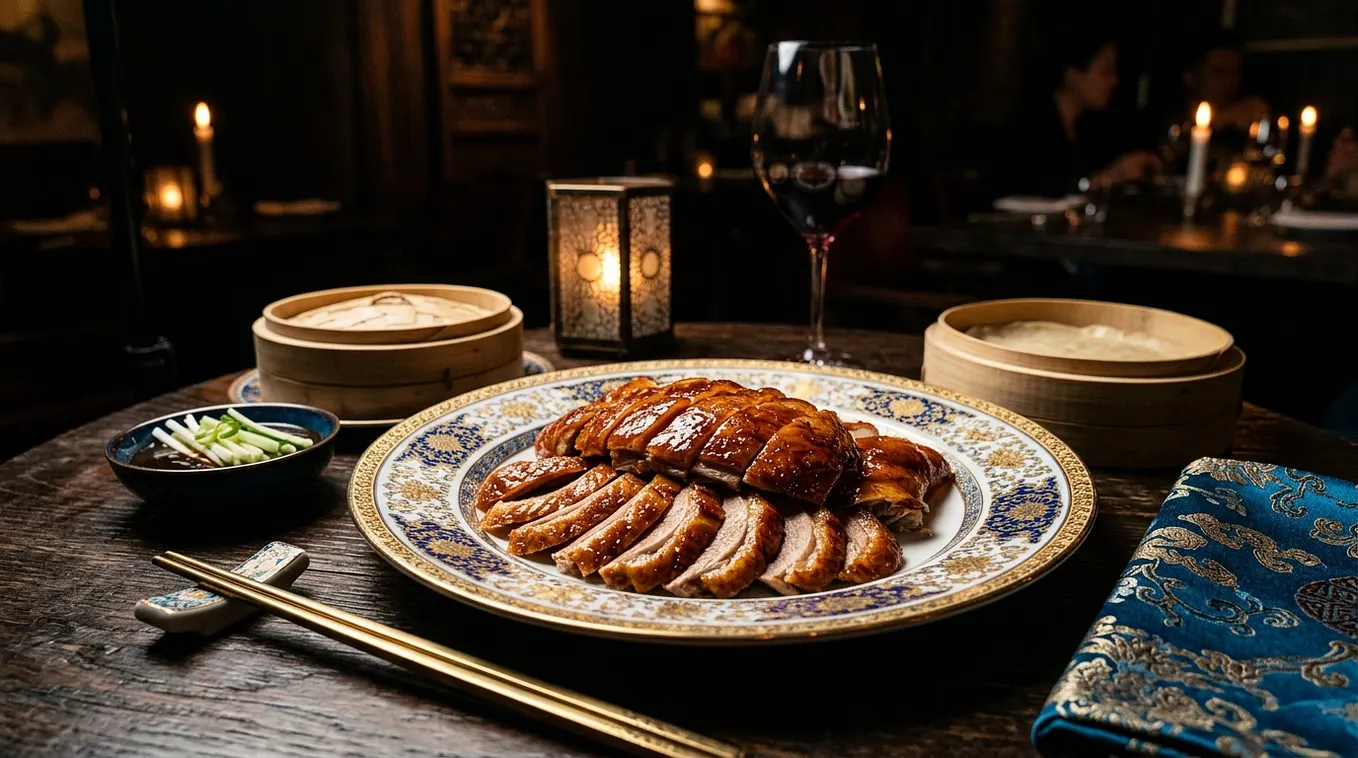
A dish should taste right. But its color matters. Its shape matters. The plate or bowl matters. Its relationship to the season matters. Even the environment in which it is served contributes to the experience.
The goal should not be decoration for decoration’s sake.
Presentation should communicate something about the ingredient, the place, the season, or the idea behind the dish.
Caption: Cuisine is more than what sits on the plate. Place, season, landscape and atmosphere all become part of the meal.
When food becomes part of the landscape
I wrote these thoughts while sitting beside West Lake in Hangzhou.
Looking across the water, it is difficult not to think about the relationship between Chinese cuisine and the landscapes from which it emerged.
Mountains, lakes, farms, rivers, seasons and local communities have always shaped what people eat.
Perhaps the most interesting restaurants of the future will not be those that hide these origins beneath increasingly complicated technique.
Perhaps they will be the ones that reveal them.
A great ingredient should still taste like itself.
A traditional technique should still tell us something about the people who created it.
A modern presentation should make the dining experience better without erasing the history behind the food.
And innovation should have a purpose beyond simply being new.
After decades of abundance, the next luxury in cuisine may be clarity.
Knowing where an ingredient came from.
Understanding why a technique exists.
Recognizing the season.
Respecting the product.
And having the confidence to let simplicity speak.
Written by Master Liu Enlai beside West Lake in Hangzhou, China, August 23, 2026.
Master Liu is a Chinese roast-duck master and founder of the Imperial Ducks King culinary tradition. His work focuses on preserving, refining, and adapting Chinese roast-duck techniques for a new generation of restaurants and chefs.
Learn more about Master Liu, Peking Duck training, restaurant consulting, and international culinary projects at DucksKing.com.