How to Choose a Relationship Tarot Spread That Fits Your Question
Start with the job each card needs to do, before deciding how many cards to draw.
You want to ask about a relationship, but the available spreads seem to answer different questions. One explores two people’s perspectives. Another focuses on a disagreement. A third considers a decision. Which one should you choose?

This article was drafted with AI assistance.
Start by finishing this sentence: “After this reading, I want to understand _____.”
Your answer gives you something concrete to compare with the positions in a spread.
Separate understanding from deciding
Consider two questions:
“What patterns should I notice in this relationship?”
“What should I consider before bringing up a recurring disagreement?”
Both concern the same relationship, but they ask for different kinds of reflection.
The first might benefit from positions about your perspective, the current dynamic, and a possible direction. The second needs room to examine the disagreement, your contribution, and an action you could take.
A spread can be beautifully named and still leave out the part you most need to explore. Read the position descriptions before choosing it.
Give each position a distinct purpose
Imagine a three-card layout with these positions:
- What I need to understand.
- What I need to know.
- What I should be aware of.
Without further explanation, those labels overlap. You may struggle to tell which card answers which part of your question.
Get Sybil Jem’s stories in your inbox
Join Medium for free to get updates from this writer.
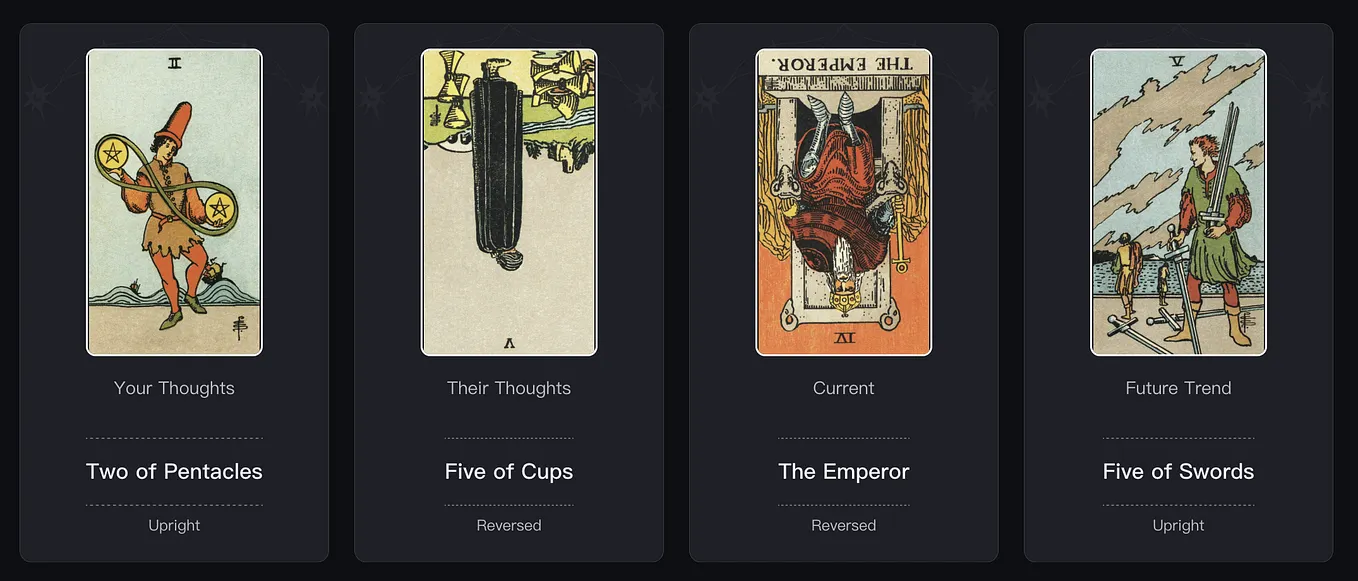
For comparison, here is a hypothetical layout for reflecting on a difficult conversation:
- What I want to communicate.
- What I need to clarify before speaking.
- An approach I could consider.
Each position has a different task. This is an illustrative layout, not a claim that a particular app offers it.
Try describing every position in one sentence. If you keep repeating yourself, look more closely at the spread’s instructions or choose a clearer arrangement.
Keep the question within a manageable scope
“Do they miss me, will we reconnect, and should I send a message?” contains several separate concerns.
You could begin with:
“What should I consider before deciding whether to reach out?”
That creates space to examine your intentions, the circumstances, and the other person’s stated boundaries. It also avoids treating a card as evidence of someone’s private feelings.
Context helps. You might mention whether you are dating, separated, or getting to know each other, along with one relevant interaction. Names and identifying details usually add little to the question.
Check how the tool actually selects a spread
On Taku, a relationship topic is a starting point. The recommended spread appears after you submit your question, and you review its positions before drawing. Where alternatives are offered, “Change spread” lets you compare them.
Selecting a topic does not guarantee a particular arrangement. A saved example also does not mean your reading will use the same cards or positions.
Our website’s relationship tarot spread guide shows how different questions lead to different roles for the cards.
Before drawing, make one final check: can you explain what each position contributes to your question?
If you can, you have a clear starting point. After the reading, compare the interpretation with actual communication and behavior. A useful spread should help you formulate better questions, while leaving decisions grounded in your circumstances.